

Shaping The (Ab)user Experience: Why Social Media Sucks At Preventing Abuse
There’s a lot of talk in web communities about “shaping the user experience,” by which they generally mean “you figuring out where to click the page to do the stuff you want.” There’s conferences devoted to user interfaces, and occasionally when you get to the next level, you find people talking about the emotional experiences they want people to have when they come to a website – a “professional” site, a “friendly” site, and so forth.
But in social media, nobody ever seems to think about what sort of experiences the users will have with their abusers.
What they think about is, “What will make us look bad?”
So they go to their lawyers, and they ask, “What are we legally culpable for?” And they go to their publicity departments (if they have one) and they ask, “What will make us look terrible?”
But to a company’s cold bottom line, a troll calling women names all day gets more advertising hits. He is a devoted user. And so they are loath to ban anyone, because these companies make money off of large user bases, and kicking someone off risks trouble.
If you look at what actually gets most people banned, it’s generally not anything that’s dampening the “user experience” of the site – it’s stuff that’s going to get the company itself in trouble.
So they’ll ban for pictures of women breastfeeding because God forbid the advertisers see boobs and the site gets marked as porn, but people emailing abusive emails in private, well, that’s a tougher case.
Over on FetLife, if you send someone an email telling them they’re a dumb bitch who deserves to be knifed, you will get banned for posting screencaps of those abusive emails with that person’s name. Because that opens them up to lawsuits. The stuff the abuser sent in private? Well, that’s bad, but…
…we’ll get back to you.
We don’t want to alienate anyone.
And so what happens is the inevitable flurry of flame wars and mobbing, where people a) achieve popularity on the site, b) get offended, and c) send their followers as an assault at someone they disagree with. Occasionally someone gets banned for something too outrageous, but the daily aggressions are seen as just a cost of doing business on the Internet. If you get popular, you’re going to get hatred.
If a site has moderators, well, moderation has never been a priority cashwise, and so they’re usually overwhelmed and only deal with the biggest cases. If they have blocking tools, those tools are usually not equipped to handle the devoted troll opening up a hundred new accounts, or a sudden influx of legit users send over from the latest popular user’s anger-dump, or a coordinated sealioning attempt.
And I think the next generation of social websites are going to have to start thinking about “the user experience” in terms of “What emotional experience do we want the user to have while they’re here interacting with other people?”
Or, perhaps more significantly: “What culture are we fostering here?”
Look, there’s nothing inherently wrong with a 4chan-style culture where everyone posts anonymously and savagery is the word of the day. That’s one way to do a website, and it has become somewhat of a default because it’s low-maintenance. You see Reddit moving closer to that – “Hey, we want free speech, so – talk about whatever you want.”
But Facebook has free speech, and it’s often this monstrously uncomfortable place where all your relatives go to yell their crazy conspiracy theories at you.
I think companies are going to have to start prioritizing what sort of culture they want to have, and look beyond “We want a friendly blue portal” and shift towards “We want to encourage reasoned arguments without name-calling” or “No personal attacks” or “If people start yelling, we need to calm that down.”
And I think, ultimately, it’s going to come down to defining “What is abuse?”
Because as someone who posts on the Internet a lot, I see a lot of different definitions of “abuse.” For some people, “abuse” doesn’t exist until someone comes to their house personally – insults are just a part of the fog of the Internet culture. On the other end of the spectrum, some think “abuse” is being called out for saying something questionable, no matter how gently that rebuttal is made.
But for the future, I think you’re going to be designing your website to last, you’re going to have to define abuse, and then work hard to prevent it.
Some of those preventions can be technical: forcing accounts to be linked to phone numbers would prevent a lot of abusive sockpuppet accounts. Finer-grained blocking tools, like blocking people based on the number of days it’s been since they’ve created their account, or blocking based on their number of posts, or blocking based on a percentage of your friends who have blocked them, would also be helpful.
And technical analysis can probably have content filters scanning for potential hotspots and alerting moderators to them – I’m certain there are analyses of text that could find abusive threads – but ultimately, it’s going to come down to companies starting to say “Abuse cannot be defined as just what will get us in trouble, but as ‘What sorts of unpleasantries will make people leave our site?'”
That will be an uncomfortable day, because it will limit your audience. Take me, for example; whatever site I’m on, I am prone to reacting to other people’s posts. If I’m on Twitter and someone says something I consider dumb, I’ll link to it with some snarky commentary. If I’m on FetLife and someone does something unwise, I often write a reaction post to that.
And telling me that part of your site’s culture is “We don’t allow reaction posts that name other people specifically,” well, I won’t make an account at that site. I won’t post. I’d find that extreme. Likewise, if you decide “no breasts anywhere” and the pro-breastfeeders show up, well, keeping them away will limit your audience.
But here’s the trick: if you define a civil experience correctly, other people will want to have that experience.
Even if those people are Not Me. Especially if those people are Not Me. Because part of any good gathering is defining who’s not welcome, and encouraging those who stay to follow the guidelines.
And when you define abuse in a way that’s clear about how you’re defining civility, and enforce it properly, I think you’ll ultimately find greater use retention. Because yeah, maybe that heavy-use troll I referenced earlier is creating a lot of ad hits by emailing fifty people a day to call them names, and is generating revenue…
…but the bottom line is not just composed of what you have, but also your costs. That troll is costing you all the other people s/he is driving away. And whether you like it or not, that troll has to be a part of how you’re designing your website’s user experience, because the first step to containing trollish behavior is in defining “What a troll is,” and companies thus far have largely defined trolls as “People who get us, the company, into trouble.”
It may take another couple of decades, but I think eventually corporations are going to start defining trolls as “Customers who drive away the customers we actually want to keep around.” And when that happens, I think we’ll see a much better Internet.
If You're Sexually Active, Do Me A Favor And Think About Partners With Herpes Now.
Full disclosure: I don’t have herpes. But as am actively polyamorous man, I have (and continue to have) sex with people who do have herpes. (Safely, of course.)
So do me a favor and think about your comfort level with herpes now.
Because I’ve had people actually stammer when I’ve informed potential lovers of my elevated risk. “You – you’re touching them?” they’ve said, sometimes shocked that I’d even cuddle someone known to have it. “Oh God. I have to… I have to check with people. I don’t know. I’ll – I’ll get back to you.”
That makes me feel like shit, and I’m not even the one who has it. So I get real ugly whiffs of how people who do have herpes must feel.
And I think that’s because most people haven’t considered what their stance on people with herpes is. Which is ridiculous. It’s a common disease – more common than you might know, given how negatively people react to it. About one in six people is estimated to have it. It’s going to come up, if you date around enough.
Not formulating your policy in advance means that you spring some pretty unthinkingly cruel reactions upon some poor soul who has it.
Thing is, I get that you don’t want to have herpes – hey, I don’t – but having it is often something that the folks with herpes absolutely couldn’t help. In the case of one person I know, her boyfriend had been tested negatively, they’d been fluid-bonded for three years, and his first outbreak after literally decades of dormancy happened on a weekend when they were visiting. In the case of not just one but several other people I know, sadly, they got it from their father when he molested them.
So it’s not like these folks were guilty of poor safe sex practices. Some didn’t have a choice. With others, the tests for herpes are poor, and often misunderstood, even at professional clinics. It’s hard to know if you have it until that first outbreak happens.
Yet there’s still a lot of shame in kink communities associated with this.
Now, I take the stance that as long as my partner isn’t having an outbreak, and we have safe sex, the risk is as minimal as it gets when you’re exchanging bodily fluids. And after seven years as an active participant, I’ve not caught it. Nothing’s a guarantee of safety in sex – but given the right treatments and practices, you can reduce risks to very small percentages.
And having seen my share of people who do have herpes, I’m not saying I want to get it – but I am saying that if you removed the fearful social stigma associated with herpes, it looks a lot like shingles. Nobody wants shingles either, but it’s usually not a death sentence and it’s usually something that doesn’t ruin the entirety of your life if you take the right medicines.
But even if you’re not comfortable with those percentages – and you’re well within your rights to conclude that you’re not, particularly if you have autoimmune disorders – still, take a moment now to consider what your stance on the topic is.
Because if someone has herpes, they are often stigmatized and demonized for something they have no control over. When your first reaction is a freaked-out flinch, that just hurts their fucking feelings like you wouldn’t believe.
So stop now. Think about how it would be if this was someone you liked a lot, revealing this secret of theirs to you. Think about the risks now, and do some research, and make a decision in advance in case someone you’re dating sits down to have “the talk” with you.
Because there’s a good chance that talk might come up. One in six, in fact. And if it does, you’ll be so much kinder if you’ve mapped this out in advance.
(NOTE: My Uncle Tommy, who raised me like I was his kid, had AIDS in the 1980s, back when misinformation ran amuck and people refused to touch him or use the same bathroom as him because they’d get “the AIDS.” As such, I’m very touchy about contagious diseases, having seen the hurt he felt. You not wanting to have sex with someone who has herpes is within your right, but any shaming will be met with such a banhammer.)
In Which I Tell Myself To "Fuck Off" In A Cataclysmic Celebration
Devoted readers will remember that when I sold my debut novel Flex, I set a secret “Fuck You, Ferrett” sales number. For I am neurotic, and keep raising the bar on myself.
That number was my sanity number. If I sold that many copies of Flex, I could no longer complain about my sales. It may be a small number – as noted in the same note, I’m not sure what is an impressive sales number for a debut author – but that number was the point at which I would have officially Succeeded Beyond My Expectations. Whatever happened after that was the point where I could look at my insecurities and say “Fuck you, Ferrett, you never thought you’d get this far.”
And I got the email from Mike Underwood at Angry Robot today:
As of last week, the “Fuck You, Ferrett” number has been surpassed. Surpassed by 52 copies, in fact. After this, everything is gravy. (Or frosting. I like frosting on everything better.)
So I’m going to dance around today, and eat a Manwich, and be happy. Because hey. I did better than I thought I would. And that’s pretty fucking amazing.
(Also, The Flux numbers clocked in at around 60% of the first-week numbers for Flex. I have no idea if that’s good or bad, but I know there is always a sequel drop in sales. Yet the reviews are stronger – it’s almost like I learned about writing novels between books! – and so I’m very very happy about that, too.)
(Also, I should add, Mike has been a huge proponent of the Flex series partially because he has written his own series based on geeky magic, and if you liked Flex then you should probably check out his Geekomancy series.)
Anyway. You know what today is?
FUCK YOU, FERRETT. YOU DID IT.
GO TO HELL, YOU NEUROTIC BASTARD.
Photos From The FLUX Release Party! (Specifically, My FLUX-Themed Nails!)
So last Friday, at indie Cleveland institution Loganberry Books, I held my The Flux release party!
(The sequel to Flex is out. You knew it was out, right? All right, continuing on.)
Anyway, it was a good night. As usual, my Mad Manicurist Ashley did my nails to match my book:
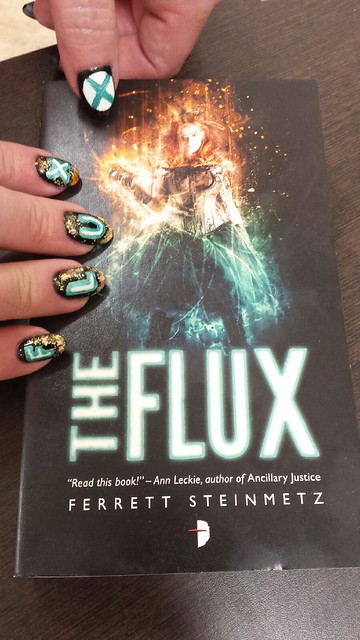
(Yes, those are Xbox logos on my thumbs. Why? Because Valentine DiGriz is an Xbox girl. Should anyone ever cosplay, it’s the Xbox controller she has on a bandolier at her hip. Assuming that’s still a bandolier.) But I got dressed up in my usual “author” suit, which some ladies deemed as “extremely kissable”: 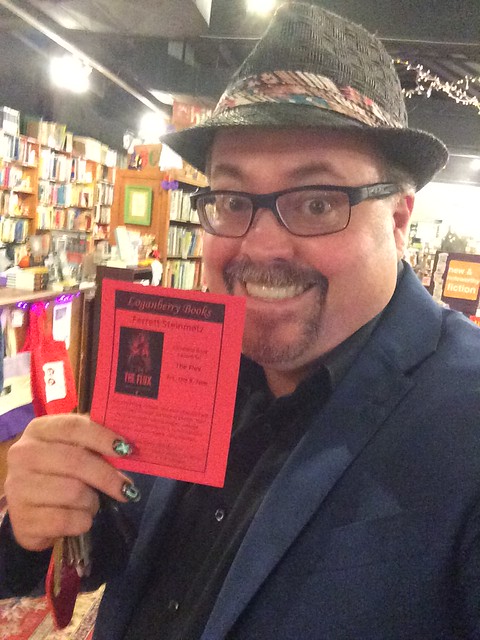
And Loganberry Books had me on a sign out front, like I was a real author and everything: 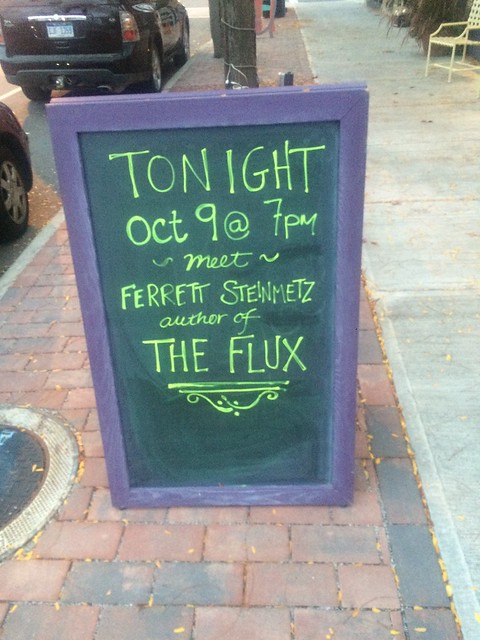
And I had Great Scott’s Bakery – the best cupcakes in Cleveland, and I assure you I’ve tried ’em all – do me up two sets of Flux-themed cupcakes. The first were Boston Kreme-flavored cupcakes, which if you’ll recall Kit said were the sign of a slovenly nature and yet, strangely, were Valentine’s preference:
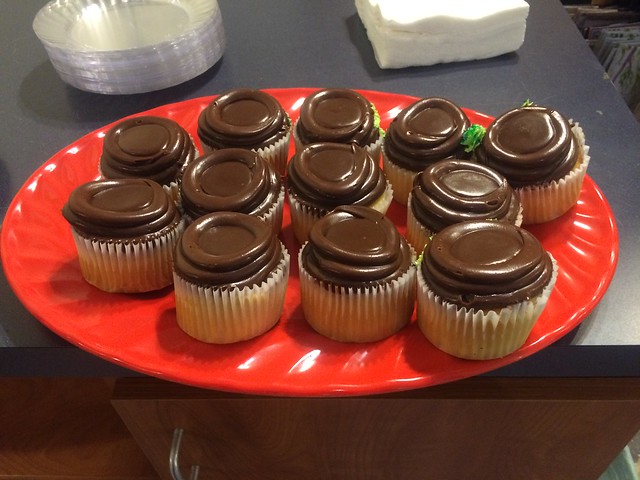
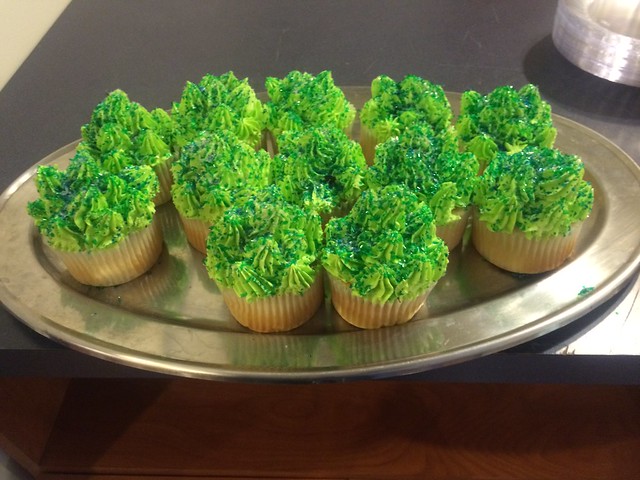
The second were vanilla kreme, but Scott (yes, Great Scott’s bakery is run by Great Scott) wanted flames on the cupcakes, and so made really high poofy flamey cupcakes.
I did not get photos of the event – I usually take a photo of the audience, but this time I forgot. But I’d say about forty people showed up to hear me do an Extremely Dramatic reading, including a Surprise Sweetie Appearance from my sweetie who came all the way from Pennsylvania – which would be the drive-in record if not for another person I knew who’d driven four hours from the hell-and-gone side of Michigan to see me for an hour or two.
And I read my Dramatic Chapter, and shilled for my goddaughter Rebecca’s charity Rebecca’s Gift, and did not eat cupcakes until the next morning.
And there was only one cupcake left over:
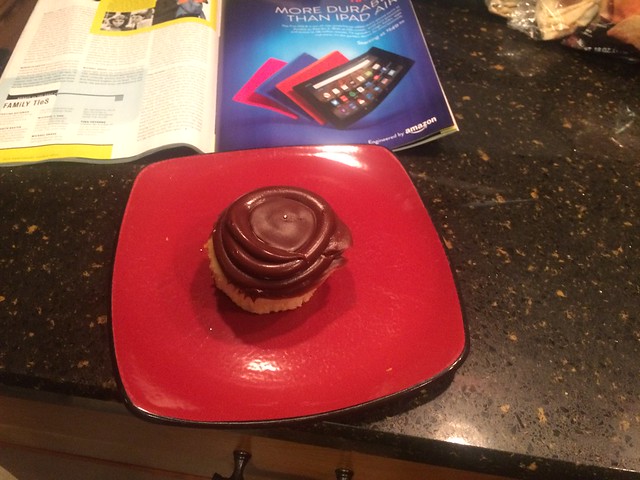
I devoured that sucker. That cupcake was for me.
And it was sweet.
The Gift She Gave Me So I Could Live Alone
So Gini is now in Seattle. She’s on a cross-country trip for three weeks, leaving me at home with the dog.
It’s pretty lonely. Not too lonely; our youngest daughter has moved back in with us for a few months while she finds her feet, but still. I’m used to a life with Gini, and not having her sitting across from me while I work feels empty. I’m staying up hours later than I normally would, because I’m avoiding going to a bed without a Gini to snuggle in it.
But my wife loves me.
Honestly, she could have just dumped a bag of Bachelor Chow in the basement and skedaddled off, but instead she busted her ass on a project to remind me of her love. She’d been threatening to make me an otter quilt for months, ever since we’d found some otter fabric in a store in Oregon and I squeed “ZOMG OTTERS I LOVE OTTERS OTTER FABRIC.”
Yet I didn’t understand why she’d taken to staying up late into the night, sewing and cutting and pinning and laying out, until she said to me, “I won’t be here, but my quilt will be.”
Such love.
And when she finished it, I squeed. It was big, so I could sleep underneath it, and heavy, because I like warmth, and it was full of love. And it looked like this:
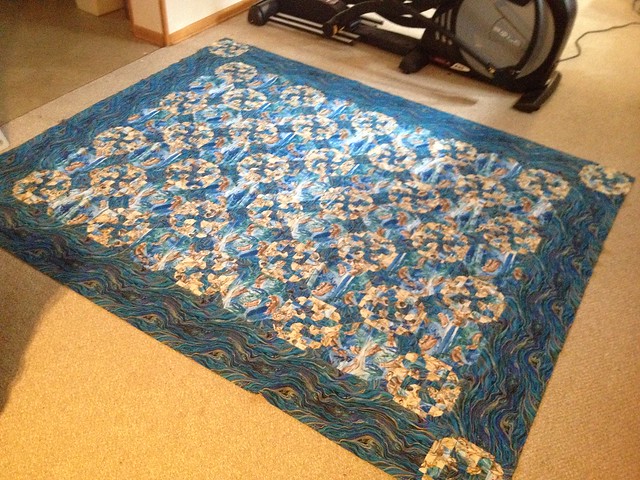
It’s hard to see the otters from this distance, but she did a wonderful job – putting them in little swirling circles so it looks like they’re swimming. It’s a very active quilt. And it’s full of otters, my favorite mammals.
And when she presented it to me, it looked like this:
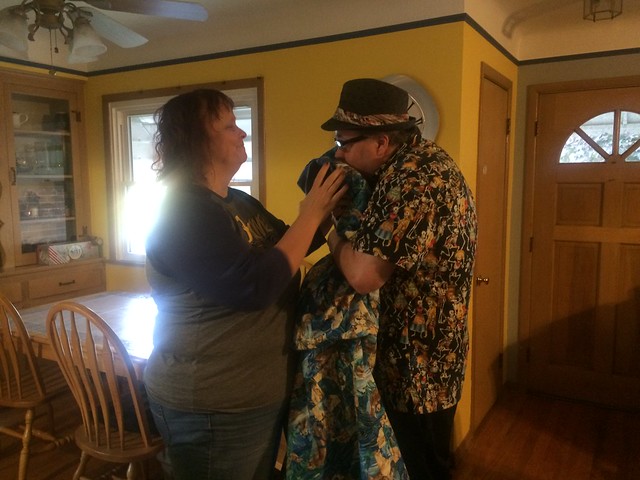
She’s gone, and she’s still gone, and she’ll be gone for another few weeks still. It’s a lonely house.
But I can go to bed a little sooner, because when I do I am wrapped in her love.
And otters.
Mastering Polyamorous Alert Notifications
So here’s something at polyamory that I flat-out suck at: transitioning into my partners’ new partners.
When I arrive on the scene, I know what’s going on: Okay, she has a husband, and a boyfriend who might as well be a second husband. But she’s affectionate to me, and clearly I am beloved despite my newness, and so I accustom myself to this stable landscape.
Then she starts dating someone new, and my neuroses eat me alive.
Why is she dating someone else when she has me? I ask, even though I date other people when I have her, but that’s different, she’s awesome and kissable and who wouldn’t love that, whereas I’m this leaking bag of DNA cluttering up the house.
I get nervous, which depending on my mood can express itself as cool distance, or irrational anger, or smothering clinginess.
I’m not unusual. The whole “Add new person, everyone loses their shit” is a reasonably common denominator in polyamorous relationships.
But you know what makes it way tougher?
Nobody agrees WHEN a new person has been added to the equation.
Most polyamorous relationships have an agreement in there somewhere that goes, “When a relationship with someone else hits critical mass, you’ll tell me about it.” (Except in don’t-ask-don’t-tell relationships and in some forms of relationship anarchy, but even the anarchists usually have a gentleman’s agreement to say, “By the way, I’ve decided to move in with Adam.”)
The problem is, “critical mass” varies *very heavily* from person to person. It’s untenable except in the paperworkiest of relationships to email someone daily, outlining every flirtation you had that might go somewhere – particularly if you’re heavily active in the kink community – meaning that it’s kind of up to you to decide when a relationship has hit the Okay, Probably Should Ping My Lovers’ Radar phase.
But when?
- When they start flirting with you?
- When you start flirting back?
- When you start flirting back and decide that you really like the attention? (Which *is* a distinction, yes, for those of us cursed with unconscious flirting capabilities.)
- When you scene at a club?
- When you scene in private?
- When a scene’s aftercare turns unexpectedly steamy?
- When you kiss? (I mean, I kiss a lot of people. It’s like a moist handshake.)
- When you plan a date?
- When the date goes well and you decide a second one is on tap?
- When you’ve decided to have sex with them?
- When you have sex, and the sex goes so well you plan a date? (Don’t laugh, this happens to swingers.)
- When you first feel that emotional pang of “Crap, this person matters to me?”
- When you first feel that physical pang of “Crap, this person turns me on?”
The list goes on and on, and it’s filled with edge cases and weird turns because kink and polyamory and attraction gets routinely weird.
Yet the problem is, most folks agree “When this relationships hits critical mass, it’s time to tell the other partner.” Yet when one person thinks “critical mass” is “flirting” and the other thinks is “The kiss went well enough I want to pursue this,” well…
…shitstorms of insecurity arise. Because now you’ve got the scarybump of What Does Potential New Partner mean, and also your partner has just demonstrated that they don’t know when you think something is significant.
That makes everything harder.
And again, it gets more complicated when you’re dating someone, and last month you didn’t care all that much who they were sleeping with as long as they got tested, and now you’re emotionally closer to them so you want to be more inclued to their other romances.
Like a lot of miscommunications, nobody’s exactly at fault here – it was just two different definitions that you didn’t quite jine up – but things can go south really fast if you don’t believe in honest mistakes.
So I feel one of the better skills to prioritize mastering in a polyamory model that includes active dating is synchronizing notification expectations. Having discussions on when to properly ping your lover to go, “Hey, heads up, this is becoming significant” – however you define significant – can sidestep a lot of problems, even if that partner has no say over who you’re dating.
And the trick is to sit down and go, “Okay, how much do you want to know?” Like for me, “making out” is something I do with friends. Friends I trust and love, yes, but I have a lot of sexual relationships without a romantic component. Fondness, yes, but not necessarily romance…
…so my wife wants to know once I either a) have decided I actively want to sleep with someone, or b) am falling romantically for someone I’m sleeping with. (And yes, those are two separate things in my mind.)
Whereas for me, I don’t want to hear the fine details of my wife’s sex life – “good” or “bad” will do – but since she’s engaging with fewer people, if she starts flirting with someone with intent, I’d like to know. I’m okay with her smooching whoever she wants, but I want to have an idea of who she’s with.
Yet I have a sweetie who I don’t even need to know. She’s a swinger. She has a lot of sex. As long as she gets tested, I’m happy to hear great stories when we get together.
And my other partners have their own definitions of when they want to know, and what they want to know. And part of being a good partner is telling them what they want to know, when they want to know it – not out of any sense of rules, but because I love them and I recognize it can be stressful for new relationships to rewrite the established Thing we have going on here, and so I want to make them as comfortable as possible.
And looking back at a lot of my failed poly relationships, those critical existence collapses have often been directly attributable to the two of us having different ideas of when it was time to go “Okay, New Person is here!”
We freaked out about What New Person Meant, and then we freaked out over How Could You Not Know To Tell Me Before All Of This. And while less neurotic couples may do better on What New Person Meant – remember, I told you I was shit at that part of things – I still see good communication habits evolving to stop the How Could You Not Know.
So maybe have a discussion now, before New Person shows up. Ask your partners when they’d like to be informed. Because if your partner thinks “flirtation” is when the alert gets triggered, and you think it’s “after the sex turned romantic,” well, you’re gonna have a situation that can look a lot like concealment or cheating even if that’s not at all what you intended to do.
So, you know, talk now. Before you surprise anyone. In a bad way.