
Pre-Order My New Book, “The Dragon Kings Of Oklahoma”!
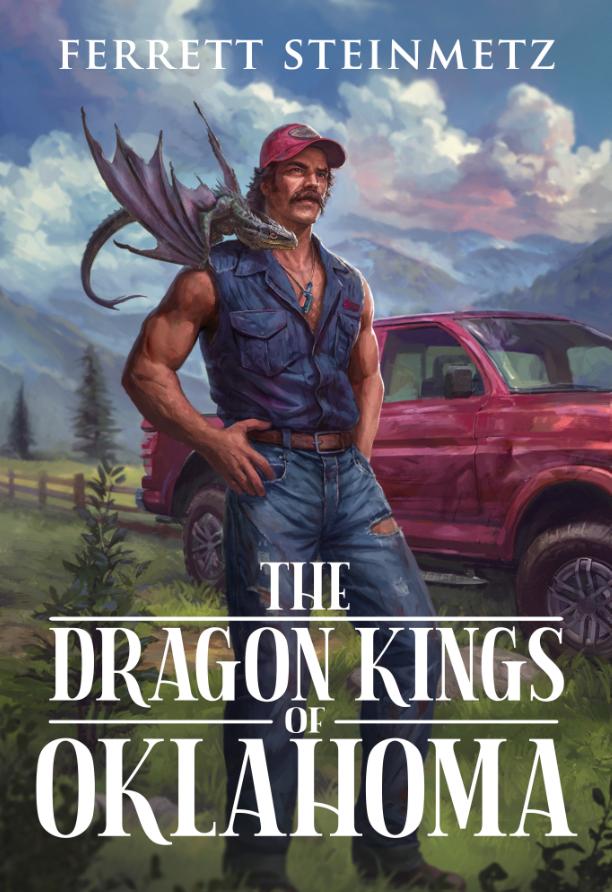
The Dragon Kings Of Oklahoma
Releasing September 3rd, 2024
$2.99 for Kindle only
They were just two good ol’ boys putting out a fire in the Ouachita mountains. They didn’t expect to find a mother dragon sitting on her brood…
Daisy Collins was born in Oklahoma and he’s gonna die in Oklahoma. But a busted hip means that Daisy can’t hold a steady job and is in danger of losing his family home.
So when Daisy stumbles across a botched scheme to smuggle dragons out of Germany, and his best friend Wild-Eye says these dragon eggs could be the ticket to financial stability, Daisy agrees. How hard could it be to sell off baby dragons?
Very, as it turns out. Everyone wants the dragons – Dusty, the werewolf owner of the local All-Mart; Johanna, a dragon-hunter who’s tracked Germany’s lost national treasures to Oklahoma; and Sheriff Kenny, who’ll do anything to save his town’s tourist-friendly image.
But the biggest threats to his get-rich-quick plan are these adorable, deadly dragons, who Daisy slowly comes to think of as his beloved pets…
If you’re still reading this blog, I assume you want a few details on how to support this, soooo….
This is my first self-published book. They say that if I can get about 100 copies sold before it comes out on September 3rd, it has a good chance of making the top 10 for many Amazon bestseller lists, which in turn makes Amazon more likely to recommend it. So if you’d like to help a writer out:
1) Buy the book (it’s $2.99, and I believe I am obliged to say that it “costs less than a cup of coffee”)
2) Mark it as “Want to Read” on GoodReads.
3) If you have friends who’d like to read a book that’s “Tiger King, but with baby dragons,” please, get the word out to ’em.
And yes, there are sequels already written and ready to go. The Fae Lords of Oklahoma is coming out in late October, and The Hippogriff Riders of Oklahoma is arriving in early December. But I’m still waiting on cover art and final proofreading edits, so I’ll give you the pre-order link when I get it.
(Though Dragon Kings has the first chapter from Fae Lords of Oklahoma as a tasty sample, so you can get a feel for the series when it comes out.)
Anyway. I’m out here, being terrified, takin’ chances, doing the thing.
How are you?
Shasta Clarion McJuddMetz: 2012-2024
A long time ago, I put out this post to announce that we had gotten a new dog. That was when I was blogging a lot. I posted a lot of pictures of her, my sweet girl.
I’m no longer blogging. But since she started out in whatever public eye I had, it… feels wrong to not mention her passing.
It was sudden. It was surprising. It was, fortunately, not too bad on her, though it’s hard to say because she was a dog and a shockingly stoic one for how little and often scared she was. But we made the decision yesterday, and held her as she went peacefully.
She trusted us. She trusted us so much.
She good girl.
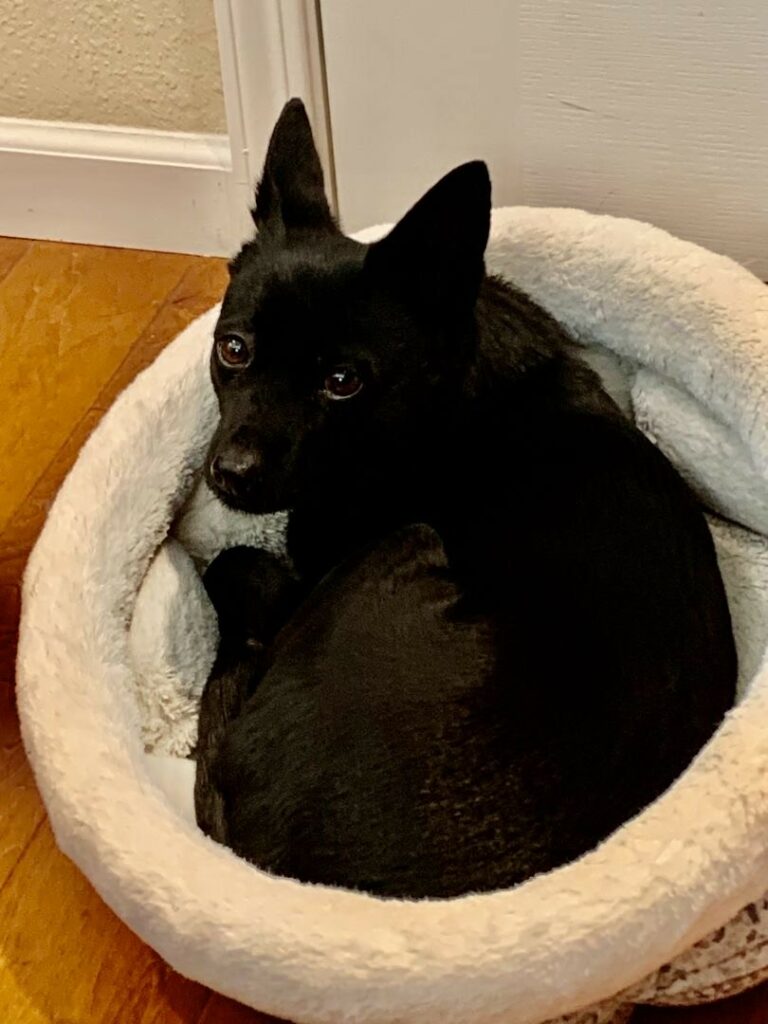
She good girl
If You’re From Rural Oklahoma Or From The Osage Nation, I Could Use Your Help!
So! I’ve written an urban fantasy novel set in modern rural Oklahoma – and while I’ve done a lot of research (including visiting several towns), I could use a beta reader who’s lived there to ensure I don’t get anything too wrong. (Bonus points if you have extensive experience with functional opioid addicts.)
In addition, one of the characters (not the lead) is an Osage native, and again, while I’ve done a lot of research it’d be nice to ensure I haven’t put a foot wrong.
So if you’re someone who meets either of those qualifications and is willing to read through a fairly thick (but fast-paced!) novel in six weeks or so to give your impressions, do me a favor and email me with the subject “OK IS OK.”
This requires a quick turnaround time, so if you don’t have time now, appreciate you but I have a mighty need. And if you don’t meet those qualifications, I appreciate the effort, but I’d prefer you read it when it came out. If you wanna make sure you don’t miss it, you can subscribe to my long-dormant newsletter at https://theferrett.substack.com/, which will announce when my next book is out (which is hopefully reasonably soon, if I can get out from under my own feet).
In other news: yep, working on books still, still around, just quiet. Appreciate you if you still drop by here from time to time. Or if my RSS reminds you I’m alive.
An Apology, An Explanation, And An Exit From Blogging (But Not Writing)
When I was a teenager in the 1980s, I idolized New York’s shock jocks – those vaguely-liberal, outrage-inducing dudebros who thought it was brave to make fun of everybody.
So when I wrote my first essays in the late 1980s, I emulated Howard Stern and his buddies – writing proto-edgelord columns about personal dysfunction. Come the 2000s, I ported that mindset to LiveJournal: three to six blog posts a day, tossing off half-chewed opinions on the day’s topics.
In the course of that, I said some staggeringly thoughtless and sexist things. I’m not thinking of any specific writings, sadly; just a lot of posts that accidentally stereotyped, demeaned, or just misunderstood women.
I regret putting those ideas out into a universe that’s sexist and thoughtless enough. I believe an essay is a statement of intent – either the intent of “Please take this idea seriously,” or the intent of “I am writing carelessly,” or both. And I often had stupid ideas written carelessly.
Not a good look.
So if you’ve ever stumbled across some turd I crapped out and thought what idiot would think that’s a good idea?, I apologize for the harm. I was broadcasting concepts from a left-leaning dude who had, at best, a shoddy idea of the struggles of any kind of minority. There’s no real excuse; best I can tell you is that growing up white, straight, and cismale’s a helluva drug, and I’ve spent my life detoxing.
Still. I put that crap out there. That’s on me.
I’m sorry.
That’s nice, Ferrett, but a true apology requires both action and change. What are you doing about that?
Well, the answer to that is “I’ve spent up to twenty years writing essays trying to undo the harm I unleashed on the world.” I’ve written a custom plugin for my blog to indicate that I used to be an asshole, that I may still be an asshole (because let’s be honest, it’s not like the only problematic essays I wrote were fifteen years ago), and when I wrote newer essays I tried to do so in ways that were thoughtful and compassionate in ways my old essays were distinctly not.
(Not that I was a total misogynist – I meant well – but yowza, my ideas of equality were rooted in a lot of privilege, which led to grievous missteps. Those old essays weren’t consistently horrendous – some I’m still proud of, most were harmless – but tossing off four careless posts a day with a blinkered understanding of power dynamics means you’re occasionally gonna barf out some toxic buuuulllllshiiit.)
Now. I wrote those newer essays because I was trying to elucidate the thought process that led me down my own personal road to Damascus, mainly in the hopes of swaying someone as thoughtless as I was. My personal logline for my essays was “Making the mistakes so you don’t have to.”
In fact, I’ve spent so long writing essays in attempts to stop others from duplicating my dumbassery that I’d wager some of you only know me as the More Thoughtful Ferrett who evolved from that jerk – a guy who’s been strident about women’s issues.
That’s….part of the problem.
See, when I wrote a viral essay about how I hoped my daughters would be sexually empowered, an essay that racked up a million views and got me invited onto talk shows (I declined), I got numerous emails saying, Wow, you’re a good Dad. I wish you were my father.
And I was like, uh, I wrote one essay.
I don’t think I’m a terrible father, at least not judging from my conversations with my daughters. But strangers judging me based on my best writing fills me with the same itchy allergies as strangers judging me on my worst writing.
Yet that happened all the time. I’d write some polyamory essay based on a hard-earned lesson and people would rush to assume that I was a perfect partner, that my opinion was always wise and my actions were always just. I got asked on playdates by strangers who knew I was “a good guy” because I had skill with the keyboard.
I’d pen an essay dissecting all the ways I’d been a thoughtless creep on some recent occasion, hoping to prevent others from slipping into my harmful obliviousness – and people would rush to justify behavior I myself had condemned, telling me I meant well, I had good excuses, anyone could have made that mistake.
I kept writing, trying to refute my past idiot self – but each time, I felt trapped between two competing interpretations of me. I began having breakdowns. I couldn’t win – if I wrote a good essay, people would fetishize me as some impossibly wise and noble creature. If I accidentally put a bad opinion out there, people would take that as confirmation that I hadn’t really changed.
It didn’t feel like there was room for me on the Internet as a human being – just as a saint or a sinner.
Truth is, I’ve never been as bad as my worst detractors say I am – but I’ve never been as good as my most ardent fans thought. That’s not me saying I’m a wretched human being; I’ve tried my damndest to evolve into a better person over the years. But there will always be a gap between my aspirations and my execution.
I think that’s just being human.
So to sum up: yes, I feel deep shame about the stupid things I said, and I apologize for that. And don’t you dare call that “Cancel culture” – I said some offensive things, people formed opinions based on what I was felt was acceptable to broadcast for public consumption, and some people have consumed only to decide nope, not the flavor I want.
That’s how it’s worked. That’s how it’s always worked. And for all the right huffs about “Cancel Culture,” they’ve always been fine taking down a Colin Kaepernick or an Anthony Fauci.
Truth is, I could still be here blogging, Tweeting, trying my best to eke out a public presence for myself. The thing that really bothers me about so-called “Cancel Culture” is that the best way to fight it is to act without shame, pretending like nothing much happened – to pull that Trumpian tactic of speaking with such boldness that your audience says, “Well, if they’re not mortified by their behavior, it can’t have been that bad!”
Yet I do feel shame for the dumbass things I said. Still – I could forge ahead and keep writing, taking up arms in this modern culture war, finding new people to read these more considered thoughtpieces, building up enough folks with angelic opinions of a newly-branded 2020s Ferrett to offset the negative opinions of dumbass 2000s Ferrett.
But, I think, if I was that oblivious a decade ago, is it smart for me to be speaking up now? I wonder. Because I fear putting more harm out into the world – as my therapist says, “There are people who’ve been to prison who fret about their past actions less than you.” I don’t like who I was, and that lends an uncomfortable uncertainty to who I am.
The problem with being an author is that a half-decent writer can make almost any tripe sound halfway plausible. And who’s to say I won’t regret today’s blinkered hot take another fifteen years down the road?
I’m no longer sure I’m qualified to speak with eloquence.
So from now on, I’ll still write novels – I can’t stop – and those more thoughtful, fictional takes will be published somewhere, eventually. (I’ve got two full novels in the hopper searching for a home, plus a third out with beta readers now.)
But blogging? Social media? An opinion on the topics of the day?
I think I’m done.
But it didn’t feel right to leave without explicitly apologizing for any harm I’ve inflicted to you, either textually or personally.
(And for the record: I did step away from social media in December 2019, literally a month before this little virus called “Covid” came a-knockin’. This time? I’ve gotten comfortable with radio silence.)
So. If you want to know when my next book’s published, either subscribe to this blog, or subscribe to my newsletter. If you want to stay in touch with Ferrett-the-fallible-human, you can email me, or even join my sparsely-populated-but-lovely Discord. I’d love to hear from you – even if that’s just you, asking for a personal apology. Maybe we could even be real friends instead of some parasocial relationship.
But if you want to hear my opinion from now on, you’ll have to ask me. And in the past few months, I’ve discovered that almost nobody cares to ask.
Honestly? It’s kinda nice.
(Comments are disabled because they’re only gonna encourage that angelicization/demonization problem I was discussing. If you wanna talk about me, I’m doing my best to withdraw from public discourse; talking to me is where I’m at.)
I Need Beta Readers For My Excruciatingly Long Fantasy Novel!
Back in November, I mentioned that I’d written the rough first draft of a massive generational fantasy novel – 311,000 words. In case you don’t do writer-speak, that’s literally bigger than all three books in the entire Flex trilogy stacked atop each other. And since I’ve taken three months to do minor edits, clarifying the worldbuilding, boiling down the prose, now it’s…
285,000 words of potentially-good book. And I need people to read it to help me make it a great book. So I’m looking for ten people to beta-read for me and give me feedback.
(Why seven to ten? Because I’d like four to five people’s feedback, and generally I find that you hit about 60% on getting beta readers to get back to you in time. Probably less with such a gigantic book in play.)
Now, y’all should know that touting yourself by saying “I’m really good at proofreading” pretty much excludes you from a lot of writers’ beta circles, including mine. I’m going to mangle all the prose anyway before I’m done, and assuming I sell it to a publisher when it’s done, we’ll have professional copyeditors and proofreaders sniffing this sucker like a hound dog. Flagging misspelled words and minor grammatical errors is, actually, a hindrance.
No, what I need are the sorts of people who can tell me four separate things cogently:
• The things that confuse you (“Why would $character do that?” or “Why did this technology not work this way?”)
• The things that throw you out of the story (“$Character wouldn’t do THAT!” or “Factually, that’s so wrong!”)
• The things that give you ass-creep (“I got bored here”)
• All the things that make you pump the fist (“This moment was truly awesome, and unless I tell you how awesome it is, you might cut this part out in edits”)
So if you think you can do all that in three months (or, preferably, way under that), do me a favor and email me at theferrett@gmail.com with the header “FERRETT, I WOULD LIKE TO BETA-READ YOUR EXCESSIVELY LONG NOVEL.” This comes with the dubious reward of being name-checked in the acknowledgements, if this behemoth eventually sells. I may get filled up on people, but if I do, I’ll put you on the list for the next revision.
And if you’re wondering where I’ve been, it’s like I said last time; I’ve got reasons I’ve been absent from social media and blogging, and eventually I’ll share why, with an apology. I owe you folks that much. But if you wanna email me to just say hello, well, fine, feel free to do that too.
(Comments turned off because those would carry the expectation of me responding. I’m near-entirely in lurk mode this days.)
Win A Story Critique By, Uh, Me!
Worldbuilders does some really great sci-fi related charity work, and so I’m happily volunteering my time to help em out. You can help them out by donating!
Basically, every $10 you donate gets you a chance to win a critique from a pretty stellar group of authors, and somehow also I am included. The list (and the opportunity to donate) is here.
Should you get a critique from me, I’ll do up to 10k words, giving you an opportunity to see what a real Clarion-level critique looks like, focusing on structure, voice, and creating tension. I’ll be gentle but firm.
And if you don’t feel like getting a critique from me, well, Worldbuilders could still use your help. So if you have the coins to spare during this holidayish season, donate!
311,796 Words.
I know I’ve been absent from blogging and social media as of late, for good reasons, and I’ll explain that sooner or later (with a necessary apology appended, don’t argue, I know when and what I need to apologize for). But I’m firing up this dusty blog to mark one special occasion:
I have finished the longest novel I’ve ever written in my life.
It’s taken me eighteen months from start to finish to make even this rough draft, and it’s 311,796 words. For the record, Flex was 80k, Sol Majestic was 90k.
To answer your questions: Yes, this is an untenable length for a book. No, it’s not written as a trilogy. No, I have no idea whether I can sell it to a publisher or not. It’s just a sweeping lapbreaker of a book that covers multiple viewpoints over ten years, a big 70s-style generational saga with a fantasy twist.
No, it will not be available to read soon. It’ll take me months of effort just to get it ready and revised for beta readers. All this effort was just to push out the rough shape of it, and fine-tuning it to get the themes and characters and history right is its own separate effort.
And what’s it about? Well, it’s about 312,000 words is what it is. I can’t say more than that, simply because blasting out details of unsold projects tend to be difficult for publishing purposes at times. And this is a strangely personal project; I wrote it on the way out to help my mother with her cancer treatments, reading it to my wife chapter by chapter as we drove cross-country, and she absolutely adores it. If it turns out to have more use than that, then great, but as it was it did what it what it was intended to do.
(…I hope. I’ve still gotta read the last four chapters to her. This dysfunctional pile of pages also has 40,000 word chapters, so you gotta understand that the words “easily published” really do not apply.)
I’ve been quiet, and probably will continue to be quiet; if you miss me, feel free to contact me directly.
But this is a special day, and I am celebrating. If you too would like to celebrate, feel free to join me.
Love to you all.