

"That Wasn't Written For You": Writerly Meanderings On The Insufficiencies Of Words
I wound up making an argument recently that I hate to make in general, let alone of my own writings: “Well, a lot of people liked it.”
But a friend of mine had complained that one of my essays, which dealt with a certain type of BDSM submissive, was too simplistic and didn’t reflect her experience as a sub. And I replied that I didn’t write the essay for well-rounded, self-policing submissives like her, I was writing it for all of these other submissives who often conflated “submission” with “being a doormat to anyone who asks”… and as evidence, I pointed to the 500 FetLife “loves” that essay had accumulated as proof that my words had hit home for someone. (It eventually went on to become my most popular essay on FetLife ever, getting over 2500+ “Loves,” 500+ comments, and inspiring at least two workshops.)
The problem was, I felt like a dick. “Popularity” isn’t a synonym for “good,” and it felt uncomfortably to me like I was whipping out the “Hey, the public loves it!” card in lieu of an actual, you know, debate. But that’s not what I was actually trying to say.
What I was trying to say is that you can do one of two things in an essay: hit home with someone emotionally, or be perfectly clear that this feeling that some people have doesn’t apply to everyone. But it’s near impossible to have both, since accomplishing one successfully minimizes the other.
I knew when I wrote the essay that I’d be addressing a subset of people, so I did what I often do: I started by saying, “Here’s how ‘you’ are.” Look at how I constructed the opener:
“So you’re a good little submissive in search of a Master. Handing control of yourself over to someone else feels like a vacation – no more decisions, no more worries, just a firm hand on the back of your head and a cock in your throat. You crave that feeling of being owned. You want to live there.”
What I’m trying to do here is actually twofold: one, to say to the people who do feel this instinct, yes, I get how you feel. But more importantly, I’m creating a narrative dissonance, throwing out a warning to those who don’t feel this: if this ‘you’ I’m describing is violently at odds with who you are, then you probably want to walk away right now.
In fact, if you look carefully, you’ll note I try to add an escape hatch to every essay I write that pretends to give advice: the place where I encode a message to tell the reader: if this doesn’t ring true for you, please abandon this advice posthaste. Sometimes it’s a small escape hatch, as it often is when I say, “Of course not everyone feels this way…” seven paragraphs down, or sometimes it’s right and blatant when I start an essay with, “There is a type of person who…”
Yet I need that escape hatch. Because the human condition is very large, and there’s literally no words I could write on it that everyone would agree with. Yes, I could write “You will die some day,” but there are people who genuinely believe they’ve stumbled onto the secret of immortality, and they don’t agree with it emotionally.
Let me be clear: There is no class of people for whom I can speak completely.
No matter what situation I speak about, no matter how narrow, I will misrepresent the feelings of some significant subset of people. You might think “BDSM submissives” is too big, so I’d write about the emotional experiences of “24/7, lifestyle enslaved BDSM submissives.” But some statement I’d make wouldn’t encompass everyone, so I’d have to narrow down to “24/7, lifestyle-enslaved BDSM submissives who are in the household of an abusive partner.” But then there’d be some significant omission, so I’d have to narrow down to “24/7, lifestyle-enslaved BDSM submissives who are in the household of an abusive lesbian rope-mistress.”
Eventually, I’d write about one person: Mary. And Mary might not well agree with my take on her life. Essay: failed.
And that’s the central trick of writing: you don’t write for everyone. You write to evoke emotions in a specific subset of people. Quite often, in fiction, that person is you (as I often say, “If I won’t cry for my characters, who will?”)… but the point is that there’s a reason some writers are beloved by some and hated by others. What those writes wrote rang true about life for the people who loved them, and came off false and/or patronizing to those who didn’t.
So in writing essays designed to help people in a specifically bad situation, I write to evoke the emotion that they feel, to start off by making them go, “Yes! That’s who I am! This dude gets me!”… and then, once I’ve slid under the door and proven that I understand their situation, I’ll start dissecting all the issues that comes along with this emotion.
Which is why my essays are often as effective as they are. I’ll say to someone, Yes, I’m one of you… and here’s where I know we have problems.
But in writing those openers, what I don’t – what I can’t – say is, “You realize you’re not representative of the BDSM submissive community as a whole, and not all submissives feel this way” – because if I did, then I’d throw up a wall immediately between them and me, and all that emotional intimacy would vanish. Oh, sometimes I try to add a coda near the bottom of the essay that says, “This is not universal” – but even though the disclaimer words are right in the essay, and I can quote them at you, people routinely ignore them. I can’t tell you the number of times I’ve told someone, “No, I said this wasn’t universal,” and quoted chapter and verse of the paragraph where I specifically disclaimed, and the commenter completely didn’t catch it.
Why? Because by the time they got to the disclaimer, I’d invoked such strong emotions that they literally couldn’t see me saying this emotion didn’t apply to everyone. Yet the essays where I did say “These feelings aren’t for everyone” so strongly that that message was part of the emotional impact often turned out to be so dry that they got no responses at all.
Which is the problem with writing: total clarity is the enemy of emotionality. If you want to see writers struggling to express perfect, logical ideas, you need look no further than philosophy writings, where they attempt to wrangle every exception and clarify every vagueness. And in doing so, they take a hundred pages to express something that a more sensibly omitting piece of writing could do in a paragraph. All of that truth bogs the writing down, loses us in a labyrinth of exceptions, makes us so concerned with “getting it right” that we never get it in the heart. It’s true in an abstract sense, but it doesn’t feel true in the way a love poem does.
Hardly anyone reads philosophy to have emotions evoked. For that, we turn to fiction. (And note the “hardly anyone,” for doubtlessly someone will claim that they do read philosophy to be uplifted, thus proving my central point.)
Which is why I felt bad about arguing with my friend. What she said was absolutely, 100%, positively true – I had not written something that applied to all submissives. But she seemed to feel that failure made my essay was offputting, alienating, and as such it had failed as a whole. To which all I could reply was, “Well, it wasn’t written for people like you. It was written for people like them. And they seem to be happy with it.”
Does that mean what I wrote was wise, or accurate, or even helpful? No. No, it doesn’t. But it does mean that in terms of “reflecting the experiences of a subset of people,” it succeeded. And as such, I can’t think of that essay as a complete failure – since the popularity of one of my essays doesn’t equal quality, but popularity often does equal “depicting some common experience that many people share.”
That’s just how writing is. You can evoke a emotion in a subset of people, or you can be very clear about who this applies to and fail to connect with the people you’re hoping to reach. And I wish there was a better way – but really, if there is, I have yet to find it.
A Little Frustrated
It’s 7:15 on a Wednesday night, and I may be going to bed soon.
Nine weeks after my heart surgery, I’m able to walk around, talk, carry on mostly a normal life. But I flew out to Roanoke for a business trip, spending two days in intense software architecture meetings as I helped design the future of StarCityGames.com, and between the plane flight and the having to keep my mind ready and the sleeping in a strange bed, I’m exhausted.
It’s especially embarrassing, because my boss offered to take me out to dinner. I was so tired that I stayed at home, so I’m in his house now, trying to work up the energy to go upstairs to his guest room. It feels rude, and antisocial, but… I’m about to fall asleep. (Or, more likely, to flumph into bed in a semi-comatose state, able to browse my iPhone until the battery runs out.)
I’m glad I survived. I’m glad I can still work at my job, and be productive. But this is still a recovery phase, and that’s humiliating at times.
That is all.
The End Goal Is That We Are Happy
“We’ve been dating for about a year now,” my friend said apologetically. “She’s really good for me emotionally – I trust her implicitly. I love the life I’m living with her. But,” he confided, dropping his voice low, “She’s not polyamorous. So I’m monogamous now. But she makes me happy…”
“Stop,” I said. “Isn’t that the end goal?”
Which, as far as I’m concerned, it is. But there’s a lot of people who seem to feel that finding happiness isn’t the end goal, dating the proper way is. So if you’re a lesbian who falls in love with a man, you’ve somehow betrayed the cause. If you’re a bisexual who gets married in a monogamous relationship, you’ve depleted the pool of one (1) bisexual. Or if you’re a polyamorous person who falls for someone who is unabashedly and incontrovertibly monogamous, settling down is a violation of the polyamory contract you signed when you became an ethical slut.
So there are these embarrassed conversations, explaining that yes, maybe you’re not part of The Crew any more, but you’re actually okay with that – no, more than okay. Turns out that thanks to the magic of chemistry, with this one person, an issue that seemed so huge actually becomes minor. Because when you click on that many levels, some mighty large issues get cut to size.
I mean, I’ve heard the tales of people losing friends over finding a partner who’s at odds with their social group’s paradigms – the gay man who falls in love with a woman and sheds all of his buddies by accident. But why? Was the whole of what held you together your shared sexual preferences? Are you telling me that if someone turns out to be slightly different from what you’d thought they were, you need to berate them, question them, step away?
Is your friendship so shallow that a single definition is the only thing that can bind you?
Fuck that, say I. Happiness is mighty thin on the ground. Hardly anyone finds it, and if you’re truly happy then I’m gonna be happy for you. Maybe it won’t last forever; to quote Detective Gaff, “It’s too bad she won’t live! But then again, who does?” And maybe you’re different from me, maybe you’re different from what I thought you were, but I’d like to think that my definitions of friendship can include people of different sexualities, different colors, and – most importantly – of evolving choices in their lives.
So hey. I’m polyamorous. If you go monogamous, I’m still going to support you. Because that’s what friends do.
Have My Posts On Relationships Helped You?
So I’m thinking about pitching a polyamory-themed self-help collection of my best relationship essays, tied together in some overarching form, and the problem is that, well, I’ve written a lot of them over the years. So rather than going through ten years of a very blabbery journal, I figured I’d see what’s sticky by asking you all:
Which polyamory/relationship essays of mine have helped you?
It’d help tremendously if you could give me a link to said essay, but it’s not necessary. You can list as many as you’d like; I figure if you remember them a few years down the pike, it’s probably a thought worth including.
I don’t know whether I can get such a book published, but it’s certainly fun to think about… and if you’d like to see it in print some day, then helping me now would be a definite boost. Thanks.
A Beautiful Annoyance
I went to a party last night, and every conversation went something like this:
“Hey, Fred! How are you – ”
“Ferrett! You look so good! Oh my God, it’s so good to see you!”
“I know! I’m standing! So what’s new with – ”
“We were so worried about you. How are you feeling? You okay to be out here like this?”
“Yes, of course, I wouldn’t have come otherwise. But on Facebook, I saw you were – ”
“I am so glad you’re okay!”
At which point I sighed and gave into the flow, realizing that I would have to tell an accelerated version of How I Discovered I Was Having A Heart Attack before we could proceed with the conversation. Which, given the quick pace of party conversations in a place suffused with distractions, often meant telling my tale was all the time I got to talk with some very wonderful people.
(And I hate just telling tales. I mean, I know my stories. I come to hear yours.)
So as Gini drove me home, I said, “It will be nice when I can attend a party and the first thing I have to talk about is not my heart.” Because it’s a story I’ve told many times before, and will doubtlessly tell many times after, and it’s not even a fun story.
But still. It’s an annoyance, but a beautiful annoyance. Because it’s an expression of people caring about me, and wanting to know how I am, and looking after me. They all held such love for me in that moment, and this wasn’t about me – I was finally strong enough to reassure them, because they were scared, and didn’t want to lose me, and now I’m here and they want to touch me and hug me and ensure that I’m going to stay with them for a bit longer.
So yes. I’ll talk about my heart as many times as I need to. Because their concern is an outpouring of love, and I’d be churlish not to respond.
In the meantime, a young girl I didn’t know came up to me last night and said, “I painted my nails for you!” and it was all I could do to choke out a heartfelt thank you before I teared up. She wandered away, happy to have been of service, but it’s the little things that mean much. Oh so much.
Friend Fruit
After my surgery, I received many wonderful gifts. And I still plan on thanking the folks responsible for those things, for they were each treasures; on days when I felt like I wanted to give up, I’d get a card or a drawing or a video, and suddenly I was reminded why life was worth living. And that was beautiful, and I can’t let it go unpassed.
But there’s one gift that arrived afresh today: Friend Fruit.
You see, when I fell sick, my online critique group was deeply concerned for me. Which was sweet; we’d all done Viable Paradise together, we’d somehow kept in touch and kept critiquing the shit out of each other. I’d read their novels, their stories, pumped the fist at their publications.
And being creative writers, they devised a thoughtful gift to keep me around: a subscription to the Fruit of the Month club. First month: oranges.
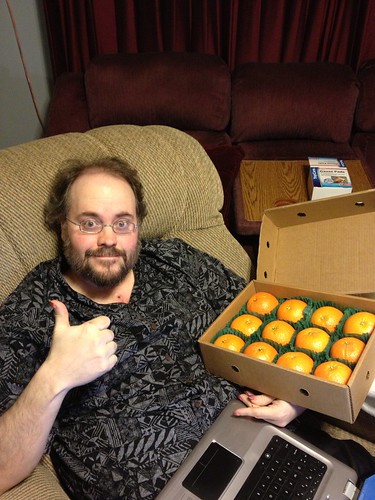
The thing is, I still don’t like fruit all that much. But every morning, when I woke up, I thought, “My friends want me to eat healthy.” And so I ate an orange, which I labelled “friend fruit.” My family shared in my fruit, and together we ate well, and that made me happy.
Yesterday, the second shipment of friend fruit arrived: grapefruits. I’ve never had grapefruits. I don’t know whether I’ll like them. But I do know that I’ll smile as I eat them, because it was a gift given by some thoughtful buddies of mine. And that makes these fruit all the sweeter.
So thank you, Lara, George, Miranda, George, Sean, Christian, and Eric. I’m gonna eat some grapefruit today. For you.