

On The Vital, Romance-Preserving Skill Of Saying "No"
So when I discussed how I was unwilling to help Gini clean the house to her spartan standards, I got a fair amount of silence. The few comments I did get went mostly along the lines of, “…yeah, I think that’s you.”
I think many people’s reactions could be summed up by this comment:
“This whole ‘I don’t support Gini in this because I don’t need to because it’s her hobby that I have no interest in’ strikes me as contradicting a post of yours I really liked from a few years back, where you talked about how both you and Gini sort of adjusted your housekeeping standards around each other and found a sweet spot, where you’d pick up clutter and become more aware of your environment because you knew it’d please her, and vice versa. THAT, to me, is an expression of how awesome your relationship is.”
Here’s the thing, though: This is that exact same essay, told from a slightly different point of view.
In relationships, we’re told all about how giving is love, doing stuff for your partner is love, sacrifice is love. And that’s what our culture interprets as “romantic” – every rom-com ends with one partner giving up some aspect of his/her life to be a better match with his or her mate. So when I say, “I’m willing to do this for Gini,” that’s pre-programmed to give you the warm fuzzies.
But while boundary-setting may not be romantic, it’s every bit as valid to a functioning relationship…. And you write that off at your peril. We’ve all seen the horrid relationships where a guy finds the love of his life, gives up all his hobbies and outside interests and friends for her, and then she leaves because he’s not the man she used to love.
Sacrifice and giving is but one aspect of a healthy relationship. The other is knowing when to say “Fuck that noise.”
Is it romantic for Gini to have said, “You know what, Ferrett? I can’t reassure you of my love as often as you’d like. Either learn to keep it to yourself, or get the fuck out.” Of course it’s not. Viewed through our cultural lens, it’s rather cold and clinical. It’s the speech of the first, bad girlfriend in the movie who throws the noble hero out on his ass before he finds the true love of his life.
But the alternative was her putting up with a behavior that irritated her to the point where she’d either have to leave, or would have to compromise her own self-esteem to the point where she’d be constantly miserable.
The reason we’re together is because Gini was willing to tell me to GTFO. And God bless her.
This so-called “sweet spot” of house cleaning is actually a constant, low-grade irritation to the both of us. In an ideal world, Gini would prefer that she lived in a cleaner house; I would prefer to spend less time cleaning. We tolerate it because we love each other, and that love helps make it go down… but it is a compromise.
And the compromise can only be negotiated because we have upper limits. Gini is not willing to tolerate me reaching a certain level of sloppiness, because it would stress her out; I am unwilling to do exotic cleaning beyond a certain level, because it would stress me out.
The middle is formed from these extremes.
Is it romantic for me to say, “You know what, Gini? This level of cleanliness is more than I’m willing to pitch in on; it’d be hours of effort that I’d hate, and the end result would have me living in a house that would be as uncluttered and personality-free as a hotel room, a sterile place that would make me feel uncomfortable in my own house. So you can do it if you want, but I won’t pitch in.” Of course it’s not.
But it’s vital, because otherwise I’d be so in love that I’d do anything for my sweetheart, and I’d clean and work and quietly resent the change. Eventually, my whole personality would warp to become nothing more than an extension of Gini’s desires, because without that ability to say, “This will make me unhappy, and I know it” then I’d be shifted into co-dependency one gentle “Aw, why not?” at a time.
Saying “No” to your loved one is a wondrous power, one that should never be taken for granted.
Yeah, it might be nice if I just schmoopily did everything Gini wanted and never questioned…. But that’s not the real world. As it is, I’ll clean a lot more than I want to. Do not think that having boundaries means that I am an unsubtle oaf; I put in a lot of effort to make Gini happy, having adopted hundreds of unnatural habits to make her environment more livable for her. I work hard at pleasing her.
But the fact that I love her does not remove my ability to have limits. And exercising those limits is not wrong.
Boundary-patrolling is wondrously hot, and vital. If all you get out of our relationship is, “We do wonderful things for each other,” then you’re failing at the lessons we’re trying to teach. Part of the reason our relationship is so wonderful is that both of us know when to say, “Okay, no, that’s more than I’m willing to give, and so I’m not doing that. Let’s discuss alternatives.”
Romance springs from this loving climate. This boundary between “This is what I am willing to give, and this is what I am not.” That’s where the real power grows.
Because You Demanded It: The Latest News On Our Bees!
Yesterday, I asked “What do you want me to blog about?” The #1 answer by a landslide: bees. “How are your bees, Ferrett?”
The problem with bees is that they’re just not that exciting during the winter. They go dormant for months at a time; you crack the top very quickly, so as not to let out all the heat and kill them, and then nothing happens. Fortunately, I do have an official announcement:
Our bees survived!
Witness:
This was quite gratifying, seeing them all flying about, because when we went to a beekeeping conference last fall, a legendary Detroit beekeeper told us: “You’re a first-year beekeeper? Oh, yeah. They’re gonna die.” But our bees have survived, mainly by dint of us not getting in their way. We didn’t really make any special preparations, didn’t medicate the hive, just let nature take its course. And they live!
(The mild winter probably helped, admittedly. As well as us deciding not to harvest any honey so our bees would have the best chance of making it.)
Now that the weather is warming up, it’s time to start feeding our bees – and the number out there was a little terrifying. Last year, we started with a box of 10,000 bees – which seems like a lot, but isn’t. Now that hive probably has about 60,000 bees, and you can see them swarming enthusiastically. They’re starved, as witness the fact that they went through two full containers of sugar water yesterday.
They also went for my bright green Yoshi pajama pants, which apparently looked like green fields with flowers. They were quite fascinated. This was distressing, especially given that I unwisely ventured outside sans protective underwear.
In any case, this is all the bee news I have to give. There won’t be much for another month or two, but at the end of April we’ll be getting our second hive. That’s right; two boxes of bees in the back yard.
We are crazy, crazy people.
Once Again, It's Personality Over Policy, Or: SFWA Politics
So the SFWA politics are reflecting mainstream politics, which irritates me.
Here’s the background, for those of you who aren’t SFWA members: John Scalzi is running unopposed for President again, which is fine because he’s done a good job. Mary Robinette Kowal, however, has stepped down from her position as VP, leaving two people to run: Rachel Swirsky and Lou Antonelli.
Lou posted a blog entry announcing his candidacy, and in his personal bio he said: “Louis and Patricia have two adopted Canine-American children, Millie and Sugar Antonelli.” Author Nisi Shawl (who literally wrote the book on writing about other cultures respectfully) took offense at this characterization, saying, “I, too, am a dog-lover, but I struggle for the words to tell you exactly how and why your flippant trivialization of the ethnic identity movement with this phrasing revolted me.”
Lou replied, perhaps unwisely, “I have no damn idea what your problem is. If I offended some esoteric aspect of political correctness, I don’t care… If this some way of saying your genes are more important than your citizenship, then it’s bullshit…. You obviously take yourself way too seriously.”
…at which point a heated discussion broke out on Twitter and in his comments (and in Jim Hines’ blog) about how a man who responded so angrily to a complaint from a SFWA member wasn’t fit to be Vice President. (Most of the people I saw referencing it fell into the category of “Weren’t bothered by the Canine-American silliness at first blush, but the response was so full of swearing and tone-deaf dismissal that I don’t think this man has what it takes to represent a diverse organization.”)
These discussions brought all sorts of additional scrutiny to his biography – which claims that Lou would bring “diversity” to SFWA by being an older white Baptist. (Which, to be fair, may be a minority among SFWA members, but still.) And many decided not to vote for Lou based on the mini-scandal brought by his blog post.
All valid points. You know, if a fairly prominent SFWA member comes to you with concerns about your tone, swearing at her is not a smart political move. Do we want to elect a guy who can’t Google “Nisi Shawl” and then “Ethnic identity movement” before responding?
But.
But.
This is politics in a nutshell once again, with personality trumping policy. Because the real bombshell was buried in Lou’s goals for SFWA, were he elected:
“I would like to see an amendment to the criteria for a professional short story publication, going back to the three cents a word standard (which I believe was the pay rate over a decade ago).”
In other words, Lou’s main platform is “I would like to lower the minimum pay rate for authors to be considered professional.” Which is a nice way of saying “I’d like authors to earn less money,” because the “pro rate” of five cents a word is what lower-tier magazines struggle to make in order to be called “professional.” They make triumphant blog posts when they do make it. SFWA sets the standard for payment. The second you lower that rate, the marketplace will adjust to three cents a word.
How fucked up is that? For the record, I had three professional short story sales in 2011 – more than most members, I’d wager. And for those three sales, I made a sum total of about $600, two from online markets who were quite proud about finally hitting the “pro” rate. Not exactly a princely sum, you see.
Under the Lou three-cents-a-word program, there’s a better-than-even chance I’d have made $440 instead.
So why would I vote for this guy? His argument is that we’ll get more SFWA members with a lower rate – which is great for SFWA’s coffers, but actually actively terrible for me as a writer. Five cents a word wasn’t really livable back in 1990, and after two decades of inflation we’re going to roll it back?
Seriously. What the fuck?
To my mind, that’s the real scandal. Not to dismiss Nisi’s complaints (though I should note she later accepted Lou’s apology, an apology I think was genuine), but what the blog-o-sphere should have reacted to was the cockamamie proposal on the table, one that would have made the economic realities of struggling authors patently worse.
Once again, we have the real world at work. In a just place, Lou would have been dismissed out of hand for bad policy long before we even thought about writing him off for any political missteps. But because policy is boring and insults exciting, we have the shitstorm raised by personal error, with the policy being raised only once the blog-o-sphere erupted in anger over something Lou did wrong. (And I’m not immune – I didn’t notice the three-cents policy until Keffy pointed it out to me.) I think Lou’s probably well-intentioned overall, not a bad man by any means, but that policy…. oof.
That vexes me. I wish more people paid attention to platforms and got as angry about them as they did the scandals of personal misconduct – me included. But we don’t. Even in the small world of SFWA.
In other news, Rachel Swirsky is a wonderful human being and a very competent woman who has my wholehearted vote for SFWA vice president. She had it before, doubly so now.
So What Do You Want Me To Blog About?
I find myself in an odd quandary; I have a couple of blog posts I’d like to write, but they’re large subjects that would take too much time in a work-heavy week. So you know, time to see if there’s anything you’d like to see my take on, or any followup questions you think I should handle. (Not that I haven’t followed up on questions before.)
I’m open to all topics. If anything, you’ll at least get an interesting comment reply.
If that fails to appeal, well, here, have me in the stylish outfit I was sporting yesterday:

A Whole New Level Of Support
While I was away, Gini spent the entire week cleaning the house to up her standards. Her standards are spartan; nothing on the counters but the barest of essentials, everything else put away neatly in a drawer. The house is visibly lighter after Gini has swept through, as the sunlight has so many more open flat surfaces to reflect off of.
I do not support her in this. And so I shall not help.
This is why our marriage works well.
Don’t get me wrong, I’m not opposed to clean. I won’t leave dishes out just to prove a point; certainly, Gini has raised my cleaning standards over the years to be more compatible with hers. But Gini’s idea of “a nice house” is something that looks despicably barren to me, more of a show apartment than an actual home. I like a place with a few books strewn about.
So I shall not help her in her quest to do this. I shall not particularly stop her, either, but I won’t go out of my way to help her achieve her look.
This is a vital skill in marriage.
There’s much talk about being “supportive” in marriage, but there’s not much talk about the low support that most things actually require. When I think of “supportive,” I think of helpful wives brightly saying, “Yes, sweetie, get out there and go exercise! Have you biked this morning? Here, let me help you out of your chair and get your bike out of the garage!”
Yet the majority of the stuff that Gini and I deal with can barely be called “support.” It could, grudgingly, be called “not opposed to.”
For example, take my exercise. Gini hates jogging, and cannot drum – so when it comes time for me to exercise, I’ve pretty much gotta do it alone. Gini never asks whether I’ve worked out that day, doesn’t really care to know the details of my jogging/drumming unless I share them with her, and is mildly happy for me because it makes me happy…
…but other than that, she couldn’t care less. Much like she really has no inherent interest about Magic, or videogames. Or like I don’t really have an inherent interest about her quilting or classical music. These activities are interesting only to the extent that we share them with each other… Yet if I never said a word about the Dark Ascension prerelease, Gini would never follow up.
This is a positive thing. Sometimes, the best thing your spouse can do is shrug and let you do it, if you want. Gini doesn’t need to run down to the gaming room and organize my Magic cards for me…. Because as a human, you need to learn how to be self-directed and get that shit done yourself, if it makes you happy. Relying on your partner to constantly push you into happiness makes for a sad and work-like marriage.
There are things we do check in on; if I didn’t write for a week, Gini would be concerned. Gini needs to have some hobby going on in her life, lest she feel awful about wasting her week on iPhone Sudoku, so I urge her to go do something if she’s been sufficiently still. But the majority of our “support” involves “you go right ahead, and I’ll even listen if you want.”
So if Gini wants the house super-super-clean, I’m going to not be a dick about it, but I’m also not going to spend a half-hour out of a busy day in efforts to keep the house to a standard I’m not overly fond of. Instead, I’ll simply let her do it when the urge moves her, and not actively complain about oh damn, the book I had in the place I was reading has once again moved to another room where I have to go search for it.
Such is our support: not getting in the way.
It works.
Writing Is Fucking Is Writing
I wrote another essay today over at FetLife, the Facebook for kinksters, where I discuss the more personal sex-related topics that I don’t necessarily want people to stumble across accidentally. (If you seek it out, great.) And today’s essay is how some revelations I’ve had on writing have led me to feel better about my sexual style:
All my life I’ve been insecure about my sexual ability. No, check that:
All my life I’ve been insecure.
In a sense, that insecurity is a good thing, because it drives me mad to correct my faults. When I fuck, I fuck with a considerable amount of skill because I am determined to become better in bed with every coupling. If a woman is kind enough to let me into her bed, least I can do is not kiss like a slobbering German Shepherd. So I work that shit, even as I still lose myself in considerable passion. (I was told this weekend I “fuck like a beast,” which I’m going to purr over for a bit.)
But with insecurity comes the badness: the need for reassurance, the anxiety of Doing It Wrong, the drive to sometimes push when stasis is not only fine but what’s needed.
That said, one of the things that Neil Gaiman said to me at my Clarion class resonates in a weird way with sex….
If you want to read it all, well, it’s in the usual place.
Getting Older Is Not A Consolation Prize
I’m forty-two now. I know what forty-two is supposed to feel like: the first creaks of oldness, settling into a mundane life in suburbia, the first pangs of losing yourself in that self-involved, Baby Boomer-like nostalgia where only the old songs are the good ones.
Yet with each year, I keep picking up power.
It’s odd. On Saturday, jenphalian took me out to get a manicure. On top of Bec’s henna, that leaves me with some pretty pretty hands:
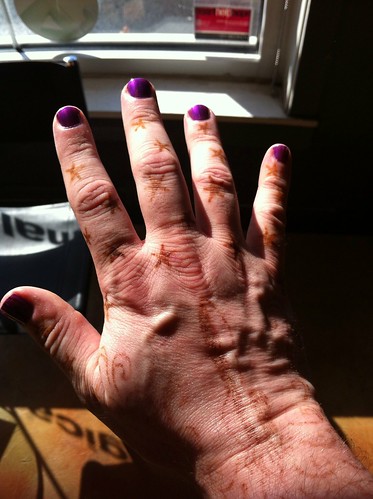
And as I left the parlor with my henna hands and my purple fingernails, I thought of what a strange difference this was. Back when I was twenty, I might have done the fingernails and henna, but it would have been as a way to show How Radically Different I Was. I was so desperate to make a unique mark back then that my every move spoke of flopsweat. It wouldn’t have been art to please me, but rather art to define me.
What I didn’t guess was that over twenty years, I’d be finally be defining myself. And part of that identity is pretty pretty princess nails.
America’s culture is youth-crazed, so there’s this concept that middle-aged life kind of a consolation prize – sure, your life isn’t as exciting as it once was, and you’re uglier, but now at least you have some money before you start dying! We all know old age is sad and pathetic.
For me, though, age is strength. I’m learning more every day because I’m not wrestling with new problems – just variants on old ones. I’m a better writer because I have the discipline to sit down and work every day, even when I feel like fucking off and playing Mass Effect. I’ve got a better sex life because I’m exploring kink and polyamory responsibly, without the psychodrama or insecure implosions I would have engendered as a twenty-something kid. I’m listening to more kinds of music, exploring more fiction.
I’m told that middle-aged suburbia is to have your life shrink. Mine’s expanding.
Every day I wake up and I feel more me. It’s a concept that is strong, quiet, confident. It’s not always there – I’m shaken by my usual insecurities – but more and more I’m waking up and going, “Yeah, I’m going to fuck up sometimes, but mostly I know what I’m doing.”
That’s potency. Born of experience.
There’s a part of me that’s thinking about getting a tattoo, now – not a huge piece of artwork but rather some lyrics that mean a lot to me. (It’s from the chorus to this song, in case you’re curious, the words of which sum up pretty much entirely what I’m trying to do ever.) And before, I’d always thought, “How do people get tattoos of silly things like that? What if you’re wrong? What if you put the wrong thing on your body?”
Forty-two year-old me hasn’t made the decision yet. But if I do, it’ll be like my henna and nails – something for me that I don’t mind you watching. I’m comfortable in who I am, settling into my skin.
This isn’t what old age was supposed to be like, but I’m glad as hell that it is.