

"Poor Brad" (or, Thoughts on Angelina Jolie's Breasts)
In case you haven’t heard yet, after discovering she had a gene that made it 87% likely she would get breast cancer, Angelina Jolie had a preventative double-mastectomy. And I’ve been thinking about two words that have been enraging me:
“Poor Brad.”
See, because, Angelina Jolie’s tits were for Brad’s entertainment, and he had ownership of the best tits in the world, and now they’re gone. This is a loss to Brad, you see. As men, we should feel sympathy for him, as expressed in a very common comment left across many news sites.
At which point I try to imagine the pain of being so certain I had testicular cancer that I literally thought, “Well, it’s them or me.” I envision the anguish of wrestling with that decision to literally neuter myself, of thinking “What if I’m in that 13%? What if I don’t need to do this?” All of the medical issues, the pain, that fluttering of identity when a large part what you consider Your Body gets chopped off and you have to come to terms with the fact that maybe all of you could go away. The realization that my body would be altered in ways I might find aesthetically horrible. The knowledge that everyone would know about this once I blogged about it.
And then I imagine seeing that comment sprayed everwhere: “Poor Gini.”
Because, you know, I’d be less useful to her without balls. My whole goal in life is to satisfy her sexually, and if I fail at that, it’s a tragedy for my wife. In fact, her biggest concern would doubtlessly be my lack of balls, because I had one job, and now I couldn’t do that for her.
Everything I wanted? Fuck that. I’m a support role for my partner’s sexual needs. She’s the one grieving the loss, really.
…except people wouldn’t write that. I’m a guy. Oh, there’d be a lot of sympathy for the sex I couldn’t have, but the underlying premise is that as a male, my body serves my needs. If I want to wear a comfortable shirt that hides my pecs or makes my belly look big, then that’s my decision; I don’t have to deal with a societal pressure to display myself appropriately for the needs of others. If I have to change my body, then that’s what I need to do. I don’t have to consider, or sympathize with, the feelings of all the women fantasizing about me when I feel like doing what’s medically necessary.
I’m not an object for someone else’s pleasure.
Look, it’s well known that I like big breasts, and I literally cannot lie: I’ve never been shy about blogging my love of sex, or of porn. And on those occasions women have felt generous enough to allow me the usage of their breasts for my pleasure, it’s inevitably been a wondrous occasion.
Yet I never once thought the breasts were there for me. They were a part of my partner’s body, and she carried all of the downsides of having them – needing bras, enduring back pain, the difficulties while jogging. When some of my lovers opted for breast reduction surgery I was supportive, because they weren’t just a pair of tits to me – they were a human being, and an unhappy one. If reducing their breasts would make the rest of their lives better, then I wanted their lives better.
As Damien W. Grintalis said, “My guess is Brad would rather have her alive and breastless than possibly dead.” Because a real relationship is multilayered, complex, full of all sorts of supports that go beyond HI YOU ARE SEXY FUNTIEMS NAO. Gini and I had some difficulties getting back into the swing of sex after my triple-bypass, but I don’t think Gini once thought, “If he doesn’t get better in bed, I’m gonna have to leave him.”
Angelina Jolie was, and doubtlessly still is, a beautiful woman. But Brad Pitt had his choice of beautiful women, and as such I assume he picked Angelina for reasons that go far beyond prettiness. I hope he and Angelina are doing all right as they weather today’s storm of media coverage, bracing themselves for the first round of tabloid photos that are sure to arrive. It’s gotta be a tough day for both of them.
Poor Brad? Fuck that. Poor Brad and Angelina. And I hope, I hope, it gets better for the both of them.
Mindful Practice For Writers: Five Tips To Get Your 10,000 Hours In
To master a skill, you must devote 10,000 hours to it – or so the theory goes. But that 10,000 hours must consist of mindful practice, or else every fryolater slapping burgers at McDonald’s would be a master chef. No, you have to concentrate purposefully on improving your skills, flexing different muscles to install new muscle memories.
So how do you practice mindfully as a writer?
Look, I believe in the 10,000 hours, because I’ve experienced both sides of it. I wrote fiction for twenty years and failed at it, sinking a lot of my time into writing but without making much headway. And then, after Clarion removed some much-needed blinders from me, I wrote purposefully and I started to sell lots of stories. So while every writer is different (the trick to “writer’s tips” is understanding that they’re all about unlocking your inner efficiency, and so you should ruthlessly discard whatever sounds silly to you), I think I can tell many writers how to get those 10,000 hours in so they work.
1) Write Short Stories, And Finish Them.
…at least for purposes of practicing. Novels are wonderful beasts, but they’re sprawling things with hundreds of moving parts – and it’s difficult to get friends to read your 120,000-word saga and offer useful advice. Whereas short stories can be finished in a week or two, they’re usually about simpler scenes, and it’s easy to get people to spend the forty minutes it’ll take to get through them: all things you’ll need. You can write fifteen short stories in the time it takes you to write a novel, and get better feedback as to how the internals of it worked (because with a short story, people are more thorough about critiquing).
Also obvious, but some people never get this: finish those stories. From a practice perspective, five half-written tales aren’t nearly as effective as one completed story. You learn the full arc of a tale when you complete them – and more importantly, you can go to Step #2:
2) Get Each Of Those Stories Critiqued By People Who Like What You’re Trying To Do.
Particularly when you’re in the early part of your journey, there’s going to be a gap between “What you intended to do” and “What you actually evoked in the reader.” For most people, it’s impossible to tell where those gaps are without actually bouncing them off of other readers, and getting their feedback.
You need good readers, though. Usually your Mom and your buddies are just happy to see you writing, and they aren’t overly critical in the way that they analyze it. You need people who are willing to tell you, kindly but firmly, that this story totally didn’t work for them – and then break down what, exactly, what in your prose stopped them from reading the story you wanted to write. (People who complain because you didn’t write the story they would have written? You can dispense with them post-haste. And you can’t rely on rejections, which are too often a mere “no” and hence offer nothing of use for you to go on.)
So find a good writers’ group (or just a group of writers) and have them break down your stories in depth. Otherwise, you’re like a pitcher who can’t see where your ball is landing. You need some feedback to work on your aim.
3) Focus On A Different Technique With Every New Short Story.
If you’re reading a lot of fiction – and you should – you’ll notice the strengths of other writers. As your crit group savages your tales, you’ll notice weaknesses in your own fiction. So to practice mindfully, write stories that focus exclusively on those techniques. Think, “I’m not very good at writing stories without action sequences,” and then set out to write an effective story with no explosions. Think “I usually white-room my stories, not putting much effort into setting,” and then write an evocative prose-piece that’s as much about the exotic bazaar it’s set in as it is about the people in it.
I can tell you what new technique I was trying to master in any story I’ve written. For example:
- “‘Run,’ Bakri Says” was me saying, “I don’t write action stories, so I should write a story that’s nothing but action from start to finish.”
- “Sauerkraut Station” was me saying, “I really liked the way Little House on the Prairie made a bunch of mundane activities like farming and house-building seem riveting. Can I write a story in space that does the same thing?”
- “A Window, Clear As A Mirror” was me saying, “I usually have at least a little plot planned out when I begin writing. What happens if I write a story with no ending point whatsoever, and just wander?”
- “My Father’s Wounds” was me, absolutely loving the way Steven Brust made magic seem mundane, and asking whether I could write a story that had totally human elements with a bit of magic in the way that he did.
- “Dead Merchandise” was me saying, “Wow, Cat Valente writes really dense prose that’s elaborately descriptive, and I’m so bare-bones. What happens when I write something really visual with poetic imagery?”
Now, if you read those stories, you may note that they might seem totally different from the intent I started out with. That’s what happens when you make a story your own: it drifts away from the original influences, and becomes this wonderful melding of new techniques and old strengths. (Or it turns out to be a glorious failure – I have a couple of stories dead at first draft that expanded my skills, but weren’t good stories on their own. That’s okay; the techniques I learned there came in handy in later stories.)
The point is, by experimenting with each of those stories, I practiced. Some of them sold, and got good reviews. Some of them got shelved. All of them sharpened bits that were previously dull. All of them made me a better writer – and quickly, because instead of spending months writing a novel that utilized some (or all) of these ideas, I wrote an easily-critted tale that could tell me whether I’d succeeded or failed.
4) Do Not Write Scratch Pads.
Note that the “test” stories I wrote above were all published: one was nominated for the Nebula, two got “Recommended” reviews from Locus, the toughest reviewers in sci-fi. That’s because even though I was trying new things, I still wrote these stories as though I intended to sell them.
Even if you’re doofing around with something that seems insanely out of your element, even if this seems absurdly stupid to try this crazy new technique, treat the tale as though you had a deadline and an interested editor. Approach every story you write as though this is the big one – because it might be. Who would have guessed that my 18,000-word Laura Ingalls Wilder rip-off would become my most beloved piece of fiction? Hell, I thought it was unpublishable.
5) Practice By Not Writing.
Some of the best mindful practice I got came from not writing, but analyzing. It’s a lot easier to see how fiction works when your own ego’s out of the way – and looking at how tales work (and, just as critically, how they don’t work) expands the brain. So a lot of your practice can, and should, be things like:
- Critiquing other people’s stories. (As a bonus, it helps you stay in that crit group.)
- Being a slush reader. (Breaking down out why six stories a day aren’t publishable makes you realize just how high the bar is in fiction.)
- Reading with intent, which is to say reading your favorite author to go, “Why do I like this so much? What really works here?”
You can’t write for four hours a day every day, but you can usually get a story read on a lunch break. That’ll nudge you closer to your 10k goal.
Why Calling Me "Cracker" Just Isn't The Same.
A thought just a hair too long for Twitter:
A racial epithet only really works if it’s been used throughout your life to demonstrate how you’re second-class. And while I know there are terms like “cracker” and “ofay” that black people use to denigrate white people, as a white guy raised in largely white towns? I have no emotional connection to them. I’ve never had a black guy threatening to kick my cracker ass, nor have I had any girl call me some stupid ofay when she realized I was smarter than she was.
So I know what the intent is. But it just doesn’t hurt me, because, well, I’ve got this grand fucking life of privilege I’ve surfed on.
Which is why I try to eschew the N-word when I can, even in quoting its usage. It’s not just a word; it’s a hot button of bringing a tide of emotional reactions to the surface when I say it, because assholes who share my skin color have created an association between “white people saying that word” and “rubbing in just how insignificant all of your actions are and will ever be.”
Sure, the names exist. And I’m sure there’s a white guy somewhere in a black neighborhood who has those flush-faced reactions to “cracker,” because he was a minority in his neighborhood and pounded for it. But for most white people, the insult’s kind of like a, “Oh, you were trying to insult me? Why didn’t that hurt?”
Why Masturbation Is Ruining Our Lives
So the other day, I discovered the existence of Reddit’s No-Fap Challenge, which basically talks about how men need to stop masturbating right now. There are a lot of threads in there, presumably because they now have tons of free time.
The gist is this: Buttering your bagel hurts guys, because the free availability of porn makes polishing the pope an incredibly easy orgasm. But after you’ve completed the Roman helmet rumba, you become slothful – why would you seek out a woman when you’re spent and dripping with man-juice? You have no urge! And so you waste your days in your apartment, endlessly shaking the snake and marinating in loneliness.
Plus, teasing the weasel to Internet porn gives you tremendously misguided notions as to how women work – you expect all your women to be porn stars, all your positions to be pornish, and these attempts to recreate fantasy in your bedroom is akin to saying, “Wow, I really love musicals, let me sing all of my emotions to you.”
No, milking the mule is a sure road to isolation and awkwardness. Your constant toad-stroking has simultaneously lessened your urge to find women, and made you unable to interact with them on any realistic level. So the solution? Stop dating Ms. Slick Mittens! Don’t allow yourself to come until you’re spasming into an honest-to-God, real life vajayjay! This is your only chance to meet girls – so abandon this useless shaking coconuts and get outdoors!
If this was all coming from an external source, it’d be ridiculous. But no, this is a home-grown movement, a bunch of guys devastated by a chronic stirring the yogurt problem who have decided they have had enough of bongin’ their schlong. Leaving all of this adolescent main vein straining behind has made them into happier, more socially adjusted men. There are testimonials about how good it feels to leave all of this squishin’ the sea burrito behind, how even the ugliest of guys have been propelled into real life and now have girlfriends to ejaculate into.
…okay, I’ll stop with the crazy masturbation synonyms.
The thing is, I’m not unsympathetic. As someone blessed with a high sex drive himself, there are days I feel like my orgasms are trying to shovel sand against the tide. I have an orgasm, and for a while I’m a sane man. I’m different. My thoughts are not clogged with these desperate need to hump, and for a while I am, to paraphrase Louis CK, “a guy, shopping in a store.”
Then, slowly, the urge seeps back in again, and then I become crazier. Not a madman, exactly – the guys who use this sex drive as an excuse to harm others are scum – but kind of a low-grade caffeine headache, a growl in the stomach. A perturbation at the edge of my senses, a thing that probably affects more of my decisions than I’d care to admit. I wouldn’t be surprised to find that Dr. Jekyll and Mr. Hyde was secretly inspired by that post-masturbation paradigm.
And so, if my actions are different, it’d be no surprise to find that this constant post-orgasm state causes men to react differently. There’s a grain of truth to it: are we are motivated to eat a fine meal immediately after we’ve scarfed down a bag of little chocolate donuts? No. Stay hungry, my friends. And driven by this inability to get off except at the hands of other people, you will take greater chances, step out of your apartment, and probably come to realize that porn is nothing like real sex most of the time. (Which is good. If all you’ve had is bad sex, and were naive as a country boy, one could see preferring the stability of porn.)
But.
I also think it’s really overblown.
I don’t doubt there are guys who’ve ruined their lives with masturbation and porn. I don’t doubt there are a lot of them by sheer numbers, if not as a percentage of actual men. But I see this whacking-love like any other addiction – which is to say that the cure is both necessary, and often annoying and proselytizing from an outside perspective.
Hey, I support Alcoholics Anonymous and all the other cures – because when you’re in that deep, you need a new structure to your life to jar you out of entrenched habits. Having an addiction is like having a rudder that’s forever tilted left; unless you’re fighting the current, you’ll steer straight back into the old storms. So you need systems to constantly remind you to be vigilant, you need friends to back you up, you need a lot of effort to keep clean and stay clean. And I support this.
But what often happens is that these people come to believe that everyone needs these structures to stay clean. I’ve been lectured more than once by a (usually recentish) AA member that I had a problem with my drinking, I needed the help of everyone, here, come with me, I’ll help you. And that’s after three beers at a club. And if you have a friend who’s a recent convert and is framing everything in terms of the old hit song My God, Life Is So Much Better For Me Now (And It Would Be Awesome For You Too), then it gets annoying if you’re not so far gone that your masturbation has not eaten your life whole.
I dig why they do it. Staying on the path would be so much easier if everyone they knew was on the path. Unfortunately, the benefits from being on that path usually only accrue is if you’re as far gone as the addict, and so there’s often – not always, but often – a subtle insinuation that this is your problem, too, isn’t it? Which, yeah, it sometimes is and you’re just in denial, but if it isn’t then it’s just a guy with his own personal set of issues trying to project them onto the world.
So the NoFap movement? I think it’s great for the people who it helps. But I don’t think that having an arm wrestle with your one-eyed vessel is a global problem, one that hurts men as a whole. I think most men whack it occasionally and yet still manage to get out of the house. I think that most men watch a little porn, and those porn-thoughts probably seep into the emotional groundwater a bit and cause some pornish sex, but they’re not wrecked by having to slavishly recreate porn-style sex or it’s useless. And I think that the guys who are that wrecked need to be more vocal to get the word out to the secluded folks who are affected – after all, it’s not like you’ll run into them at parties – but that doesn’t mean it’s a tragic issue that’s destroying our generation.
I support rampant masturbation. I support NoFap. The two thoughts are not mutually exclusive. And if you need it, go for it.
I’ll be over here with my wife. She knows I occasionally grease up the ol’ love monkey. This has not distracted from what is otherwise an excellent sex life.
Recommend Me A Roleplaying Game?
I fell out of love with D&D when I realized that the game was tilting towards explaining everything.
I couldn’t blame them; the vast majority of players want firm stats, new feats, monsters with clearly-defined powers and a set number of hit points. So they buy supplements that give them those hard figures… and when Wizards of the Coast figured that out, they made D&D 4th Edition, which is essentially nothing but a dry set of rules to accommodate combat. “Why should we accentuate the roleplaying?” Wizards asked. “The people who want to do that will just break the rules anyway. So let’s give the players a strict framework of guidelines to run combat in, and the rest will take care of itself.”
Me? I want mysteries.
This is why I adored Planescape, which was a world defined largely by belief, and had many things that could not be beaten by mortals. (You weren’t taking down a God, you weren’t settling the Blood War, and there were no stats for the Lady of Pain.) I love Delta Green, with its methodical attention to detail and its grim meathook way of dragging you into the abyss. I love Unknown Armies, the way that there’s always some new and crazy obsession-related magic around the corner. I love Deadlands, with its crazy Wild West History and stock archetype characters carving their way through a fragmented United States.
What I really like, as it turns out, is a detailed look into another world. These aren’t necessarily roleplaying games for me; they’re a travelogue into a new land, with different magic systems and strange challenges. I’m a writer, I don’t need stats; what I need are mysteries to spark ideas that I can then run with in my own campaign. I love reading someone who’s clearly gone to great lengths to devise a land that’s both meticulously thought-out and yet still full of unanswered questions.
(…Which is why I never liked White Wolf’s supplements all that much. They always struck me as well thought-out, but I never felt there were serious mysteries in them; rather, there were these intense political campaigns with no room for the players to squeeze themselves into. I kind of wished they’d just write novels and stop pretending like they wanted players to interact with them.)
And I know such things exist these days; I just don’t work in a game shop any more, so I’m unaware of them. So I’ll ask you experts: What roleplaying games do you think I’ll enjoy reading?
(Not playing, sadly. Just reading. I really want to run an Unknown Armies campaign now, but that’s a very acting-heavy system, and I’d need at least four people willing to throw themselves deeply into character. I just don’t have the critical mass of local peeps to make for a satisfying UA campaign, which wouldn’t involve victory over the odds but rather people trying to come to terms with the deeply weird world they’ve accidentally opened the door to.)
I’ve given you my top four: Planescape, Delta Green, Unknown Armies, Deadlands. If you can recommend any new RPG worlds (preferably created in the past seven years), I’d be grateful. I’d like to get up to speed, and see what folks have done lately.
Today's Pretty Pretty Princessing
This weekend was Kinko de Mayo, Cleveland’s big kinky convention. So naturally, I couldn’t show up with last week’s nails!
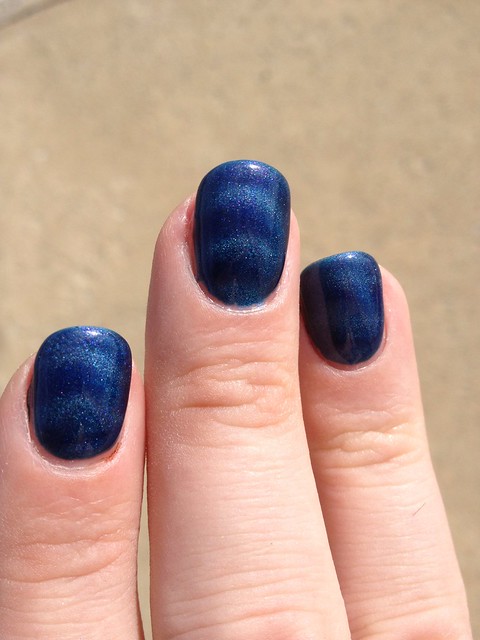
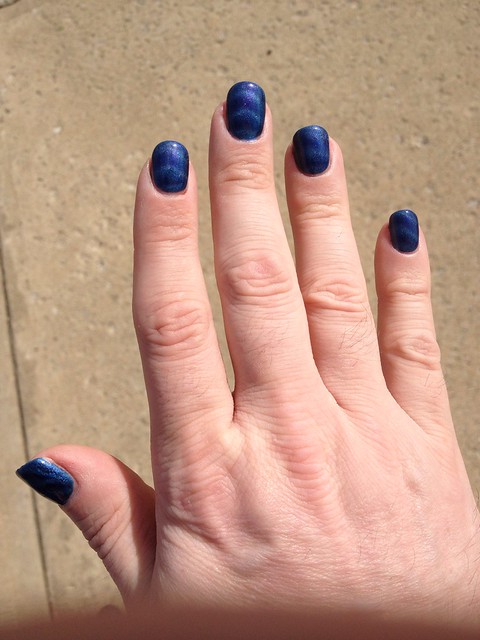
These may be my favorite nails of all time; they’re masculine, and yet unmistakably pretty. The trick on this one is that the nails have little magnetic filings in them, and they’re aligned by judicious use of a magnet before being cured with the ultraviolet light.
And holy God, I wish I’d gotten pictures of these babies in the blacklight. They glow like jellyfish in ocean water. It’s glorious.
(If you’re curious about what Kinko De Mayo is like, I have a con report up over on FetLife.)
Funeral For A Queen
We broke into the hive of our friendly bees the other day, only to find it was the Overlook Hotel.
Which is not to say it was empty. But it was hive full of dwindling ghosts, bees working on autopilot on tasks that no longer mattered. They were fetching pollen, getting honey, keeping the comb clean….
…and none of it mattered, because the queen was dead. There would be no new bees. There could be no new bees, without a queen. The combs were completely free of eggs. All of their bustle was devoted to furthering a future that could not exist. Left to their own devices, the poor things would have worked literally to death, the population dropping until eventually every last bee was dead.
“But wait,” you ask. “How do bees reproduce, if they all die when the queen dies?” Well, if the queen dies during the spring or summer or early fall, then she’s already laid a bunch of eggs. The bees pick one egg for reasons that nobody quite knows, feed it royal jelly, and what would have been a worker is suddenly upgraded to an egg-laying queen. The hive will be struggling to catch up, as bees have short lives and a lot of them will die during the transition period, but the queen will eventually hatch and start up the great bee Circle of Life.
If the queen dies during the winter, though, there are no eggs to upgrade. The bees open up shop, same as always, emerging from their winter downtime, but there are no raw materials to work with. All they have is food and comb, and they tend to those like nothing has gone wrong. But it has gone wrong. Everything around them is dying. They are a sterile hive.
The only solution in this case is manual: Gini is driving down this afternoon to fetch a queen bee, as it’s a race against time. We’re going to put this new queen bee in the hive, give it a week to let her pheromones saturate it so the remaining bees don’t sting her to death upon release, and hope that she can lay enough eggs while the survivors of the last generation are around to tend to them that she can kickstart this hive.
Yet it’s still a loss. The queen we knew, the one who laid all of those nice bees, is dead. Perhaps killed by the cold, or maybe by old age – she wasn’t that old, but into her third year she was getting on. The queen is the personality of the hive, and these bees have been the sweetest, most docile bees a beekeeper could ask for. Her death is a serious loss to us, as even if this new queen manages to rebuild the population, it won’t be our hive. It will be a hive, with some overlap for a few weeks, but by the end of June the last traces of the old queen will be gone and New Queen will be firmly in effect.
It’s a terrible loss. It is an odd thing, to be so sad over a single insect, but this insect was in a very real sense a colony – and a colony we loved. So we’ll carry on in her memory, and hope this emergency patch works, but…
…it won’t be her. We’ll miss her. Her and all her kind.
Goodbye, queen.