

WeaselCon, New York City, 02/20 at 4:30 pm – A Reminder!
As a reminder, I’ll be spending two hours at the Beer Culture bar in New York City at 4:30 pm on Thursday, February 20th. If you can read this, you’re welcome to show up and say hello to Gini and me. (Though it’s nicer if you RSVP so I know you’re coming.)
I will provide nametags. I will also post a picture of what Gini and I are wearing that day on my Twitter feed, so you’ll have the best possible image of me. I will, as threatened, pontificate at length about the new corduroy pillows.
Feel free to show up, if you wish. I have no idea how many people will arrive, so we’ll see how it all goes.
Oscar Movie Reviews: Her, American Hustle, Wolf On Wall Street
Every year, Gini and I try to see all ten nominees for Best Picture. I don’t know whether we’ll get through it this year, as we’ve boiled it down only lacking the three smallest films – Dallas Buyer’s Club, Philomena, and Nebraska, two of which you can only see in theaters – but we did go on a run last week where we saw three of the big nominations.
Her
I was so excited to see this film – it’s by a director I love, it’s near-future SF, and it deals with AIs interacting with human beings (which is one of the things I continually write about). So when I got to the theater, I was bouncing up and down in my seat.
So why didn’t I like it?
First off, the problem with Her is that it’s incredibly self-indulgent. Yes, I know, it’s trying to create a sense of time passing, but there’s so many shots of Joaquim Phoenix wandering sullenly through melancholy rainbows that you could literally shave ten minutes off the film if you cut those wandering scenes out. I get that he’s lonely and isolated. But when you keep repeating that montage throughout the film, it adds flab.
Then there’s the other unfixable issue in that Her is trying to tell two character arcs – I won’t spoil it, but basically Her is two movies bolted together. And by the time we got to the end of the first one, I was satisfied, and emotionally exhausted – and then it told a whole other side of that story, and I just didn’t have the energy for it. And that other half of the relationship is entirely necessary, as it’s what gives the film its emotional depth, but it’s also got a heavily preordained conclusion.
Unlike the first half of the film, which has the potential to go in all sorts of unexpected directions, the second half starts with a heavy-handed foreshadowing of what’s going to happen, and then… that’s exactly what happens. There are no surprises on this road to the end, just a repetition and deepening of the dilemma. And so, when you’re already tired from dealing with the emotions stirred up in the climax of the first half, you’re watching a very on-rails experience in the second half.
Which isn’t to say it’s a bad film – I quite liked a lot of it. I liked that the OS Joaquin Phoenix falls in love with very much has her own agenda. She is not a passive construct, but something actively seeking, and the fact that she’s willing to contradict and baffle him is glorious. I read a Twitter-review that said that the OS was all that was bad about women – a clingy, needy, bitchy girlfriend – but I think that says far more about the writer than the film, because the OS is a literal blank slate who is dealing with a man who purposely eats his emotions. He’s actually kind of a schmuck to her, and the fact that people sympathize with him is actually somewhat of an issue.
But I liked that Joaquin Phoenix was lonely, but not isolated – he had friends, a small social life, a good job. He wasn’t a stereotypical nebbish who no one liked, he was just sort of a disquietingly soft-spoken Man Of Awkward who could be nice in the right circumstances. (A creepy guy who dated, via some combination of wish fulfillment, the most astoundingly beautiful women – his ex-wife is a heartbreaker, and his romantic tension is Amy Adams, for Christ’s sake. That kept throwing me out of the film as I thought, “This mustache with this personality gets these women?”)
But basically, this movie is self-indulgent, taking over two hours to tell a story that could be told in 100 minutes. It’s got some really nice stuff in it, but I wondered why it was crashing at the box office. Now I know why.
American Hustle
Basically, at this point, I’m going to assume that Christopher Bale is magic in whatever he’s in.
American Hustle is a wonderful train wreck of a film where you take a bunch of clearly-defined dysfunctional personalities, put them in a paint can, and shake. Basically, every time a situation could be solved easily, someone exacerbates it by acting in an entirely in-character and yet totally disastrous way. It’s a ping-pong ball where alliances shift effortlessly as these idiots wound each other and take stupid revenge…
…and yet you actually feel sympathy for them. They’re all in pain in some way. And yes, they are taking it out on other people, but there’s a certain desperation in the way that none of them know how to be happy, and they want to be happy, and so they’re grabbing at other people like a drowning man clutching at a life preserver. They’re making the absolute wrong moves, of course, but the genius of American Hustle is that even as you facepalm you can understand why they think this is a good idea.
They’re wrong. They’re always wrong. But American Hustle is a frenetic masterpiece of glory to watch, and cements David O. Russell as one of my favorite directors.
(Also – and I will be honest here – watching Amy Adams and Jennifer Lawrence slink around in revealing 1970s dresses is pretty easy on the eyes. Sorry, straight ladies, you get the freakazoid hairstyles of Christian Bale and Bradley Cooper. It’s really not fair at all.)
Wolf on Wall Street
I really did not want to watch this, as I’d had enough of three-hour indulgent movies. Add that to the fact that it’s about bankers who make my skin crawl, and I thought it’d be like being locked in a party filled entirely with people you hated to talk to.
Yet Wolf on Wall Street is Scorcese’s funniest movie. There’s several scenes – the quaalude scene, the discussion of midget acquiring – that could be straight-up raunchy comedy. It’s as though Scorcese, who always admired gangsters and so never really made them look ridiculous, said, “Fuck it, bankers,” and decided to make them look as goofy as possible.
Don’t get me wrong: my ass wriggled for a lot of this film, as everyone in it is repugnant, and doing repugnant things, and I kept thinking, “Okay, Gini and I know that all of this hooker abuse and drugs are nothing anyone should aspire to… but after Gordon Gecko, I know the next generation of scummy bankers will be using this film as a checklist of things they want to do,” and that kept sickening me. But I don’t know how you approach that. I don’t know how you make a movie about excess that won’t actually cause some psychopaths to respond positively to it.
(I mean, you can, but then it’s so dreary that no one will want to watch it.)
So Wolf on Wall Street was like watching a training film for the next generation of assholes. I know people will be citing this as an inspiration. And that sickened me.
But the thing about Wolf on Wall Street is that it’s smartly indulgent. Yes, an hour of this movie could be cut – but we’ve seen this story before. Guy gets the joys of crime, gets the crown, overreaches, gets caught, winds up a schmuck. If you’d cut it down, you’d make it less interesting, because all of the good stuff is literally the stuff that’s not important to the plot, but is hysterical. In particular, the most memorable sequence in the movie (quaaludes, man) is a narrative dead-end that literally thumbs the plot to a pause for twenty minutes – but like any good anecdote, it’s worth telling. Cut out the anecdotes, and the story is cliched.
So I liked it more than I thought I would. And Jonah Hill is a surprisingly good actor. Really, I’m more impressed by the dude’s narrow range every time – he doesn’t vary wildly outside of sad-sack, but he sure plays a lot of notes on that tiny violin.
The Butterfinger Discussion: An EVEN MORE Ludicrous Polyamory Update
Long-term readers will remember The Butterfinger Discussion – which is not a lost Big Bang Theory episode, but rather a metaphor I devised thanks to problems caused by me constantly asking Gini for sexual permission.
The stress was caused because, being polite, I asked Gini for permission every time I thought someone I liked might ask me to have sex with them, just in case the opportunity arose. If there was someone cute at a con, I cleared it. If someone flirted with me in the vaguest sense, I cleared her. That made Gini feel stressed and unappreciated, because I was constantly asking, “Hey, what about her? What about her?”
And so I devised the awfulness of the Butterfinger Metaphor – wherein I said this:
“Look,” I said. “Imagine that we’re going out to see a movie. You know I love movies, because movies are awesome. But imagine, if you will, that there was a chance that at this movie theater, on any given night, the cashier might also give me free Butterfingers. It’s like this sudden, unexpected bonus of something I don’t need, but I really like!”
“I don’t care if you eat Butterfingers.”
“Well, in this world, you do care. In fact, you care about the Butterfingers so much that I have to make sure you’re aware of every Butterfinger I eat…”
Ladies and gentleman, in the wake of my triple-bypass heart surgery and my entry into the Land of Coronary Patients, we have entered that world.
For if I were to eat an entire box of Butterfingers – a heart-clogging 187% of my saturated fat content for the day in one box – Gini would fucking kill me.
And if Gini had to choose between me participating in the calorie-burning activity of sex with a strange woman and the calorie-laden act of chomping a candy bar, Gini would be grabbing my ass and urging me to put more cardio in my coitus.
The world is weird. The lesson is, be careful about what kind of things you envision, because sometimes? They come true.
(Oh, and if you want to know the rest of the Butterfinger discussion, just read that entry.)
ZOMG NERDY NAIL WRAPS
So these arrived yesterday:

Those are nail wraps from Espionage Cosmetics – who, among other things, did the Browncoat Eyeshadow Collection and The Collection of Ice and Fire. These are from their Kickstarter, and I’ll be curious to see how they work in real life – they’re kind of like stickers that go on your nails, and I suspect my nail salon will be mystified.
But I do intend to wear them to WeaselCon in New York next Thursday. No, I won’t tell you which one – I actually have six more of these suckers. And yes, Gini will be wearing them too, since I share.
I can’t wait to give you a review!
When Gays Are Beaten In Russia, Why Should You Give A Crap About SFWA's Shenanigans?
My critique buddy Charles Oberndorf had this to say on the SFWA scandals:
Given the disastrous stance in Soviet Union and Nigeria against gays and lesbians, given the lack of rights for women in most of the Middle East, it seems to me there are bigger fish to fry than a few outdated musings by two older guys who have done a lot for the field. To acts as if these musing were civil rights violations is plain silly.
I agree that the shameful treatment of gays and women overseas is a bigger deal than the internal politics of some writers’ organization. But you know what?
I’m not a member of the Soviet Union’s culture, or Nigeria’s, or the Middle East’s. Those people aren’t reading me – and even someone handed them translations of my essays, they’d probably view me – rightfully – as some idiot outsider trying to meddle in their morality. That always goes well.
They’re also massive issues. My chances of affecting what they think are small. I can put in a vote to maybe have Congress condemn them, but realistically? My voice in those organizations is miniscule.
My voice in SFWA, and in gaming culture, and in polyamory, is large.
Not as large as, say, John Scalzi or Seanan McGuire or David Gerrold or David Brin. But I have a far better chance of affecting those cultures by writing and complaining about them. Already, the fact that several prominent SF authors have spoken up has changed the culture of SFWA – maybe you don’t agree that it’s for the better, but by God when we spoke out loudly, things shifted.
Maybe that’s not, say, legalizing the protection of gays in foreign countries. But we have made this space into something I perceive as friendlier to women.
And I think the idea that, “Well, this change isn’t as big as the global changes that need to happen, so why bother?” is pernicious and detrimental. You change what you can, where you can. Even if it affects five people, those five people’s lives are bettered.
I can’t change the location of the Olympics or arm-wrestle Vladimir Putin into being cool with homosexuality. I can, however, speak out loudly in the smaller groups I’m involved with, and contribute significantly to creating change within them. That’s vital. In some ways, it’s more vital, as changes don’t happen in one global sweep; they happen in tons of little evolutions cascading through smaller structures until they achieve critical mass.
If this was a more equitable world, I’d devote hundreds of blog entries to the massive inequalities across the world, and those blog entries would change people’s minds. But they won’t. Those distant folks aren’t listening to me.
So instead, I’ll talk to the people who are listening, and maybe change a couple of minds in smaller cultures, and call it “good enough.”
This shit matters.
Keep talking.
The SFWA Shuffle: Is It About Respect?
When I was growing up, Walter Cronkite was like Jon Stewart times a thousand. Walter was one of three newscasters – ABC, NBC, CBS was what you had – and he was by far the most trustworthy. White-haired, placid Walter didn’t make a habit of going on rants like Jon Stewart, or Bill O’Reilly, or, well, any of the thousand cable jockeys. He just mostly read the truth as he saw it.
There weren’t feedback forums in those days. The best you could get was to wander on down to the bar and get into an argument with someone. If you wrote a letter to the newspaper, the newspaper decided if they printed it – imagine having successful comment on a blog take three days to arrive, and having it be a big deal when it went through.
There was no community. There was only Walter, holding forth, one man telling you the truth. You believed in Walter, because you never had any reason not to. And Walter only pronounced judgment a couple of times in his career – but when he said that we’d lost Vietnam, it was like God himself told us that things were over. The tears of Walter Cronkite were a terrible thing to see, like the tears of America itself, inspired only by the death of a President.
You trusted the Godhead.
Now? Nobody gets off light. If you’re in broadcast, you’re not only one of a thousand folks on the screen, but your words are torn to shreds by a million Twitter-feeds and blogs and Facebook posts and comment forums the second they’re off your lips. Trust is for suckers, the Rush Limbaugh junkies who lap up what he says uncritically – and note that his audience is mostly older folks seeking a Walter Cronkite methadone. No, conservatives and liberals alike know to question, to poke, to prod, and to seek verification – even if it’s only verification from like-minded individuals.
One misstep, and the fallout is very public. Rage used to happen silently, impotently, in phone calls to the station and flurries of letters, and the stations themselves got to determine how loud the dissenting voices were. Now anyone can tune in to the constant stream of fury, and you’re not Walter Cronkite. You’re literally only as good as your last broadcast. Reputation counts for very little; even the longest-term of friends can be yanked off their pedestal by one misstep.
And I wonder.
There’s a SFWA petition going around because of the way that Barry Malzberg and Mike Resnick were “censored,” and what’s interesting is that aside from notable conservative Brad Torgerson – who also seems to idolize much of the past – I don’t think there’s a person on that petition who’s under sixty.
I wonder how much of that reaction is the Grandmasters Of Yore feeling threatened by this new culture that’s swimming up to engulf them.
See, they’re supposed to be Walter Cronkite now. The elder statesmen. When they speak, their words should fall on fertile ground. And when they saw Mike Resnick and Barry Malzberg being savaged by these people who were nobody – nobody! – until Mike and Barry got taken off-stage, I wonder how terrifying that is for them, to see someone’s grand legacy simply not count. The idea that these men’s decades of service, their reputation, would not shield them from the onslaught, well… the only reaction is that this must be censorship. Nobody would call for the heads of respected statesmen.
And I wonder whether there would have been a petition if, instead of People Who We Know Are Brilliant Writers, the column had been written by Phil and Jackie Nobody, just two old folks recollecting the way an editor looked in a bikini. I wonder if all these Grand Statesmen would have required a petition for that column’s removal, seeing that as the Thin End of The Wedge – or whether they would have cheered to see such ignorant rabble escorted from the room.
I suspect Robert Silverberg and Harlan Ellison wouldn’t have given a crap about Phil and Jackie Nobody.
See, to this generation, Who Gets To Speak is about who has the smartest thing to say today. We’ve all linked to a blog post from someone we’ve never heard of who nonetheless articulated things beautifully, and we’ve all condemned a long-term hero who shoved his foot in his mouth. Reputation counts for something – but in this new world, it will not shield you, and the reputation is not so much an acquired position so much as it is the accumulated head-nods of people agreeing with your wise positions.
But to that generation – and a generation is often a state of mind, not an age – they believe in Walter Cronkite. One suspects they aspire to Walter Cronkite-hood, and are pleased to have gotten there. Who wouldn’t? Being The Voice is a wonderful thing. And to them, I wonder if the reaction of “censorship” isn’t so much that “people are being fired for saying silly things,” but “people like us are getting fired for saying silly things.”
Walter Cronkite didn’t say silly things. Whatever he said was made golden by the fact that Walter Cronkite said it.
And I wonder whether these otherwise quite-wise and compassionate people weren’t signing a petition against SFWA so much as they were protesting this newer and rawer and more brutal way of life.
Bring Your Own Goddamned Context, Guys: On The Latest SFWA Scandal
There’s another Science Fiction Writers of America kerfuffle this time around, and I think CC Finlay sums it up admirably. Go read what he wrote.
But CC links to a pretty decent essay by David Gerrold – not that I agree with what he says, but I think he’s pretty even-handed and honest as a man can be who stands on the other side of this issue – who says this:
The indignation junkies immediately whooped up an outrage posse to complain that the bulletin was a sexist rag — Malzberg and Resnick’s response/explanation was judged and found wanting. They had to be flogged.
Okay, I exaggerate — but I know Malzberg and Resnick. I admire them. I’ve learned from them…
To which I immediately said:
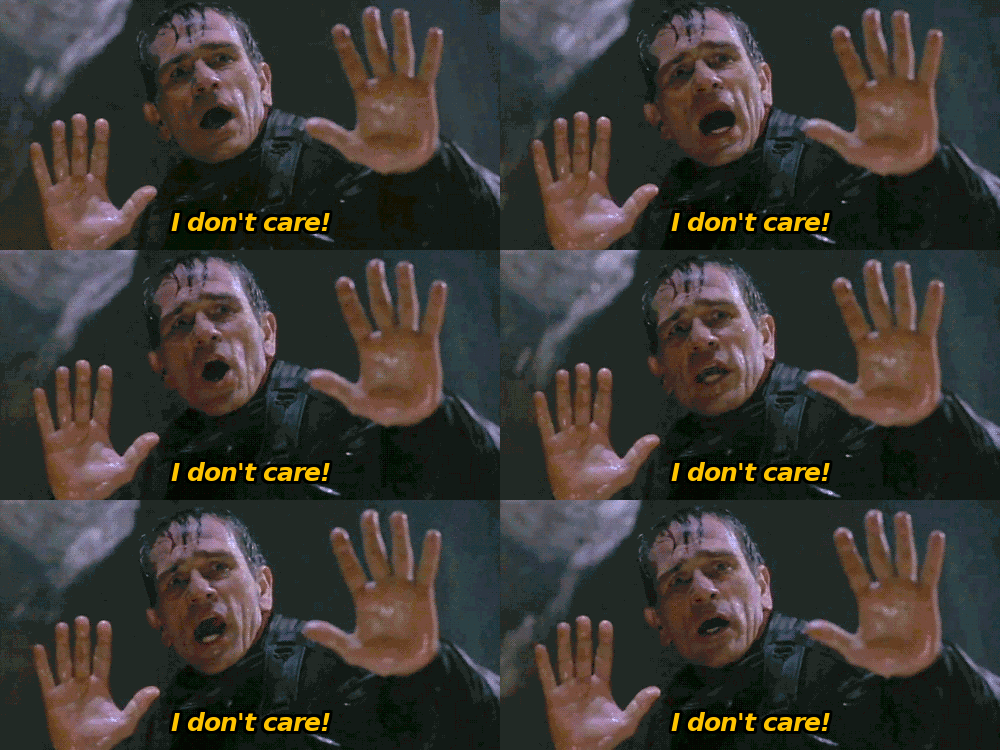
Look, I don’t know Michael Resnick and Barry Malzberg – nor should I have to in order to parse their essays properly. As writers, they above all people oughtta know that when someone’s reading you, you should not expect them to understand intent, but rather what you put on the goddamned page.
And I for one am sick of the idea that one can only interpret a given blog post via the rose-colored filter of knowing someone. As anyone who knows me, I have stuck my foot in my mouth monstrously on more than a few occasions. And when I have misrepresented myself so grievously, it is not the reader’s fault. It is my fault for failing to provide my own context.
Am I happy to have friends who’ll defend me when I fuck up and come off as a misogynist asshole? Absolutely. Am I glad when they do? Yup.
Do I use that personal knowledge as an excuse to come off like a jerk in print?
No, no, no.
I don’t give a crap what Barry and Mike are like in their personal lives. Full truth is that I’ve been on a few panels with Mike Resnick, and he seems like a decent guy. But would Mike Resnick expect me to know who he is in order to make sense of his latest novel on Africa? If he wrote a chapter that, in its entirety, consisted of the words “Whoop whoop, the jungles are floppy,” would his friends rally around him, going, “No, no, Mike’s been to Africa, you see! You gotta know what he means when he says floppy, which you can get by hanging around him at the bar!”
I suspect they’d say “fuck that.” You need to bring your own context with every story, amiright?
Well, that rule applies also to non-fiction.
What Resnick and Malzberg wrote was offensive to me – and worst of all, not particularly useful. If it had been the “Barry and Mike toss around wimmen-in-bikini jokes while explaining how to break into the Chinese translation markets,” well, sure, maybe I mighta had something to offset the 1960s gags. But there wasn’t. And I don’t think it’s “censorship” to make an editorial decision, “Hey, this backslapping column that is routinely offending people while also providing no useful writing knowledge should be cut.”
Look, the SFWA Bulletin should be a place for everybody. You wanna rail about politics? You’re a writer, get a blog. But I think a central place for SFWA’s membership should offend no one – not because I think that debates should not be had, but because I think there are appropriate places for debates. You’re a dick if you start spouting your Ayn Rand bullshit at a kid’s birthday party. You’re choady if you start spouting your pro-Obamacare beliefs in the middle of someone’s date.
There are plenty of on-topic debates for SFWA to have – hell, I’d love to see a raucous throwdown between traditional publishers and self-publishers. But those are all related to the central subject of writing. And I suppose the SFWA bulletin could be bawdy all the time and start prefacing every mention of Harlan Ellison with “Award-winning and breast-grabbing author Harlan Ellison,” or by referring to the military fiction authors in jest as “toothless gun yokels,” but there’s no sense in it.
If we can not offend our paying members in the central meeting place of our organization, then that is a good thing.
We’re all writers, man. This is a hard enough goddamned gig without bringing in worthless crap that divides people. If the bikini-clad woman on the cover gets chucked in the bin? Fuck it, it’s a cover. If that cover was a blank white expanse but the inside had Connie Willis telling me how to research on the Internet, a debate between Seanan McGuire and Jim Butcher on the best way to become a best-selling urban fantasy author, Chuck Wendig explaining how to raise your blog traffic and Mike Resnick explaining how to pitch an anthology, by God I’d be so happy with that fucking magazine I’d hug it in my goddamned sleep.
But no. What we got was bikini covers and two guys taking up six pages to amuse the people who knew them already, and that’s not censorship to take that down, that’s a not particularly useful magazine.
And as for Barry and Mike, well, I don’t assume you’re bad people. You said something a little dumb, doubled down, and are perplexed by this “negative feedback” you’re getting when you don’t come off as charming any more. The problem is that this new generation – and we may be ingrates – does not care. We have no gentle tide of your past charm to surf on. All we have are the words on this page, right now, and what can you do for us, guys?
As always, the writer starts with a blank page, and a blank audience. Stop blaming the page, and the audience, and write better.