

Two Kickstarters For Writers I Like
Kickstarter is one of the best things to come out of the Internet in a while; it’s enabling artists everywhere to crowd-fund projects in a powerful, flexible way. Anything that rewards the die-hard fans with scalable prizes for donating and allows an artist to keep producting new work is a beautiful, beautiful thing.
And there are two writers I like personally who have Kickstarter projects that I think you should take a look at.
The first is Tobias Buckell, who I’ve referenced in this blog previously a few times for his politics, but he also has the Crystal Rain universe – a genuinely diverse set of science fiction adventure novels. I forget who said it, but there was an essay somewhere that discussed that for a lot of sci-fi books, the reader had to wonder about the plague that had killed off all the blacks and Chinese and other non-white races, because none of them seemed to exist in space at all. Tobias’s universe has all sorts of interesting people of differing races.
His Kickstarter is for the fourth book in the series, which is a concern, but I know he’s a smart enough writer to make it accessible to newbies. Check out his Kickstarter here.
Then we have my old Clarion teacher Mary Anne Mohanraj, who writes some rather intense erotic fiction, and what she wants to do is to create an interconnected science fiction series where the world is ending and there’s a lot of fucking. To quote her pitch for Demimonde:
On a planet far, far away, tensions are rising. Men against men, men against aliens — the players in this game are complex, and the average citizen doesn’t really understand what’s going on. They just want to go on with their life: go to work, go home, make love to their wife. Or wives. Or husbands. Or indeterminate gender human and/or alien partners.
She’s only got 23 hours to go, and as with all Kickstarter projects if she doesn’t make her target the project fails, so I’d seriously check it out now if you’d like some nice hot squirmy writing.
New Story! "Run," Bakri Says
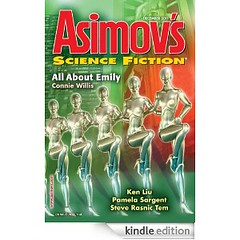 I’ve only written two stories where I finished them and went, “I’m going to sell this.” As a writer, you live for those moments – it must be what Babe Ruth felt like when he pointed to the bleachers and smashed the run.
One of them was “As Below, So Above,” which was picked up by Beneath Ceaseless Skies and was later made into a PodCastle audio production. The other was this story: “‘Run,’ Bakri Says,” perhaps the most powerful story I’ve ever written. It’s certainly the only story to get a “Recommended” from Lois Tilton over at Locus, a notably tough reviewer who’s slammed some of my previous work. (Writing a tale that impressed her was one of my minor goals for this year, so I’m especially proud.)
This story is about a girl and her mad scientist, terrorist, time-travelling brother. It starts like this:
“I just want to know where my brother is,” Irena yells at the guards. The English words are thick and slow on her tongue, like honey. She holds her hands high in the air; the gun she’s tucked into the back of her pants jabs at her spine.
She doesn’t want to kill the soldiers on this iteration; she’s never killed anyone before, and doesn’t want to start. But unless she can get poor, weak Sammi out of that prison in the next fifty/infinity minutes, they’ll start in on him with the rubber hoses and he’ll tell them what he’s done. And though she loves her brother with all her heart, it would be a blessing then if the Americans beat him to death.
The guards are still at the far end of the street, just before the tangle of barbed wire that bars the prison entrance. Irena stands still, lets them approach her, guns out. One is a black man, the skin around his eyes creased with a habitual expression of distrust; a fringe of white hair and an unwavering aim marks him as a career man. The other is a younger man, squinting nervously, his babyfat face the picture of every new American soldier. Above them, a third soldier looks down from his wooden tower, reaching for the radio at his belt.
She hopes she won’t get to know them. This will be easier if all they do is point guns and yell. It’ll be just like Sammi’s stupid videogames.
“My brother,” she repeats, her mouth dry; it hurts to raise her arms after the rough surgery Bakri’s done with an X-acto knife and some fishing line. “His name is Sammi Daraghmeh. You rounded him up last night, with many other men. He is — “
Their gazes catch on the rough iron manacle dangling from her left wrist. She looks up, remembers that Bakri installed a button on the tether so she could rewind, realizes the front of her cornflower-blue abayah is splotched with blood from her oozing stitches.
“Wait.” She backs away. “I’m not — “
The younger soldier yells, “She’s got something!” They open fire. Something tugs at her neck, parting flesh; another crack, and she swallows her own teeth. She tries to talk but her windpipe whistles; her body betrays her, refusing to move as she crumples to the ground, willing herself to keep going. Nothing listens.
This is death, she thinks. This is what it’s like to die.
This story is in the latest issue of Asimov’s, available at many fine bookstores – or, if you have no bookstore available, you can purchase the latest issue for your Kindle for a mere $2.99.
And I feel so strongly about this story that I’ll do something I’ve done for only one other tale – if you buy this because you read the excerpt here and don’t like it, I’ll give you your money back. That’s right; $2.99 in your pocket if you think it stinks. I did that for “A Window, Clear As A Mirror” and had no takers, and I’m pretty sure this won’t disappoint anyone.
Anyway, take a look.
A Couple Of Essays You May Have Missed Over The Weekend
I’m struggling on sleep today, but just a repost for the morning crowd: I wrote a pretty good essay/metaphor over the weekend called “In Which A Window Quietly Opens.” My old professor Nalo Hopkinson shared it on Google+, and since I respect her more than just about anyone in the world, that one felt good.
In other sexual news, I did write a (rather long) essay about my first public BDSM experience over the weekend at FetLife entitled “I Beat A Girl, And I Liked It, or: The TealDeer Experience Of A First-Timer.” I also made a rather significant error during my playtime, and wrote about it in a separate essay called “The Firecupping Error” – an error that outlines a phenomenon so global that I’m probably going to backport a clean version of it to my blog at some point as soon as I can find another example of theory vs. practice.
Incidentally, the error’s why I blog about this stuff on Fet – when I made an error, I was quietly corrected by a bunch of experienced kink-folk who calmly pointed it out and explained why it was wrong. That’s a very different dynamic.
Describing Ferrett
If you had to sum me up, a pretty good way of doing it would be, “He’s kind. Not particularly nice. But kind.”
First Night At The Dungeon
You can tell that my FetLife essays are extremely personal, because my marketing sucks. Normally, Mondays are the big day for new posts, certainly weekdays – traffic’s dead on weekends. And you especially don’t post an essay at 2:00 in the afternoon when no one’s reading, because the hits will be tragically low.
But I did promise to mention it here whenever I wrote an entry on Fet about my personal journey into alternative sexualities, and this one’s a fairly major one: an entry about my first public beating of a girl at the local BDSM club. Which either sounds way kinkier than it actually was, or I’m just getting really too fucking jaded.
Anyway, the essay is called I Beat A Girl, And I Liked It, or: The TealDeer Experience Of A First-Timer. You know where to find it.
In Which A Window Quietly Opens
In an argument over our heating bills, my wife inadvertently introduced me to a metaphor.
Which is to say that it was 74 degrees in the house at our most recent Rock Band party, and I wanted to turn on the AC. Gini said this was bad for the AC, and berated me for my electricity-happy ways, and asked, “Why don’t we simply open the windows?”
So we did. Both kitchen windows and the dining room window, flung open. The party went well. I forgot about our conversation entirely, perhaps due to the influence of four bottles of Yuengling.
Over the next two days, though, these weird noises intruded into my life, making the living room kind of creepy. The trees made frighteningly loud noises, with leaves shushing and branches rattling. There were sudden movements outside from animals. Occasionally fragments of half-heard conversation would drift through the door.
I didn’t realize the windows were open, so it was almost like the house was haunted. I didn’t like it. Things were too busy, and I kept getting up to see what was wrong.
It wasn’t that these noises never existed – they did – but because I had the windows closed, I didn’t have to interact with the outside world. When those windows were opened, suddenly all sorts of things I’d never noticed before were brushing up against my consciousness, and things felt wrong. Scary. Quietly out of place.
I think that’s not a bad metaphor for privilege.
Privilege has mutated into a term that’s used to silence and suppress more often than I’d like, but at its heart the idea is one that every human being in Western Civilization should keep in mind: you most likely have certain advantages that don’t even register as advantages for you because of your status/race/sex/sexuality. (The classic is male privilege, which has a nice list compiled here, along with a link to several other privilege lists of mixed quality.) The the way society quietly shunts those problems away from you are just transparent, like the air around you, not even seen as an advantage but just the way things are.
Then someone opens a window.
Once you’ve really started examining privilege, you start to hear all sorts of other noises seeping in. It’s not as comfortable. But it’s not as though those voices outside never existed; you just had a window shut so you didn’t have to hear them. Now you do, and you have to deal with them.
It’s not a bad thing. As long as you’re aware of the source of the noises, they’re not scary. The world has not suddenly become a worse place. You have simply become more aware of what’s going on, and now you get to deal with it a little more honestly.
And be a little more grateful for your house, and perhaps a little more willing to consider what it’s like for the people outside.