

Shaving With A Straight Razor For A Month: A Report
If you take out the eight weeks of post-heart attack recuperation, I have been shaving with a straight razor for a solid month now. And I must say, the biggest appeal of it all is how toyetic the process is.
“Toyetic” is a made-up word that explained Star Wars’ appeal; it made lots of cool toys. Whereas while, say, Independence Day is a fine movie on its own merits, there’s only one alien and it’s kind of ugly. (Seriously, who wants to play with the Jeff Goldblum doll?) And shaving with a straight razor appeals to men because it is not only stupidly dangerous and useless, but it is marvelously toyetic.
As witness! Before, my entire shaving kit consisted of this pathetic set in a shower:
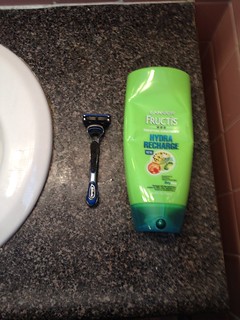
Now, it consists of this fine, intimidating regiment:

And all of those items, my friends, are the topic of stupid debates, which men naturally love. What brand of shaving cream should you use… or should you use shaving oil? Is that badger hair brush really top-of-the-line? How many times should you apply the hot towel to your face during a shave? What grip should you use? All of these allow a man to have firm opinions about something that matters really not at all, which is of course a fine thing to have.
The thing is, I find myself shaving for pleasure, which is odd. Yesterday, I completed work and went into the bathroom to treat myself – yes, to treat myself! – to a nice long shave. I call it my “blood meditation,” because you cannot shave quickly with a straight razor, and you’d be foolish to try. No, no matter how hectic your life, you must slow down to match the pace of the shave – holding the hot towel to your face, lathering up in the cup, smooshing the lather into your face.
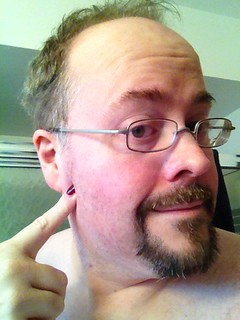 And, of course, the shave. The shave teaches you to pay attention to your face with strange detail. Before, if you’d asked me about my face, I’d have told you it was, well, a face. But now I see it in angles; there’s my sadly soft cheeks, which tend to mush under the blade, and the treacherous hollows under my jawline, and the underside of my neck. I pay attention to the directions my facial hair grows, for I must shave against the grain for the closest cut – and that, my friends, changes from inch to inch. I now occasionally just touch my face gently, with the tips of my fingers, trying to recall which way my beard grows.
So much of the shave is in that approach. Which way do I cut? I keep changing my approach, looking for the perfect set of swathes that lead me to a face with no stubble whatsoever. I haven’t found it; I think I’ve mastered it, then as I apply the post-shave witch hazel I find another thatch of cut, but not perfectly cut, hair. And there is pleasure in seeking that perfection.
Do I cut myself? Yes, of course. And almost always in the same place. For as I try to cut against the grain (which is to say, towards my ear) along my right cheek, I always find this awkward moment where I can’t cut all the way smoothly with my right hand. It’s my elbow, my damnable elbow. So I slow down, and slowing down lets the razor bite, and as such I not only have this same cut but you can actually see where the stubble is thicker after it. I have to find a better approach, even as I am terrified to switch to try to use my trembling left hand, as others have suggested.
As for the name of my razor? Well, many suggested – ha ha! – Sweeney, even though I said I do not want to cuddle up with a bloodthirsty razor. No, I want a comforting razor, a razor that is redolent of 1950s barber shops and men in nice fedoras getting a fine shave before they head off to the office. As such, several people wisely suggested “Floyd,” as in Mayberry’s own Floyd the Barber, and I think that is a most, most excellent name for a razor. Floyd never wanted to cut anyone; he just wanted to even out your sideburns.
How My Mind Works: The World's Perfect Couple?
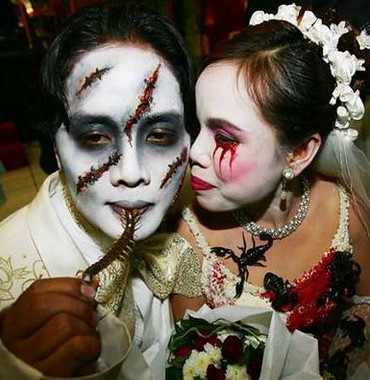 Okay, while doing research I really had no right to be doing, I discovered the fact that in 2006, a woman called the Scorpion Queen held the record for holding a live scorpion in her mouth. Two minutes, three seconds, seven inches of venomous scorpion between the teeth.
That’s not the cool bit. Who placed the scorpion in her mouth?
Her lover, the Centipede King.
Now, these guys are serious. The Scorpion Queen – or so it was reported – lived in a house with 5,000 scorpions for 32 days. Her husband lived in a cage with a thousand centipedes for a month. (Though this gives me the delightful image of the Scorpion Queen, sitting in her writhing chitinous house, with her husband popping by from time to time, stepping carefully amidst the sea of stingers to bring in the tea.)
And, in 2006, they wed.
But then I wondered: are they still together? What kind of marital disharmonies would they face? I mean, clearly they spend a lot of time apart, what with their living boxed up with bugs all the time. One hopes they can manage to get past the inevitable conflicts that arise when one starts comparing the merits of centipedes to scorpions, and make it up with insect-filled kisses.
Alas. The Internet fails us here, as I can find no update on the Scorpion Queen and her fine, verminous husband. They have dropped off the ‘net, having gone dark – a thing that seems supremely appropriate, yet is maddening in its absence.
I need to know how they are today. Have they managed to grow their love like the larvae in their walls? Are they still magnificently into multi-legged creatures? Has the Centipede King become some sort of hipster, having declared centipedes to be so 2006 and moved on to stinkbeetles? Or are they cuddling among the bugs, wreathed in many-legged bliss?
Please, please tell me they have not divorced. I could not bear the news.
For if the Scorpion Queen and the Centipede King cannot make it work, what hope is there for the rest of us?
I Was Never That Weak. I Couldn't Have Been.
Week Nine into recovery from the heart surgery, and I’m edging normal. My sleep habits are still all over the place, and my energy levels are inconsistent, but at this point there isn’t really anything I can’t do, just things that are painful to do. (Like sneezing. Oh my God, sneezing.)
And now that I’m mostly back, my brain is trying to rewrite history.
Take getting out of bed, for example. I can get up in a matter of seconds, with only a twinge of pain. And every time I do, I think, Oh, this is easy. The only reason it was so hard before is because I was scared.
Or when I power-walk three miles in forty-five minutes and get off the treadmill, sweating, only to think: You could have done that before. You were just reluctant to go full-out.
And I was reluctant to go full-out, my friends, but that’s because my chest was still freshly broken and my lungs could only suck in half the air they could today. Yet I do not want to face that terror. I do not want to ever know that I was that weak. So I keep retconning history, making it so that the reason I didn’t get out of bed and tapdance is just that I was too timid to really take this new body out for a spin.
It’s ridiculous. But I think that instinct to rearrange life is at the heart of a lot of bad politics, the kind of instinct that goes, “Shit, life is scary and uncertain, and even if you work smart and hard there’s still a chance that you could fail. So… let’s rearrange life to be more predictable! Let’s make it so that every person who has a lot of money got there because of their tremendous smarts and aptitude, and all the poor people are there because they are lazy! That’s a much nicer rule, and it ensures that the money I have is because of all my effort.”
You see that a lot, that re-attributing things to willpower and gumption because, shit, the idea that you could lose for reasons that had nothing to do with you are terrifying. Just like the way I look at myself two months ago, laid low by genetic factors I had zero control over, saved by medicine I barely understand, under the complete control of my nurses and doctors and the medicines pumped into my veins.
No. Better to think that I was just reluctant back then. I could have been my old self at any time. That’s much more comforting, and it means if I’m ever there again all I have to do is kick my heels.
Will Somebody Think Of The Children?
Divorce is a bitter, bitter thing for a child to face. It leaves scars that never heal, churning up big ugly terrors of abandonment and instability. And God forbid you handle it wrong and turn the kids into the rope of your tug o’war game with your ex-spouse, constantly demanding they take sides in a war they never asked to be in. That separation and consequent reordering of their life can fuck them up in profound ways.
If you love your children, divorce is a damned hard road to put them on… So a lot of people endure borderline abusive relationships for the sake of the kids, sticking around so they never have to go through that anguish.
But stasis also takes its own toll. Because every day you stay with your spouse, you’re teaching your children what love looks like. They’re taking their cues as to all their future romantic relationships from you, because this is most likely the only intimate pair-bond they’ll get to see in such detail.
No matter how dysfunctional the household, if you grow up with it, you think it’s normal for a time. And why not? At seven, it’s not like you’ve experienced anything else.
So if you’re pondering divorce, yes, consider the strain on the kids once those separation papers go through. But also consider all the compromises you’re making to keep this creaking marriage together, all the angry fights you’re subjecting them to (because even through a muffled door, kids pick up on that shit like antennae), all the ways in which you’re both showing disrespect for each other…. And then think, “Do I want them to think this is the way they should treat someone they love?”
Because a bad parental relationship is like chemicals in the groundwater. It’s not as explosive as the divorce, but in some ways it’s more long-lasting, so subtle they might not ever realize that they’re being inevitably drawn to unhappy relationships like good ol’ Mom and Dad because, well, they keep making decisions to hide their emotions and fight unfairly in ways that drive all the positive partners away. That the template you handed them is broken, and you never really bothered to explain that to them.
Thing is, parenting is all about uncertainties. You can teach your kids the worst lessons in the world, and some of them will still thrive and find a way to surpass every bad instinct you ground into them. Or you can teach your kids the best lessons, and still have them miserable and broke and upset. So it’s hard to give any firm parenting advice, because like much of life, it’s a game of odds where sometimes, no matter how well you’ve played out that hand of Blackjack, the dealer flops into a 21 and it’s over.
Yet that doesn’t mean playing the odds is dumb.
I think if you’ve taken on the responsibility of kids, then you owe it to them to try to make the marriage work, and give it every shot in counseling, mediation, whatever you can do to try to restart the love you guys once had. But if you can’t, and you’re still miserable, then I’d think mighty hard about whether the lessons you’re teaching them are the lessons you want them to learn. Because there’s a good danger that, in fact, they’ll learn it far better than you’d like.
What People Don't Like Are Poorly-Done Versions Of Tropes or: In Defense of Mary Sues
Someone on my Twitter feed posted this in-depth analysis, revealing the shocking fact that Patrick Rothfuss’s bestselling series The Kingkiller Chronicles features – *gasp!* – a Mary Sue in its lead role. And if you’ve ever been enspelled by Kvothe’s endless ramblings, you’ll find this list to be both simultaneously accurate and not at all useful.
Because of course Kvothe is supremely talented at everything, handsome, spat upon by jealous superiors and beloved by his underlings, the dream-lover of literally Gods. And reduced to a cold analysis, yes, the book must be as terrible as the thousands of other unreadable Mary-Sue-laced fanfics.
Except. Except.
For every one of of Kvothe’s obvious failures in character design, Patrick Rothfuss also manages to infuse him with a sympathetic humanity that thousands of people have responded to. Unlike most Mary Sues, the Kingkiller Chronicles have a feeling of constant tension – yes, Kvothe is supremely talented, but he’s also prone to hubristic flights of ego, and often self-sabotages. There’s a sense that yes, he could fail, even though in practice he never does.
In the hands of a lesser author, yes, Kvothe would be a Mary Sue and the book would be tripe. But thanks to Rothfuss’s skill, Kvothe is a Mary Sue and the book still has narrative interest. And that in turn leverages a potent fantasy that people want to live – while people hate an unbelievable Mary Sue, they fucking adore a competently done one, because when they step into Kvothe’s perfectly-polished boots they become the baddest, sexiest motherfucker alive.
Now, clearly, that interest doesn’t work for everyone… For example, Boye, the person who wrote the essay. Boye practically sneers at the idea of popularity, “Look! The Kingkiller Chronicles is like Left Behind, a patently terrible other book, so it too is terrible!” And forgetting that millions of people have not only read, but clasped those books to their chest and said, “I want more of this” – a talent that few can accomplish. As much as we spit on our Mary Sues in theory, too many popular books have Mary Sue-perfect protagonists to write off as “TERRIBUL TECHNIQUE.”
The problem I have with this essay is that while it’s a perfectly-true analysis, ultimately its argument boils down to, “If Kvothe is a Mary Sue, then the book is bad!” And the entire essay seems like one huge ground axe, spitting sparks and going, “Yeah! Look! This bestselling, beloved book I disliked is totally not following the rules! And therefore it’s objectively awful!”
The problem is, books don’t work like that. Ask any number of successful Madison Avenue retirees who decided they knew the formula to writing a bestselling tome, and failed miserable. It’s a comforting thought, thinking that writing a good book is as simple as a programming task – all you have to do is ask, DOES BOOK CONTAIN X, Y, OR Z? THEN BOOK == BAD.
The reaction here feels like terror. Like “Oh my God, if tripe like this can be popular, what does this say about my fiction? I’d better start finding some rules to follow!” (Though to be fair, I don’t know that Boye is a writer.)
But fiction, ever mysterious, simply doesn’t work like that. And maybe you think that “bestselling” doesn’t equal “good” – which, no, it certainly doesn’t. But it’s also not true that “bestselling” equals “awful.” For all of the flaws James Patterson books have, there is something buried in that lifeless prose and wooden characters that has appealed to people, getting them to come back like crack-addicted monkeys. And I think that rather than sneering that accomplishment off as, “Well, that’s just books for the masses,” we’re better served as writers by asking the more terrifying question of, “So if it’s bad on every level we deem quality, what’s actually working?”
If, as scientists, we found an engine that broke every rule we knew about physics and still produced electricity, we’d start asking, “Whoah! Clearly, something we know is wrong!” But as writers, we go, “Well, that’s really crappy electricity, and only the poorer homes run it,” and walk away feeling the problem is solved.
Because the central truth is, Mary Sues are not bad. Poorly-executed Mary Sues are bad. And I think that rather than spending your time devising a long checklist proving the Mary Sue nature of Kvothe is not nearly as valuable as, say, breaking down why Kvothe’s Mary Sue nature actually works where others have failed, and trying to learn a lesson that will improve your writing.
Because writing is about learning where the rules are, and how to break them. The more interesting the broken rule, the more interesting the lesson to be learned. And yeah, while on many levels Kvothe fails miserably, I’d rather know what the hell Rothfuss did to make such a terrible, unworkable, self-centered Mary Sue of a character and still make us want to follow him around.
The Door-To-Door Republican Problem
There’s been a big change in Ohio politics today: Senator Rob Portman has come out in support of gay marriage, stating that his views began changing when he found his son was gay. Which is good from the more global perspective of “Life may get a little easier for gays in Ohio,” and status quo for the traditional Republican problem.
Because as nice as it is that we now have a new gay marriage champion, one wonders who else we have to truck to Mr. Portman’s door to get him to change his views. He’s in favor of repealing Obamacare – must his son come down with a terrible disease before he finally considers that lack of health care may be a trouble for some? Should his son have to work two jobs at McDonald’s for several years, struggling from paycheck to unexpected cost to paycheck, before he finally supports raising the minimum wage?
When can we turn his son black? Or Hispanic?
Now, it’s not like Rob Portman didn’t know that his anti-gay marriage stance hurt people. He’s a Senator. Gays must have talked to him, petitioned him, told him all the standard stories of not being able to be with their loved ones on their death beds, being excluded from insurance, being legally bereft at the most stressful of times. He knew. But it gives us one of two unflattering opinions: he either knew, and didn’t care until these policies might have affected his boy’s happiness… or worse, he heard but didn’t really listen, writing off these tales as attempts to manipulate him into taking an unpopular political stance.
That’s the problem with the Republican party: these policies are all fine and well, until it applies to them. It’s like they’re sociopaths, unable to have any empathy for anyone outside their tribe until someone close to them gets hurt. And then, hey, maybe we should reconsider.
And because Senators are by definition wealthy – you can’t compete in a race without raising millions of dollars, so even if you’re not personally rich you’re sure not starving – you’ll never see a Republican say, “Well, I’ve seen my daughter go homeless, and so I’ve really come around on helping the poor.” Won’t happen.
Republicans may get angry at this portrayal, stating that Democrats do the same thing. And we all do, to some extent; it’s a human failing. And hey,I’m sure many Republicans do care about the poor in some abstract way, thinking a more Darwinian process is what we need to lift all boats. It’s a poor approach, in my opinion, and often shot through with a preening, “Hey, I work for my money, and all those people are lazy bums,” but it may well contain some errant shreds of compassion for people who work just as hard and haven’t had your luck. So there’s a pass on that.
But Republicans have been so magnificently cold-hearted in their anti-gay policies, so staunch in their anti-immigration issues, so willing to work to make voting harder for blacks, that one wonders at their ability to consider a question that, at our core, is really what makes us human: “What’s it like for that other guy, anyway?” And if you can’t possibly get it until you have to experience – and, given the way some worse conservatives ignore their gay kids, perhaps not even then – then you’re missing a vital part of what it means to be a functional person.
Until then, Rob Portman gets a functional thank you. Because he’s not helping the gays out of any particularly moral crusade. He’s selfishly doing it so life will be better for his son. Which is good as far as it goes, but it puts me in the uncomfortable position of wishing trauma and poverty upon his family so that his eyes might be opened some more to the realities he’s trying to inflict upon others.