

On Common Core Math
My Facebook page has been alight with anger over the concept of “Common Core” math – the new way we’re teaching math to young children. They’ve posted pictures of Common Core examples, decrying their complexity, the stupidness of needing a new method when the old methods we had worked just fine, and how dare teaches do this stupid thing.
One of the most common ones I’ve seen going around is this:
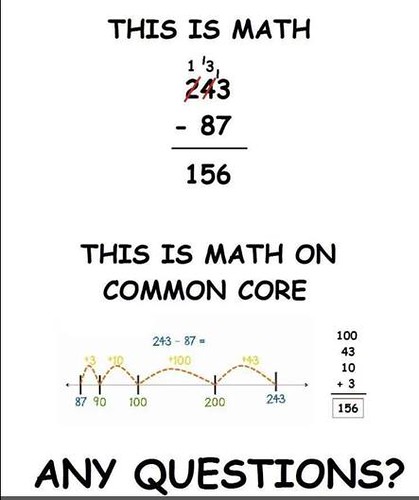
Yeah. My question is, do you realize how fucking hard the concept of “borrowing” is to someone who’s unfamiliar with math?
What I’m seeing here is a twofold storm of ignorance and fear:
1) Explaining things to newbies is entirely different from explaining things to experienced people.
Look, I sell Magic: the Gathering cards for a living – a complicated card game with a ton of rules. And time after time, I’ve seen experienced players try to teach newbies how to play the game…
…and they often confuse the newbies so much that they alienate them.
The problem is, the experienced players have been slinging cards for so long that they’ve forgotten how hard this game was in the first place. So when they teach, they tend to concentrate on the things that players who are bad at the game need to know – which is an entirely different thing than what players who are totally unfamiliar with the game need to know.
So they rush past the core concepts of the game – the base mechanics that they’ve internalized so thoroughly that they don’t even think about them any more – to focus on things that make no sense if you don’t get those fundamentals. I’ve heard them casually saying things like, “Okay, you gotta remember to play instants at the last minute, and leave your mana untapped until you need it” to baffled people who barely understand which card is which.
It’s a testament to how much fun Magic is that thousands of people still play it, despite these substandard introductions. But Wizards of the Coast, being a smart company, recognizes that the #1 barrier to entry for Magic is overcomplexity, and so periodically creates products that are newbie-friendly. And those novice-aimed products are often scorned by the “experienced” Magic community as being too simple, too stupid, too strategy-free.
“I learned it the old way!” they cry. “And I still understood!” Forgetting entirely that a) it took them a lot more effort to ingest that knowledge than they remember now that it’s reflexive, and b) a lot of people didn’t learn it, and walked away, and if the goal is to get as many people playing Magic as possible then maybe ignoring the failures isn’t your best idea.
Likewise, this Common Core example isn’t a fair example. Yes, there are fewer steps in the upper diagram – but conceptually, sorting each number into neat rows stacked on top of each other, and knowing that you can borrow a number, and understanding that the borrows cascade, and remembering the edge cases, are actually pretty hard to get for many kids. I know I struggled with it. There’s a ton of buried complexity in this, and I’m pretty sure if you showed this same thing to two people unfamiliar with large subtraction problems, the more visual example below might work better.
Plus, the Common Core example below is a better way of conceptually explaining things. Yes, kids can learn the rote method of “stack and subtract,” but that doesn’t actually teach them to internalize how math works. When I’m looking to figure out what the difference is between a dollar and 97 cents, I don’t mentally place a 100 on top of a 97 and go through it column-by-column – I count forwards from the lesser number until I hit 100.
It could be argued that in fact, the old beloved style actually presents a barrier to conceptualizing math, sort of like teaching kids that the letters S-I-N-K mean “sink.” It’d work. It’d get them to recognize what a phone is. But without presenting all the complicated phonetics behind it, getting them to spell out each letter, they’d probably not really understand the concept of words – they’d understand that a few grouped letters mean a handful of things, but not be able to extrapolate that to dope out new and unfamiliar words.
And even aside from that, from what I am told the Common Core doesn’t replace the old method, it supplements it. Here is where I venture into the unfamiliar waters of “people said,” but from what I’m led to believe the old method is still taught in class – it’s now just one arrow in a quiver full of approaches to help gets learn to add big numbers. If someone happens to find the columnar method more intuitive, they can use that in their heads. It’s whatever sticks.
Which brings me to point #2:
2) Parents are fucking terrified of looking stupid in front of their children, and hate to actually do homework. Again, here I venture into theory, but I think much of the backlash against Common Core stems from the fact that a lot of parents get off on being the all-knowing wise folk, and looking dumb in front of their kids robs them of a special power. Having to sit down with their kid and go “I don’t know how to do this” makes them feel like the schools are somehow showing them up.
And then they find themselves back in grade school, forced to understand a new concept. They’re not just helping their kid with homework; they’re back in grade school doing homework, and grah I learned what I need to I shouldn’t have to work to internalize some new approach what I knew worked fine. And rather than acknowledging that discomfort of this is something I don’t know, they instead freak the fuck out about how ridiculously hard this all is and it’s difficult and won’t someone think of the children?
But those someones are thinking of the children. If it’s hard for you, remember back to those early days when everything was hard for you. Regardless of whether you use the upper old version or the bottom new version, your kid is going to struggle to import these new ideas into their head – and bitching about the approach because you don’t get it seems small, anti-education, and churlish.
And hey, maybe your kid is finding Common Core too complex. Maybe that’s because for her, the upper example is more intuitive. But I wonder how much of that struggle stems from the fact that Mommy and Daddy are expressing obvious frustration with it, bitching I don’t know why they do this, and sending the signal to your kid that this is actually a dumb way to approach it. They pick up on things like that, kids.
So my take? Is that yeah, it’s more work for you, but as a parent, your job isn’t to make your life easy. It’s to do what’s best for your kids. And if that means you have to go back to grade school again and start over, well, go back and sit down next to your kid in class and learn along with them.
Teach them that everyone feels dumb from time to time. That even Mommy and Daddy never stop learning new things, and that new things are exciting. Because honestly, that’s a way better lesson they’ll learn than anything they can get in school anyway.
EDIT: I’ve had a lot of people saying, “I don’t like it when my kid switches schools and has to learn Common Core under the assumption that he’s been taught it all his life,” or “I don’t like Common Core because my kid can already subtract the old way and they’re punishing her for not knowing this new method,” or even “I don’t like it because the schools don’t give me any warning or context and now I have to train my kid with no help.”
In that case, you are not actually complaining about Common Core. You are complaining about an inflexible educational system that is utilizing Common Core improperly. Note how your complaint is not actually that Common Core is too hard, recognize that this essay is chastising those who criticize Common Core because it is too hard, then take your valid concerns about a one-size-fits all educational approach and move on. This was not meant for you.
You Don't Have To Feel Good To Do Good
I have never had a runner’s high. My body fucking hates exercise. My body wants its ass in this chair, guzzling chocolate milk.
For years, people told me, “Oh, when you find the right exercise, you’ll feel wonderful when you do it! Angels will sing and you’ll crave this workout!” And I tried everything, from running to Dance Dance Revolution to karate to swimming, and as it turned out what I really hate about exercise is “being out of breath” and “this burning feeling in my muscles.”
So I was a couch potato for many years.
What I eventually figured out, much to my glory, was that “enjoyment” was not a necessary component of working out. I could work out, and hate every moment of the day’s run, and do it because it was what needed to be done.
And in fact that was the key to unlocking much of the rest of my life’s potential. Did I need to feel good about sitting down to write that day? No. I just needed to plant my fingers on that keyboard and write. Did I need to be borne aloft to my job by wings of angels, carried by rapturous astonishment? Nope.
I needed to fucking work.
And the work has benefits that do make my life better. When I exercise regularly, I’m in better shape and can do more things and feel prouder of my body. When I write regularly, I become a better writer. (Seriously. My latest story in Apex Magazine is pretty bad-ass, I think.) When I work hard, I can afford to go out to see Captain America 2 and not worry about all of these home repair bills crushing my face.
Those steps make the rest of my life so much better that I don’t necessarily need to enjoy those tasks in and of themselves – I just need to buckle down and git-R-done, because if I don’t do those tasks then everything else in my life gets subtly worse.
Now, that’s not to say I set out to hate them. If I had a job I despised, I’d try to find another job. If swimming makes me miserable, I should find a less-objectionable form of exercise. And some days I have to realize that my lack of enthusiasm for a writing project indicates that it’s a flawed story, and I need to walk it back and fix it.
But if I waited to feel good about these necessary tasks, I’d write fiction once a week, go to my job once a month, and exercise when a bear chased me. And I’d be unpublished, broke, and miserable.
Which is why I don’t believe that “feeling good” is a valid foundation for necessary tasks. It’s something you should strive for, to be sure, but if you’re going to wait for a job that’s all cookies and candy, you’re going to be unemployed forever.
And likewise, with the concept of polyamorous compersion, I don’t think that I have to feel entirely wonderful about my wife dating someone in order to go, “Okay, that should happen.” Instead, I go, “Well, I like the New Relationship Energy high of dating new people, and I think it’s only fair my wife should have that.” So I endure some necessary discomfort at times, to make us both stronger.
As a result, my wife is happier, which in turn helps to make me happier, and we have a far better relationship than we would if I selfishly said, “You can only date people if it makes me thrilled.”
That doesn’t mean that I’m sitting at home, biting tinfoil, whenever she goes away for a weekend with her boyfriend. It means, like exercise, I endure some transient discomforts to make my life a better place.
And, like exercise, there are some people who fucking get off whenever they work out, their bodies flooded with endorphins, their minds filled with rapture. I envy those people, just like I envy the people who always love writing, who always love their jobs, who always love it when their partner’s happy.
But those people are lucky enough to be naturally drawn to those healthy things anyway, and so I don’t think it’s a particularly wise move to structure most advice around their needs. I mean, on one level, “Eat what feels good to you!” is totally healthy if what feels good to you is broccoli and tofu, and it’s a straight path to cardiac rehab if what feels good to you is chocolate milkshakes.
So for me? I tell people that poly’s often an effort to get right, but it’s totally worth it. That’s not true for many, who have no jealousy. But those folks don’t need my help.
I’m talkin’ to the folks who need to get out there and just work it.
Read My Story "The Cultist's Son" At Apex Magazine!
Cultists want to summon Gods to destroy the world. They also have children. And those children, if they survive, are severely damaged.
My Lovecraftian tale “The Cultist’s Son” is now live at Apex Magazine, one of my favorite fiction places. The usual excerpt follows:
“I used to think the sky would peel open,” the girl with the green hair confesses, curling black-nailed fingers around a can of Pabst. “I always had bloody knees, because I never looked down when I walked — I’d clasp my eyes to the sky, bracing myself for the sight of a gigantic hand pulling aside the clouds. If I saw Him coming, maybe I could pray hard enough in time for God to forgive me. Otherwise… Mom told me I’d burn like the whore I was. In sixth grade.”
Her smile is shy, a crooked little secret that Derleth likes. He finds his own head bobbing in agreement, his body resonating to the tune of her broken childhood.
The girl’s smile melts into a relieved grin; she’s discovered a fellow member of a secret society in a cold and hostile land. She grasps his hand.
“You know, don’t you?” she whispers. He can barely hear her over the death metal band onstage, pounding out a Cannibal Corpse cover tune. “You know what it’s like to live in fear of the world ending?”
Derleth closes his eyes. He can see the clouds parting across the mesa, black lightning slithering to the ground. Except it’s not lightning — it’s tentacles tumbling from the sky, suckered and glistening and rooted to something big enough to have engulfed the Earth. They flop down from cumulus clouds, slapping against the ground hard enough to cause tremors. The rusting tin shed caves in, collapsing upon his six brothers before the corrugated walls are scooped away by a questing tendril. A hundred other boneless limbs descend hungrily upon his squalling brothers. They haul them, wailing, up into the sky, up with a billion other innocents plucked from collapsing skyscrapers, mud huts, once-sleepy suburbs. Clouds, now tinged with crushed red.
All the while, Mother dances in crazed triumph, naked, breasts flopping. Spattered in blood, she gargles the syllables that beckoned the Goddess here…
Derleth shakes off the — dream? Idea? It’s hard to say. The girl with the green hair chews her pierced lip. She’s so afraid he’ll laugh at her, so relieved she thinks she’s found someone who shares her terror of the Rapture, that already she’s confusing intensity for love.
Derleth thinks of himself as an empty cabinet. He knows if he remains quietly agreeable, people will stack up his insides with their own needs and desires, imbuing him with all sorts of cheerful motivations. And since he does not trust his own voice — Mother’s doing — he finds that preferable to telling people who he is. Was.
Except now, he’s found someone who knows a part of him.
“You were raised by fundamentalists, too,” she begs, trying to make a light game of it. “Weren’t you?”
He turns away from her to dive into the mosh pit, terrified of the unknowable, always terrified of the unknowable.
In addition, if you’re just dying to have more of Ferrett on your platter, they’ve got a rather meaty interview with me, discussing my writing habits, my struggles with depression, and what I learned at Clarion. So go check it out.
(And as always, if you liked The Cultist’s Son, share it, retweet it, do whatever the heck ya gotta to get the word out. Short fiction never gets enough play, so every recommendation helps; it’s why I’ve started to do short fiction reviews.)
Why "Compersion" Should Not Be The Base Value Of Polyamory
“Compersion” is, basically, “I’m happy whenever my lover is happy.” If your partner’s out humping waterbuffalo, as long as he’s thrilled, so are you. It’s a nice state to be in, if you can manage it.
The problem is that people who experience this “compersion” hootenanny often use it as a sledgehammer to bash people who aren’t made entirely of cotton-candy good feelings. “If you don’t experience mirrored rapture at everything your lover does,” they cry, “Then you’re not really poly, are you? Because poly is about compersion!”
No. Polyamory is about trust.
You don’t always feel good about trust.
Look, when my daughter drove my car for the first time, I wasn’t thinking, “What glorious heavenly beauty that she’s finally gotten her driver’s license! I’m so thrilled for her new life!” No, I thought, Did she put her seatbelt on? That’s $13,000 of car I can’t afford to replace, I hope she doesn’t crash it. Oh God, the kid’s driving a three-ton hunk of metal at deadly speeds, please don’t let her kill anyone. Or herself.
Now, that flurry of prayers didn’t mean I didn’t want my daughter to ever drive. Far from it. She needed to learn how to drive. This experience was going to make her stronger, more independent, someone fully engaged with the world. I fully supported it, I encouraged it, and in fact I’d paid cash and time to ensure this moment happened….
…but I didn’t feel good about it. Well, a little. Enough to do it. But not an unalloyed good, the kind of warm ducky fuzzies one should feel according to the compersionists.
I look at compersion as a nice-to-have, a goal you should strive towards if you can do it. But “compersion” is often used as a club to smack people down for having feelings, and too many people have feelings of jealousy or fear or concern or even outrage to just dismiss them wholesale.
If all you ever feel when your lover’s off smooching someone else is happiness? That’s awesome! I envy you! I, however, often feel happiness mixed with fear that I’ll be replaced, and jealousy that New Guy can do things for her that I can’t (or else why would she be dating a carbon copy of me?), and it’s difficult enough to get past those feelings without the extra layer of “Oh, I must be bad at this if I have doubts.”
And sometimes those fears signal actual problems. I’ve had cases when a lover spending all her time with New Guy meant, in fact, that she was losing interest in me. And while in theory, I should be equitable enough to go, “Well, I’m happy whenever she’s happy,” in practice part of my happiness is tragically based on continuing to get to spend time with her.
Sometimes those fears let me see problems in time to fix them.
I trust my partners. And I try to keep my silly fears to a minimum. Just like I explained to my daughter that driving a car was a great responsibility, and could kill her and others… but when she pulled out of the driveway I plastered a smile on, because this was what she actually needed, and I trusted her enough that this would work out all right.
As it turned out, it did. The fact that I didn’t let my fears shackle her was a noble thing. Arguably more noble, in fact, because I had to fight past some concerns to place her needs above my qualms.
Eventually, I got happy when she drove. And she hasn’t wrecked the car yet, God willing.
Flashlight Redux: Checkmate
Battling cancer feels like making a series of moves and countermoves, and every move puts you in check. Because there is a point at which the doctors will abandon treatment, and call for hospice.
Hospice is checkmate. Hospice is, “There’s nothing we can do for you, so let’s just make you comfortable.”
Hospice is game over.
And as you get pushed closer to the edge, seeing worsening signs, every triumph has that desperate ring of “checkmate” lurking in it. Your whole sense of “positive events” warps. You find yourself hoping for outcomes that would seemed horrible months ago. Well, she has a new tumor in her brain, but no tumors in her spine! Maybe she’ll get to have that life-threatening brain surgery that could destroy portions of her cognitive function!
And eventually, even the awful outcomes get taken from you, to leave you with the inevitable.
Yesterday was checkmate.
Maybe Rebecca can get some treatments, but the treatments will most likely gift her a few weeks. At this point, we’re fighting for her to see another summer.
If you’re concerned about Rebecca, and you’re local, the Meyers need people to do their laundry and other minor tasks so they can focus on their children. Email Gini for details.
If you’re concerned about Rebecca and you’re distant, and you have some spare cash, donate to CureSearch for Children. One beautiful thing about humans is we try to wrest good things from the most awful outcomes – and while we may not be able to save Rebecca, we can do our damndest to ensure that future children have better treatments for this sort of thing.
And if you cannot donate, send good wishes, prayers, whatever kind energy you have. I don’t know if it helps. But kindness cannot hurt. Be kind to someone. (Especially yourself, if you’re too low on funds to donate; self-care is kindness.)
If you’re concerned about me, just realize I’m going to be a little spacy for some time. I would be comforted, in some small way, if I thought that someone in the world knew how to endure this situation in a graceful fashion, one where they were peaceful and calm and not rattled, and it was me who was merely insufficient. But I think the only person who could do that would be a sociopath, which means in the entirety of the universe there is not one good outcome, and that devastates me in ways I cannot name.
The Perfect Nails, The Perfect Whiskey Sour
I had just gotten some Very Bad News, and I needed Muppets. So Gini and I headed down to the theater…
…and the theater had a bar.
The bar was new. They were renovating the AMC down the street, and had added larger screens and reclining seats and more 3D, and they were unpacking a bar. (Called, amusingly, “MacGuffin’s.”) So we sat down and ordered a drink. Since I wasn’t in the mood for the full burn of Scotch (which I couldn’t really nurse through a Muppet movie anyway), and they had no beer as of yet, I scanned their offerings and ordered my grandmother’s favorite: a whiskey sour.
It was the perfect whiskey sour.
It shouldn’t have been. The bartenders were operating off of flashcards and pre-canned mix, and it took them fifteen minutes of consultation to cobble together something from Maker’s Mark. Yet there is a certain mysticism in getting the right drink at the right time, and this whiskey sour vibrated through me, giving me the perfect notes of whiskey offset with a little sweetness, worked through with a hint of bitterness that let me forget all of my troubles and sink into my own palate in a delirium of drinking.
Since then, I’ve been trying to recreate that magic at home. We bought a shaker:

And got a recipe from the legendary Velvet Tango Room, courtesy of its owner Paulius, which looks a little like this:

The recipe is this, straight from Paulius’ mouth:
In this order, put this in your shaker:
1 egg white ( if even a drop of yolk gets in, start over)
20 grams simple syrup
15 grams lemon juice
5 grams lime juice
40 grams whiskey
Shake without ice for 15 seconds. Fill shaker with ice, cover, and shake another 30 seconds. Maybe 20 seconds as the longer you shake, the more you dilute. Try to use ice cubes, not smaller forms and no shards. They melt too quickly.
Sit back, relax and enjoy. You can make 2 at a time, but not three…
These whiskey sours are very good, even if I have yet to make one. Which is to say that I am terrible at following directions, and so I keep fucking them up: first time, I doubled the recipe and put in the wrong amount of whiskey. Second time, I didn’t shake without ice first. (It does, amazingly, make a difference.) And this time I realized that I didn’t put the ingredients in the proper order last night, and if Paulius tells me to put them in in that order, then I’d better damn well put them in in that order.
(Fun fact: I do not at all see why gentlemen should not wear hats inside. But Paulius tells me that I should not, and if Paulius tells me this then it must be true.)
So thus far, I’ve quite enjoyed the whiskey sours I’ve had, but I am still attaining perfection. It’s actually a lot of work, as getting the egg whites is a huge pain in the ass, and we currently have a glass filled with nothing but egg yolks in search of a custard. I’ll let you know if and when I finally nail this sucker.
Speaking of nails, I finally got to use my Nailed It! nail art, and I got good results that nevertheless disappointed. If you’re not familiar, Nailed It! are little nail stickers with nerdy designs – Doctor Who, steampunk, glittery tentacles – and according to the package, you can put them on in about fifteen minutes.
…or, if you’re a professional nail tech with slightly perfectionistic tendencies, about an hour.
The stickers look like this:
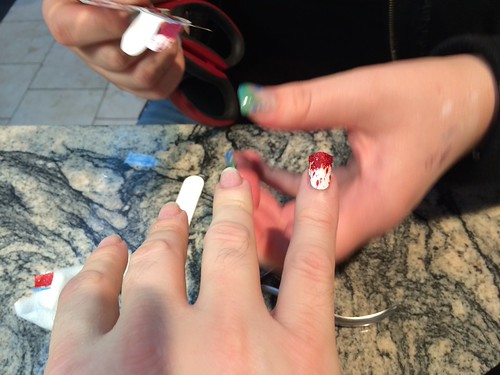
And when they’re done, they look like this:
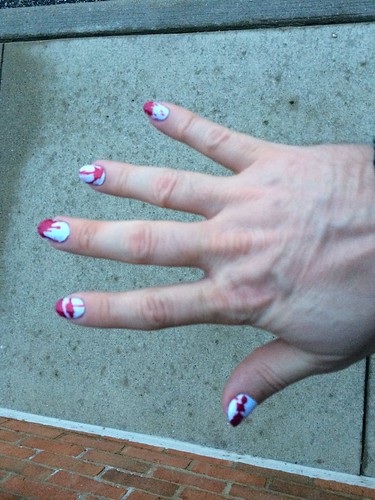
Which, you know, hey, for zombie nails! But they look a little cheap, to me. Cutting them to fit my cuticles leaves gaps, and no matter how many times my nail tech tried to smooth them down there are tiny wrinkles that are supremely evident to me. They don’t look like nails, and already they’re starting to peel, so I’m not a fan thus far. I’d rather have the glossy layer of polish all the way up to hug my precious, precious cuticles.
But we’ll see! I haven’t been out and about, so perhaps when I set out this weekend and have people gasp, I shall reconsider.
The good news is, even if the Nail Art doesn’t ever pan out, it’s still been totally worth it. The only person at my nail shop who would attempt this new-fangled technology turned out to be the most adventurous nailist in the shop, and we spent the time with her showing me her 900 photos of nail samples on her iPhone and explaining all the techniques she wanted to try. I told her that I would cheerfully be her lab experiment, and we agreed that I could walk in to an appointment with her and say, “Surprise me.”
I love The Venetian, as they’re really detail-oriented – I love the way Lan gives me three coats on dark colors because she wants it to be bold and not thin – but they’re not really experimental, and I am forever in search of the next Thing I Have Never Tried. If the Nail Art has done nothing else it’s put me in touch with a fellow mad scientist of nails, and I think that partnership will pay off.