

The Unexpected Changes That Come From Finally Selling A Novel (Part 1 in a Series)
When, after twenty-five years of plugging away, I finally sold my first novel, I thought the changes would be more personal than professional. After all, how different can it be, moving from a short story writer to a novelist?
As it turns out, quite a bit.
Short stories don’t need blurbs. Short stories don’t have covers to discuss. Short stories are tiny events, and do not require the author to see what promotions he can whip up amongst his friends. If my short story is disappointing, that’s a bad review in Locus and maybe a slight black mark on the editor’s legacy, but my tale is surrounded by four other stories and they can hold up the slack.
My impending novel, on the other hand, drops on its own. I am solely responsible for it. And so even though I’m not a self-publisher and Angry Robot is handling most of the hard work in terms of editing/finding a good cover/selling it to B&N/Amazon/Powells/whoever , I’m still thinking up ways to get the word out because this is my baby. I’ve never really had to think this much about “Say, how do I inform people about this thing? How do I get people to express their enthusiasm for it where other people can see it?” because until now, a blog post was sufficient. This involves actual marketing, and though I could lie back and just let everyone else do the work, I think y’all know that’s not my style.
But the biggest change? Short stories are short, and deadline-free.
I mean, they do have deadlines, if you write for anthologies (I can’t, as my stories take upwards of a year to gestate), and certainly edits are due after acceptance. But generally, it’s “write a story on any topic, send it off whenever.” And if they like it, they like it! And if they don’t, well, whatevs.
So I’m used to wandering free as a cloud, letting my muse flit from tale to tale – and since stories generally take me about two to three weeks to finish a draft, my schedule’s been my own.
However. The edits for Flex (please buy it) drop sometime in mid-May. That’s about two weeks from now. And I’m working on two novels – the sequel to Flex, which exists mostly inside my head at this point, and the story of a space-bound gourmet restaurant, which I have three chapters written for and want to continue.
Normally, I’d just say, “All right, let’s do this!” and commit the next three months to powering out a first draft. But I can’t start the process, because for me, writing a novel is like uncorking a soda – you need to finish it quickly, before all the fizz leaks out. And I know from years of experience managing my creative muse that if I pour all my energy into New Book, then get yanked rudely out of New Book Headspace to rewrite portions of Flex, by the time I return from Old Novel Land, poor little New Novel will be deflated and decarbonated.
So I’m in a holding pattern, with two novels I really want to sink my teeth into, and not quite able to let slip the dogs of war because I have Deadline barring my way. And there was a recent Writing Excuses talking about this same problem, where once they became novelists they had to deal with the reality of Edits potentially bursting through the enthusiasm of this new project like some sort of sadistic Kool-Aid Man.
Which is weird. If I’m successful at this, then I’m going to have to find a way to restructure my creativity so that I don’t need an uninterrupted three months to finish a novel. But for now, I’m new enough at writing novels that people want to publish that I’m not going to futz with the formula that got me here.
So I’ve got all the reason in the world to write: I’m on contract for a sequel, manuscript due next summer. I’ve got a really cool spacebound restaurant based in part on the Velvet Tango Room. And I’m sitting here walking in small circles, working on tiny projects that don’t require ambition, because soon Amanda will plop her revision requests for Flex on my desk and I must be ready.
So I’m twiddling. Twiddling as hard as I can.
The AMAZING SPIDER-NAILS Revealed!
I told you I’d post ’em. Just not until after con.
Alas, my right middle finger chipped as soon as I got home from con. Danger of non-gel polishes. I’m not used to this, but I guess I exchange prettiness for endurance.
WITNESS!
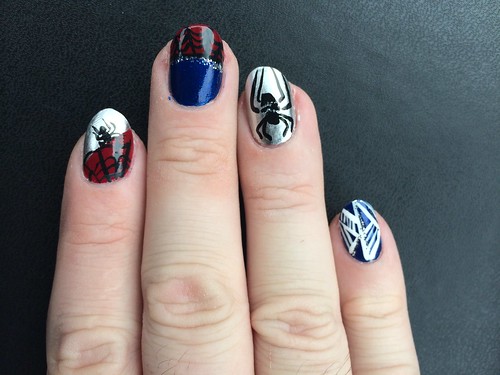
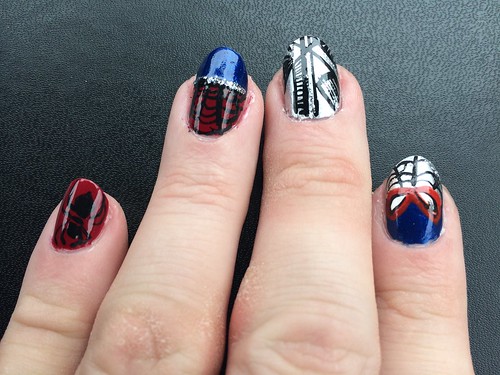
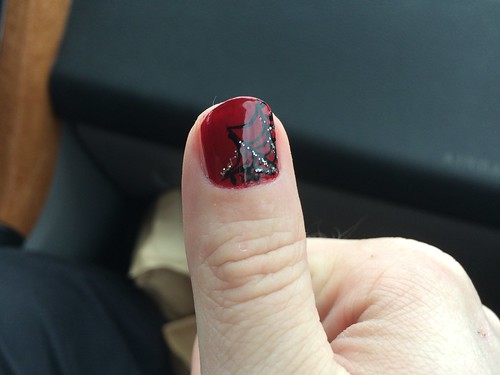
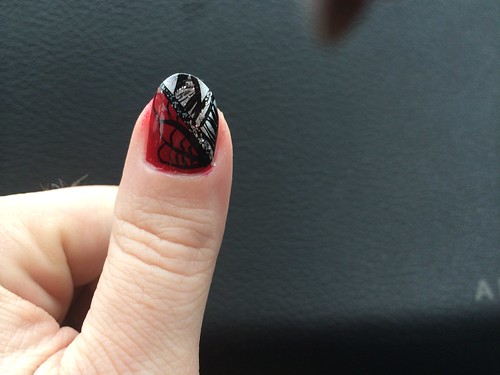
Yeah, Ashley my manicurist is pretty amazing herself.
In other news, Penguicon was good. Saw many of my peeps – but never enough. I’ve hit Con Critical Mass at Penguicon, where I now know so many awesome people there is now no way I can see them all in 36 hours.
Highlight of the con was teaching a fireplay class, which I‘ve written up in detail on FetLife (the Facebook for Kinksters!) if you want to explore some slightly heated content.
I'll Be At Penguicon With My AMAZING SPIDER-NAILS
You guys.
I got literally the best nails I have ever had on my body yesterday. I gave my mad manicurist Ashley license to go nuts, and go nuts she did, with nails so awesome that strangers who’ve witnessed them have dragged me over to other strangers to show it to them.
My inner ten-year-old boy is doing giddy leaps. These are precisely the fingernails I wanted when I was eight years old and my parents told me that boys could not have fingernail polish. Oh, how I would show these to the kids on the playground!
…what’s that?
You want pictures?
No, not yet. These nails are too good. And I’ll be at Penguicon in Southfield, Michigan tonight, doing a grueling nine panels for your entertainment. In fact, if you want to see me, I’m not going to list them all but I suspect my better panels will be:
The Guilty Orgasm: Does Traditional Masculinity Make You Worse In Bed?
Friday at midnight
In which I read my FetLife essay (which I think is one of the most important I’ve ever written) and hold a group discussion.
Straight-Razor Shaving: A Semi-Bloody Tutorial
Saturday at 2:00 pm
I’ll be teaching with Alex Drummer, another straight razor enthusiast, and we’ll see whether we can actually shave live for your entertainment. Expect lively debates of “That’s not how you do it!”
Why Do We Love The 80’s?
Saturday at 3:00 pm
Where I get to be on a panel with Ready Player One author Ernie Cline and my, uh, best friend (and Ernie Cline superfan) Angie.
Fireplay 101: Burninating The Peasants And/Or Girlfriends
Saturday at 10:00 pm
Not a live demonstration, alas – hotels hate that – but I’ll discuss the essentials (and dangers!) of fireplay, along with all my multudinous equipment.
But I’ll be at five other panels. Readily available, you might say. And if you want to see the nails of awesome, you must come up to me and say:
FERRETT! SHOW ME YOUR AMAZING SPIDER-NAILS!
And oh, my friends, I shall unfurl the wonder.
The Amazing Spider-Man 2: A Review (No Spoilers)
Last night, I Tweeted this:
If I wanted to show a non-writer what a really promising novel looked like about two drafts before completion, I’d show them Spider-Man 2.
— Ferrett Steinmetz (@ferretthimself) May 2, 2014
Which is, really, all you need to know about Spider-Man 2. It’s got some really awesome stuff, things I haven’t seen before in a Spider-Man movie. And it’s also half-baked, strangling its own emotional impact with storylines that could have been magnificent with a bit of tweaking.
Here’s the good: this is the first movie to show Your Friendly Neighborhood Spider-Man in full effect. I used to say that Christopher Reeve’s Superman was the only superhero who waved hello and goodbye, giving a little human interaction between his acts of heroism, and that’s what made him great; it told you Superman cared. All those other heroes swooped in and saved you, then disappeared or soared away. Superman was about the niceties.
This Spider-Man is clearly The Good Guy. He remembers people by name. He stops in mid-chase to brush off the shoulders of the people he’s saved, to encourage them. He’s not just saving people, he’s chit-chatting, he’s making quips, he’s funny and fun to be around.
This film doesn’t even attempt to make The Daily Bugle’s hack jobs look real. Everyone in town adores Spider-Man, and that’s that.
And Spider-Man loves what he does. Teresa Nielsen-Hayden said something on Twitter along the lines of “Spider-Man says there’s nothing wrong with being Spider-Man? Oh, these people don’t understand the character.”
Except it’s Teresa who doesn’t understand. Spider-Man is the only good thing about Peter Parker’s life, in many ways: he works a shit job, lives in poverty with his elderly aunt, and he gets to creep out of the house to play the Big Damn Hero every night. Everything that sucks about being Spider-Man is Peter Parker – his friends get endangered (often through ridiculous plot development), he has to choose between survival and doing the right thing. If he could only be Spider-Man, he’d be fine.
But eventually, he has to be Peter Parker.
And the film gets that. And the emotional realism between Peter and Gwen is well-developed, an achingly real first love, where they both realize they’re wrong for each other but think that love can overcome all that. Nothing matters but love. And, obviously, when you’re Spider-Man, the universe is going to teach you how that may not be true.
The problem is the movie’s unbalanced. There’s two villains, and, well, experienced superhero film fans know what that means. And worse, they’re not really particularly well-created villains. The Amazing Spider-Man 2 feels like a step back after Sam Raimi’s richly-reimagined Doc Ock and Green Goblin – Electro is a dysfunctional, one-note nebbish who becomes a dysfunctional, one-note supervillain, and could have been taken straight from the 1960s comics.
That’s not a compliment. Movies have grown, and so have the audiences, and while I won’t hear a bad word said about Ditko and Lee, I will say that copying their simplicity in today’s market doesn’t feel groundbreaking, but simple.
And the second half of the film falls apart, with two half-baked villains trying to take the emotional place of one, and all sorts of scenes that don’t make sense given what we’ve been told before. We have the clear Idiot Plot, and on the way back from the theater Gini and I thought up several fixes that would have preserved the integrity of the characters and raised the emotional stakes. Our fixes might not have been perfect, but this film feels like they had several action sequences to film, and an end, and didn’t really think about how to connect them all together in a way that satisfies.
(IMDB informs me that the PG-13 rating they had to keep also played a factor – you couldn’t make the villains too scary, so instead of fighting and trimming, they simply filmed entirely new scenes, much to their detriment.)
And what happens next, well, that enters the land of spoilers. Over on LiveJournal, I’ll leave a comment discussing some of the problems and how I would have fixed them… but the point is that these could have been fixed. This is what redrafting is for, to interrogate yourself honestly about the weak points in the plot and to see whether the emotional moments you’re going for are actually earned. And they’re not, not quite. The elements are all there, waiting to be honed, reshaped, rearranged. But what you get is an okay movie – and after the awesomeness of Captain America 2, we really needed better than okay.
(Also: I’d like to tell my ten-year-old self that “By the way, the fifth Spider-Man movie won’t be nearly as good as the second Captain America movie” and watch his little mind go boom. What a marvelous age we live in.)
Musings On Cancer.
“I’m not worried about Kat’s tumor,” I told Gini. “I should be. But instead, I’m depressed for other reasons.”
“Are you sure your depression isn’t because of her?” Gini asked.
“No. We’re waiting for the biopsy, and… I’m not even thinking about her. I forget she’s in mortal danger for hours at a time. Instead, I’m selfishly getting sad about all these other stupid things, deadlines and mean comments and writing, and crying for things that have nothing to do with Kat, and then I think oh, I should be worried about Kat, and I’m just…not.”
“I think you’re worried about her.”
“I’m not. And I feel worse for being such a shitty friend.”
A week later, Kat got her results back. They were clear: a benign tumor.
And within two minutes of hearing that news, the depressive funk I’d been in lifted as abruptly as a tarp being ripped off. The sadness was gone.
I just was so unable to deal with that terror that I sublimated it into all sorts of other sadnesses. It felt like depression, it felt like my usual chemical neural misfire, but deep down it was my brain being incapable of looking that terror in the eye.
When I look Rebecca in the eye, I don’t see anything wrong.
She’s five years old, and she loves me. She leaps on me every time I come near. She wants me to chase her around the house. She gives me kisses.
And I keep staring at her, trying to understand how this adorable, mischievous moppet isn’t going to live.
She isn’t. The Meyers tell me that, and I believe them. They’re bolstering up for the inevitability of Rebecca’s death, shoring up all their defenses, doing their best to squeeze every minute out of her remaining time.
But I can’t see that remaining time. I have to keep pushing myself, remembering to schedule some Meyer-time, because if we don’t this week then we might never see Rebecca again. And we go over, and it’s playtime, and she pokes me with a broom and giggles at my jokes, and if I didn’t look at Eric and Kat’s grim faces I’d have no idea that anything was different.
And I’m depressed all the time. I barely have the energy to get out of bed. Writing is a slog. In the evening, I collapse into Gini’s arms and we watch television instead of visiting friends or making dates or anything productive, and again, I don’t think of Rebecca. Except when I see a Tweet from Eric implying the horrors on the ground. He talks about handing the Do Not Resuscitate order to his child’s teacher, and that’s like a punch in the gut – a literal physical pain, right in the scar where they cut me open for my triple-bypass. The center of my newfound mortality.
They’re preparing for a future where she will be gone. A future, too close.
And how can that happen?
We have a convention to go to. That convention is tomorrow. And still we’re holding our breath, because Rebecca had some eye pain on Monday and is that a headache or a harbinger?
Everything in our lives will get dropped to be with her, when the time comes. If we get that chance. We’re holding, hovering, waiting, because in the future is a big fall and we need to catch the Meyers. We need to catch ourselves. We need to catch whatever we can of Rebecca.
We can never unclench. Except we do. We’re human. We unclench for brief periods of time, then feel horribly guilty because how could we have forgotten except memory refuses to store this, and so when we slump home we try our best to work and still, still, still.
This isn’t a chronicle. It’s an excuse.
I know you’ll accept it, no question, but I’m flaky lately, not responding to certain emails, going dim, forgetting stuff. And like Kat, I don’t think it’s Rebecca, it feels like my annual SAD, except there’s just a sharper edge buried in this usual sadness.
I’m not at the epicenter of this – that’s the Meyers. But I’m caught up in because Rebecca’s my goddaughter, and the only kid in that family who really gets my humor, and when I realize I’m not going to get to tell her all of my bad Dad jokes and goof around with her, it feels personal. It feels like an angry universe decided to smart-bomb my heart in the place I least expected it – Gini? Fuck, yeah, I’ve been braced for that death for years. My mother? My father? Inevitable. Even Erin and Amy, my daughters, well, it would devastate me but they’ve gone to college, they’ve fallen in love, they’ve become adults.
But a little fucking girl.
Such dirty play.
What they don’t tell you about cancer is that getting through it involves rationing your strength. You just won’t have the energy for some things any more, shutting down certain parts of your life – even parts you may enjoy, but there’s a stress in all areas of your life and you just can’t. And me? I’m more sapped than I’d have believed by this, and I don’t want to dump in on the Meyers – that is the cardinal sin – but there’s a level of exhaustion because somewhere in the back of my brain it understands just what’s about to happen, it’s screaming, it’s shrieking in the dead spot in my consciousness, and every other brain cell feels that horror and sags to the tune of some unknown fear.
And I keep asking, Well, what’s normal here? And there is no normal. There’s no stable place to stand. There’s only the seesaw riff of happiness and terror and anticipated loss and irrational hopes and logical calculations and rigid planning and bargaining and moping and talking with friends and blogging and throwing away that blog entry and writing and throwing away that writing and realizing that there is no way to communicate because you have to know her, you have to know how precious she is.
Last night, Gini talked me out of cancelling my novel.
Because I got the news that “Hey, you’re going to be a published novelist” on the same day we found out that Rebecca’s tumor had resurged. And I remember kneeling next to the toilet at the children’s hospital when Rebecca was in surgery, trying not to throw up, telling God if you need me to never be a published novelist, I will, if only it saves her.
So there’s a part of me that feels that if only I gave up the novel, walked back on that, that somehow Rebecca would be healed. Or at least that I should try.
Gini tells me that this is the bargaining phase. Everyone goes through it, and I had a particularly big thing to give up. She’s told me in no uncertain terms that the universe does not care enough about me to present me with such a choice, this is random, this isn’t some sign from above, it’s just a coincidence. And I trust her, as I always have in my depression.
But I would. If I knew it would help.
I would give up everything, and the Meyers would too, and we all stand ready to sacrifice everything we have to save this little girl.
The horror is that there’s nothing we can give up. Everything we have to offer is worthless. It’s all down to the chemical processes in Rebecca’s brain, and whatever help medicine can provide, and nothing else we can do matters.
And so we pray. And bargain. And rage.
And give our dwindling hope whatever flame it can.
Apologies Are Easy
I screwed up in an essay I wrote last week, and apologized for it yesterday. I apologize a lot in this blog; that’s not because I screw up disproportionately, but because I feel no shame about apologizing.
And for that, I can thank my family.
My Mom, Dad, and Uncle Tommy taught me that the apology was but one half of a transaction. The other half was where the person I’d wronged swallowed the anger and hurt they felt, and accepted the apology, and promised not to bring this up again unless it was absolutely necessary. (Because if I’d apologized every time I’d left the peanut butter out where the dog could get at it, and the dog had now eaten seven jars of peanut butter, it’s time to bring up past sins in an attempt to fix future dog-related peanut butter poop disasters.)
So for me, an apology is something that’s rightfully owed. And as it turns out, apologies are terribly helpful in real life.
What an apology means to most people is, “I acknowledge you were hurt by something stupid I did, and I feel bad about hurting you.” When you give that sort of powerful acknowledgement, it often doesn’t matter what you did – the person feels respected, and heard, and so the inciting incident is forgotten. (Maybe not right away, but the anger evaporates and the respect they garnered for you remains.)
So apologizing has helped me a lot. Being able to go “My bad, I’m sorry” and have it be a trivial thing has let me get along with a lot of people. Because I’m outspoken, and occasionally arrogant, and if I wasn’t able to go, “Yeah, I shouldn’t have done that” at the drop of a hat, then my career probably would have cratered.
But other families taught different lessons. The lesson they taught was that apologizing handed your family a club to use for as long as they cared to. An apology was a sign of weakness, and to apologize was to expose your tender underbelly. So to apologize meant that your family would forever enumerate your sins, because hey, you admitted this was wrong, this means we’ve got a free ticket to always remind you of how stupid you were.
And for people like that, apologies come hard. To apologize is, in a very real sense, to give up a part of yourself for all time. So they apologize only when social pressure and evidence heaps up to the point where an apology gets squeezed out of them.
And that’s harmful, in the long run. Because yeah, there are occasional jerks out there, like their family, who treat every excuse with sneering triumph, raising the apology like a trophy and hoisting it to all. But most people? They get the apology, they make a note to be a little wary of you in the future, and move on. And if you’re sufficiently nice and/or competent going forward, that apology will slough off like a scab.
Whereas I’ve seen the folks who can’t apologize, and good Lord their whole lives are shaped by it. Their world seems like a constant assault on Normandy Beach, piling up excuses for when they need them, angry denials, shifting blame elsewhere because good God it can’t possibly be that they did wrong.
And it seems like so much work.
I’ll freely admit when I’m wrong. That, I believe, is a strength. And I’m really happy my family had the wisdom to guide me in the proper direction on that.