

My Novel THE SOL MAJESTIC!
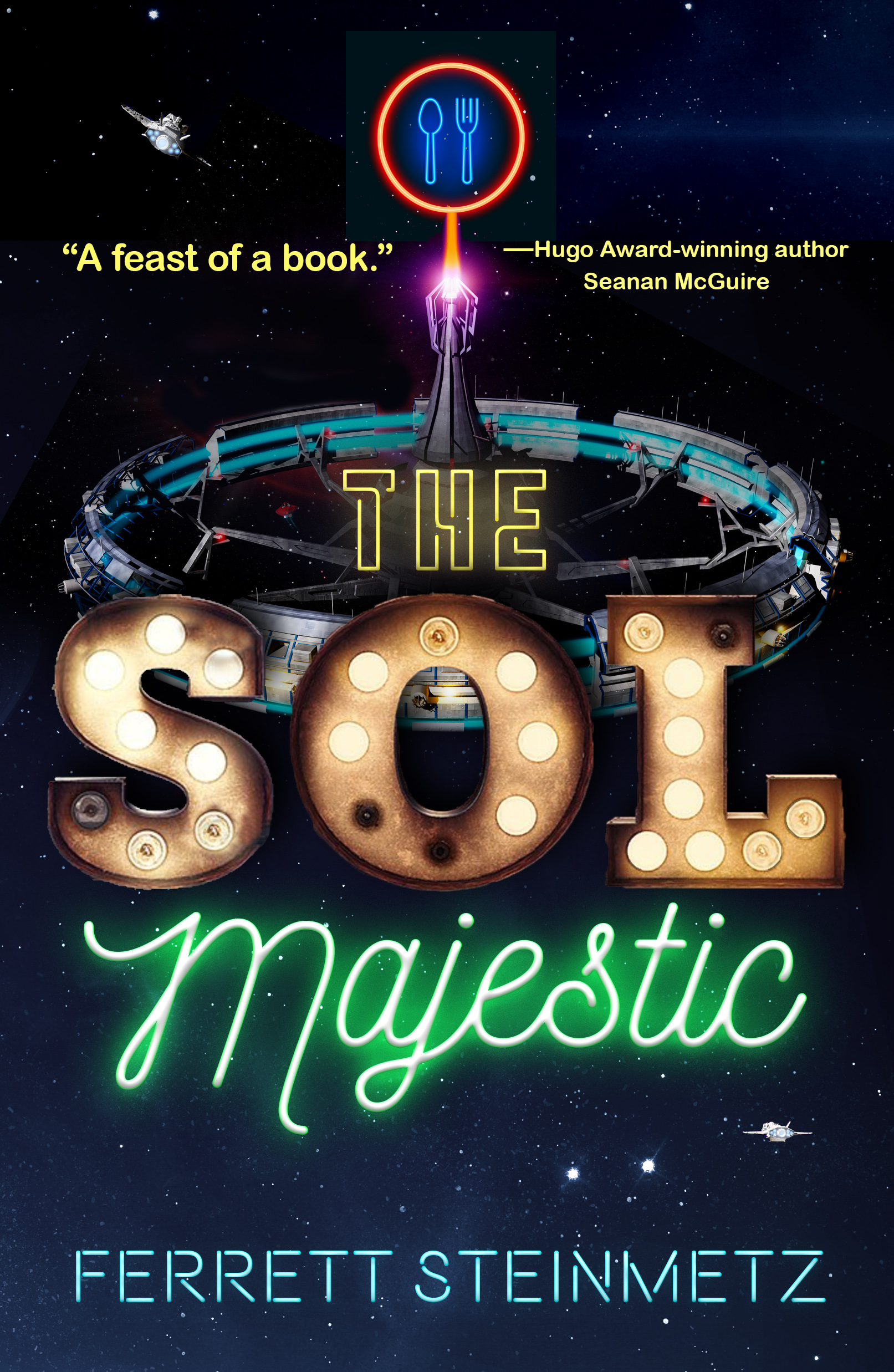 My upcoming novel The Sol Majestic is the best thing I’ve ever written – and may be the best thing I’ll ever write. If you’ve liked my other books, I’m pretty sure you’ll like this one; if you haven’t liked my other books because they didn’t feel like the guy you know from this blog, then I urge you to give The Sol Majestic a try.
My initial pitch for The Sol Majestic was “Anthony Bourdain meets space opera,” but my editor said it was “Kitchen Confidential meets The Fifth Element by way of Wes Anderson,” and the official tagline says “a big-hearted intergalactic adventure for fans of Becky Chambers and The Good Place,” and Seanan McGuire says “It is a feast of a book, with an ingredient list and flavor profile that seems strange, until you sink your teeth into it and realize that it’s what you’ve been hungering for all along, lamb and honey, vanilla ice cream and blackcurrant jam, cinnamon and chicken and rosemary” – which all tells you this is a remarkably difficult book to categorize.
But it’s pretty much as much of Me as I could stuff into a book.
This book’s my baby. I’m proud. And I want to celebrate it – with secret drinks, with signed bookplates, with all the joys I have to offer.
Polyamory Isn’t A Cure For Cheating (And In Some Ways Makes Cheating Easier)
“I can’t stop my men from cheating on me,” types the monogamous woman in her article, “But maybe if I enter polyamorous relationships, all the cheating will stop!”
She pauses at the keyboard, baffled.
Why is the bitter laughter of thousands of actually polyamorous people drifting through her window?
Well, first off: cheating happens all the time in polyamorous relationships. Polyamory doesn’t mean “You get to fuck whoever you want,” but rather “You negotiate a framework with your partners as to who, when, and how it’s acceptable to fuck.”
And it is entirely possible to break those rules. Did you promise to have safe sex and things got so hot you forgot to rock that sock? You done cheated. Did you promise to check in with your partner before things got hot and heavy, just so they’d know who you were entangled with? You done cheated. Did you conceal this hot cybersex you were having on the side? You done cheated.
“Wait,” you say, stunned. “Cybersex isn’t cheating!” Well, I’m afraid poly’s gonna swirl your world here, because sometimes nonsexual things become more important than sexual ones in poly relationships.
Look. When “We only have Teh Sexx0rs with each other” ceases to define who you are, often nonsexual things swell to fill those gaps. I personally met my wife in a Star Wars chat room. My first trip to visit her solo was to see Phantom Menace. We got matching Star Wars tattoos with our two daughters the day before Force Awakens came out.
If I went to go watch a new Star Wars movie with someone else for the first time, that would be a divorce.
And I’m not kidding. Not every polyamorous relationship has these nonsexual touchstones, but you may well find that a certain restaurant or seeing a certain band becomes something that defines who you are as a couple.
And if your partner doesn’t have the capacity to go, “No, I’ll wait a few days for my sweetie to come back from that business trip before I see Star Wars IX,” well, you’re not gonna do well.
And even if you don’t buy into the idea that nonsexual things can be cheating – some polycules don’t – polyamory not only offers more temptations, but more people to make agreements with.
Because polyamory is, theoretically, based in love. Which means you don’t want to hurt your partners – all your partners, not just the one. Which means if one partner wants you to tell them who you’re sexually involved with before anything happens and another partner is okay with oral but not PIV intercourse on a first date, you could potentially cheat on two people simultaneously.
Add to that the surfeit of temptations – in a monogamous relationship, a partner may rein their flirtatious impulses in because they know they’re supposed to be exclusively committed to you, even if they can’t consistently carry through. But in polyamory, where you can date anyone you want in the absence of more customized negotiations, you can smooch so many people that you temporarily forget about your original partner. In fact, there’s a term for this thrumming lovefest – New Relationship Energy, or NRE. And you just get so caught up because everything’s good that all your prior promises fall out your damn head.
Now.
If you’re dating men who can’t keep it in their pants when they’re dealing with just one, simple commitment – “Don’t” – do you think they’re gonna be better when you give them finer-grained permissions and a wider range of options to go astray?
No. Polyamory isn’t an answer to cheating, and in some cases it leads to more cheating. It’s not taking the reins off, it’s putting on different reins – because even if you’re into Relationship Anarchy, people have expectations they want met in the course of a relationship (even if those expectations are as slim as “Tell me if you’ve picked up an STI so I can take stronger precautions”), and the health of those bonds is forged by how responsible someone is in respecting those expectations.
Monogamy isn’t easy. But neither is polyamory.
It’s just a different set of choices.
Nonsexual Relationships Have Worth.
“So you’ve liked being friends with her and want to date her,” the comments sections seethe. “Go ahead and ask her out! What’s the worst that could happen?”
The answer to that, unfortunately, tells you a lot about someone’s values.
Because the answer to “What’s the worst that could happen?” is what does happen all too often when you interject “HALLO I WOULD LIKE THE BOINKINGS WITH YOU” into what’s been a pleasant, nonsexual relationship – the person you asked doesn’t find you attractive, and now wonders whether your pleasantries have been nothing but a way to get into their pants, and doesn’t know whether it’ll be okay to answer “no” without losing what they have. Sometimes, based on sad past experiences with people who’ve lied about “No, it’ll be fine if you say no,” they automatically back off even if you tell them you are.)
(Which is why, incidentally, I always suggest being open about your attractions – playing the so-called “Nice Guy” who keeps launching surprise crushes on people is pure toilet water. There’s nothing wrong with only wanting to interact with someone for the potential of sex, but there’s definitely something wrong with someone who pretends they want more when really, that’s all their so-called buddy can expect to get out of this.)
Anyway.
“What’s the worst that can happen?” is that a friendship you had gutters into awkwardness and fails because you wanted Le Hot Smooches and they didn’t.
And it’s the next question that tells you someone’s values:
“Isn’t that worth the risk, though?”
Which is actually another question, rotated slightly to sound more socially acceptable:
“Isn’t losing any non-sexual relationship okay, so long as you might get rewarded with sex?”
And my answer is: No. No, it damn well isn’t.
My nonsexual relationships, even with people who have sexual orientations compatible with mine, are fulfilling on their own merits. Yes, I like makeout sessions and slippery-wet fucking and claws across soft skin…
But I also like late-night conversations about movies, and having someone to talk to when I’m feeling down, and sending jokes to someone who I know will get them in the same way I do.
And this concept that all of these things can be jettisoned trivially so long as I might – might! – get to fuck them is a little shallow as far as I’m concerned. Some of the greatest things in my life have arrived from theoretically-compatible people I have never, would never, and *could* never have sex with. If I lost my relationship with those people, I would lose all these nonsexual happinesses they gift me.
And of course it’s a variable equation. Deciding to risk a close friendship of three years is different than rolling the dice on someone you’ve had three days’ worth of nice chats with. Sometimes, you’ll risk losing a budding friendship because you wanted more – and again, that’s okay.
But the people who ask “Isn’t it worth the risk, though?” generally don’t know about the specific relationship that’s being gambled, though – because it doesn’t matter. Any chance at le smoochins, no matter how faint, is worth any amount of nonsexual interaction. You’ll drop anything, anyone, who needs you if there’s some sex in it.
And I think that’s what you see in those assholes who forever pester women in the coffee shops with “Can I buy you a coffee?” (Which, for the record, is still one of the best essays I’ve ever written.) Yeah, they know these chicks have headphones on, or are doing homework, or are otherwise projecting glacial waves of indifference at them – but what’s important is not respecting someone’s projected social cues, but HEY I HAVE A SHOT HERE I GOTTA TAKE IT.
BECAUSE SEX IS BETTER THAN ANYTHING ELSE I COULD POSSIBLY GET, INCLUDING PLEASURE FOR BEING A DECENT HUMAN BEING.
(Cue the inevitable whines of “But If I Can’t Buy You A Coffee, How Will Our Species Reproduce?” – which, fortunately, I’ve already written an essay about.)
Look. For the third and final time, there’s nothing wrong with wanting sex as your primary goal, whether you’re a man, woman, or nonbinary. And there’s nothing wrong with looking at the relationship you have and deciding that yes, the chance of evolving this into a sexual one is worth the cost of losing them.
But what is a little skewed is when you’ve quietly decided that every nonsexual pleasure you could have is automatically outweighed by the possibility of a sexual dalliance somewhere in your future.
“What’s the worst that could happen if you ask?” Well, I could muddle a nonsexual relationship.
Does that matter to you?
Because, ya know…. it should.
I’m Not Really Mentally Ill. I’m Just A Drama Queen.
When I was nineteen and finally found myself some friends, I became a walking drama-bomb of a teenager. I remember being curled up in a ball while everyone else was standing in line at the movie, clutching my head and shrieking, “THE MEDICATIONS! THEY’RE STEALING! MY WORDS!”
Everyone else was just trying to see Coming To America. But me? I apparently needed to be the real show.
I look back at those moments with skin-crawling humiliation – the stupid things I did when I was a teenager that I would never do now.
But at the time, I believed that having big, scene-stealing panic attacks were how you found out who your real friends were. If they dropped everything to comfort you, no matter how embarrassing you were being, well… they were your friends. And all the other people you lost along the way were jerks for being mean to a depressive.
Victory either way, really.
Yet as I got older, I realized that the idea of acting out to get people’s sympathy was, fundamentally, a shitty blackmailish mechanism for making friends. You didn’t actually acquire buddies so much as you rallied the codependents to circle the wagons around you, and making friendships on the basis of “Who would drop everything to help someone else out?” meant that you spent a lot of your time embroiled in soothing your buddies, who – like you – had little interest in finding the right medications or the right therapists or the right self-soothing methods because dammit, the whole goal of this process was to find who could handle you at your worst.
And I evolved. I was still dramatic on occasion, of course – I don’t think you get to post consistently to a LiveJournal blog without splashing a little drama on ya – but I learned.
I learned that I had this whacko tendency to cry in public for attention, or to self-harm to get sympathy, or to fake-stutter when I was stressed, and thank God I was slowly stepping away from all that silly drama.
Yet I was distressingly weak at times. I’d be at a party and find myself hyperventilating in a bathroom, chiding myself – Ferrett, how dramatic, you don’t need to do this, just be happy.
I’d pick up the knife, ready to carve slow gashes into my arms because it was the only way to distract myself from the tsunami of negative thoughts, and part of me would snidely observe, You really want your friends to worry about you, don’t you? Imagine how they’ll react when they see your scabs.
I’d stagger around the house, completely alone, muttering distressed whimpers to myself as I wept so fiercely that my face hurt from dehydration, and I’d think, Oh, my, if you do this for just six more hours your wife will be home, what an act you’re willing to go to for drama.
It seems a little elaborate, doesn’t it? I mean, nobody knows why I’m in the bathroom. If I slip and do cut myself again, nobody knows how hard I work to wear long-sleeved shirts around my friends and family – even sleeping with a towel on – to conceal my stupid dramatic outbursts. And by the time my wife gets back from her trip, I’ll have sponged off my cheeks, I’ll have swallowed back those whimpers, I’ll have on a fake smile and I’ll tell her everything is fine.
I’m such a goddamned drama queen.
I’m glad I’m a goddamned drama queen.
Because if I wasn’t a drama queen, why, that would mean I was genuinely mentally ill. You can fix drama, that’s a stage you grow out of, but mental illness means you’re forever going to be breaking down at inconvenient moments, you’re condemned to an eternity of needing these pills and this workaround and this level of friendship – and even if you get everything you theoretically need, you’ll still have some days where you’re shivering against a cold wall, trying hard not to shout out the crazy things that come into your head, because if you do you’re dramatic and by suppressing all that crazy you are, in fact, a mature and good and sane person.
If I’m a drama queen, well, every time I suppress my craziness then I am, at heart, a sane person who’s fixing himself.
But if I’m not, well… then I’m bugfuck looney, doing his best to squash all evidence of his real and serious and unfixable problems down so that his friends don’t know how bad it gets sometimes, and…
I mean, wouldn’t you rather be a drama queen?
And I am dramatic. Always have been. It’s why I write fiction. But there’s days I look back at me having a complete goddamned breakdown in line to see Coming to America, thinking of all my friends wincing because Oh God there goes Steinmetz again, and I wonder.
Maybe that was a legitimate breakdown. Maybe that was me genuinely unable to fucking cope, so unable that I couldn’t consider the social consequences of going batshit in a public place with my buddies and I wasn’t just pretending to be a nutball, I was actually every bit the basket case.
But that?
Who wants to admit that?
To this day, I don’t know whether I was crying out for attention, or legitimately breaking down, or a combination of both. People are complex. It could be that I was integrating both thought models, which is why I do try to suppress my more outward-acting tendencies, because if I’m a good friend then I should try to minimize the number of times I ruin someone’s evening. If I can handle tonight’s panic attack by cloistering myself in the bathroom for ten minutes, well, then the panic attack is handled and my friends don’t have to spend their evening clustered around Old Breakdown, here.
But there are days where I’m absolutely alone, out of medication, curled up against a cold basement wall because I’m repeating madness mantras to myself, these endless flows of self-hatred, speaking them aloud because if I internalize them I might very well kill myself before anyone else gets home, and on those days I am so very glad I’m a drama queen.
If I wasn’t a drama queen, I’d be crazy. Seriously, incapacitatingly, crazy.
And if I’m a drama queen, then I can snap out of this funk. Any time now. It’s all under my control, you see? It’s not that I can’t stop muttering and stammering and shivering – it’s that I just don’t want to yet, oh Ferrett, you silly old attention-seeker.
Thank God.
Thank you, God, for making me a drama queen.
Thank you, God, for letting me believe I might be something other than this sad, broken thing that I am.
Why Fallout 76 Is A Terrible, Terrible Betrayal Of Its Past (And Also Okay)
So the reviews of Fallout 76 are in, and they’re confirming it’s the game I dreaded seeing: almost no story, no NPCs to interact with, just a big empty arena to grind levels by killing monsters, and tolerating playing with randos with names like “TurdFerguson.”
That’s not Fallout, as far as I’m concerned.
I’ve played Fallout since the first Fallout – and back then it was a dialogue-heavy, character-driven RPG that was astonishing because it rewarded flexibility. I put all my points into a Charisma-based scientist smooth-talker, and in fact at the end of the game I didn’t need to fight the final boss – I used my expertise to pluck apart his grandiose arguments for world domination and left him behind to self-destruct.
To me, Fallout is about the dialogue trees and strong storylines, backed by a marginal combat system that is alternately too punishing or too trivial once you get the right gear. That’s literally what it’s been since the mid-90s.
And now all that’s been stripped away, harvested to create a game that’s basically got zero storylines, no crafted missions, just doofing around with PVP and random encounters in a game that could be, well, any other game.
Yet that game is not necessarily a bad game.
It is merely a game that no longer appeals to me.
And I wish more people understood that goddamned distinction.
It’s what I consider to be The Batman problem. Everyone loves Batman, right? And when I went to see The Dark Knight in the movie theater, I came out pumped because that was Batman, that was the killer interpretation I’d been waiting for.
But my friend Dana was disappointed. Why? Well, she’d grown up on the 1970s comics, where Batman was not some jumped-up thug but in fact the World’s Greatest Detective, a man who valued brain over brawn…
And while The Dark Knight was a perfectly good movie for what it set out to do, it wasn’t her Batman.
At which point I realized that someone saying “I love Batman” means almost nothing. It certainly doesn’t tell us what Batman means to them. They could love the doofy cheerfulness of the Adam West 1960s Batman, or the bone-crunching take-no-prisoners 1980s Frank Miller Batman, or love the Batgadgets, or really enjoys the Batman rogue gallery of colorful criminals.
When you say “I love Batman,” you don’t. You love a specific Batman. And if the franchise continues long enough, you’ll find Batmen that you don’t love.
Because the reason Batman is a global sensation is precisely because Batman is a concept wide enough to stuff a thousand interpretations into. Whenever someone reads a Batman comic, each fan is enjoying a particular aspect of that comic – the way Batman fights, the art style, the Bruce Wayne playboy fantasy, the idea of Batman as a self-made hero…
No two people are seeing the same Batman.
And what’ll often happen when a new interpretation of the Bat hits the screen is that fans will claim “it sucks.” But what is actually happening, even though they don’t have a critic’s understanding to piece that logic out, is that this Batman isn’t ticking all the boxes that, for them, defines their Batman.
It doesn’t suck. From a critic’s viewpoint, “suck” would be ‘It failed to do what it set out to do.” Whereas what’s actually happening is, “It’s doing what it wants to do, and very effectively, but it’s not what you wanted them to do.”
Like The Dark Knight. It’s still a great movie from many perspectives. But if you’re judging it by the “Is Batman smarter than Sherlock Holmes?”, well, then, no.
Likewise, Fallout 76 is the final step in a looooong series of subtle retoolings to the Fallout series that have, quietly, removed all the portions that I considered to be essential for a Fallout game. The RPG story-based mechanics were what defined a Fallout for me, and they’ve been reduced to almost a vestigial portion of the game. Now it’s gone.
So for me? Not a Fallout game.
But for many thousands of people over the last decade, “Fallout” could equally well be “Traipsing through an incredibly detailed wilderness, picking off monsters and leveling up.” And that’s not an invalid interpretation. If that’s what makes them happy, then that’s good.
This bullshit that “Every piece of media must be specifically designed to make me happy” is toxic, man. It’s okay that there’s stories not aimed in my direction. There can be beefy manpain gunfight movies and weepy LGBTQ romances, neither of which appeal to me much.
That’s good. The world is larger than me. Acknowledging that is a major step in becoming a functionally compassionate human being.
And it’s not wrong for me to mourn the loss of a franchise I loved. If Fallout 76 is successful, then what defines a Fallout game for the average person will be permanently rearranged, and I’ll never get to play the game the way I wanted ever again. (Which is why secretly, I’m hoping that Fallout 76 is a crap game in the sense that “It fails to appeal to the people it’s designed to appeal to,” and they have to start appealing to schmucks like me.)
But it is wrong for me to get furious because Bethesda screwed it up. Part of being a grownup is understanding that franchises evolve, take chances, and part of those chances involve potentially veering away from the things you love. That’s not a betrayal of you personally; that’s any art, honestly exploring itself in that eternal dance between “aesthetic goals” and “gotta pay the bills.”
Why is that distinction important? Because in this day and age of Internet-fuelled fanboys, you can steamroll that outrage into a poisonous mass of hatred, and come to believe that the reason your show got cancelled or your movie didn’t pan out the way you wanted is because people were actively out to sabotage what you like. And they’re not. As someone who knows a hell of a lot of creators of videogames and RPGs and books and music and movies, they’re all doing their damndest to try to make a good product, and they feel sick when they fail to deliver.
So if your favorite series isn’t topping the charts or your beloved series hangs a sharp turn to nowhere, that’s not anyone working to suppress you. You have to understand that, well, some of the things that are dearest and best to you don’t resonate with other people. Which is a painful lesson to learn, but that makes it no less true.
Is Fallout 76 good? Based on the reviews, I can honestly say it’s lacking everything that draws me to a Fallout game. Does that mean it sucks?
If I’m being intellectually honest – which I should be – then I’ll say that it automatically sucks for me.
Let’s see whether it sucks at providing what other people define as “The Fallout Experience.”