

Fiasco: A Brief Review Of An *Awesome* RPG
“Do you want to play a roleplaying game with no GM?” my friend Flicker asked me.
“No GM?” I asked. “How the hell can you play a game if there’s no central arbiter of reality? Who creates the plot? Who makes the rulings?”
Yet I have been introduced to anarchy RPGs through the magic of Fiasco, and lemme tell you, it’s pretty fun.
Fiasco is more of a shaped improv class than an RPG; the goal is to create a small-town, Coen Brothers-style narrative like Fargo or Glengarry Glenn Ross, where desperate people do awful things for low stakes. (And as rewarded poorly.) It’s also a game about story, tailor-made for writers, because the whole goal is literally to create scenes that advance the plot and reveal character. You’re not trying to level up your wizard: you’re going, “Okay, we have six scenes left, and three of them need to end on a good note before the bad ending, so how the hell can we make it look like things are going well?”
The way Fiasco works is fascinating: you show up with no characters, intending to build them on the spot. There’s a general situation given: a small-town news office, a crime-infested southern town, a mundane suburbia.
You roll a bunch of dice, Yahtzee-style, and then place a notecard between every playing. Each player goes around, selects a die from the pool, and uses that die to choose a class of relationship between the two characters from a simple table: FAMILY, CO-WORKER, CRIME. Then you choose from a sub-menu, further defining what kind of Crime connects these two people: Corrupt Official, Drug Dealer, Con Man and Mark.
Then, in similar fashion, you choose A Need, An Object, and a Place. Within minutes, you’re all debating what sorts of characters could fit these rough outlines, making them up on the spot. It’s literally like writing a story from a prompt.
Then, you have to create a set number of Scenes to advance the plot of this sordid story. The trick is, when your character has his scene, you can either determine how a scene starts, or determine how it ends – but whichever you leave fallow, the other players get to choose. So you can say that you’re going to confront the mob bookie who has the goods on you, but if you choose that start then the other players will tell you how it ends up, usually determined halfway through the scene as you roleplay it with the other people and see how it ends up.
The dynamics are fascinating, particularly because half the scenes have to end well (i.e., your character gets what s/he wants) and half of them end badly. So you have to juggle a way to keep the plot moving, and make it appear that things are going well, but are actually leading to a horrible end.
You do half the scenes, then roll The Tilt, which is the mid-point at which things go horribly wrong, consulting another table for the way things are going to unroll. And then you play out the rest of the scenes, and act out the denouement.
Thing is, I like Fiasco because it’s very act-y, and very write-y, and totally interactive. You’re all trying to tell a story together, so you share that common bond of “Fuck, we’ve written ourselves into a corner” followed by the thrill of “Oh my God, we know how to make this better!” You’re tossing around ideas for how your characters could work, moving towards the end game. And since there’s no authority to break ties, it all comes down to a collaborative effort that is kind of awesome in its effervescence.
In fact, I think Fiasco is so awesome I’m going to run it at ConFusion next weekend, in Detroit. So if you’re interested, hit me up. I’ll show you how this works, because it’s great.
Help Name My Face-Flayer!
For the last two weeks, I have been pressing a cold blade to my face and having it shear off my epidermis. This straight razor has removed hairs, supped on my blood, tasted my fear as I have learned to come to an uncomfortable balance with it.
Yet we have never been properly introduced.
As the lovely Sheryl points out, if I am going to have a blade, it should damn well have a name. I don’t really want to name it as a weapon, as if it’s drawing blood, it’s my own fault. Still, the blade is unforgiving, and I feel that perhaps granting it a semblance of the life it is so cheerfully nicking from my face might help me to keep things together.
So. What is my razor’s name? I’ll announce a winner sometime next week.
A Year Good Enough For Surprises: Thoughts On The 2013 Oscar Nominations
This year makes me pump the fist, because it’s what the Oscars are fucking for, man.
Last year was a thin, watery gruel of Oscars: a lack of good movies and a swollen Oscar category led to The Artist winning by default. The Artist wasn’t a bad movie, but its winning felt like that guy you’re dating because you don’t want to be alone, but God you wish you had a satisfying romance in your life. It was present, and competent, and even a little clever, but the best of a bleah bunch.
Yet with this year’s announcement, we have a bunch of movies that people loved, many of them box office successes. I’ve seen people go off on passionate loving rants for Lincoln, for Argo, for Life of Pi, for, well, every movie on that slate except for Zero Dark thirty… and even those people are going off on rants on how creepily effective that film is portraying torture. This is a field full of beloved movies, gladiators in the pit with people eagerly betting on them.
But more importantly, we have surprises.
Great but underlooked films had to go head-to-head with movies everyone has heard of, and liked. Hey, who saw Beasts of the Southern Wild? Amour? I didn’t. (And few saw Silver Linings Playbook.) But when you realize that Beasts and Amour nudged out Quentin fucking Tarantino, on a movie that’s his most financially popular flick ever, then it’s a strong recommendation: we saw Quentin, and he was brilliant… but this was better.
So what I predict will happen is that people will go, “Crap, people are saying this is as good as Lincoln? As Argo? I should check this out.” And tiny, tiny films will be financially rewarded – which always makes me happy, because “financially rewarded” means “these talented people will make more films, possibly with bigger budgets, leading to them having a career.” Jennifer Lawrence came from nowhere in Winter’s Bone to get cast in The Hunger Games, and now she’s a star, and that’s partially thanks to the Oscars shining a spotlight on a good performance.
This is what the Oscars are meant to do. Often, they’re this grim exercise in unhappiness, because the Oscar voting bloc seems to think that “no humor” == “MAGNIFICENT.” But this year, you had movies with a lot of funny bits mixed in the drama – Lincoln’s weird anecdotes, “Argo fuck yourself,” pretty much all of Silver Linings Playbook’s weird love affair – and so I’m energized to see the rest in this year’s Quest To See All The Oscars, as opposed to my usual “Oh God I’m in for ten hours of miserable people trapped in hopeless situations.”
So yeah. Go, Oscars. You took a good year and worked it.
Oscar-specific thoughts:
- Silver Linings Playbook cleaned up, as it should. I dislike the director personally, as he appears to be a dick not too different from his manic-compulsive hero in Silver Linings, but as a quirky love story it’s a brilliant (and accurate) take on dysfunction. When the dinner conversation revolves around which anti-anxiety drugs you’ve taken, and their side effects, and it’s flirting? Oh, man, I hate to admit how many times I’ve done that.
- I hope the six-year-old actress from Beasts of the Southern Wild wins, just so we can say to Hollywood, “A girl who picked up all of her acting tips from Dora the Explorer did better than Sally Field.”
- First thing we checked: Yep, Anne Hathaway made it. We don’t have to kill anyone.
- Hugh Jackman also made it for Les Miserables, which… he didn’t deserve. I thought in many ways he was the weakest part of the film. But here’s the thing: I love High Jackman as a person – he appears to be generous for an actor, and sensible, and possessed of both a work ethic and a sense of humor, so I’m not going to bitch. I’m just going to be happy for him.
- I really wish Seth McFarlane had announced the Best Actor category by saying, “The nominees for ‘Best Actor’ are Bradley Cooper, Denzel Washington, Hugh Jackman, and Joaquin Phoenix. The winner for ‘Best Actor’ is Daniel Day-Lewis. Let’s not kid ourselves.”
- Robert DeNiro’s turn in Silver Linings Playbook is, honestly, the first nomination I think he’s deserved. I mean, I like DeNiro, but to me he’s an actor like Will Smith – hey, this is someone pretty much like DeNiro, being DeNiro! So I don’t give him that much credit for acting chops. Nor did the producers of Silver Linings Playbook, since I know they auditioned him in the very scene where he convinced me he could act because they had worries it was outside his range. But they cried, and I cried, and dammit Bob why have you been wasting all this time playing mobsters.
- The big loser of the day, I think, was “Moonrise Kingdom.” I haven’t seen it yet, but I have heard good things – just not good enough for this year. Then again, it’s not like the Oscars have ever really loved Wes Anderson anyway, so I could be wrong about that.
- Quentin shut out for Best Director? Ouch.
Shaving Cream, Be Nice And Clean, Shave Every Day And You'll Always Look Keen
Here is today’s grand straight razor shaving adventure in three photos:

First, here is me unshaven. And uncombed. And un-everything, Jesus Christ, I’m not a movie star I BRUSHED MY TEETH FOR YOU BEFORE THIS WHAT ELSE DO YOU WANT
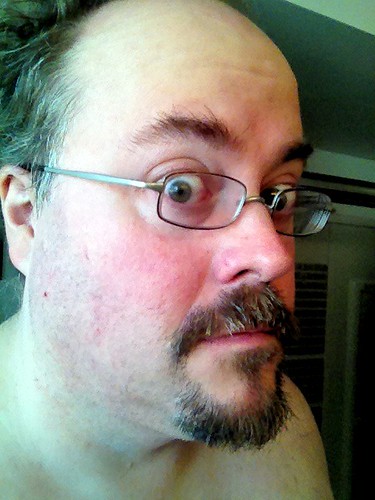
Here is me having shaved with the grain of my skin, i.e., “Down slope on the hairs.” I have pretty much mastered this. The reason I look terrified is because I am about to shave against the grain, which is to say, “Uphill,” which is to say “I’mma about to cut my face all up again.”

…but it went okay! A little razor burn, to be sure. This is the first shave I’ve had since I started shaving with the straight razor that’s actually comparable to the disposable – something no one tells you about. Sure, you will have a super-close shave, eventually, but first you’re going to have a three o’clock shadow immediately after shaving. Or, you know, a face full of gashes. Or both.
There’s really three tricks, I’ve learned, about straight razor shaving: first, you have to have a good cream. The shaving soap I had wasn’t working, even with the judicious application of hot water to my face beforehand; if you’re an amateur, like I am, you need a thick layer of goop to blunt the deadly edge in your trembling hands. A handful of tiny bubbles ain’t gonna cut it, Mr. Ho. Or, to be more accurate, it will cut it all too well.
The second trick is that you have to have a good grip. But like writing, while everyone’s full of advice and you should try everything out, it always comes down to what works for you. I have yet to find any manual that suggests the rather awkward grip I use, but once I discovered that’s what I was comfortable with, things got better.
And the third trick is that you have to understand skin. It is, as polymorphism put it, “a new intimacy with your own skin.” Straight razor shaving requires you to really pay attention to that fleshy cheek, that ridge over the jaw, that hollow on the left side of your throat. You’re learning how to interact with your body in a new way – which, as polymorphism also put it, is rather a wonder to discover after possessing a body for forty-three years.
Next up: Honing, in about a month. We’ll see how that goes.
The Object of Dread: Something Few People Talk About In Love
The trick to understanding love is that it is the easy part. Love flows freely, as we all long to be in love, and so given the slightest outlet love will come fizzing out of us like champagne from a bottle.
The problem is in this society, “love” gets confused with “like” – and anyone who’s ever loved a family member who irritates them with every single phone call and yet still rushes to the hospital in tears whenever something goes wrong, knows that love and like are as similar as apples and crankcase shafts.
Give someone a relationship full of love but no like, and it’ll be awash in petty arguments about mundane things – why do you watch that stupid FOX News, well, why do you listen to that insipid song, oh look we’re late for this movie again. It’s like living in a sniper pit, where you’re continually being shot at by irritations. But give someone a relationship with zero love, yet topped off with vast amounts of like, and it’ll function well enough. Won’t be as satisfying as a sweeping romance, but you’ll live in a house without killing each other, and you’ll pay the bills on the time, and not fight over what movie to watch, and enjoy each other’s company.
Love often renews, automatically, like a magazine subscription. It takes a lot to shake someone out of a good love.
Renewing like, however, takes an active effort. And when the like’s gone, as I have been arguing here, the relationship might as well be over. You won’t be happy in it. You can’t be happy. You’re with someone who’s constantly jabbing at your ribs with an umbrella, and though it may be an accidental jabbing, you’re still stuck with someone who’s lowering the quality of your existence.
And what no one tells you is that as each dollop of like evaporates, it leaves behind a thin layer of dread.
Like many things about relationships, dread is best recognized in retrospect. It’s that small “Oh, God, I have to…” when you think about being in your lover’s arms. It’s that reluctance to show up, lest s/he do That Thing again. It’s that twinge of reassurance you have to offer yourself that everything will be wonderful if that just doesn’t happen. It’s that weight on your heels as you go out the door, realizing that if you don’t go you’ll have to explain why and oh Lord let’s get it over with.
Learning to identify dread is a very valuable skill in a relationship, because most people are bad at it. We’re trained that if we’re in love, everything is wonderful, and so if there is dread, we try not to acknowledge that. We submerge it. We argue it away by saying that doubtlessly, we all have bad habits, and this is just one soft spot among the many delightful things our partner brings to us, and aren’t we just as bad sometimes? We see it as a problem to be worked on, something we’ll get used to, like choking down vegetables until you learn to like the taste.
Yet dread is different than annoyance. Annoyance is when your partner does something, and you hate that, but you still want to be around them.
Dread is when you actively start to not want to see them. You often do, because if the relationship hasn’t tumbled head-first into the Chasm of Dread, there’s still a left to like, and this twinge of please no is drowned out by a chorus of yes please.
Yet the relationship’s in trouble when, consciously or no, you hesitate and do that calculation: should I?
And dread creeps up slowly, because usually you’re floating on a big sunny sea of New Relationship Energy where everything is wonderful, and you’re loathe to call it dread because society says that you can’t be in love forever with someone you dread, and by God society is pretty spot-on on this one. You don’t want to think it’s over this soon. So you try not to think about it and just blindly hope that it’ll get better.
Little bits of dread can sometimes be snipped away, but that gets awkward, because you have to have to say, “Something you’re doing is so big a turn-off that it’s making me not want to show up.” There’s a careful alchemy here, which varies from person to person – step too lightly and they’ll go, “Oh, you’re not really bothered by me subjecting you to Dutch Oven farts when we’re in bed!” Step too harsh, and they’ll react as though you’ve just told them a part of them is vile and repellent – which, you know, it actually is to you if you’re talking about it honestly, but you’re often not asking them to stop being that, just to not be that around you.
Which is tricksy. Dread’s often a sign that you’re fundamentally mismatched. Who wants to talk about that?
But dread is the death of relationships. You need to recognize when dread is creeping up, and look it boldly in the face to say, “Maybe this isn’t gonna work.”
Since you can, as noted, get by without love. If you have to, you can function as a unit for the kids or your career without like. But when you’re saturated in dread, well, the biggest danger is not a break-up. It’s that you’ll stay together, loathing so much of each other that it’s like living in a mosquito-filled tent and never being able to really swat, filled with all sorts of awful things you can’t bring yourself to say because you love them and don’t want to hurt their feelings and they don’t seem to have all of this dread, they’re filled with nothing but purest love, and how could you refuse that?
So you wait. Dreading. Flinching in anticipation of the next hammerfall, and it will fall. But not leaving, because hey, you’re in love, that should mean something. And there, trapped in a place where you have no affection left in your heart, you will find out just how bare, rocky, and discomfiting love – and only love – can be.