

"She Must Have Deserved It": An Uncomfortable Reality About Abuse, And Reporting It
In discussing the resistance most victims of domestic violence face when trying to explain things to their friends, someone raised an uncomfortable question about dissecting the abuser’s motivations:
“Is it that hard to believe he hit her for no reason at all?”
Yes.
Yes, it is.
It’s hard to understand because most people, I’d argue, don’t emotionally understand that other people are different than they are. Oh, they get that there are differences – Coke vs. Pepsi, Stones vs. Beatles, Romney vs. Obama – but 90% of the people I met view their neighbor as basically a reflection of their own morality, and get confused whenever they witness significant distinctions. Naturally, they’re frequently confronted with evidence that people aren’t pretty much all “just folks” under the hood – but when they see this, the dissonance is confusing and painful, so they either withdraw, simplify, or forget.
(This is why people tend to withdraw into echo chambers on the Internet, where everyone thinks like they do. It’s easier than reformatting your entire universe.)
And the good news that emerges from this particular bad response is that most people would never hit their partner. When told, “He hit her,” most people run this information through a I-am-the-world filter that goes something like this:
“Gosh, hitting the person I love? I can’t imagine myself doing that. But that did happen, apparently, so how would that have come to be if I was in the driver’s seat? Well, I suppose if she constantly did something designed to hurt me, all the time, on purpose, maybe – eventually – I might snap and feel horribly guilty afterwards. But what the hell kind of actions would someone take to drive me to that monstrous behavior? Because I/other people wouldn’t just beat someone for no good reason. So what did she do? She must have done something.”
In other words, their failure here is their inability to put themselves in the shoes of a sociopath. And so they focus on the reasons as opposed to the action. Which creates a toxic resistance to the idea that the abused partner wasn’t at fault.
Their central fault is that they assume, erroneously, that there must be some large driving force behind this disproportionate response. But there isn’t. The truth is that a lot of domestic violence comes from men – and women – who are eager to display power by punching powerless folks in the face. Where most people would only resort to brutality when backed into a corner, knowing the emotional damage a beating does, the abuser views physical pain as just another tool to be used in a relationship, mundane as arguing and chore-swapping.*
As such, I think the best way to fight this insidious idea that the abused brought this abuse upon themselves** is to change the narrative.
What we need to get across in the case of domestic abuse is that this is a different breed of person. This is not you and me, this is a man or woman who views the world in a way that thinks of hurting someone as just another method of control. He may be friendly, he may have made you laugh over a beer – but underneath, if he thought pain would be a better way of getting you to do what he wanted than humor, he’d drop the beer and tear your fucking hair out.
They’re not you. And you gotta fight to get that one across, but when you do you’ve opened up a tool that gets a lot more societal justices created. Because once you get – really, fundamentally accept – that the world is not full of Mini-Mes and in fact some people’s experiences has led them to something catastrophically different from you, whole worlds open up that you can begin to shape to better ends.
Because the women who got hit? They didn’t do anything that warranted an ass-kicking. They just are with someone who thinks ass-kickings are a-okay, and the problem lies with him, not her.***
* – And when you’re unfortunate enough to run into another sociopath with an easy out to violence, that sociopath genuinely sees the situation as “She deserved it,” giving a similar end. It could be argued that most people are then sociopaths. But given the comparative – comparative – rarity of domestic violence in the Western cultures I’m familiar with, I don’t think that’s the case.
** – The kernel of truth within this otherwise-scurrilous claim, I think, is that if you’re a victim of abuse, you need to be very careful as to who you date. Children of abusing parents are fifteen times – fifteen times! – as likely to wind up married to an abuser as so-called “normal” people, which means that your abuser broke some vital instincts within you. If you’ve got that kind of background, date slowly, trust carefully, because your parents have wired you to be drawn to other abusers. This is no different than anyone else’s bad instincts in relationships, of course – except that if I go on autopilot, I wind up with a psychodramatic relationship, and if you do it you wind up broke and desperate with a woman kicking you in the ribs. So if you’ve been abused? Be vigilant. Be careful in who you choose to love. Because goddammit, you deserve better than that.
*** – Or with her, not him. Domestic violence isn’t man vs. woman, it’s abuser vs. abusee. Please remember that.
A Much-Needed Skill, For Writing or Woodworking.
Yesterday morning, I put up this pegboard. I did not do a good job.
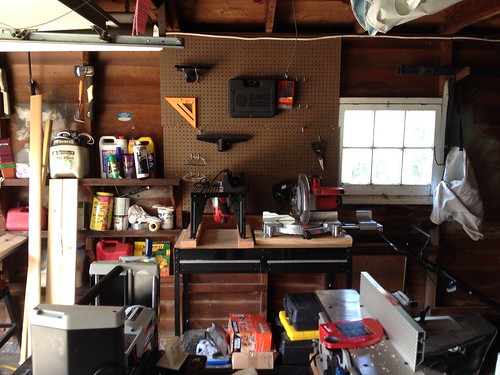
Now, this pegboard is a surprisingly large deal, as it’s the first time I’ve physically altered my environment with my own hands. This was the first time I ever went, “This thing is insufficient,” then went, “So why not change that?” and then ripped down part of a wall and put up another part. In terms of worldview, it’s quite the large change.
In terms of actual work? Shoddy.
If you look closely at the picture, you’ll notice that I cut the pegboards wrong. There are two boards, and one juts out a little to the left, creating an unsightly gap. If I’d done a better job, I would have noticed this before I started screwing things in. I would have cut the boards to fit, measured them in advance properly. It’s something I’ll probably be deeply embarrassed by, when I get to be good at this.
Yet I can still take pride.
I’m lucky enough to hold those contradictory thoughts of “This could use improvement” and “I’m glad I made this.” And when I look at the pegboard I’ll neither be tempted to rip it all down in disgust, nor wander away thinking this flawed work is brilliant. I can be content that I’ve done something I’ve never been able to pull off before, yet make notes for future betterment.
Which is the way I write: I’m highly critical of my stories. I can show you the soft points in every story I’ve published, even the ones I’ve been paid hundreds of dollars for; they’re riddled with errors I just couldn’t fix properly. But at the same time, those flaws don’t negate the work put into it. Like the peg board, it’s enough to hang some tools on. Like the peg board, it’s taught me something about how to do this. Like the peg board, ultimately it’s useful.
When you write. When you work wood. When you create. Note your errors, fix what you can this time around, vow to do better the next time. Yet be proud; you did a fuck of a lot more than the people who created nothing, and you’ve leveled up in some small way.
You don’t have to be perfect. You shouldn’t be casual. And you should never, ever stop.
Two Photos That Sum Up Yesterday
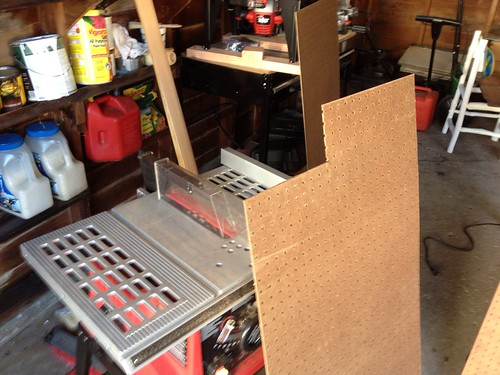
I used my table saw yesterday for an actual task, which was a heady experience. It’s a small task – chopping up a pegboard so it’ll fit on the wall – but it’s the first time I’ve used my tools and my hands to alter my fucking environment. As someone who’s largely hired people to do stuff for him, saying, “I want a new pegboard on that wall” and then going all “SO MOTE IT BE” is a little crazy.
Incidentally, I’ve settled upon my first project for the workshop: an arcade cabinet. This oughtta be interesting.

And this would be my lovely wife Gini, picking up our food from the food co-op we subscribed to. A bunch of fresh veggies and fruits, all for us! We’re trying, man. I hope we can keep up with all this nature. (And now, I’m off to eat some strawberries.)
Let's Do Equations Involving Assholes
When it came to negotiating cheap airline prices, there was no one better than Russell. He had a way of browbeating innocent clerks until, exhausted, they handed him over to their manager – and then Russell would hammer the manager, mentioning that we were a big organization, we booked a lot of flights, did you want to lose our fucking business? And while Russell made service managers weep – literally weep – he got us flights at rates that looked more like Greyhound Bus rates.
As a volunteer organization with a slim budget, this skill was invaluable. But Russell came with a cost:
Nobody wanted to work with him.
A prima donna, Russell knew he was good at his job – and he’d turn that scathing anger upon his fellow volunteers as quickly as he would the clerks. Anyone who faltered, who missed a deadline, who blew an opportunity for savings – Russell would chew into them gleefully, call them out publicly, haul out their dumbass behavior and spread it as far as he could. They’d fling up their hands and say, “I don’t want to deal with this asshole.”
And when you confronted Russell on his asshole behavior, he’d chuckle and admit that he was an asshole. But a productive one. He did the work of five of these other slackers – a fact he kept hammering home repeatedly. “If you put five guys together,” he said, “They couldn’t do half of my job! So fuck them if they want to leave!”
Unfortunately for Russ, that constant refrain actually encouraged us to formulate an equation:
One active Russell == How many lost volunteers?
Russell was, arguably better than any five generic volunteers – a herculean feat. But his asshole behavior drove people away at an astounding rate. If Russell did the work of seven volunteers, and alienated only five members, well, then we had a good deal on our hands.
But how many people was he alienating, really? Because the equation changed if Russell’s presence caused ten people to fling up their hands and walk away.
That was Stage One of my incipient Asshole Theory: Assholes will consume a certain number of other people. Whether it’s Russell booking planes for guests or a dazzling troll in some forum who raises good points, an asshole will cause some percentage of your crowd to go “Fuck this.” And the first stage in Asshole Theory is that you must place a value upon the asshole, and then figure out how many people s/he is worth losing.
This is an easy if it’s a useless asshole. Gets a little more talented if it’s a useful asshole like Russell, or a charming asshole who has slavish devotees. Then you have to start figuring exactly what sort of fallout you’re ready to endure should the asshole leave.
Yet when we started asking around about Russell, we found stage two of Asshole Theory. Turns out that the number of people who actively complained about Russell? Wasn’t the real total. When we started inviting comment upon Russell, quietly tugging people who weren’t volunteering aside to ask, “So why aren’t you helping out?” The answer was, frequently, Russell. But who wants to cross an asshole, particularly one who’s known for going off in public spaces? Who wants to criticize a guy who wields grudges like clubs?
That’s Stage Two of Asshole Theory: The number of people consumed is greater than the number of active complainers. People feel no obligation to tell you how dysfunctional your organization is; they’ll just walk, quietly, and figure you know the problem exists. (Which – and let’s be honest – you kinda do.) So that cost usually has some portion hidden, though it gets tricky to figure out if some of the complainers are also assholes.
When we investigated and estimated, turned out that yes, Russell really did do the work of seven people. (Which is pretty damn amazing.) But he alienated fifteen people… fifteen people that we could find. There were likely more. And so, once we did the hard work of doing the math and then extracting Russell from the group, we had a flood of new people who were willing to help. We did pay more for our airline flights, it’s true, but we also had more people to handle the tasks that Russell couldn’t quite keep up with.
That’s my Asshole Theory: you need to keep track of your assholes, and determine what their cost in members is – whether those members are volunteers, employees, staffers, or dues-payers, the asshole is definitely costing you some amount of them. Your job: to figure out what that cost is, overestimating if you don’t have the time to actually dig deep and find out, and then determine whether it’s better to keep the asshole on-board, or to jettison him.
Why do I bring this up today? No reason. No reason at all.
XBoned
I’m sort of astonished at how poorly Microsoft is handling all of this PR over its new console. None of the choices they’ve made have been indefensible – they just need to make an argument for them. Which they haven’t.
Take the “always-connected” issue. Sure, it’s an inconvenience. But if Microsoft had been aggressive, saying, “Look, the Internet is the way of the future, and being always-connected lets us do some really cool things for you. [List the cool things.] Smartphones are always connected to the Internet, and look how useful they are! Truth is, at some point all devices will be connected 24/7 – we’re just ahead of the curve.”
Instead, they took the opportunity to insult their user base, implying that only cornpone hicks aren’t connected. Which makes the argument be entirely about the inconveniences of continual connection.
(Which, don’t get me wrong, as someone who fucking hated it how he couldn’t play 9/10ths of his Rock Band song collection when the Internet crashed, I’m wildly against needing a constant connection. But there are arguments to be made for it, and you’d think Microsoft wouldn’t have been so astonished that people didn’t like the idea that they had no plan for it.)
Likewise, the whole “not reselling games” thing could have been promoted as a new and bold ecosystems. Talk about the publisher’s complaints of not making any money from three-quarters of the sales of their games, how reselling is secretly stifling innovation, how once this happens games can be cheaper and more piracy-free and this will be better for everybody. But once again, Microsoft seemed to have their heads so far up their asses that they didn’t recognize that most people like lending games to buddies and getting money back.
Then the XBox One is $100 more than Sony. It’s like, wow, has anyone been this far behind in the console wars this early? I’m not counting them out, as it’s all going to come down to the games that are available – but how the hell did Microsoft not look at these as the liabilities they were? What culture is going on inside Microsoft that they didn’t marshall their PR people to start spinning this from before the first announcement?