

How To Not Convince Someone
“Hey, sweetie,” I said to Gini, “Did you hear that Michael Stackpole thinks all professionally-published writers are ‘house slaves’?”
“Maybe a guy who made his name writing Star Wars and Battletech books isn’t the best judge of that,” she replied.
That said, yes, Michael Stackpole called the non-self-published writers “house slaves” in a blog post, and then doubled down in a long essay that explained that no, “slavery” is not merely the trafficking of human chattel, but also the never-ending contracts of indentured servants. Publishers may not want to steal your body, but they do wish to steal your entire future output. As such, he is entirely correct, or so the essay goes.
The problem is, it’s a shitty essay. Not because Stackpole doesn’t have some valid points buried among his overstatement – he does – but because “slavery” is a hot-button comparison that’s going to alienate more than illuminate.
There are certain words that just shut down people’s minds when you start making comparisons, because the actions you’re drawing a parallel between are incredibly hurtful things. Rape, pedophilia, being called the N-word – there’s a whole zone of actions where if you write an argument that says, “Keeping your NetFlix account is just like an abused wife staying with her husband!” you’re going to thumb a button where a lot of people who have directly experienced the fallout from those actions goes, “So when did NetFlix physically throw you down the stairs?”
You’re yanking on some of their deepest hurts to make a point. And these people do not go, “Oh, you’re right, NetFlix charging me an extra ten bucks a month is a lot like the husband who broke my daughter’s cheek and then knocked me unconscious so I wouldn’t take her to the emergency room,” but rather roar, “How dare you trivialize my pain by making such a comparison?”
Now, that doesn’t necessarily mean you don’t have legitimate points about commonalities. There probably are some psychological similarities between people who keep justifying their love’s behaviors, and going back based on the idea that their continued support will change them. But by making a comparison that reaches so deep into people’s personal injury, you haul up years of buried pain and anger… And that makes them angry at you, no matter how logically correct you may be. You’re not arguing to a stadium of Vulcans.
As a writer, Stackpole has to understand the power of words. He knows on some level that making the comparison to slavery is going to drag up a lot of personal hatred from those people who are still suffering from the fallout of slavery in America (and yes, it’s still an ongoing wound even if nobody’s currently in chains). He knows this is going to piss a lot of people off.
Still he says it. Which is, in itself, a statement of his core values: Fuck your pain. What’s important is that you know I’m right. He even admits that he wrote it “to shock and draw attention.”
In other words, Hey, you know all of those buried aches you have? I’m gonna tapdance on them to show you how utterly awesome self-publishing is.
It’s a bad essay because for every person it draws attention to – and note that I did link to it – it alienates nine more, having people walk away going, “Christ, if self-published authors are this insensitive and strident, why the fuck do I want to deal with them?” The impression I come away with reading Stackpole is that he’s a smart man with a couple of relevant points buried among the muck, but his main goal is to show you how goddamned smart he is.
(Side note: Wow, the contracts he’s whining about are ones that most competent agents I know would renegotiate stat. It’s like, dude, if you sign the first thing people put in front of you without reading it carefully, you deserve your troubles. I’ve only published short stories thus far, and I’ve sent back contracts because I didn’t get the audio rights back after X months.)
Maybe it’s a good essay. Maybe having so many people reading your blog is better than making a non-incendiary post that few link to. But it strikes me like punching a stranger in the face, and then saying, “While I’ve got your attention, may I discuss the joys of self-publishing?” I think overall, some will be swayed, but most will come away with that icky taste in their mouth where Stackpole is now the face of self-publishing, and that face is smirking, cocky, and dismissive.
As for the rest of you: if you’d like to actually convince people instead of stirring up the hornet’s nest, don’t go there. Yeah, there may be some legitimate points to be made. People won’t hear it. And if your goal is to actually convince people, try something else.
If your goal is to be a compassionate human being, stand back.
Herman Cain Pisses Me Off
So allegedly, when a woman asked Herman Cain how he could help her find a job, he pushed her head towards his crotch. This claim, the fourth in a series, may be enough to sink Herman Cain’s run for President.
This pisses me off.
Look, don’t get me wrong, I’m as down on rape and sexual harassment as anyone. If the accusations are true, Herman Cain’s a scumbag, and he’s not getting any invites to my birthday parties.
But really? Herman Cain’s blatantly awful 9-9-9 tax code wasn’t enough to scuttle his chances? His ignorance that China already has nuclear weapons? The many other dumb-ass ideas he’s floated aren’t enough to take him out of the candidacy? Look, I get everyone says something dumb from time to time, and when a million cameras are trained upon you, they’re going to catch every brain fart you have and magnify it. But Cain’s been consistently numb-nutted enough that it should be apparent that this is a habit.
In a sane world, voters would have analyzed the 9-9-9 plan and gone, “As stated, that’s actually going to cost the average taxpayers more money, give the rich more cash, and take in less money overall than our current system.” And the majority would have said, “A dude like that doesn’t have the brainpower to make it as President,” and would have chucked him out on his ear.
But no. What’s killing him in the polls? Evil sex. Because the voters of America don’t give a good goddamned if you can’t add two numbers together as long as you’re a nice guy… But yhe minute your personal character’s in question, then you’re not fit.
Here’s the deal: I don’t want a scumbag rapist in office who takes advantage of his position to try to force women to suck his dick. But that’s the lowest level, on a par with the obvious statement of “NO SERIAL KILLERS PLS.” That should be our last level of filter, not our only filter.
Because I don’t want a guy who can’t do math in the Oval Office, either. I don’t want an ignoramus there. I don’t want a guy who is almost willfully ignorant of international issues. I want a guy who knows what the fuck he’s doing.
But unfortunately, at this stage of the game, it doesn’t matter how fucking stupid you are. The only way to get a definitive knock-out is to try to put your dick in the wrong place. It’s as though we’re trying to elect not a President, but a Nicest Guy In Chief.
I know a lot of nice guys. Many of them are incompetent. Can I be so bold as to ask for a maybe-not-so-nice-but-not-a-rapist-either competent dude? From either party? Thank you.
Book Review: 7th Sigma
If you are a writer who goes to conventions, you will rapidly ascertain that there is very little correlation between how much you like someone and how much you like their work. This gets awkward when you find someone who you adore personally, but whose fiction you cannot stand.
Steven Gould, author of Jumper, is one of the nicest guys in sci-fi cons – quietly witty, fun to talk to, perfectly willing to apologize for the wretched movie based upon his book, which he had nothing to do with. Which is why it’s such an extra-special triumph to report that his latest novel, 7th Sigma, is as fine as his company.
The pitch for 7th Sigma is nothing like the book itself, which is good. The pitch, designed to get you through the door, is, “Welcome to the territory. Leave your metal behind, all of it. The bugs will eat it, and they’ll go right through you to get it… Don’t carry it, don’t wear it, and for god’s sake don’t come here if you’ve got a pacemaker.” Which makes it sound like this book is all about battling the ferocious metal-eating piranha bugs that bore through human flesh – a good hook to grab teenaged boys.
But no. The bugs are simply an excuse to transplant modern sensibilities and knowledge into a frontier lifestyle – what would it be like if we had to live with our medical knowledge and technology, but in a world without computers and construction equipment? This isn’t a slam-bang action adventure, but rather a series of well-told incidents that outline the cleverness and compassion with which humanity survives in a world made new. The cleverness inherent in the worldbuilding is filled with the kind of down-home, reassuring solutions that make you go, “No matter how bad things get, we’ll find a way to get by.”
Gould wisely avoids turning 7th Sigma into a Little House on the Prairie Clone by having the lead character Kimble, a young teenaged boy running away from his father, take up a job on an apprentice dojo. As such, there are many localized lessons on Buddhism and martial arts philosophy from his teacher Ruth, all laced in with the endless chores one has to do to stay alive. Kimble is a smart kid, sympathetic and brave, and as he learns how to fight, he learns when to fight, and eventually gets caught up in trying to remove the drug dealers and pimps that are making life worse in the territories.
The absolutely brilliant thing about 7th Sigma is that it wisely avoids any semblance of plot. Which is to say that part of my love of 7th Sigma comes from its sleepy rhythm; each chapter is a parable, mostly self-contained, and it would have been all too easy to knit it into a big slam-bang freight train of a plot that would have moved the story along but lost most of its charm. No, like All Things Great and Small, each chapter’s an anecdote of Kimble having a mini-adventure, and there are themes that overlap and amplify to provide a sense of movements, but there’s no point at which the Great Bug-Generator is found and everyone must take up arms to defeat the boss monster before it explodes and destroys the world. This is all intensely personal, at a low level.
(Not to toot my own horn too much, but if you liked the day-to-day rhythm of my Little House-inspired space station novella “Sauerkraut Station,” which came out last week, I almost guarantee you’ll love 7th Sigma.)
The only real ding about 7th Sigma is that it ends with a lot of questions unanswered – not personal questions, since Kimble’s personal journey is wrapped up, but this book is clearly sequel-bait in the sense that hey, you know those crazy metal-bugs, there’s clearly more to tell. And that’s fine. When a book’s this good, I don’t begrudge the sequel-baitness of it, but rather look at it as the first salvo in a series of tales I’m quite anxious to hear the rest of.
In the meantime, I’ll just say that 7th Sigma has been responsible for a lot of hot water usage around here, as I devoured a quarter of it at a time in the bathtub, then handed it off to my wife for her bath. We’re wrinkled, but happy.
The Mysteries Of The Hand Dryer
Here is a picture of a hand dryer. You know, that thing where you wouldn’t have washed your hands if you’d known you had to use it instead of towels.
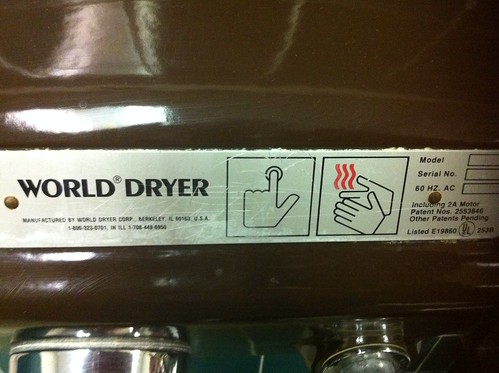
The hand dryer’s weak cough of a drying solution is well-known. Sure, there have been modern versions of it like the Xcelerator and the Dyson AirBlade, but the classic hand dryer’s asthmatic flow means you’ll be wringing your hands for eternity, and still leave the men’s room with clammy palms. I’d actually prefer it if I pushed the button and got bacon, as the info schematic promises.
But it’s the the lower right-hand corner that gets me: “Other patents pending.” They developed this in, what, 1920? Haven’t they actually finished completing the patents on this fucking thing by now? The goddamned dryer’s been inconveniencing the stinkfingered since I was a kid, which is irritating enough – but the idea that they also have a lazy set of patent attorneys, their feet on their desks, going, “Yeah, we’ll finish those other patents some time”? It just pisses me off more. They can’t get my hands dry, and they’re slackers to boot.
What if those other patents are, like, cures to cancer? Cheap space flight? Fat-free chocolate that doesn’t taste like stale candles? I picture the World – and note that they’ve fucking copyrighted THE WORLD in their fucking logo, like they’re the fucking Illuminati or something – anyway, I picture the World(R) Dryer headquarters like that warehouse at the end of Raiders of the Lost Ark, just all the lost secrets of the Incas lying around in huge stacks while two gray-haired lawyers doze in the corner, oblivious to the improvements they could make in this world if they just got off the fucking couch.
And it just makes me hate these air dryers more. Grr. You fucking air dryers, with your fucking tenuous zephyr emanating from a lukewarm nozzle, now you’re not just making my fingertips wrinkled, your endlessly pending patents are causing kids to starve in Botswana. You’ve got the fucking world-savers in there, World(R) Dryer – fucking cough it up! GIVE US THE TECHNOLOGY! You fucking assholes.
I typed this with wet hands because World(R) Dryer sucks.
I Love My Wife Because She Disrespects Me
Gini is yelling at me to go to the damn party. Gini is incorrect.
Gini is demonstrating a very tricky part of the carefully-cultivated disrespect that good relationships need to thrive.
The problem is that I am in hibernation mode and do not want to go to the damned party, even though it will have my favorite people there. I would not have a good time if I went to the party. I’m in my asocial mode, and I will be far better served by sitting here in my underwear and playing X-Box until midnight. This will recharge my introvert social-batteries, and make me much better prepared to enjoy the next party.
Gini is quietly removing the controller from my hand. Gini is yanking me off the couch. She is telling me that if I do not come to the party, I will be making a mistake, and so she is not really giving me a choice in this matter.
I shuffle off to get dressed – not because Gini is right, but because it’s less trouble than getting into a fight with her. We’ll go make a quick appearance, show up for the requisite forty-five minutes…. and then I will come back home, strip to my underwear, and play Rock Band. What I need is solitude.
We return home at one in the morning. I’ve had a fantastic time. I loved hanging out, and I got to talk with Kal, and flirted with Emmy, and Jack and I had this great discussion on technology, and what?
…oh yeah, I was wrong.
We humans often are.
The thing about relationships is that there’s a lot of talk about respect, which is important. Vitally so. But we rarely talk about the corner cases where it’s necessary to disrespect with love.
“Respect” is often a synonym for “I do whatever s/he says s/he wants”… but while that guideline’s a solid wall for strangers that should be abided, it gets tricky when you’re dealing with someone you’ve known for years. The “I do whatever s/he says s/he wants” logic assumes that Person X knows exactly what they want when it comes to life, and by giving them everything they request, you’re giving them everything they need.
Problem is, what we desire does not always get us what we actually want.
If, in a long-term relationship, you just hand people what they want like you’re handing out candy to trick-or-treaters on Halloween, you often encourage their worst habits and make them unhappier.
Take me, for example. I have depressive tendencies. When I’m in a bad mood, which is more often than I’d care to admit, I’m absolutely 100% certain that going out anywhere will lead to disaster. But if I follow my instincts and stay home alone, my thoughts just loop and amplify, and at the end of the evening I’m usually even more depressed. Going out to a party actually breaks that cycle, gets me focused on something else, revitalizes me.
Gini knows that. So she disregards my wants to drag me out to get me to what will actually make me feel better. Even though I don’t know that at the time. (I may know it intellectually, but this party is different, like every party we’re ever invited to.)
Likewise, Gini loves being sexy and attractive, but as she hits her early 50s, her natural instincts these days are to dress conservatively, like other older women do, and to damp down her natural flirtiness. I have to remind her, no, you’re wearing that sexy dress tonight with the low-cut neckline, go back and change, don’t argue. She’s uncomfortable when we set out. At the end of the evening, when she’s swimming in compliments, she’s happier.
Now, it should be noted that this pressure is not an absolute; there are times Gini’s tried to pull me off the couch when I did know better, and I fought to stay, and won, and was right. There are times when I’ve said, “Wear something sexy” and Gini’s retorted that it’s not that kind of party. But overall, the pressure we apply to force each other to our happy zones is often intense, and could be interpreted as disrespectful by an outsider.
Yet I’ve seen relationships where each partner hands the other whatever they desire without question, and very often what you wind up with is a rock-stable relationship with two desperately unhappy people at the center. They stay because they’re with someone who “understands” them – why would they go elsewhere when they get along so well with their partner? Heck, they can’t go, anyone else would question them, they have to stay.
And all the while, the rest of their lives are miserable, with them steeped in long depressive fits that they just can’t seem to shake. They’re comfortable, and miserable. Because of a deep respect, or at least something masquerading as that.
The disrespect technique is a dangerous one, because obviously it can get out of hand if you a) don’t know your partner as well as you think, or b) are not able to separate your desires from their needs. (Certainly there’s any number of dudes who’d haul their fiancee to the football game because that’s what makes them happy.) And it’s a lot easier to not fight with your spouse, to just hand over the loot, because you never get into conflict when you give them what they asked for over and over again.
Yet while it’s a tricky thing to get right, I think it’s something that ultimately has to be mastered – because though we hate admitting it, we’re not always the best judges of what’s going to work for us. We’re the final arbiters, certainly, but to assume that we have 100% absolute correctness in what we require at any time to be happy is to assume that we are machines and not fallible human beings. Having a partner who not only supports you, but pushes your limits to ensure that you’re going where you need to, is vital. Questioning someone’s motivations often leads to insight and evolution.
Sometimes, your partner will haul you, dragging and screaming, from your comfort zones and into a place you do not want to be. Sometimes your partner is going to be absolutely correct to do so. And there will be more conflicts as you determine what’s actually going to work, but in the end what you’ll have is a relationship that brings both of you to the happiest place that both of you can find.
If you have a good relationship, a bit of carefully-constructed disrespect is what can transform it to “great.”