

I Promised You Me Wearing A Cape
Rebecca’s Cancer Walk was this Saturday, and the cape was the big hit of the show. Rebecca found it to be the most awesome toy ever – we wrapped her sister in it, played tug-of-war all over the park, and spent a lot of time hiding in and under it. If you didn’t know Rebecca had a potentially lethal brain tumor, you would have found it hard to believe she was this sick.
Which led to possibly my favorite photo of me ever taken:
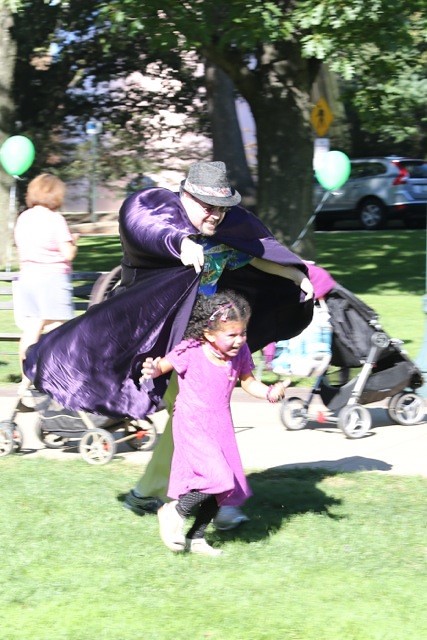
But the Cancer Walk itself was heartbreaking. Because it was so sparsely attended, it reminded me of all of the Men Supporting Men gatherings in Fight Club; a sad group of people battered by diseases the rest of the world ignores, struggling desperately for dignity and attention. Nobody much likes children’s cancer. Too many kids die to feel good about even the victories. And we’re so good at fighting regular cancer that we assume that kids must also benefit, but kids need differing treatments. (Which we benefit from in this case – Rebecca’s brain tumor would be a near-automatic Game Over in a grown woman.) There were maybe three hundred people there, which seems like a lot until you look at the crowds for MS Pedal to the Point or any 5k race in Cleveland.
And when it came time to call the parents of the dead children up to the podium to release white balloons in honor of the kids who didn’t make it, I lost it. Just lost it.
Everywhere around us were people wearing T-shirts with their dead kids on them. And I kept looking at Rebecca and going, she’s so alive. Such a squirming, resilient bundle of life.
I don’t want her as a photograph.
I don’t want to use her image for a cause, I don’t want to shamble out here once a year in her memory, I want a fucking alive Rebecca with me forever, to be a pain in the ass when she’s ten and a disrespectful teenager of fifteen and a twenty-year-old college kid who’s going through the inevitable college heartbreak and struggles with studying.
And I was, and am, infuriated by the lack of attention paid to children’s cancer. It’s like a hideous secret club you get escorted into only once you get the bad news, one where you discover exactly what the odds are once a kid gets cancer, and discover that only 4% of cancer funds go towards kids despite the fact that a lot more kids get cancer than we’d like to think, and you feel like you’re staring into the sun. You feel like you’re being forced to look at something that nobody else has to, and the rest of the world is looking away because it’s too horrible, but goddammit people, why are there only 300 out here on a sunny, beautiful day when I’ve been at small 5ks that were sporting at least 500?
What the hell kind of world is this, where this can happen to a little girl, and this lack of attention is mirrored across the nation?
I know, I know. There are always good causes. My Uncle Tommy had hemophilia, and so I’m hyper-aware. My wife’s sister had kidney disease, as does my girlfriend, so I’m hyper-aware of that. There’s a million diseases, and all of them are terrible. But what’s happening to kids is so deadly and we assume it’s all just okay, that we’ve kind of gotten the level of kids’ cancer survival rates up to that of adults, that it’s just infuriating.
Rebecca has the best shot of survival the Meyers can engineer. It’s still, as we’ve all taken to saying, a toss of the coin. And they’ve resected her tumor and got her the best kids’ care in the nation, and done everything to maximize some pretty crappy odds.
But still. If this enrages you the way it does me, then donations are still open. Heck, pitch in to the fundraisers in your own town. Because while I’m usually not a fan of “awareness” as a cure (we’ve won the battle for being aware of breast cancer years ago, folks), in this case being aware of how dire the situation is and communicating that to does does some genuine good.
Because Rebecca’s my window to a much larger problem. My heart throbs like a toothache, all the time. I love her, and through her I love all the other children enduring this, and through them I hope we can find something to do about all of this.
Have another photo of Rebecca. This is who we’re trying to save.

Every Episode Of "The Dog Whisperer" Ever
AGGRIEVED DOG OWNER: “Cesar! My dog is disemboweling mailmen!”
CESAR: “You are a failure at life. Your dog must be submeesive. Here. Stand near your dog like this.”
*Cesar strikes a pose*
*dog stops disemboweling mailmen*
VIEWERS: “…was that actually helpful for training my dog? I’m not sure.”
How Grammar Is Like Dining At A Nice Restaurant
I wore a patched Ronnie James Dio jean jacket that featured a very large image of a demon hurling a priest into a lake of fire. My hair was long and uncombed, and my gum-chewing date had spray-on 80s hair, fuck-me pumps, and a jacket more obscene than mine.
We had stumbled, accidentally, into one of the most expensive restaurants in New York City.
The waiters and patrons alike wore tuxedos. The tablecloths were of fine linen, the menus engraved. Bowls of sherbet were brought to the patrons between courses to cleanse the palate, and it was the first time in my life I might have been exposed to the phrase “amuse-bouche.”
My uncle, who was wearing his standard accountant’s outfit of blue jeans and a button-down workshirt, looked at the maitre’d. We’d been walking for hours, propelled by our picky eating habits; no restaurant seemed good enough. And now we were exhausted, far from home, and felt wildly out of place in this exquisite dining emporium. But even at sixteen, I did like good food, and this looked good.
The Maitre’d, God bless him, didn’t blink. “Do you have reservations?” he asked.
My Uncle, God bless him, didn’t blink either. “No. Have you a table for three?”
And, unbelievably, they sat us down.
The meal was the first truly great meal I’d ever had in my life, but alas, I don’t remember the food – I remember the sherbet, I remember the way the waiter came to scrape the crumbs off the table between courses, and I remember the bill being a staggering $350, which was pretty damned pricey today, let alone 1986.
And I remember the way they sat us very far at the back, so we wouldn’t upset the other customers.
The thing is, a quality restaurant won’t judge you by your appearance. They’ll sit you down, bring you food, and let your manners decide the course of the evening. I think my uncle’s polite request, his fearlessness in the face of snooty, saved that evening and made it magical. That was the secret signal to the maitre’d that “Yes, despite our slovenly appearance, we do respect this place, and will appreciate it.”
So they treated us well.
And while it was very kind of the restaurant to seat us, I also recognize that a restaurant owner would have been right to judge us. When we showed up to a place like that, where the dress of the day was clearly above our pay grade, we were signalling a potential disrespect. Those heavy metal jackets and torn jeans could have just as easily been a signal for, “We don’t know what this place is like, and we don’t care, we’re going to do as we please.” Because a good restaurant wants you to care about the food, to delight in the experience, to be invested in the group experience of fine dining where everyone has a good time – and if you’re going to show up to burp Pabst Blue Ribbon and laugh at the waiters’ penguin suits, then you’re fucking it up for everyone.
Dress matters. It’s what makes people comfortable. In the same way that showing up to your local dive bar in tuxedos is a signal that these people don’t get what you’re trying to do, it sets people on guard, makes them look at you askance, makes them worry that maybe your appearance signals a deeper problem that you’re actually just completely disinvested in this. Which is why you gotta tailor your look, to some extent, to the crowd… or risk people taking offense at smaller sleights that better-dressed people might miss.
It’d be wonderful if they could overlook your dress. But the fact is, you’ve already said in one way, “We may not know how we’re supposed to act here to maximize everyone’s enjoyment. Or we may not care.” And they’re gonna be on their guard until you’ve demonstrated that you’re cool.
Likewise: grammar.
Someone emailed me this morning with bad grammar in an email, asking why his writings didn’t go over well. And I think bad grammar in most cases is like showing up at an elegant restaurant in a demon-flinging jean jacket: right off the bat, you’re making people nervous as whether your inside’s as jumbled as your outside. It’s hard to convince people you have brilliant thoughts to say when you’re showing a disrespect for the language immediately, and people will suspect your logic is as poorly-presented as your grammar.
This may not be fair. It may well be that, thanks to dyslexia or some other issue, you’re like me and my Uncle Tommy stumbling into the lobby of the fine restaurant – secretly food lovers, clad in unfortunate garb, eager as any other diner here but having accidentally arrived underdressed. And you can hope for a grand maitre’d, one as welcoming as that bold and wonderful man who let us in and treated us like royalty.
But what you’ll usually find is people skirting around the edges, skimming, not wanting to get to know you too closely because you already don’t look like you know what you’re doing. And there are snobs who get too into dress or grammar, blowing people off for a split infinitive or the wrong shade of shoes – these people are jerks. But that’s no excuse for not trying to match the general tone of the establishment… and on the Internet, barring places like YouTube comments, the tone is generally “Decent grammar.”
Because I love that maitre’d… but he sat us in the back, near the kitchen, away from the rest of the crowd. Because we made the other patrons nervous. They did not know that we shared their vision. They could not know, until they got to know us better. And if I could find that restaurant today, I would dress up to the nines, because why put up barriers when you don’t have to?
Which is why, I say, if you’re blogging or communicating, default to proper grammar when you can. Grammar or bad spelling doesn’t mean you’re dumb, but holy God is it a big ugly jean jacket in a nice restaurant.
Bad Game Design That Leads To Immortality.
Magic: the Gathering was a horribly unbalanced game from the outset. Part of that was not the game designers’ fault.
Nobody expected Magic to be as popular as it got, so with this new collectible card game designed in the days before eBay, the designers (sanely) assumed that nobody would buy enough cards to collect all of them. They assumed most people would buy a few packs and play games with the handful of cards they had, which was inherently safe. Maybe it would be nigh-impossible to beat someone if he got ten of all the best cards… but what were the odds on that?
Whoops.
But more importantly, the designers didn’t understand how powerful some effects were – a decision that warped Magic for years. They didn’t understand that “drawing cards” and “mana for free” were actually so powerful that anyone who harnessed these strategies for cheap was effectively unbeatable. So cards like Black Lotus and Ancestral Recall, which seemed so impotent to beginning players that many of them actually traded them away as crap cards, turned out to be so ridiculously strong that today they’re worth… well, click the links if you wanna see what they’re worth.
Which meant that the early days of Magic play often consisted of hunting down these overpowered cards, jamming them all into a deck, and making a deck literally unbeatable by poorer and less-devoted players.
Was that a mistake?
I was pondering that while I walked Shasta the other day, because early D&D seems terrible and overpowered, too. Wizards were glass cannons at the early levels – “Cast your Magic Missile and fall asleep” – and then effectively unbeatable at higher levels. Meanwhile, boring old fighters kept leveling up and doing the same things over and over again.
Plus – and this is a huge design flaw – Wizards can do pretty much anything except heal people. What can’t a spell do? The slate’s almost unlimited. There’s no actual thematic feel to what a “Wizard” spell feels like, aside from being cast by a guy in a robe, which means that of course the characters are going to be imbalanced when there’s nothing a spellslinger is incapable of, given a high enough level and a thick enough spellbook. If the D&D game had said that Wizards were masters of elemental energy, or controlled the mind, then Wizards would have been a lot narrower and given others room to grow… but as it is, you get to ninth level and getcher hands on Time Stop or Wish (Time Stop is better), and it’s game over.
Except.
Except as little Ferrett, ten-year-old boy, those ridiculous levels of spells were what entranced me about the game.
I loved living out my little power trips in my head. I figured out exactly what spells I’d be kitted with on any given day, obsessed over which spells would be most useful in the greatest variety of situations, imagined the potency of a Time Stop at the right moment. And talking to some of my old buddies, I’m not alone; in real life, people often played fighters or thieves, but I’m pretty sure that when lonely little kids were imagining the fun of campaigns, it’s Wizards who got played inside their heads.
If the early rules had been more balanced, I don’t think I’d be a D&D fan today. Some of what made it fun was that overpowered nature – and while I acknowledge that as a game, it’s far better if all the classes are mostly equally useful at every level (or, at least, you’re open about some character classes flat-out being inferior like Ars Magica), for purposes of popularity I think it was the right move to have those ridiculously overpowered and all-encompassing spells.
We can fix the game balance in future editions. But without future editions, we don’t have a game.
Likewise, I know a lot of the dorks in Magic who were thrilled when they discovered that shit, that useless-looking Mox Sapphire was actually really overpowered, and the chase to find those literal gems in trade bins was what got their juices flowing. Yes, some cards were too strong. But they weren’t obviously strong, and I think a large part of what leveraged Magic up to the next level of popularity was discovering that hell, these bleah cards were actually so good that you had to have them, and then a certain portion of high-profile fans got off on collecting the rarest cards and building unbeatable decks. Their energy, their commitment, towards making the “twenty Black Lotuses, twenty Ancestral Recalls, twenty Fireball” deck made Magic spread further than it would have if all the cards were roughly equal.
So is that bad game design? Or is it inadvertently brilliant game design?
I can’t decide.
I'm Suspicious Of Anyone Who Idolizes Me, And You Should Be, Too.
Rain DeGrey wrote an awesome post over on FetLife called Take It Down A Notch, Rock Star, about how community leaders need to not accept the adulation given them. She talks about how it’s bad for the community; I’m gonna talk about how it’s bad for you, buying into your own hype.
Read fast. I’ve got five minutes to write this before my therapist arrives.
The thing you need to realize about people loving your shit hard enough to follow you about is that in many cases they don’t love you, they love the idea of you. They want a world where someone has it all perfectly goddamned together, where mastery of a technique or wisdom in an area spreads out to touch all other areas of life. They make you perfect because they want to be perfect some day, and if they can put you on a sufficiently high pedestal, then they can believe that some day they too will never make mistakes.
You made perfect art == therefore you must be perfect == therefore, I will one day shed this annoyingly inconsistent life.
Don’t get me wrong: it’s an honor to have someone love your stuff. There’s a core of you-ness at the center of it that they genuinely resonated with, and you did the hard work of transforming that you-ness from an internal to an external state. I demonstrate my being with words; others do it with rope, or guitars, or video productions, or what-have-you, and learning to translate your inner thoughts into a form that others can appreciate takes time and effort that should be appreciated. What you did was awesome, and many of the folks who stick around to see what you’re doing next are doing so simply, and rationally, because you make good stuff and they are eager to see your next…stuff.
So I am not, repeat not, saying that nobody should compliment you or like you or want to follow you. But I am saying that this compliment often inflates into a “She’s so good at rope, she must be perfect at playing in the dungeon, she must never hurt anyone,” and that chain of logic inevitably meets a messy end somewhere.
I’m really, really good at not accepting adulation. And I think that’s saved me from some pretty horrendous fates at times in my life. It’s a toxic drug, because you want to believe that life has quick-fixes where you’ll never have to feel lost or stupid or uncertain again, and here’s someone telling you that you know the answers.
When you know the answers, you stop asking questions. And it’s the questions you don’t ask that fuck you up the most.
Buying into your own hype stops your development as a person. And I think if you’re lucky enough to get any kind of fame, even a small one like “Having a C-list blog” fame, you need to learn how to shake off the idea that this means anything beyond the fact that you connected with someone, and that’s awesome.
Doesn’t mean you’re skilled in other areas beyond communication: some of the greatest writers were completely dysfunctional in their real lives.
Doesn’t mean you’re incapable of making mistakes: some of the best magicians still fuck up.
Doesn’t mean you’re a nice person: God hands out talent with one hand and kindness in the other, and you’d do well to remember that.
It means you succeeded as an artist. That’s wonderful. That’s killer. And if someone tries to bring more to your table, your best bet is to push it away with a pleasant “No thank you” and return to the hard and confusing and often completely dissatisfying work of improving your life.
And if you’ll excuse me, my therapist has arrived. Time to improve mine.
Numenera: How'd The First Session Go?
After reviewing the Numenera core book, some people said: “But Ferrett, you haven’t actually played the game! How can you call that a review when you haven’t had rubber hit the road?”
Well, last night I ran my first Numenera session. You want some impressions of the most interesting new roleplaying game to hit this year? Well, by God, I’ve got ’em.
Nice Thing #1 About Numenera: The Character Creation Is Superbly Flavorful
When I create a character, generally it’s “concept first”: I think of an idea (“What if I had an Amish kid who fought vampires with Jackie Chan-style antics?”) and then try to shoehorn that into whatever mechanics the game provides. Because the mechanics for character creation are often dry and uninspiring (“Oh, you’re a fighter, like all the other fighters.”).
But each of the four players in my game showed up with no pregenerated ideas of who they’d be, and the way the creation is structured actually herded them towards creating someone with a personality and a unique set of powers. Creation itself was like walking someone through the options: “Do you want to be good at fighting, good at technology, or a little of both? Okay, now what kind of personality do you have: Charming, Rugged, Mystical? Now that you know what kind of personalty and type you are, let’s hook you up with a badass power like Bears a Mantle of Fire or Works Miracles.”
(In a related note, it’s really nice to be able to fit a mostly-completed character sheet into a Tweet: “Fred is an Intelligent Jack who Explores Dark Depths.” Bang. You know all you need to know.)
For the first time since I was a GM, “making the stats” really got people excited about their character as they worked through the process, as it told them who they were and what they were like. The only snag was “Okay, now why do you have these weird powers? What’s your origin story?” – but even then, the book had a generated list of suggestions, which led to a bunch of pretty kick-ass backstories generated easily.
Also, it’s right in the character generation that the players have to interact with other players – “Choose one character who is immune to your Mantle of Fire,” “Choose one character who you feel protective of” – so when we sat down, there was an instant knitting of a sense of Group as they all introduced who they were playing and then discussed how their backstories intertwined to create these unique player-on-player interactions.
Bad Thing #1 About Numenera: Stat Pools Presented As Stats
If I told you one character had a Might of 19 and the other had a Might of 3, and then told you each had to dead-lift a two hundred-pound weight without putting any special effort into it, what would you think each characters’ odds were?
What if I told you that in Numenera, barring some skill training, they had the exact same odds?
It’s a little weird, but all the “stat pool” means is that if the character wants to burn that pool to apply Effort, they can make the roll easier. Which means that having a ton of Speed doesn’t make rolls easier in itself, it just makes it so that you can apply bonuses to the roll more times in a day – the 19 Might gal can reduce the roll’s difficulty maybe seven or eight times before she gets tired, while the 3 Might guy can only do it once. But in terms of dead-lifting that weight, both the 19 Might gal and the 3 Might guy have the exact same chances the first time if they apply Effort.
It’s not a bad way of doing things, but people were a bit confused. Shouldn’t having a gigantamous Intellect mean that you have a better chance? Not without activating your Intellect skills, no.
Bad Thing #2 About Numenera: No Good Character Software (Then).
When I was creating the characters, the character generator wasn’t out yet, so I used an online generator linked to by Shanna Germain. It didn’t tell me when a character was incomplete (and I didn’t know, since I was still inhaling mechanics), so several sheets printed out lacking Edges and other vital-to-know stuff. I’ll have to check out the “official” app this week.
Nice Thing #2 About Numenera: The Characters Rolling Is Pretty Nice
As a dice addict, I was concerned about one of Numenera’s semi-unique features: the GM rolls no dice, ever. The players do all the rolling. If they’re on the attack, they make an attack roll; if they’re being attacked, they make a defense roll. That turned out to be a really nice system, because there’s a tendency for the GM to “seize up” during most games as he rolls dice and calculates damage, and you can see the little hourglass icon over his head as he calculates. Having the players roll for everything keeps them involved at every step, which made for a much livelier game, and I didn’t feel like I wasn’t in control.
Plus, the ability for players to spend Effort to reduce their rolls made the rolls interesting by default. It usually wasn’t just “Okay, hit a 6 or more,” it was “Do I do something cool to lower the target number? Do I spend my points?”
(This was also heavily encouraged by my on-the-fly-but-now-personal-canon house rule of “If you do not describe your attack in a gloriously cinematic fashion, the difficulty increases one step.” That’s right; anyone who says, “I roll to hit” without detailing the incredibly cool way they’re assaulting this monster – and thus giving me the chance to reduce the difficulty by assigning Asset bonuses – actually finds it harder to land a blow.)
Bad Thing #3 About Numenera: It’s A Front-Load Of Stats
The Numenera system is pretty simple, but because they’re doing all the rolling, they also have to do a lot of the calculating. As a DM, for novice players, I can often do a lot of the calculations for them if they’ve got that deer-in-the-headlights look, but Numenera encourages a fair amount of “You do it all!” And they’ve made it as simple as they can, but it’s still a fair amount to dump on a newbie. (And yes, you can do math for them, but when it’s not a complex chart like D&D, the easiness of the system seems to make them feel a little more stressed for Not Getting It in the beginning. Or maybe that’s me.)
Bad Thing About Numenera #4: You Can’t Save Them From Bad Die Rolls Early On.
Poor Jerry rolled more 1s that evening than I’ve seen ever. The dice hated him. And while in a longer-term campaign he could have burned XP to reroll bad dice (which he did!), in this first session the only way I could give him XP to avoid the hatred of the dice was by making things harder through GM intrusion. As it is, thanks to a slew of bad die rolls, nobody emerged with any saved XP, and I felt bad about that.
Good Thing About Numenera #3: The GM Intrusions.
Numenera is unusual in that you get XP by the GM “intruding.” I say, “Okay, I think it would be interesting if your sword got stuck in the monster’s head and it was snatched out of your grip. Do you agree?” If you do, you get two XP immediately, one of which you have to hand to another player, and your sword goes bye-bye; if you disagree, you pay me one XP and keep your sword.
I was worried this would be too heavy-handed. As it was, people seemed to enjoy them, as I used them only to make the fighting more chaotic and not to generate insta-kills, because if I say, “Okay, this beast carrying dead bodies suddenly produces a flamethrower cypher,” that’s actually kind of cinematic and cool – and you get rewarded for it with immediate XP. We’ll see how it goes when things go more to their detriment. But I think while it’s a bit of explicit hosing of the players – as in, we’ve lifted the DM’s screen to make it very clear when you’re engineering events as opposed to pretending that was supposed to happen all along – that leads to a little less “pretending the world is seamless,” that cost is offset by the “Well, we’re all mapping out this world together.”
If you’re the kind of guy who wants to pretend that the world was this way when you got here, then the intrusion system is a constant ping that “THE GM IS MAKING THIS STUFF UP” that may distress you.
(Also, the players seemed a little nervous at first trying to figure out who to give the bonus XP to, not wanting to hurt anyone’s feelings; one suspects that’ll fade in time as they’re more comfortable with the characters.)
Thing To Learn About Numenera #1: The Intrusions
As a GM, it quickly becomes apparent that the #1 GM thing in Numenera (outside of storytelling, obvs) is when to intrude, and how often. I don’t think I did intrude often enough in the first session (only three times), and I need to determine when that works.
Good Thing About Numenera #4: The Cyphers
The “cyphers” are Monte Cook’s attempt to give players a variety of powerful, one-shot effects – because in D&D, when you know exactly what your 1st-level thief can do, it gets a little boring. They’re scavenged tech that works once and gets replaced, and I explicitly told my players, “Use these things, you’ll get more.” And they added a lot of fun to the play – in the first combat, they burned two cyphers: one on a nanotech grenade that actually hurt everyone in the area (because the players all agreed they’d take some damage if this damn thing went down), and another awesome use of an intellect-destroying cypher when they were all running from a monster with an about-to-explode rocket embedded in it, and used the intellect dampener to confuse the monster so it didn’t explode while hot on their heels.
That added a lot of variety to the game, because otherwise each character did have a small, discrete set of powers, and the cyphers added variety. “Oh! I can do this! Once. And I trust I’ll get something else later on!”
But I think you have to be explicit about the “Cyphers show up a lot” as a GM, otherwise some players (like me) will hoard their magic items for the Ultimate Moment of Distress – me, I always show up for the final battle in videogames with a thousand potions I’ve been too chicken to use – so my advice would be to say, “Yes, yes, use them flagrantly.”
Bad Thing About Numenera That Wasn’t Really Numenera’s Fault #1: The Pre-generated Adventure
Rather than spend valuable novel-planning brainspace on a campaign, I instead used one of the canned adventures. Which is a perfectly good adventure for what it is, but it’s not quite my style: it’s combat-heavy, very rails-oriented with one branching point, and funnels the players along. This is what you want in a starting adventure, but it’s clear that my personal style (lots of talk and personal exploration with one big cinematic setpiece combat per session) is going to conflict with the pregen stuff… as it always has. I’ll want to create my own adventures that interact with these characters explicitly – oh, the raging barbarian has a soft heart, let’s explore that, and the parkour-exploring Jack has commitment issues, let’s craft an adventure around that.
It saved some time, which was the goal, but as a snooty GM my take is that the hand-crafted adventures are always superior. Yet first sessions are always awkward – “Hey, you’re all together and yet barely know who you are! How’s that work?” – as players figure out who they are, and it’s worse when you’re snorting mechanics and new concepts at a furious rate. This was a clunky session but the fun times we had were still pretty good, so I’d say this is working pretty well.
I'm Walking. Are You Donating? Please?
As a reminder, I’m doing a charity walk this Sunday to help my goddaughter Rebecca and all kids with cancer. I will be wearing a purple cape because her favorite color is purple. So if you have a few bucks to donate, that would be nice of you. If not, I’ll take prayers.
In a clarification that bothers me, technically speaking Rebecca is not our goddaughter. Rebecca is Jewish, and as such the Meyer family doesn’t have a tradition of godparents. But we’re basically the ones who are on-deck for so many issues, and so dear to our heart, that we call Rebecca (and Carolyn, and Joshua) our um-children, because really there’s no tradition of Godparents per se but dammit, they’re something significantly above “our friends’ kids.” And so when we were blogging during the initial crisis, we didn’t want to have to explain that shorthand seventy times a day.
Anyway. Rebecca is ill. Her proton therapy and chemo is going as well as can be expected – she has not been robbed of notable brain function yet – but she could still use your help. So if you’ve got a few spare bucks and don’t mind donating, here is the link. (And I’ve tried to thank everyone who’s donated to me personally, but if I missed you, please contact me for my personal “You are damned wonderful” comment. Seriously. You deserve it.)