

I Don't Know Charlie Hebdo
I’d be shocked if you haven’t heard, but there was a recent terrorist attack on a French magazine called Charlie Hebdo, which published cartoons of Mohammed. Twelve dead, including the editor and four cartoonists. I think the only word that comes close to summing it up is “terrible.”
I had not heard of Charlie Hebdo before this attack.
Fortunately, social media has my back.
Over the last two days, Twitter has provided me with a mini-education on what Charlie Hebdo was, the long tradition of purposefully offensive French satire, a smattering of cartoons, and past controversies. This is better than Wikipedia, in many ways – Wikipedia summarizes a thing in an essay style designed to be as dry as dusty encyclopedias, whereas Twitter links me to shining jewels of editorials, reducing things to the pithiest of quotes. I’ve read probably a good novelette’s worth of information on Charlie Hebdo since the murders.
Yet this education is incomplete.
The thing I find lacking in all of these talks on Charlie Hebdo is, well, Charlie Hebdo. I could be thought to be well-read on the topic – but the truth is, for all the furor, I still have zero idea what the inside of the magazine looks like. I’ve seen a few covers, which appeared to be pretty amateurish to me, and some translated cartoons, but…
I have not experienced the source material in any meaningful way. Only a radiating circle of reactions to it.
Which happens a lot in social media. I sure know a lot about Justin Bieber and what a jerk he is and how his fans are crazy, but I couldn’t pick a Justin Bieber tune out of a Spotify lineup. I’d read tomes’ worth of Twilight’s regrettable gender politics and shoddy writing long before I finally sighed and picked the damn book up to see for myself. The Michael Brown shooting gave me voluminous essays explaining to me Just What Happened During The Shooting before I gave in and read the coroner’s report for myself.
In social media, the story becomes its own narrative, often divorced from the core material. Yet we wind up considering ourselves experts on a topic we’re still, in some vital way, unfamiliar with.
Interestingly, I wound up envying my friend Billy Moreno on Ferguson, because he took some time off and went down to Ferguson to participate in the protests. Now, Billy, he has a good take on what happened down there. He got off his couch and got some direct experience – and admittedly it’s just a sliver of real life, but that’s all any of us get, really.
Yet even a tourist’s direct take is better than a Twitter overview, to my mind.
I’m not saying the hundred essays I read on “What it’s like to live in Ferguson” were useless – some education is always better than none – but I remain excruciatingly aware that any image I take away from social media is lacking some essential truth. It’s a flurry of opinions, many from people I usually agree with, but I can no more get a full idea of what it’s like to live in Ferguson than I can fully get what it’s like to live as a black man by reading essays.
It’s good to use those essays as a bridge to understand things, mind you. I’m a better person for having read black fathers’ takes on the talks they have to have with their sons, and imagining me having to say that to my kids, and feeling that burn of the ol’ empathy muscle flexing and flexing hard.
But it’s also good to recognize that “reading someone’s take on an experience” is not the same as “knowing that experience.” Just because I read about that black father doesn’t mean that I get what it’s like to be him, now. Just because I read about Ferguson doesn’t mean that I know what’s happening down there. Just because I’ve read tons of fan reactions to Twilight doesn’t mean that I know what reading the book is like.
There’s still that gap.
And so I come to Charlie Hebdo with a student’s ignorance. They were engineered to be offensive. They served a long-set function in a foreign society I don’t understand that well. Nobody should have murdered them, of course – but when I look at, say, their cover presenting the Boko Haram sex slaves as welfare mothers, I have to acknowledge that this cover was presented in a context, and despite reading much of the hubbub surrounding that cover, I am largely unaware of that context.
And maybe this is just my take on things, but I frequently feel like people are force-educating themselves on daily topics so they can have opinions – hey, Charlie Hebdo just got shot, how do I feel about that? I need to be a part of this social media story, to have something meaningful to contribute, and so I gotta start finding what I think Charlie Hebdo was so I can be relevant. It’s the old op-ed columnist trick, where you wake up and have twelve inches of column to fill, and you’d better fill it with something. Let’s start asking Interesting Questions! Was Charlie Hebdo too offensive? Should people be defending them? Hey, can we find all the worst moments of Charlie Hebdo to kickstart a discussion on my watch? Can we find the finest moments when they spoke truth to power?
People sometimes get accused of “seeking offense.” I don’t think people seek offense. But I do think that social media encourages people to seek a story that they can attach themselves to, to determine super-quickly whether they are For this new stage of events or Against it – and thus they carbo-load on other people’s interpretations of these events so they can stake out a position. So they can be seen to be participating.
As for me, though, I kind of think that social media discourages a very important skill: the ability to Not Know. Do I think that Justin Bieber’s a spoiled twat? I honestly don’t know. Never met the dude. All I get on Twitter from friends who delight in watching snotty teens go down is a constant stream of his worst hits, and I refuse to assume that this is accurate.
What I hear about him sounds bad, I agree. I’m willing to go so far as to say that he looks like an entitled jerk who’s going to run into trouble when he runs out of fans. Just like it was entirely fair of me to say “I haven’t read Twilight, but a lot of my friends think it’s pro-stalkery pap, and so I have no interest in reading it.” (Even if I eventually did.)
But when I speak of Justin Bieber, or Charlie Hebdo, or Ferguson, or any breaking story, I also acknowledge my own ignorance. I don’t know them. I haven’t been there, myself. I am being educated second-hand, by takes on people’s takes – and it’s not merely okay, but actively healthy, for me to say, “I don’t have to have an opinion on this.”
What I see on Twitter isn’t necessarily the truth. It’s just a collected amalgamation of the opinions of people my friends agree with. And while I trust my friends, they can fuck up, and I can fuck up, and so the least I can do is keep my ignorance on the topic firmly in mind.
Until someone starts writing about pudgy white male depressives. Then I’m an expert.
If Someone Gives Me Another All-Male Cast, I'm Gonna Ancillary Justice 'Em
I’m reading Ancillary Sword, the sequel to the most excellent Ancillary Justice, which has a “hook” that’s confused a lot of people:
All of the characters are referred to as “she.”
Not that the universe is all-female, of course; it’s just that the lead character in the Ancillary series is actually a computer AI given a fleshy body, and in this universe gender clues are both subtle to spot and socially painful to get wrong. And since the book’s told from Breq’s viewpoint, she just assumes that everyone’s a “she,” even if they have a beard or an Adam’s apple or a chest as furry as a black bear in heat.
This has gotten a lot of pushback as “stunt writing.” Who is Ann Leckie to just gender a whole universe? It’s confusing! It’s crazy!
But in other news, Mark Lawrence made a post where he was very proud of publishing a (successful) book with an all-male cast, which led to a discussion of how a lot of fantasy writers just sorta forget to put female characters in except when it’s time to fuck. All the leads are male. All the shopkeepers are male. All the politicians are male. One wonders how these universes breed, when women are all hidden like cockroaches, not venturing into the light until one of the very manly testosterone-producers waves his magic schlong and they all arrive from whatever hidden chick-village they hole up in.
That’s unrealistic. So the next time I read a book where it’s all-dudebro, all-the-time, I’m just going to assume that the lead character is, like Breq, actually psychologically incapable of spotting the difference between men and women, and we are hearing the strange story of a man who is so in love with his muscles that he has accidentally misgendered a whole world. It’s not that women don’t exist here; it’s that he is incapable of recognizing the female nature of someone who’s not sexually attracted to him personally, and these bold adventurers are actually severely psychologically dysfunctional in a way that they, sadly, cannot recognize.
These poor souls! But now that I’ve just Ancillary Justiced their plight, I can feel their pain. This isn’t bad writing that presents a completely unrealistic world artificially warped to service the needs of very manly men; it’s just very subtle characterization, where the author is drawing attention to how stunted the world view is of so many heroes.
It’s a service, guys. Thanks for providing it.
Hi! Ferrett Is Currently Engaged In A Battle To The Death With A Mac.
You may note some silence here; if you follow my Twitter, that’s because you know that I’ve switched to a Mac for work, and things have not gone well. I’m slowly easing into the environment, but it sure is hogging a lot of my CPU resources now.
(The next person who tells me “Macs just work” is gonna get a snootful. I love certain features on the Mac – gestures are tech – but if I didn’t know how to Google things I’d be staring at the screen dumbly. Also, every Mac touchpad and mouse assumes you’re working on a hard surface, which is supremely annoying when no Macintosh mouse will actually register a click on the armchair rest that I work on.)
Anyway, so I’m bouncing between laptops as I enter passwords and download new programs, and come the evening I just want to watch porn. So hey, I’ll entertain you again at some point, but that’ll be after I figure out how to use this new she-beast that has heaved into my life.
(But when it’s done? I can learn how to program iPhone apps. And that’ll be exciting. Also, I’ll be a Cool Kid, and who doesn’t want to be a Cool Kid?)
I Love You Like I Love My Dog: Honestly
My dog Shasta is an adorable black-eared package of joy. When I wake up in the morning, she’s dancing at my feet, ready to go outside and get at the world. When I’m bored, there is no better amusement than seeing her bright black eyes, asking, “Wanna play? You wanna play?” And if there’s a better expression of joy than watching her bolt after her squeaky monkey, I do not know of it.
Shasta is also one shallow goddamned dog.
All Shasta wants is to play. She will play with anyone; she’s gone and lived at our friends’ houses for weeks and never expressed concern that Mommy and Daddy weren’t there. She does not care how you’re feeling; if you crawled in through the front door with shattered knees, weeping because the mobsters slaughtered your family, Shasta would prance around you wondering why you weren’t tussling with her.
I’ve heard of dogs who know when their owners are depressed, curling up next to them and bumping them with their heads to try to carry them out of their misery. Shasta is a self-centered dog, if such a thing can be said; when we were immobilized with grief, Shasta jumped on the couch to lick our face. And we thought Oh, she’s maturing, all this play-play-play is just because she’s a puppy, she’s learning to read our moods at last!
Then, once she’d licked the last of the tasty tasty salt off our cheeks, she pranced off.
Thing is, I’ve told people that Shasta doesn’t care much about us. They treat me as though I must have gotten this wrong: “No, Ferrett,” they say with deep concern. “She’s your dog! Of course she loves you! How can you say that?”
No. She loves what I do for her, and probably has some limited affection for me, but she mostly loves it when I toss monkey.
And that’s okay.
Thing is, we’ve been trained as a society to see “finding fault” as “lack of love.” If you love someone, you shouldn’t critique them – you should just love them!
Problem is, that separates the concept of “love” from the concept of “analysis.”
When you love something, you’re not supposed to find flaws in them! Love is a form of anesthesia! You’re supposed to just trust-fall into your partner’s sweet embrace – and if you fall on the floor a couple of times because he went to the store for a smoke, well, you just gotta trust-fall *harder*!
And you can see people getting nervous if we’re discussing my dog and her inability to read our emotions comes up. They start twitching, looking at Shasta nervously, as if the fact that I’ve noticed something she doesn’t do is a sign that maybe I secretly hate this hound.
But no! It’s entirely possible for me to be honest about what she gives me and still love her a fuck of a lot. (Certainly enough to walk her three times a day in the snow.)
In fact, that honesty about what she does for me makes our experience better. I don’t expect her to provide solace when I’m down. She’s the happy-fun dog, my go-to dog when I feel like wrasslin’ a cute puppy – and quite often, I can cheer myself up by playing with her, regardless of whether she knows she’s doing this or not.
And I don’t blame her for being shallow – she’s a dog, for God’s sake! I wasn’t expecting a Jungian analysis of Shakespeare from her. But even were she a human, some of my friends and lovers have serious flaws. Doesn’t make ’em bad people – but Lord knows my friend G gets uncomfortable whenever things turn serious, and J doesn’t get my polyamorous lifestyle, and oh God let’s not discuss what happens when we make plans with E, who’s a great buddy but not someone to rely on.
It is okay to analyze your friends and figure out what they’re not good at. It does not lessen your affection; in fact, I see it as being a deeper love. You’re not shoving your head in the ground and ignoring the less-lovable bits of them – you’re looking those parts straight in the eye and going “You are wayyyyy too prone to go off on political rants, my love, and yet still I adore you.”
Being honest actually makes your life run a lot easier. You don’t trust-fall into people who aren’t good at catching.
And while yeah, it’d be nicer if she was more aware of our moods, that doesn’t mean that she’s not perfect for me on most days when I get up and that adorable doggy face is going, “WHAT EXCITING ADVENTURE WILL YOU LEAD ME ON NOW, FERRETT?”
The exciting adventure is a ball. She’s not going to be the kind of dog who curls up next to me and cuddles; the instant I touch this dog, she sees an opportunity to play.
Which is fine. When I want to play, I get Shasta. When I want emotional support, I go to my wife.
They’re both awesome, even if Gini refuses to fetch.
Paul McCartney Is Going To Be Forgotten, And You're Going To Die
So Kanye West teamed up with this unknown artist called Paul McCartney to make an album. And a bunch of teenagers asked, “Who is this Paul McCartney dude? Why does Kanye think he’s important?”
And my friends reacted like these teenagers had gone on a kitten-murdering spree. “How can they not know who Paul McCartney is?!?!? What the hell is wrong with their parents?!?!?”
No. What the hell is wrong with you?
Dude. The Beatles were fifty years ago, and teenagers have always been remarkably ignorant of the past. When most of you were teenagers, you couldn’t have picked an Al Jolson song out of a lineup. And Al was just as big and influential in his day as the Beatles were – I had a friend argue that Al Jolson wasn’t nearly as influential on the pop music scene as The Beatles, which just proves my point that she had no fucking clue who Al Jolson was. Al Jolson, the guy who basically modelled the idea of musical theater? Al Jolson, who brought black music to white America? Al Jolson, the guy who starred in the first talking movie musical of all time?
(Al Jolson, the white dude who loved performing in blackface? Also horrendous. But I don’t excuse that, any more than I excuse John Lennon beating his wife.)
Fact is, most teenagers these days are probably aware of the Beatles on some level, but couldn’t name the individual band members, any more than most of you could name Charlie Parker’s pianist. There’s nothing wrong with that. Time marches on. Things get old, and lost from pop culture. History will always remember Paul McCartney and the Beatles, but pop culture? It’s not history. It’s a more merciless beast. If you haven’t done something relevant in the last decade, you’re not in pop culture, even if you’re still selling out stadiums.
You’re getting old. There’s nothing wrong with the teenagers. That terror you’re feeling is that sliding, yawning gulf of the difference between the culture you grew up in and the culture they grew up in, and oh my God they’re not concerned with the things that you loved, they couldn’t give a shit, they’re making their own way.
The thing is, the reason most of y’all are horrified is because the Beatles existed before you did. New Kids on the Block? The Backstreet Boys? Those all were created in your lifetime, and so you’re fine with them fading into oblivion. But the bands that were popular in the generation before you came along, the ones that all the hip grownups listened to? They were supposed to be immortal. Watching them fade into the answer to a trivia question limns your own crumbling physicality.
Which is not to say that Paul and the Beatles didn’t do wonderful stuff. They did. So did Al Jolson. So did Glen Miller. So did Jerry Lee Lewis. All the sources of massive cultural changes in their day, mostly unknown by teenagers today.
Paul McCartney will never be forgotten, per se. He’ll be clutched to teenaged girls’ chests forever; in some high school, someone will love him. But he’ll be loved in that sense that Brahms and Bach are still loved by teenagers – it’s going to be an individual passion, a mark of uniqueness, something their friends don’t quite understand, but what the hell. “Paul McCartney” will no longer be a universal touchstone, but a secret passphrase. You’ll see two teenagers light up when someone reveals they too know the lyrics to “When I’m Sixty-Four,” and they will bond, knowing on some level they are meant to be friends. And that too is delightful.
But what they won’t know is how thoroughly “When I’m Sixty-Four” was influenced by Al Jolson – maybe not directly, but a long chain of musical footprints that touched McCartney. And, most likely, neither did you.
We all fade. We all die. Paul and John and Ringo and George (and, thankfully, Yoko) are all fading into the sunset, and at some point everything you loved will be a footnote in some history book, so seriously. Let that shit go.
Would You Like A Weasel To Visit Your Town? Tell Me Now, And I Might.
So now that the release date for my upcoming novel FLEX seems reasonably set in stone (hint: please have your credit cards primed for bureaucratic magic come 3/3/2015), I’m now starting the planning for my book tour.
…or “book vacation,” as it’s more like. I’m not earning any cash on this – but I’m using my book release as a good excuse to wander about the country, visiting cities I’ve meant to get to, and hopefully making friends at awesome local bookstores. I’ve almost certainly got a place to sign in New York, and one in San Francisco.
But if you have a bookstore in your local town that you think might be amenable to having me come in and read a chapter on magical drug-dealing, then sign as many copies as they’ll let me, please let me know the name of that bookstore. (Also, if you know the name of someone specific I can talk to at said bookstore, that’s super-helpful in accelerating the process. Also to the also, if you’ve got a place to crash for me and possibly Gini, that would be awesome.)
Even if you don’t have a bookstore in mind, emailing me “I’d come to a signing in {$TOWN_X}” helps a little if I can find a good bookstore there. So if you’ve got a longing to see me sometime between March and April, please email me at theferrett@theferrett.com with your town name (and, hopefully, a nice little shop), and I’ll start planning ALL THE THINGS.
For Rebecca: Two Images. One On My Body, One On My Soul.
As they carried Rebecca’s body away, I saw a glimmer of green. Fireflies. It was too early in the season, but as the men lifted what was left of her into the back of the van, a single firefly darted about their shoulders. One single emerald streak.
One small firework for a dead girl.
When I am tired of fireflies, I have long said, put me in the ground. Fireflies are my renewal. Every year the fireflies come and dance across my lawns, and no matter how old I am I still rush out in that cloud of spotted bioluminescence, and hunt for the fireflies floating in the dusk until my eyes ache so I can scoop them onto my fingertips and carry them for a while. They’re irritated, they always are, but they tolerate me well.
So to see them carrying Rebecca off seemed like my soul was going with her.
And mysteries upon mysteries; the fireflies kept coming. Whenever Gini and I went on long walks and spoke of Rebecca, a firefly streaked, sometimes out of nowhere. We’ve lived in our house for fourteen years now and never had one wander inside – but this year one did, a dancing spark, lighting up our living room.
When Gini and I were done holding each other, I looked for the firefly, to escort it outside. But we never found it.
I remain, at my heart, both a skeptic and a mystic; do I believe that Rebecca’s soul appears to us clad in fireflies? No. But I don’t not believe it, either. The world is large, and I’ll acknowledge that coincidence oft overlaps with mystery – and while I see confirmation bias everywhere I look, the universe is too big for me to fit it into all my scientific boxes.
And so Rebecca became intertwined with fireflies. I doubt I’ll ever walk into spring again without feeling her hand reaching back to me, irrational though that is.
Yet magic or coincidence, things happen.
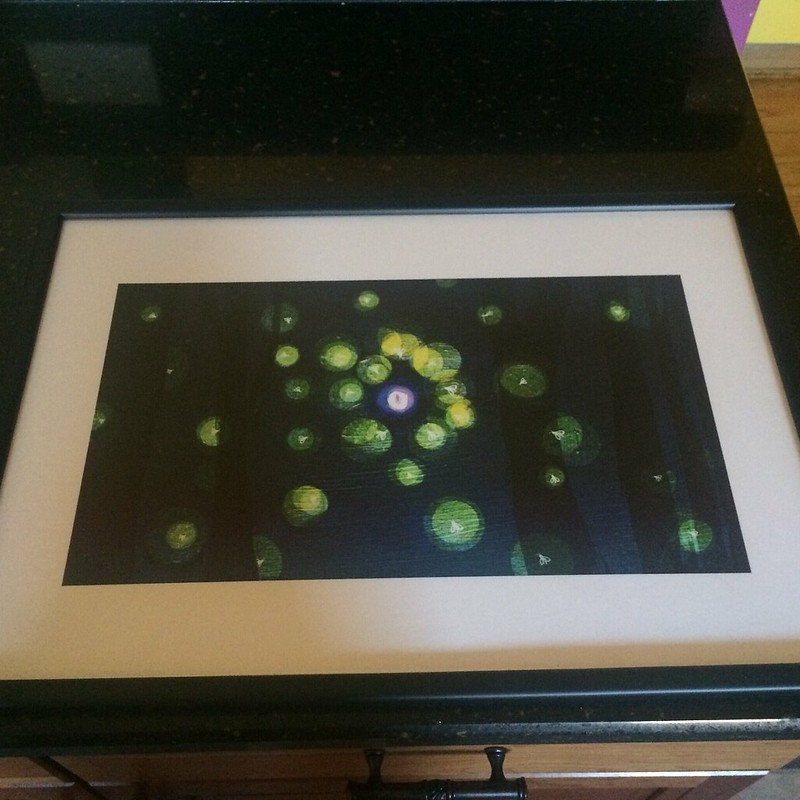
Far away, artist Maria Fabrizio was working on an assignment for NPR; she was to illustrate a story about assisted suicide, which had to be done tastefully. She was reading articles, and saw Eric’s eulogy for Rebecca, and watched the fireflies dance across her lawn. And she thought of us all huddled together, watching Rebecca as her breath slowed and stopped, and decided that fireflies were a metaphor for a beloved passing.
Coincidence or magic, she wove herself effortlessly into our mythology.
And she sent the picture to Eric, who had a print of it made for us. This isn’t as it appeared on the article; she tinted the central firefly purple, to represent Rebecca, and we as the other glows staying as close as we could as she soared away.
It’s beautiful.
As for the other image, it involves no fireflies. It’s just needles in flesh, a permanent engraving to carry Rebecca with me. She got so short a time; I often wonder why the hell I didn’t let her sip my drink. She never had alcohol, never had her first kiss, never got to college. There’s something terrible and bottomless about a girl who never lived long enough to sneak seeing an R-rated movie with her friends.
She’s on me, now. I’ll carry her with me. And it’s foolish, thinking that maybe some part of Rebecca is knotted in my flesh now, watching all the things she never got to see, travelling by my side as I show her all the things she never got to witness in an absurdly truncated life.
But I do think that. And I miss her.
And she’s here.