

On Beyond Two Souls And The Fatal Flaw Of Interactive Storytelling
So I played Beyond Two Souls this weekend, and I absolutely adored everything about it. It had a strong storyline that justified just about every quirky narrative choice, a female lead who my heart ached for, and a large-scale story that ended solidly.
My daughter and I also mocked it relentlessly over the entire weekend.
The problem is that Beyond Two Souls is a videogame in the new “Interactive Storytelling” genre, and the failure mode of Interactive Storytelling is that you wind up pressing buttons to do the most trivial of tasks. (Heavy Rain, in particular, features you using the controls over the course of ten minutes, to get the protagonist off the bed, maneuvering him to the bathroom, working the joystick to shave him properly, turning on the shower, drying himself off, choosing his clothes, during which it is impossible to fail.)
So Amy and I kept shouting things like “Press X to coffee!” and “Press X to shiver from cold!” and “Press X to battle this ever-encroaching sense of ennui!” and “Press X to baby! Baby harder, Jodie! Baby harder!”
Interactive Storytelling is both glorious and ridiculous, and as such it is polarizing in the videogame community. How can you call it a videogame if the game itself is an appendage, this sad dotting of Quicktime events? I’m usually down for a good challenge in videogames, but I put BTS on “Easy” mode because frankly, I’d made a character choice to beat up this faux-Somali on this mission, and I didn’t feel like watching my heroine fail dismally because I forgot which button was the triangle.
Yet there is something compelling about being part of a story. Yeah, you can watch movies, but when you’ve made the decision to either forgive or flay your parents, you get engrossed. I couldn’t wait to see what happened next in Beyond Two Souls, just as I couldn’t wait to see what happened next in Until Dawn, just as I’m itching to complete Heavy Rain even though the controls suuuuuuuck.
The problem is the story’s never deep enough.
See, the issue with all the storytelling games I’ve played is that they promise “Interactive choices!” – by which they mean to imply you can change the plot. But because these videogames are big-budget adventures, graphically beautiful, every genuine plot divergence is millions of dollars put into branching paths you may never see.
So after you’ve played through once, you realize that there’s never any real variance. Heavy Rain is a mystery, but the murderer is always the same person. Beyond Two Souls is a science-fiction action adventure, but it’s filled with lots of dramatic chokepoints of But Thou Must where you’re obliged to kill this bad guy or sneak out of this Navajo home. You control who lives or dies in horror game Until Dawn, but the same sequence of events will play over and over again, with plot-dependent characters being immune until the final scene.
The Interactive Storytelling allows you to make choices. And those choices can affect some of your emotional shading – if I decide to choke my father in Beyond Two Souls, well, he’ll be mad at me. But my dad is leaving forever in that scene regardless of what I do, so the effect is that I feel bad but no events change.
And I think Interactive Storytelling will be forever stunted until they figure out a way to fuse plot and choices. You can be furious at Ryan or you can be in love with Ryan or you can be indifferent to Ryan, but you can never leave Ryan. And they give you all sorts of good rationales for that, because Ryan is your CIA partner and the missions need you, but past a certain point you realize that the stories they tell are constricted because they can only tell stories where you can’t alienate or leave certain people. Every Interactive Storytelling tale in this has people in boxes, and after you play through for the first time you see the rails.
What would really blow the genre way open would be the introduction of true plot-changing decisions. Like Ryan? You keep doing CIA missions for him, and you have a plotline that blossoms into global politics. Don’t like Ryan? You branch off into another storyline where you go it on your own and never see the global politics thread.
Ah, but budgets are tricky, and it’s hard to justify spending hundreds of thousands of dollars on visuals that you’ll never see. If they design a setpiece, they need to justify that you’ll see it, and pouring the cash into a scene that at minimum 50% of the game’s players would never see on the first playthrough because they told Ryan to go to heck is hard to swallow.
(And that assumes you don’t get the usual heavy videogame abandonment rate issues. Lots of people never finish a game. That “50% don’t see it” number might be closer to 80% when you count in the folks who never got that far.)
Yet if you had a true plot, well, you’d have more than one branching plot choice – you’d have this glorious iceberg of a game where 90% of it was hidden from you because you made choices that took you away from fully-fledged levels. One decision early in the game would wall you off from 50% of the levels, and then another crucial decision an hour later would wall you off from 50% of the remaining levels, and so on until you talked to your friends and realized that hey, they played an entirely different game than you did.
That would be a game people would play in droves – assuming the storytelling was equally compelling in every segment, and you’d have to write dialogue and quality controls and graphics for each of these levels that were different, and economically I don’t think it’ll ever work.
As it is, I loved Beyond Two Souls. But I don’t think I’ll play it again. All the differences converge in 24 different endings, and hell, I know what happened until those final ten minutes of the game, I’ll just watch it all on YouTube.
But I long for a game I won’t see. I want a game where my psychic character can walk away from The Institute and evade the FBI and have some plotline utterly unrelated to the ones where the character went to boot camp and became a psychic soldier.
Won’t happen.
But I can dream.
Five Myths About Writers That Non-Writers Don't Get
Hard Work Does Not Equal Talent.
It helps, to be certain. The more you write (as long as you’re writing with the idea to improve), the more you better your chances of creating something magnificent.
But every writer knows some prodigy who writes rings around them. Someone whose talent blossomed much younger. Someone who doesn’t work nearly as hard as you do, yet creates stories of beauty and majesty that you can’t touch.
What sucks about this business is that all you can do is cultivate your own talent. Some people just write better than you do, and you can drive yourself crazy wondering why they’re so good and you’re so struggling. There’s this myth that the person who puts in the most effort magically succeeds – yet just like there are gifted athletes, there are gifted writers, and most basketball players have to come to terms with the fact that no amount of practice will give them Michael Jordan’s instincts.
That doesn’t mean you can’t be on the All-Star Team, though. You just have to remember that every moment lost to envy is a moment you’re not bettering your own skills.
Talent Does Not Equal Success.
What is success, anyway? Is it awards? Money pouring through your door? The adoration of people who admire?
Whatever it is, every writer knows an exception.
There’s always some immaculately-reviewed writer who, somehow, never makes the awards ballot. There’s always some critical darling with a cancelled series and friends wondering why more people aren’t reading them. There’s always some bestselling author fuming about bad reviews.
Look, if publishers knew how to generate bestsellers on demand, they’d do it. But as William Goldman, the guy who wrote The Princess Bride says, “Nobody knows anything.” Publishers buy a bunch of manuscripts because honestly, nobody in the world knows why one novel takes off and another one sits on the shelves. Publishers have thrown million-dollar marketing campaigns at books that landed with a thud, whereas self-published books with an initial print run of 200 copies turned out to be bestsellers.
And then there’s the luck factor. Fun fact: a few months ago, a prominent agent read my book Flex and raved about it. I know that agent has recommended Flex to their friends, because some of their friends have written to me and told me how grateful they were that this agent told them about it.
I sent Flex to this agent.
They were one of the first three people who declined to represent me because they didn’t think Flex was good enough.
But that doesn’t mean the agent is terrible: it means they were in a different headspace that day, or that some minor change I made to the first chapter really made a difference, or that their assistant read it that day instead of them. So much of success involves the right person reading your book on the right day that it can drive you crazy.
All you can do is write the best book you’re capable of, and hope to hell it resonates with the public. It may be a brilliant book, one that broke the hearts of your agent and your publisher and all your friends and all your author buddies, and even then it might flop. And then Fifty Shades of Grey will outsell you a million to one.
The alchemy of writing is mysterious. Success is elusive. And while we’re talking about that…
A Talented Writer Does Not Produce Consistently Talented Works.
The late great Jay Lake had a theory he called The Bathtub Theory, and I’ll quote it in full here (his site has illustrations):
Think of the publishing world as a bathtub.
In that bathtub there is a line which represents the level of professionalism one must reach before one can begin selling pro stories.
Into that bathtub flows the water of your talent and effort.
It fills over time, as you practice your craft, learn new techniques, refine existing ones, submit to markets, apply consistent effort to producing new materials and generally do all the writing and writing related program activities which your favorite pros spend their time at. Note that the waterline is wavy, like a child’s drawing of the ocean. This is because while you have a baseline, or mean, level of quality in your output, at any given point in your career path some work will be better than other work. Variability within an established range, so to speak.
So, as the water of your talent and effort continues to flow into the bathtub, the waterlevel rises up.
At first you sell one or two stories over a span of time. The peaks of your waves have touched the “pro line.” Then you begin to sell with some consistency, still missing sometimes. The midline of your waves has touched the “pro line.” Eventually, if you are smart, persistent, lucky, and most of all consistent in your practice, even the troughs of your waves will rise to the “pro line”.
Think of success not as a point which you pass, but as a state which you enter with increasing frequency.
The point of this is that people seem to think that a Good Writer writes A Good Story. And the truth is, some stories you write are brilliant because you’re on fire, and some stories just aren’t that great. Good writers have a baseline level of talent, yes, so when Stephen King writes a bad story it’s like sex and pizza – which is to say, pretty good even when it’s not good –
– but some stories you write will be wonderful, and some won’t, and damn if you know the difference. Which leads to the next myth…
Love Does Not Equal Quality.
A friend of mine told me that the third book in my series had to be good because she knew I loved these characters so much. “You can tell when an author doesn’t really love what they’re working on.”
Sadly, no.
Again, history is rife with authors churning out classic works they didn’t really care for – Sir Arthur Conan Doyle most notably came to loathe Sherlock Holmes and actually killed him off in the hopes of shedding light on the works he adored more. (It didn’t work.) Those stories were still golden.
Whereas every author has a story they adored that never got the success they’d hoped for. And most writers have a story that fans liked way more than they, the person who actually wrote the story, did.
There is no steady correlation between “the amount of adoration you poured into this work” and “how much people like it.” We wish this was so – but according to Stephen King, Lisey’s Story is his best work, not IT or The Stand or The Dark Tower.
You may be sensing a theme here – that there’s no guarantee in publishing. This may seem frustrating. I assure you, it is. But there’s one benefit to it all…
We Are Not In Competition With Each Other.
I graduated from a Clarion class with seventeen other writers. My classmate Monica Byrne’s The Girl In The Road debuted to fantastic reviews. My classmate Emily Jiang’s book Summoning the Phoenix won awards. My classmate Kat Howard’s upcoming book Roses and Rot got personally blurbed by Neil Gaiman.
Their success does not eclipse my own.
Look. My ‘Mancer series is a crazy urban fantasy series about obsession-based magic and the love of donuts. Monica’s Girl In The Road is a cross-cultural science-fiction journey about a woman who flees assassins by walking across an energy-harvesting bridge. Emily’s book is a children’s poetry book of Chinese music. Kat’s book is fairy tale magic.
None of us are writing for the same audience.
And frankly, even if we were, there’s always room for good stories. J.K Rowling’s success did not mean Lev Grossman’s The Magicians and Scott Hawkin’s Library At Mount Char got squashed, even if they were basically all the same concept.
People want to read fascinating tales, and if you write one they will buy them.
Yeah, it’s sometimes a little intimidating looking at other authors’ sales numbers, but they’re not stealing from my pocket. Rowling got a lot of kids into reading, and chances are a couple of people who were spurred to a love of books by Harry Potter picked up Flex. What matters is the story, and yeah, maybe other authors write better or have bigger sales or are more beloved by critics…
But as always, all you can do is make your own space.
That’s the truth about writing.
Good luck.
"How Do I Get Past My Jealousy?": For Poly Newbies
Like pain, jealousy is a symptom – not a diagnosis. If you have a stabbing ache in your heel, it could be bone spurs, it could be the onset of Lou Gehrig’s disease, or maybe it’s time to take off the stiletto heels.
Jealousy tells you there’s a problem.
It does not tell you where that problem lies.
And when poly newbies ask me for advice, often they say, “How can I get past the jealousy?”
The big question is, should you?
Look. Sometimes the problem is your insecurity. Your partner has showered you with love and attention, you know they’d be there if you really needed them, and yet somehow now that they’re out on a date you feel insignificant and small.
Those times, the diagnosis is “handle it on your own.” Yeah, it’s tempting to interrupt your partner’s good times to ease your own ache – but tromp on your partner’s happiness enough and eventually they start to resent you. And generally, you want your partner to come back from a date and be happy to see you, swept up in multiple loves, rather than feeling like they’ve had a good evening and now must pay the cost with you.
As such, most good polyamorous relationships involve a couple of lonelier-than-you’d like nights while they’re out having fun.
(I suggest getting together with friends. Or planning your own dates! And remembering the nights your partner’s presumably at home when you’re out having fun, and repay their generosity with your own, whenever possible.)
Yet jealousy is like pain. And this relentless focus on “getting past jealousy” often allows monsters to thrive.
Because if this jealous pain signifies an actual problem, the last thing you wanna do is “get past” it. If you’re hurt because your live-in boyfriend stayed at someone else’s house without calling home first, the “suck it up and deal” approach actually is terrible terrible advice.
Sometimes, you’re jealous because someone did something that ignored your needs, or treated you as disposable, or shoved you aside in favor of someone else, and that’s not okay. “Getting past” that is like the guy with shooting chest pains sitting in his chair and going, “All right, let’s muscle past this.”
The truth is, handling jealousy in a polyamorous relationships – particularly beginning ones – is really fucking tough. You need to do is to have the maturity to say, “Okay. I am crawling with jealousy right now. Why is that?”
And the answers to that are knotted with paradox. Swing to one of the extremes, and you’re doomed.
You have to realize that not every spasm of jealousy is anyone’s fault. Accidents happen between good people. Looking for a whipping boy for every bad feeling of yours will lead to disaster…
…yet you have to realize that some spasms of jealousy are someone’s fault because they’re treating you badly, and this jealousy is a pain that signifies a disrespect you should not tolerate.
You have to interrogate your own needs to say, “Yes, I am not afraid to ask for the baseline standards I require to remain happy in this relationship.” Even if they’re silly, or seem stupid, or you can’t properly explain why you need these things from your partner…
…yet you have to be careful not to shovel endless partner-sacrifices into a gaping maw of jealousy that will never close over. You have to know yourself well enough to not fall prey to slicing your lover to death by a thousand cuts, endlessly promising that this new thing they cannot do will somehow ease your pain when it won’t.
You have to look at whether you told your partner this was okay for them to do, and not blame them for acting on a willingly-given permission for something you now regret…
…yet you have to look your partner in the eyes sometimes and say, “Yeah, I thought I was gonna be all right with this, and I’m not, so I’m not blaming you for what you did but man I can’t handle that happening again right now.”
You have to be a bare-knuckle advocate for your own needs, unafraid to throw elbows when you see something that’s required to keep you sane and functioning…
…yet you have to have compassion and empathy for not just your partner but your partner’s partners, refusing to treat them like human dolls to be moved about for your amusement, remembering that they also have needs and working to negotiate towards a center that makes everyone happy, not just you.
All of that’s complex. But it starts with saying this:
“I’m jealous.
“What does that mean?”
The Opposite Of "Unrealistic" Is Not "Gritty"
When I grew up, some moral guardians had the bright idea to “sanitize” kids’ shows. They removed all violence – the Superfriends cartoon, infamously, would not allow the heroes to punch anyone, even villains, so Superman spent a lot of time plugging volcanoes with rocks and Batman spent a lot of his time with his thumb up his ass.
So the comics I read had no drugs. No blood. No swearing. No heroes with bad attitudes, really. No villains who ever won. Just a steady stream of sunny outcomes. Comics were for kids, man, and this is what kids needed.
So when people started writing adult superhero stories in the late 80s, of course they explored all the fallow areas that had been suppressed since the Seduction Of The Innocent scare of the 1950s. Superheroes killed messily, and fucked, and fucked up, and swore, and met nasty endings.
Unfortunately, this sent a message to comics readers that the industry has never recovered from:
Happy is unrealistic.
Depressing is reality.
And so there’s been a pressure in comics ever since to go bloodier, badder, bigger. Anti-heroes are where it’s at – because people who’d stick to their moral tenets are childish. Good characters get stuffed into fridges because callous murder is the only way to motivate someone, and really, isn’t brutally killing someone the act of a mature narrative? The darker you can get, the better.
This has culminated in Zack Snyder’s Batman vs. Superman, where Superman murdered his opponent in Man of Steel and now, apparently, Batman’s got no problem offing punks either. Both heroes have blood on their hands, and it’s a dark grit-fest where people get tortured and slaughtered because hey, that’s how the world is.
The problem is, it’s not.
Look. I like dark. If you read my books, Flex starts with a daughter being hideously burned in a fire, The Flux has that same daughter being trained to kill by a sociopathic pyromaniac, and the upcoming Fix has a protagonist betraying everything they hold dear. There’s plenty of downer moments in my books.
But life also holds moments of transcendent beauty, and if all you ever do is show dark then you’re just the polar opposite of those 1970s Superfriends shows – all graphic violence instead of no graphic violence.
I write huge, apartment-destroying magical battles in my ‘Mancer series, but what people remember are the donuts. Because in the ‘Mancer series, donuts signify connections with other people – the weird laughter folks have even in the midst of total tragedy. And the best narratives (not that I’m saying mine are) mix dark with light to create a chiaroscuro of happiness – the dark moments seem more frightening because we’ve had that ray of hope to cling to, and the happy endings seem more earned because we know this wasn’t some sanitized, preordained ending.
When it’s all dark, we’re staring at a flat black wall – maybe you can make that wall impressively large, as Snyder seems to have done, but eventually it all looks the same.
Sadly, Snyder and DC have inhaled the most childish idea about superheroes – that the opposite of “unrealistic” is “gritty.” And they’re selling this concept with bold spectacle, which appeals to some people, but ultimately what you’re getting are not heroes, but “men with power.” And there is a difference.
Snyder went on record at one point of saying that Superman had to kill someone, for how else would he know it was wrong? And man, isn’t that a terrifying statement about cops, who each presumably must have a body buried somewhere to explain their being drawn to the law?
No. What Snyder is doing is buying into the idea that every story must have a murder to be Mature, and mean joyless people are Grown-Up, and he’s Very Concerned with telling a story that’s Adult and Not Childish. And sadly, he’s selling that joyless vision to DC at a time when Marvel is eating their lunch by telling stories about heroes who face the darkness and yet emerge triumphant. (Don’t tell me The Winter Soldier isn’t dark and gritty when the Soldier is gunning down civilians on a highway as Captain America tries vainly to stop him.)
You have have your darkness. Just leaven it. Have a few honest laughs, a few characters you root for who don’t get tortured, a few moments of good men on the same side.
Trust me. It’s a better story.
And before I go, let me quote an essay from Leftover Soup author Tailsteak, who says something very wise about Superman:
Okay, time for a controversial opinion about Superman. Ready? Here we go:
A haiku is not merely an art form – it is a puzzle. It is a challenge to fit what you’re trying to say into 5-7-5 as elegantly and naturally as possible. If you write a poem that’s 5-7-6, you have not created an ultrahaiku. You have not challenged a stodgy tradition in a bold and innovative way because you’re a rebel. You have failed at writing a haiku. Your poem may be beautiful and moving and a wonderful work of art, but it is a nonhaiku, and if you include it in a book with “HAIKU” on the cover, that cover is false advertising.
If you write a story about an alien superhero who – despite having near-infinite godlike powers – is placed into a situation in which he has no choice but to take a human life and then feel really really bad about it, you have failed at writing a Superman story. You aren’t a bold and creative rebel who’s defying tradition to show a world that’s dark and gritty because that’s what real life is really like. You are a failed writer who has failed to write a Superman story and your comic with Superman on the cover is false advertising.
Superman has effectively infinite strength and speed, so showing him fistfighting a robot or throwing a mountain into space is boring. Having him lose his powers and struggle to get them back is stupid. That’s why they’ve never made a decent Superman video game – they’ve all been action adventures.
A Superman story shouldn’t be an action adventure – let Batman and the other mortals have those. A Superman story should be a puzzle. Watching Superman thwart evil – without taking a human life or committing a crime or even telling a lie – should be like watching a man use a backhoe to repair a pocketwatch.
He’s correct, you know.
Hi. I Don't Want To Have Sex With You. But I'd Like To Hang Out, Somehow.
So I went to get my nails done the other day. And next to me was this pretty blue-haired girl.
When I mentioned Harry Potter as part of my conversation with my manicurist, she perked up. We all started talking together about Universal Studios and Disney and trivia quizzes about the best parts of Harry Potter, and then it was time to go and I fumbled about awkwardly and then left.
Somehow, saying, “WOULD YOU LIKE TO BE FRIENDS?” seemed weird to a total stranger.
And I had no ulterior motives. I joked with my sweetie afterwards, who had gone with me, that I could have held her up as proof: “I’m full up on dating! She’ll tell you! This isn’t about that! You just… seem neat.”
But then I thought about navigating those weird waters, trying to say “This isn’t a date” when in fact that’s what every quote-unquote “nice guy” schmuck says when he’s hoping to sneak into somebody’s pants through the act of friendship, and watching her face as she determined my level of creep, and doing that in front of my manicurist and the whole staff, and….
I left.
And the truth is, it’s kind of hard to make friends. There’s that awkward transition where you meet someone on a plane or at a bar, where you’ve enjoyed this conversation but you’re not quite sure whether this enjoyment extends to multiple engagements, and you’re worried you’re going to ruin this nice chat you’ve had by giving the foul aftertaste of “Then he hit on me,” and so it’s easier to just leave it on the ground.
Gini says you gotta treat it like you’re six years old on the playground. Just walk out across the sandbox, arms out, and shout: “WANNA PLAY?” Which is great if you’re an extrovert and don’t mind embarrassment, but for me I often find myself thinking of people days later, wondering Hey, do they still think about me? And if they did, how could I possibly find them?
I probably have potential friends scattered across America, hanging snippets of ten-minute conversations. We connected, in those brief timeframes, but neither of us knew how to break that icy embarrassment of not wanting to intrude, not wanting to be eager. And having been caught in a couple of awkward snafus where I was making polite conversation and someone wanted to be best buds, it’s not the worst thing to default to walking away.
Still. She was nice.
We coulda hung.
Or at least I think we coulda.
My New Nails! Batman vs Iron Man vs Superman vs Captain Americaman
So as usual, I went to my Mad Manicurist Ashley with a challenge: “Batman vs. Superman is coming up. So is Captain America: Civil War. ENTER MY HANDS ONTO THIS BATTLEFIELD.”
And so she did!
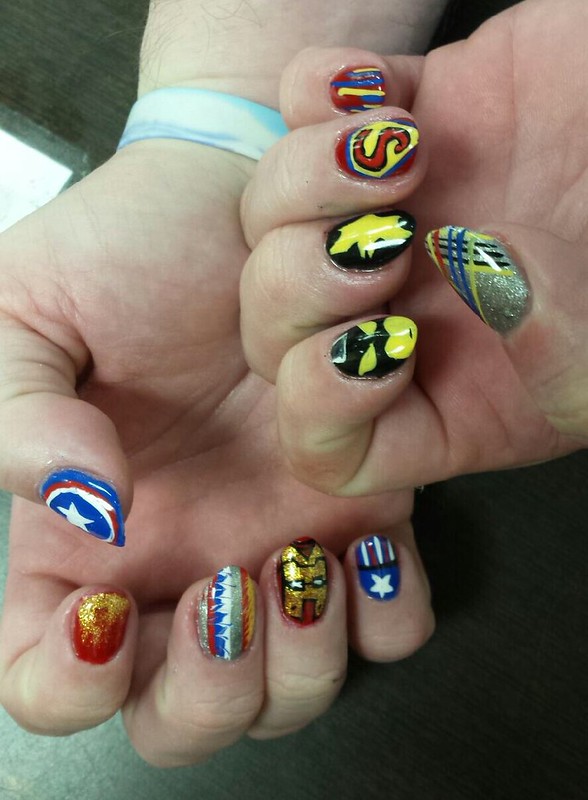
The smeared “pizzazz” nail in between Cap and Tony is, I think, my favorite.