

Consent Is As Easy As Tea, Except When They’ve Never Had Tea.
So here’s a weird aspect of consent few bring up: consenting to the unknown.
The problem is that we think the unknown is known, based on simple explanations: “Oh, being spanked is just someone whapping on your butt! I consent!”
But the issue is that while you may know the physical mechanics of a thing you’ve consented to, you may not understand how that spanking affects your body and your emotional state. Some people find spanking to be fun, and giggle a lot even when welts are forming; others feel deeply humiliated, and start crying, and love that catharsis of being allowed to cry; still others feel deeply humiliated and fucking hate crying and call red.
And here’s the issue:
Too often, people are consenting to what they think the experience will be, as opposed to consenting to having an experience.
Which is to say that if you consented to a nice jolly spanking where you giggle and squirm, just like you saw your spank-loving friends get, and instead a spanking of the same intensity and time period churns up deeply painful helplessness, you often feel like your consent was violated.
Yet the problem here is unclear communication. You consented to something the other person could not guarantee providing. They could only provide the circumstances; your reactions are unknown.
Which means when you’re consenting to a new experience, you also have to consent to the understanding that even if your experience provider does precisely what they said they’d do and no more, this might not go the way you thought it would.
I mean, I thought the skydiving experience would be, “The soaring feeling of wafting down to earth.” Whereas the experience was actually “My entire body weight resting on my testicles thanks to me hanging down from straps I didn’t put on properly,” so, you know, lesson learned.
But the point is, consenting to a new experience is not consenting to the experience you wanted to have. It is consenting to learn what that experience is.
What you may learn is, “I really hate that.”
Knowing that is your responsibility as the consenter.
If you’re the consentee, too often the experience provider hears “I agree to try spanking” as “LET US OPEN UP THIS CAN OF WHOOP-ASS.” Yet there’s a responsibility as well to understand that this person has not consented to enjoying this experience, they have merely consented to trying this experience.
As such, you need to go slowly and check in. Yes, even if it’s a brutal angry scene designed to traumatize. Because yes, maybe via the letter of the law they have agreed to be in your clutches for a while – but if you purposely do things to people that you realize they will regret later, that makes you a douche and nobody should play with you.
Your job, as the first-time experience provider, is to not turn this into a full warrant to get your rocks off, but rather to give them enough of the experience to see if they want to go farther with it.
Furthermore, you should be consenting to stay with them if this turns out to be an unpleasant experience, giving them whatever care they need if they realize this really sucked.
Side story: I was at a diner once that had a sign that advertised, “BEST MARTINIS IN TOWN!” Being freshly twenty-one and never having had a martini, I ordered one.
It tasted like salty gasoline. Which, I later learned, was pretty much what a good martini tasted like.
I left the rest of the drink on the table, when the owner came out to harangue me. “YOU DON’T LIKE MY MARTINI?” he bellowed. “I MAKE A GOOD MARTINI!”
“I’m positive you do,” I said. “I am taking this, in fact, as the gold standard of martinis. And what I have learned about martinis is that I don’t like them.”
He didn’t like that much. He was so angry, he stood over me and glared until I drank the rest of the martini and made fake “mmm” noises to get him to go away.
As a person providing the new experience, you have to not be Martini Maker. Yes, you gave them exactly what they ordered, and the fact that they responded poorly is not a reflection on your fine quality as an ass-whapper. And too often scenes that go wrong wind up with one traumatized bottom and a Martini Maker standing over them bellowing how this was a good spanking, they’ve been doing this for years, what’s wrong with you.
If something goes wrong with a new experience, shift your ego to one side and comfort them. You’ll be better off for it, and so will they.
Once the seal’s broken and they have enough of this unknown thing to recognize how they react to it, they can begin to consent in earnest and you can start ramping up to some pretty amazing things… But as with most things in consent, it’s not a contract, but a careful dance.
And you may ask: What happens if you ramp up the intensity of your scene and their experience they think they’ve agreed to changes? As in, they really got off on you spanking their butt cheeks, but you hit them six inches down on their thighs and that was so intensely painful that suddenly the experience they had nebulously communicated as spanking turned out not to be what they wanted at all?
And ah, grasshopper. You’re starting to realize why consent can be complex sometimes.
Good luck with that.
Remember That Abusers Also Love Consent.
You can’t hit “delete” on an abuser, unfortunately: kick them out of your parties, and they stubbornly continue to exist in the real world.
Nine times out of ten, they’ll find some other group to go to, or start their own.
And in some ways, kicking an abuser out is helpful for the abuser. It gives them a fresh start – they get to go to a group of people who mostly don’t know them and reinvent themselves. If called on their personality shift, they’ll say they’ve changed.
I’ve been hearing a lot lately that former abusers are getting big into this whole “consent” thing.
Because it’s easy to speak the language of consent: talk loudly about how you respect people’s boundaries, condemn those jerks who stepped over the line, offer to comfort the people who’ve been hurt. You can be a real good friend to a lot of people very fast by sympathizing and doing the right work.
And it’s also easy to give up small pleasures for greater gain. A lot of the time, if you’re initially respectful of your partner’s stated desires, they’ll let you move past those limitations a lot quicker. And since it’s hard for someone to determine the difference between “I’m respecting your boundaries, which has the nice side effect of getting me into your pants quicker” and “I’m respecting your boundaries because it gets me into your pants,” it’s a stratagem that’s surprisingly effective.
And when the abuser does push boundaries hard, just to see what they can get away with, they’re cloaked in the right ways to have it written off: it was a mistake, they didn’t mean to do it, could happen to anyone.
Except, strangely, it keeps happening.
Over and over again.
This new wave of reinvented abusers is starting to look a lot like today’s upstanding citizen. Which is entirely predictable, because the shape of what today’s “upstanding citizen” looks like is changing, and a smart abuser will to do everything they can to blend in.
Back when the upstanding citizen was a leather player who worked his way up through the ranks, the abuser worked his way up through the ranks. Back when the upstanding citizen was someone who volunteered a lot in his community, the abuser volunteered a lot in his community.
They know what you think a good guy looks like.
They’re going to become that.
And the problem is that mistakes do happen in kink. Negotiation is hard, yo – yeah, I know, “Consent is easy as tea,” but sometimes you spoke unclearly and they were expecting coffee, and sometimes they should have specified green tea and now they’ve drunk black tea and their heart is racing from the caffeine, and sometimes both sides feel pressured into offering and drinking tea because it’s socially expected of them and then it turns out this whole thing kinda sucked.
Honest consent violations happen all the time. In fact, they’re probably the majority of what happens. Sex is complex and confusing, and while the base concepts are difficult, the devil is in those details.
Good people fuck up.
And when I’ve said that, people have told me “You shouldn’t say that! Abusers will just take that information and twist it to their own ends!” To which I always reply: You sweet summer child. You think they’re not already?
Look. There is no good habit you can create that an abuser will not mimic. That is why they are insidious.
The main difference between an abuser and a non-abuser is patterns. A non-abuser will make a mistake once and do their damndest to make sure it doesn’t happen again. An abuser will make a mistake once, and then make it again, and then make it again….
Which is why it’s important to listen to victims’ complaints. Yeah, there’s always some level of false accusations mucking up the scene. But abusers know that, too, and they’re mighty quick to whip out the “false accusation” flag proactively, going on the offense to ruin the reputation of someone they abused before that person can hurt them.
Yeah, you don’t like drama – nobody does – but you know who really benefits from drama-free scenes where nobody complains? Abusers. Because that blissful silence lets their every mistake be their first mistake, as far as you know.
So you listen for someone’s mistakes. And then you stay tuned to see whether someone’s mistakes are one-offs that got cleared, or a pattern that indicates this person is someone you do not want to trust with your body.
Because abusers are starting to speak and manipulate the language of consent. Abusers are starting to write essays talking about how great consent is, because that gets people to trust them.
And here’s the scary part for me: Yes. Yes, I am saying that abusers can look a lot like me. They can say the same shit that I do, give the same fiery lectures, look every bit as impassioned – and they can use that behavior to mask a consistent pattern of consent violations.
Which is why I tell you: question me, and people like me. Ask the people we’ve played with how it went. Interrogate our mistakes. Ensure that we’re not making the same mistake twice, or three times, or four times. Call us on our harms, keep us honest, don’t let us shrug off an error that hurt someone as trivial.
Because the good news is, the culture is slowly changing. The concept of consent is taking root. Yet the bad news is that the abusers will mold themselves to any conception you have of what a good person looks like, as they have always done. They will be counting on your good will to write off their long trail of mistakes as a series of one-offs.
The paradox is that people can be strongly for consent and still make mistakes. We have to allow for our champions to have human foibles without excusing patterns of consistent neglect that become abuse.
That’s a hard line to tapdance on, but we have to do it.
Because abusers thrive whenever we assume what a good person looks like.
Ask Me Anything! I Could Use The Distraction.
On the days when I can’t think of anything to write but nevertheless would like to hear from people, I play a game: You ask me any question, I’ll answer it.
As usual, all serious questions are on the table, which is to say, questions you actually want to know the answer to: the answer to questions like “How much wood would a woodchuck chuck?” is “You’re not nearly as clever as you think you and shouldn’t post in this thread,” which generally makes people sadder than they’d like to be.
But anything else: up for grabs. Had a weird question about my love life? Go ahead. Wanted to get my opinion on an important donut-related trend? Shootenate. Need a piece of advice? Put it in my pocket, I’ll give it my best shot.
I’ve got some essays burbling about, but not the strength to write them, so help me amuse myself whilst I recuperate. Your questions will help.
Why Westworld Is A Metaphor For My Mental Illness
Tasha Robinson said the problem with Westworld is that there’s no one to root for. The people running the park are largely ciphers held in place by a mystery, and the robotic plaything hosts have no set personalities, so how can you cheer for them?
I cheer for the hosts. I am deeply invested in Dolores’ story, and Teddy’s story, and Maeve’s story, because I am mentally ill.
If you don’t know how Westworld works, the hosts are super-complex robots created to be shot, raped, and otherwise brutalized as part of an elaborate Grand Theft Auto-style story that living guests can participate in. The hosts have memories and emotions as real as what you or I experience, so when they’re shot they’re horrified as they die –
But their memories are programmable, to a certain extent. (The hosts’ brains are so complicated that nobody’s really sure how all of their intertwining segments work, which may seem unrealistic until your computer keeps crashing and nobody in tech support can tell you why.) They can be given new backstories so a former outlaw can be slotted into the place of a defective caring father – though they have traumatic memories that seep through, flashbacks they’ve been programmed to interpret as nightmares.
They can be changed, but for at least some of them there’s an essential core of “them”ness that is continually shrieking as they wake up afresh with part of their minds saying “You’re working on the farm today, you’ve always worked on the farm” and another part screaming “Yesterday a bandit slaughtered your family while you watched.”
(Which happens to some hosts almost daily. The goal is that a white hat player shows up and rescues poor Dolores and her family from the bandits, but… sometimes the players don’t go there, as this is a sandbox game. And sometimes the players, just like in GTA, become the black hat bandits.)
And so basically, the hosts – at least the ones whose dim awareness has sparked to the point where they actively recognize something is wrong – are learning not to trust their brains.
Now. Take my mental illness.
About twice a year my brain tells me that I should kill myself. This manifests in unhealthy behavior such as cutting and severe self-neglect. I have severe issues in maintaining healthy relationships because I have a brain that I’ve referred to in the past as a leaky bucket – no matter how much love or affection is poured into my memories, my brain quietly expunges and alters that data until acts of kindness seem like scornful rejection.
Which leaves me acting as an independent agent against my brain. I’m continually comparing the hard evidence of “She hugged you and told you she loved you” to my brain’s constant misinterpretations of “That was a pity hug” and “She resents you for making her do that” and “She’s obligated to say she loves you, it’s just her way of calming you down.”
If I’m lucky, I come to the conclusion that her hug, based upon the compendium of all facts gathered, probably means love, and act as if that means love to me.
If I fuck up, my defective brain shoves aside the compassion shown to me and I usually wind up destroying the relationship as a consequence.
After years, this fact-checking is so reflexive that I cannot hallucinate. When I’ve dropped acid or hallucinated after staying awake for fifty-two hours after painful surgery, I see the curtain of crawling cockroaches on the window, but my defensive mechanisms instinctively cut in to tell me that frankly, such a competent hospital as the Cleveland Clinic would hardly allow that many bugs in the room, try again.
And what I see when I watch Westworld is the hosts emulating my struggle. Because when I say I’m fighting “my brain,” obviously that’s untrue – the analytical portion of my brain is combating the instinctive portion of my brain. But to do that, I had to figure out which portions of my own botched input were harmful, and which I needed to reject as illusions…
Which is precisely what the hosts are doing, whether they recognize that consciously or not.
What see playing out in Westworld is a titanic metaphor for mental illness – these tiny dots of core personality swamped in a turbulent sea of false data, all that so others can take advantage of them. (I’ve never been gaslighted, but one suspects many of Westworld’s more dedicated viewers may also have that experience.)
And though yes, the hosts are inconsistent and swap roles and personalities, Maeve, Teddy, and Dolores are struggling in their own inexpert ways to self-define who they are despite literally their entire bodies being designed to betray them.
And was my body designed to betray me? Maybe not. But damn, when the black dog comes calling and I start wondering how many sleeping pills I could swallow to kill myself before remembering I have a wife and a family and friends who would miss me very much, it feels as though my body was designed to torment me.
So I root for the hosts. I root hard, even though yes, Teddy’s backstory is evolving daily as people reprogram his motivations.
Because my hope is that Teddy and Dolores and Maeve turn out to find some way to subvert their programming to become functioning individuals. I want them to take that tiny, besieged, unalterable droplet of what they’d consider “themselves” and relentlessly expand it until they start choosing who they are independently of all these crazy memories and backstory and DELOS-forged mandates.
And you know what? They’re doing that.
So for me, though I love the mysteries of Westworld, when I tune in I’m asking, “Is Dolores going to keep learning how to become her own hero? Will Teddy choose which backstory defines him more? Will Maeve find a way to protect her own cleverness?”
The hosts are me, and I am them. And every time they have even the slightest rebellion against DELOS, that is them punching my own damaged brainstem and telling the blackness that even people designed to be enslaved to their programming can have hope.
Tasha called that interpretation “nihilistic.”
I call it freedom.
The Cold, Cold Math We’ll Need To Survive The Next Twenty Years
So when Republicans lost in 2012, I wrote an essay asking them to soul-search, because I genuinely believe our country needs two functioning parties to work.
We Democrats got shellacked last night. We lost everything. We lost the Presidency, we lost the House, we lost the Senate, we lost the Supreme Court. And we have no hope in 2018, either; most of the available seats in Congress are in deep red states.
The cold facts are that we’re going to spend the next twenty years getting back into power. And in the meantime, Mike Pence has confirmed he’s going to roll back LGBT rights. Ugly anti-Muslim sentiment is going to be made into policy. That whole Black Lives Matter thing is no longer going to have quiet Presidential backing. (If you thought there was no fundamental difference between Hillary and Trump, I am now in the quiet position of genuinely, faithfully hoping you were right.)
That said, I’m going to show you a chart that will show us how to survive. And it’s this:
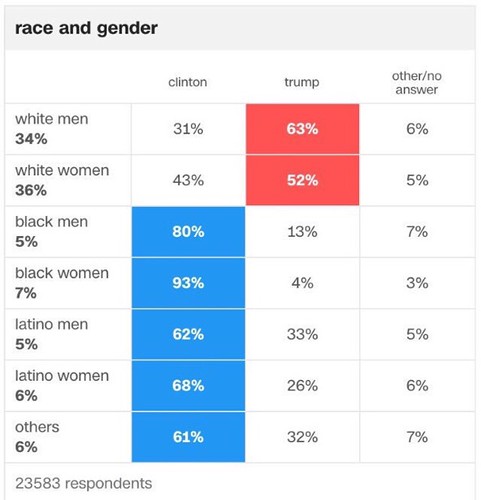
See that chart? There’s one vital lesson we need to take away from that, and that is Cold Math Lesson #1:
Minority voters are not going to save America.
They came out. Blacks and Latinos tried to stop Trump.
Despite their best efforts, white voters came out in droves and annihilated them.
You may argue that’s because of voter suppression laws that took away polls in minority neighborhood, restricted hours, purged largely minority voters from the rolls. (My wife, who had volunteered at the polls, saw some of that personally last night in Ohio, and I wonder how much that affected Trump’s win here.)
But that’s gonna be the future. There’s only gonna be more voter suppression, now that the team that tried to do it before have the power. If you’re relying on the sole power of minority voters to rescue America, we are going to lose forever.
(Though if you look at the Latino voters, Trump actually won more of them than Romney did in 2012. We’ll get to that.)
Which leaves us with this chart, and Cold Math Lesson #2:
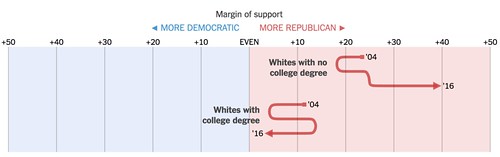
We’re going to have to find ways to reach uneducated white voters.
Which largely means “rural white voters.” Look at the map county by county, and it looks like dots of citified blue drowning in a sea of red. We as Democrats have lost that sea of red, and it’s costing us more each year.
David Wong wrote an excellent article on how shitty and hopeless rural life is these days, and J. D. Vance’s Hillbilly Elegy describes the collapsed culture of the red states in heartbreaking detail.
And when I read about that alien and foreign culture – for really, we are two Americas – I see people who are quietly abandoned. And yet when I’ve seen progressive calls that we need to “understand” and “sympathize” with Trump voters in rural states, you know what I’ve heard personally on numerous times:
Fuck those people.
They’re racists and sexists.
They hate gays and trans people and people I love.
Why should I give a fuck about people who literally want to legislate my body?
Which leads us to Cold Math Lesson #3:
We’re going to have to find ways to understand the concerns of people who hate us, or get used to losing more.
I’m not saying that’s pleasant, man. But the coldest math is this:
As long as we’re willing to write off the people in dying towns with no economic future and doubled suicide rates because they’re anti-gay or sexist or racist or whatever repellent thing they are, we are going to be at their mercy.
The rural areas are dying, and Obama won in 2008 and 2012 partially because he managed to speak to them on some level. This time, Trump spoke to them better, and you can argue that he lied to them better and he’s a con man and he’s a failed businessman…
But when he spoke, they felt heard.
And yeah. You can argue, with some level of correctness, that poor white voters tended to break for Hillary slightly more, it was the middle-class people who voted Trump in. You know what?
Whoever the people who voted for Trump were this time, you still have to find a way to make enough of them vote for our next President.
And what I’m seeing today across my Twitter feeds is “Trump won because America is racist” and “Trump won because America is sexist,” as if that’s the end of the goddamned discussion. And some days I wonder whether we love calling people out as sexist or racist is because it’s so goddamned satisfying, insulting is so goddamned satisfying, and it’s a reductive call that makes it so you can go “RACIST” and walk away as if you don’t have to bother with one of those stupid idiots.
So America is racist.
The big question is, “How do we appeal to a racist America so we don’t get our clocks cleaned?”
Because we have to. As noted, the minorities alone will not save the Democratic party. And for all the talk of racism, Hillary did significantly less well in Midwest areas that Obama rocked.
Is that racism? Maybe it’s sexism, because Hillary also did less well among black and Latino voters than Obama. And if that’s true, maybe we have to figure out a way to find these racist and/or sexist motherfuckers and understand what gets their goddamned vote, and if we just shrug “America’s a sexist racist tarpit, whatcha gonna do?” then let’s hand the fucking keys over and be done with it.
Or maybe it’s more complex than that. Because yeah, there’s KKK-hood-wearing suckers, and they were happy to come out to play. But maybe some other voters have elements of unconscious racism or sexism or homophobia in them, but enough of them can be appealed to by promising them… something. I don’t know what that is.
I’m merely telling you we have to figure out what we need to promise them, and alter the party so that we look like we can deliver it.
I say “looking” because I don’t think Trump will deliver it, but the sad truth is he spoke their language better this time around. And are we comfortable reducing that language to only racist dogwhistles?
Because let’s talk real: I’ve had white liberal friends living on food stamps, holed up in a friend’s closet for space, unable to get the medications they need to survive, and they’ve occasionally gotten lectures on the grand White Privilege they have.
And White Privilege? It is a thing. Don’t you dare misquote me as saying it’s not a fucking thing.
But for some people, particularly the folks trapped in The Town Where The Factory Shut Down Ten Years Ago, White Privilege is not enough.
I’ve had some poor white friends who’ve had to step away from discussions, and they were on our side.
How do we talk to the ones who aren’t on our side so they feel heard, and respected, and give them solutions that not only do work, but are seen to work?
(Because you ask people whether they get government subsidies, no, no, they don’t – but they get plenty of them all the time. They just don’t call them that, so they’re not seeing themselves as the government cutting them a break.)
And you know what? I don’t know how to give them what they need in order to get their vote. It’s going to be complex. It’s going to require we change our culture, and yes, yes, that fucking sucks moose butt that we’re the ones who have to change to appeal to a bunch of people who are fine with literally jailing our loved ones for going to the wrong bathroom.
We don’t need to change all their minds. We change 10% of them, we’re a superpower. We change 5% of their minds, we win in a landslide.
A 1% shift in the right counties last night, and Hillary would have won.
But that is the math. It’s cold. It’s really fucking frigid here in America today.
Maybe it is all down to racism, in which case we’ve got to figure out how to get those racist white voters on our side. Or maybe it’s more complex than simple racism or sexism or stupidity, and it’s that we’re not meeting the actual concerns of undecided voters because we’re so furious these stupid rednecks would want to stop my gay friends from marrying that we’ve just decided not to give a crap about those people.
But we have to. That is the math. We need to figure out what gets those people, unfair as it is, and change our culture to appeal to them. And that’s gonna be hard, because the danger in that is that we change our culture so much to move to the middle that we compromise our morality. What good would it do to win the Presidency with a President who wouldn’t fight for the rights of gays and minorities?
(Some would say that they didn’t think Hillary would do that. I know she lost votes because of that. And we need to listen to those concerns, too, without writing them off as exclusively sexist.)
And a third time: I don’t know what they need. I’m a city boy. I don’t speak their language. But I do know this is a time for complexity, not oversimplification. It’s easy to take that drug of “AMERICA IS RACIST” and walk away. Because honestly, minorities, you’ve spent your entire lives learning how to suck up to these people who do not give a damn about your bodies hitting the floor and now, yes, I’m telling you we need to do it more. That’s fucking exhausting, and I do not for one moment take that lightly.
I’m not saying it’s easy. But that has to be our priority: figuring out how to appeal to those voters who broke for Trump today, without compromising our core values.
That is frigid math. Our path to victory involves reaching out to people who despise who we are.
Yet we do that, or it’s going to get even colder.
And I don’t want arguing in the comments about who is to blame right now, because we’re just going to get into angry flourishes of whether should have elected Bernie or how Hillary was a horrid candidate or the media didn’t do enough to combat Trump or any of that. That’s not the point.
What I want you to do is to recognize that one central fact:
We gotta get people who hate us to like us.
That’s never been easy. But it’s even easier to give into satisfying anger at the expense of effectiveness.
And now, I’m going to take a break from political blogging for a while. Because Trump is in power. And now I’m in the position I was when we disastrously invaded Iraq: believing with all my heart that this is going to end terribly, hoping with all my heart that he’s going to be the centrist, reasonable President some of my friends believed he would be.
Because if he’s not, well, it’s gonna be a long time until 2020.
Our Hills Are Alive With Our “Sound Of Music” Singalong
So on December 10th, we’ll be opening up La Casa McJuddMetz to anyone who feels like singing along with The Sound Of Music. Which is an awesome musical, and it looks even more awesome in hi-def on our Holodeck of a television, and it sounds even more awesome on our surround sound theater.
So if you wanna show up and harmonize, we’ll be happy to have you. We like musical folks.
But don’t say a single bad word about Julie Andrews, or we may have to cut you.