

Call To Save The Affordable Health Care Act Now, Or You’re Going To Lose It.
So the Republicans voted last night to show what the repeal of Obamacare (a.k.a the ACA) will look like, and it looks grim:
- They’re getting rid of preexisting conditions, so insurance companies can drop you when you get sick;
- They’re not allowing children to stay on their parents’ health care plans until they’re 26;
- They’re getting rid of contraceptive coverage.
It is important to note at this point that they’re repealing the ACA with no replacement plan. They claim they’re going to put in a replacement at some point – but if you’re a conservative who believes this, I ask you, “Is now the point where you start trusting politicians?” (And they haven’t settled on a plan, which is because nobody can agree on a plan, which means that in the way of politicians they’ll repeal the ACA and then kick the replacement can down the road while innocents suffer.)
(And Trump will not veto the repeal if it passes. If you’d like to argue this, I will bet you $50, placed into escrow in a third party, that he will not. Put your money where your mouth is.)
The ACA hasn’t been repealed yet, they’ve just laid out the blueprint for how they intend to repeal it. You currently have 36 hours to call your Senator and save the good portions of the ACA. Yes, even if your Senator is a conservative.
Here’s how you stop that:
CALL, DO NOT EMAIL.
Politicians can ignore emails the way you do. They can’t ignore calls. Their staffers have to take the calls, which means their staff doesn’t get anything done while they’re handling calls, which means the Senator is far more likely to hear about how the office is slowing to a crawl because the ACA issue is jamming the lines.
In addition, most Senators don’t get that many calls; under normal circumstances, 15 people calling a day is *huge*. For an entire state. If you can get 50, that’s usually off the charts. So even one call can make a significant difference.
(For the record, I’ve called my very conservative Senator four times, and twice he’s reversed his position. In one instance, it was specifically mentioned that the call volume on the issue changed his mind.)
SAY YOU’RE A VOTER FROM YOUR TOWN.
Let them know you’re local. Calling Senators when you’re not a potential voter generally does diddly. You do not have to give your name, though you can if you want; they may ask you for your zip code.
HAVE A SCRIPT READY, IF YOU’RE SOCIALLY AWKWARD LIKE ME.
A good script is something like:
1) I’m disappointed in last night’s Affordable Health Care act vote;
2) Please do not repeal the ACA without a strong replacement (they’re going to repeal it, the idea is just to keep the parts that keep people alive);
3) If you have a preexisting condition or the ACA has helped your life in some way, talk about that and make it personal how your life (or the life of someone you love) depends on this;
4) I will not vote for any Senator who helps repeal the ACA without a strong replacement, either in the primary or the general election.
You’re free to go on, if you like, but be polite. They kind of have to listen. In my experience, they’ll generally say they’ll pass the message onto the Senator, and hang up. But if you want to be that person who the office groans when they have to handle them – that polite-but-firm person who will be heard – then hey! You can contribute to the office gossip that people are *really* concerned about this ACA issue, which is good in politics.
CALL YOUR SENATORS, NOT YOUR REPRESENTATIVES.
That means you have to make a maximum of two calls, which will take ten minutes max. (Unless your Senator’s line is already clogged, in which case, keep calling.)
You can generally look up your senator by using Who Is My Representative, but if not you’ll find a phone number on their website. Calling the local number is generally viewed to be slightly better.
And here’s the trick: If you’re a conservative who’s opposed to mandating that insurers must be able to insure people with preexisting conditions (for some reason), flip the script and call as well. This is a republic, and you deserve to have your voice heard.
That said, I fully expect the ACA will be repealed without a replacement, and politicians won’t bother to replace one for years, if ever. If you don’t like that very real fact, then call now. The vote’s going up very soon. You have until Friday evening to get your calls in.
Call now.
TWO EDITS:
1) Some people are suggesting calling the “pivot” Senators who live outside your state. As a former Congressional staffer told me:
“If someone is not a constituent (and I worked for a progressive D who was very welcoming to all) they will politely take your info and toss it. Their salaries are paid by their district and that is where their focus has to be. That is why it is so very important to call *your* representative and voice your concerns.”
Calling the Senators you don’t vote for is wasting your time – if you want to do it, fine, but call your home Senators first.
2) Other people are asking, “Is it worth calling my Senators if they’re already supporting the ACA?” My response is, “Telling the Dems that this is important helps make them realize their next election hinges on satisfying the liberals, not the conservatives.”
My Book “Flex” Now Available In Large Print And Braille!
If you’ll recall, my mother is legally blind. So this one means a lot to me:
My novel Flex is now available in large print and Braille for anyone who wants to read it. (I’m unsure if this applies outside the UK, but still.) Which warms my heart; I know of some sight-challenged people who’ve been “reading” Flex and The Flux on audiobook (I’m told Fix will be coming along soon), but it’s nice to actually be able to read at your own pace, in your own voice.
While we’re discussing “Things for sale,” I should also add that my upcoming novel The Uploaded is still available for pre-order at Amazon and Barnes and Noble. Initial editorial feedback says that it “provides a new take on both the cyber and post-apocalyptic genres.” Which is a nice way of saying “Ferrett can’t do anything that anyone else has tried before.”
Oscar Movie Reviews: La La Land, Moonlight, Manchester by the Sea, Hidden Figures
Every year, Gini and I watch every Oscar “Best Picture” nominee… well, except for last year. And then the Oscars sucked.
Because the Oscars get way more exciting if you’ve seen the films involved – it shifts from “Oh, Leonardo won! Good for him!” to a frothing “I SAW THAT MOVIE AND HE WAS OVERACTING AND ROBERT’S PERFORMANCE IN THIS FILM THAT NOBODY SAW SOOOO DESERVED TO WIN.”
Which is, really, the point of Oscar movies: Nobody’s seen them. Everybody’s heard about them, but if it wasn’t for the Oscars they’d be resigned to their tiny, art-house backwater, culturally irrelevant. An Oscar win can take a movie that nobody’d heard of and turn it into a movie that people feel guilty for not having seen.
Now that’s power.
Anyway, so the Oscars haven’t been announced yet – but people who follow the scene know that there’s at least three locks on this year’s nominees, so we went to go see them.
La La Land.
This is the first musical I’ve seen in a long time where I didn’t buy at least one track off the soundtrack.
La La Land is beautifully visual; a lot of movies are basically old-time radio scripts set to film in that you can turn off the screen and the actors will tell you “QUEEN MORONA! WATCH OUT FOR THAT KILLER MANATEE! NOOOOOOO!” Dialogue and sound effects will tell you all you need to know.
La La Land tells its story exclusively through visuals much of time. And it’s clever, and creative, and a joy to watch…
And the songs are pretty forgettable. Not that they don’t do their best, because the songs are rooted deeply to the storyline, and the story is a very good one about Hollywood ambition and love. You may wind up remembering the songs because what the characters did during those moments the songs were playing, in the same sense that John Cusack could have been playing any song on that boom box hoisted overhead but it’s going to be Peter Gabriel’s “In Your Eyes” until the end of time.
But the songs themselves are meh. They’re not offensive. They’re nice. They do what they’re supposed to do and leave. And I think La La Land would have been a knockout film for me if the songs had been as memorable as the beautiful dance numbers and that wonderful ending and the chemistry between the two leads, but as it is what we have here is a musical number where the music is the weakest part.
Whooops.
Unfortunately, La La Land is also a tale about how Hollywood Magic Makes Things Wonderful and Isn’t It Hard To Be An Actor? – which means that regardless of its merits, La La Land is most likely going to sweep the Oscars like it did the Golden Globes, because there’s absolutely nothing actors like being told better than how wonderful they are.
La La Land is a solid B+. This director’s impressed me; I loved his last film Whiplash, and now I’ll see his next film without waiting for the reviews. But it’s picking up a lot of attention just because it’s kissing Hollywood’s butt, which is a shame because it’s simultaneously overrated and quite good.
Manchester By The Sea.
This is a slow film – positively Stanley Kubrickian in its pace. But whereas a lot of films try to take Kubrick’s measured sluggishness and instead become boring (I’m looking at you, VVitch), Manchester by the Sea leaves the camera on long enough that you’re forced to look at the humanizing elements of a dehumanizing situation.
The trick is that you pause the camera on someone, and leave it there until the audience starts to squirm a little and their uncomfortableness matches with the person on screen, and then they start looking for the tiny details about how this character feels. Done right, you can make someone study a character just by refusing to look away – which means you need a cast who can give you the small details that make this hunt rewarding.
Manchester by the Sea is immaculately acted. Casey Affleck is beautifully, instinctively, uncomfortable in his own skin. And I don’t want to tell you what the movie is about, because part of the film is that slow grind of lingering on the “Why are we spending so much time on this mundane detail?” until the light blooms and you realize oh, yeah, that’s what this means.
It’s a super depressing film, but it’s not despairing. Bad things have happened. People are trying to survive in the wake of them. They’re doing their best to be kind. They’re just… not always able.
(And this film would have been 15% better if they’d been a little more restrained with the melodramatic background music during the key scenes. Still, well worth seeing.)
Moonlight
My friend Charles said that Moonlight was very good at handling complex relationships. In the beginning, I didn’t see that. The relationships start out simple – a young black kid is fleeing bullies in a poor neighborhood, and meets a guy who’s eager to help him out. Cue father figure relationship.
But then you find out who the kid is, and why he’s being beaten up, and things get complex fast.
Moonlight follows the kid through three very critical moments in his life, played by three different actors, and he does not have an easy life. In that sense, it’s easy Oscarbait because it’s pain-porn. But too much of the Oscar pain-porn is a bleak howl of despair, and Moonlight works hard to find those small moments of happiness within the pain, and is trying hard to ask difficult questions about redemption. And whether it can even be done.
And the final performance of the kid should win Best Actor, except it’ll probably go to Ryan Gosling because he’s playing an artist and he’s smooth and graceful and, well, basically Ryan Gosling. But Trevante Rhodes plays the kid grown up, and he’s hardened into something angry and thuggish – except for these beautiful moments he does with his eyes, where he has to be cruel to survive but somewhere within is this beaten kid who only wanted kindness.
Moonlight is the movie I am rooting for to win Best Picture, currently. (I may change my mind as I see the others.) It’s the dark horse, because it’s a film about black culture, and frankly those can’t traditionally compete with the rah-rah isn’t Hollywood great? films.
But. I bitch about going to see all the Oscar films. I talk about how it’s a drag, and it is, because a lot of Oscar films are turgid arthouse circle-jerks.
The reason we go is because occasionally we stumble across a film as good as Moonlight.
Hidden Figures
Some of NASA’s greatest mathematicians during the Space Race were black and female. This is their story.
This is a box office hit, and deserves to be. It’s what I call simple-complex – it’s a drama, but the three lead characters are drawn in broad strokes (The intellectual visionary! The fixer! And the sassy smartie!), and the plot points are pretty predictable. It’s not going to challenge anyone intellectually, because it’s the polar opposite of Manchester by the Sea – whereas Manchester holds the camera until you figure out what’s happening, Hidden Figures tells you outright and moves on.
Which makes it hellishly enjoyable. You’ll laugh, you’ll clap, you’ll boo at the right times. But you probably won’t be surprised, because in the end this is a feel-good film and what you think is going to happen largely happens.
Yet that is not bad. Predictability isn’t a detriment when everything else is entertaining, and those three characters are smart and capable in a world that’s stacked against them – and what’s unusual is that almost nobody’s racist as white people today define race. Nobody’s actively out to get our three black heroines – they’re merely enforcing the status quo, they don’t see themselves as bad guys. One of the refrains of the film is “That’s just the way it is.”
It’s not a complex look at institutionalized racism, but then again when you’re making a cheery feel-good popcorn film you don’t want complex. The point is made, and made well; nobody has to mean to be racist to wind up perpetuating racism.
Gini proclaimed this the best film she’s seen this year, and we’ve seen all these films this year. I’m still giving the nod to Moonlight, but damn I hope this picks up a nomination.
Mild Panic At The Disco
About three years ago, I had a triple bypass. Which was, if you’ll recall, the most traumatic incident of my life. And mostly, the heart condition wasn’t my fault – I have a genetic predisposition that really sprays fine cholesterol particles everywhere, which requires medication to clamp down upon.
Tomorrow, I go in for a cardiac stress test to see if everything’s okay.
I’m prepped. I shaved my chest, because those leads will do a number on a furry guy. I’ve got my alarm set so I drink no caffeine after 6:00. And I’ve been working out regularly, and doing long walks with the dog, and eating better, but…
There’s also chest pains. There always are, of course. Part of the issue after every heart problem is that you always have little pains around, things you hadn’t considered big deals before the diagnosis, but now every gas pain is a concern that maybe this is it, maybe you’re dying.
Maybe tomorrow they look at me and discover that all this has come back, and I’ll have to go in for more surgery. I hope not. I’ve tried to keep myself relatively healthy. But I’m terrified that some time after tomorrow’s test I’ll get a call from the surgeons saying that things have deteriorated, that it’s time for more stents or open-cardiac stuff or just the clampdown where I never get a chocolate milk again and it’s nothing but kale for the rest of my life.
I’m more terrified than I let on. But that’s what it is. Tomorrow I get the evidence for what my life will become. I won’t know for a week after that, of course, but this is a scary time and maybe it’ll be nothing but I have firm evidence that at least on one notable occasion it wasn’t nothing. It was a something. A something that’s affected the rest of my life.
I need to know, of course. I can’t just stick my head in the sand. But I understand that urge. I understand that sense that it’d be better if you didn’t know, if you just kept trundling along in life and skirting that huge cardiac elephant in the room until you just keeled over and died, because maybe it’s better that death sneaks up on you rather than you looking it in the eye.
It’s probably nothing. It’s probably nothing. It’s probably nothing.
But I’ll know what it is soon.
Let’s hope it’s nothing.
The 2017 Cleveland RV Show: 15,000 Steps And A Bunch Of Videos
So Cleveland has a gigantic indoor center for conventions – so large it has a Ferris Wheel, which you can actually miss seeing within the IX center’s vast expanse.
Which means when they park five hundred RVs in there, you’ve got room to wander.
And the RV show is our favorite attraction of the year, because it’s this wonderful tension: people want to have their home with them, but they’ve also got to drive this fershlugginer thing, and also afford it. And the designers have to make each one unique enough that someone else will buy this RV over the 200 others with the exact same dimensions.
So there’s a lot of people trying to do a lot with a 20″x8″ room. Bumpouts have become standard, where you have a portion of the room on extensible hydraulics that slides out to one side. You’ve got attempts to make RVs into two-floor monstrosities that can still fit under a bridge, usually by giving you a claustrophobically flattened upper floor. And you’ve got chandeliers, and fireplaces, and mantelpieces….
But anyway! I documented this extravaganza so that you could see it! First, we have the ridiculously stupid blurry video I took to intro this (trust me, the rest of the videos are better-quality):
And then, just to sample what the lower-end RVs look like that can be videoed, here’s the $17,000 RV. (There are $10,000 RVs, but you can’t really get good footage inside of them because there’s only about five feet to move around in.)
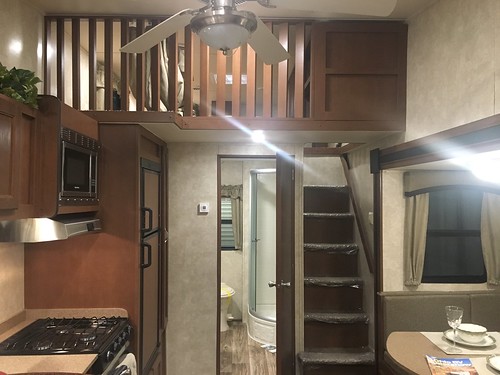
But even small RVs often come with big amenities – as you can see, this RV has a second floor, a ceiling fan, a walk-in shower, and fine woodworking:
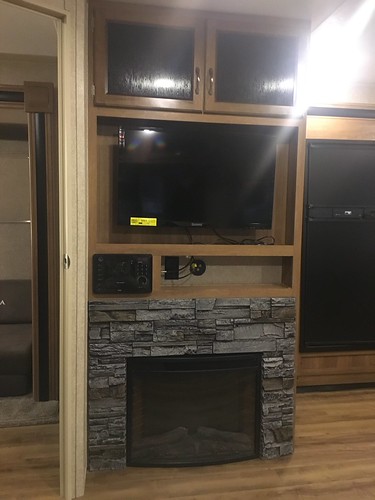
And fireplaces and wall-mounted TVs are basically de rigeur now:
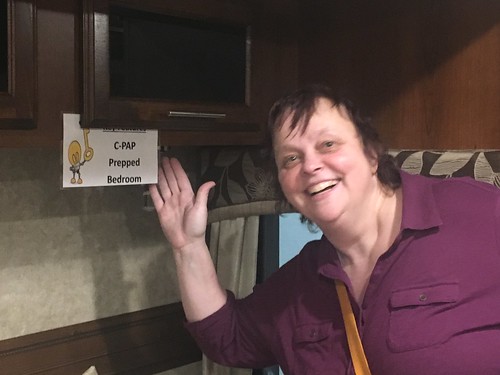
Along with some other unique extras:
Aaaand, of course, THE STAIRCASE (which is slightly unusual, as most of these have ladders and not staircases):
But if you wanna see a $50,000 RV, which is not quite top-of-the-line but definitely upscale, then you get this.
Realize, however, that both the $17k and the $50k are towed RVs, so you have to pay not just for the RV itself, but for the truck to drive it around, which is usually another $50k or so. Also, RVs have pretty much zero resale value, deteriorating by 60% the second you drive it off the lot, and you’re lucky if you get an RV that lasts for ten years without repairs so big you might as well buy another RV – so you really have to view this as an expense if you’re planning on driving around.
(Although every bank plan assumes you’ll be taking out a 20-year loan. I wouldn’t.)
Now, every year at the RV show brings a couple of weird extras that eventually become commonplace. When we started going, fireplaces were something rare enough to “ooh” and “aah” over; now they’re just part of even the lowest-scale models. (They’re technically space heaters with a fireplace cover, but still.) Then big-screen TVs. There’s an RV arms race, and it gets better every year.
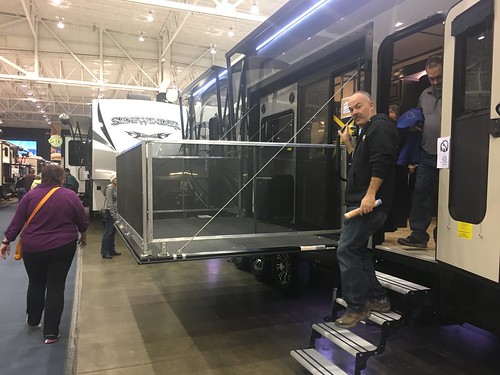
Gini and I couldn’t decide which of this year’s two major additions were more ludicrous: the drop-down front porch:
Or the walk-in closet (which, yes, in an RV is still big enough to walk into):
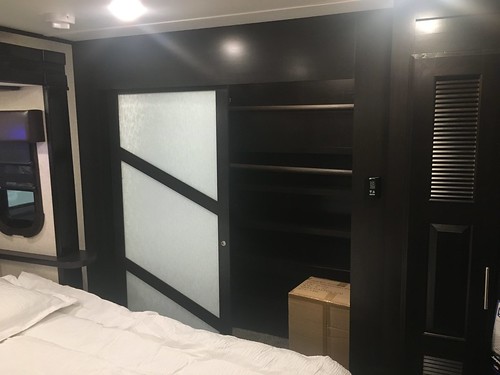
And if you think the walk-in closet isn’t that big, you’re not used to RV crunches, where everything is tiny. This won our personal “smallest sink” award, but it’s not that much smaller than a lot of sinks in the RVs:

Though if you want the quote-unquote “big” models, you gotta go to the “Class A” models, which are the ones you don’t hook up to a car. Those get pricey quick, because the chassis to carry these things get ridiculous – and they also subtly encourage drunk driving:
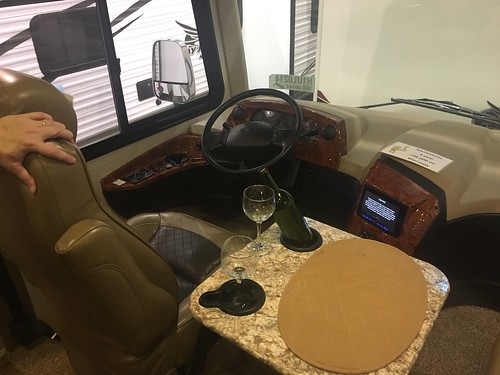
But if you wanna see the $120,000 version, well, here it is:
Thoughts On Recording An Audiobook For My Mother.
Back in August of 2015, I told my legally-blind mother that I would record my book Flex for her so she could hear it. Yes, it’s available as an audiobook already, but we didn’t know that it would be at the time I promised it to her – and besides, she’d get to hear me read it to her.
I am only vaguely ashamed to say that I finished the project last night.
I say “vaguely ashamed,” because holy crap was this a lot of work. I probably spent six hours trying to make the opening prologue audio-book perfect – not a stutter or a mispronunciation in earshot, clipping all the uhs and pauses out with Audacity, stopping and restarting whenever the damn dog barked, which was all the time.
And I’m told that I do a damned fine reading – but that process stressed me out so much that I avoided it, because it was going to take me 240 hours to do this perfectly and when I read the next chapter I was hyperaware of every word I spoke and so I screwed up more, and so….
In December, I finally said, “Okay. I’m gonna read it to Mom like I’d read it cold to a room full of people. I’m good at reading, and she’s my Mom, so if she hears the dog bark or my chair creak, well, maybe that’ll sound more like her son did it.”
And even then it was another 24 hours worth of work, sitting down and reading and editing and listening and chopping out the most egregious mistakes.
Audiobooks are crazy work, man. Maybe if you’re a professional, with professional recording techniques, it gets easier – it could be that people read through with zero mistakes. But I’m not that person, and it’s my book, so I figure if I can’t read my own words through perfectly the first time, I’d have problems with everyone. Which means that audiobooks must be a constant stream of tiny edits, endless nigglywork.
And I kept thinking about what The Little Red Reviewer said about my public reading style:
I’ve been lucky enough to see Ferrett Steinmetz at Conventions and attend his readings. My friends, if you ever find yourself in the same city as Ferrett, get yourself in the same room with him in the hopes you will hear him read his work. The man has an amazing voice. At first it seems he’s reading slowly. But no, those are deliberate, planned pauses. Those are moments in which the words he is saying (and not just the sound, but the words and the meaning and the weight) sink in. He’s doing you a favor – giving you time to absorb and digest what you are hearing. While I was reading Fix I heard Ferrett’s voice reading it to me. Slower than I usually read, a kindly and sympathetic voice encouraged me to slow down to experience the full effect of getting kicked in the feels in nearly every chapter. Thanks Ferrett, for making my cry for like an hour while finishing this book!
Yet I guess I don’t read that slowly, as the professional version of the book is 11 hours and 43 minutes, and my book is about twelve and a half. (I misremembered it as ten hours total, which panicked me – how slow was I reading?) If I’d been studious about going through and clipping out every excessively-long pause, I’d probably cut another 5-10 minutes out of it.
(Because it’s better to go too slow. When I see other authors reading, the most common mistake is to blitz through it so fast that you don’t leave the audience time to process. I’ve seen some very funny chapters mangled because the author told the joke and then accidentally stomped on the laughter by racing ahead to the next line.)
But I did like the ability to put my own spin on the takes. Having listened to it, I think I did a good job at keeping things listenable – and I love the way my microphone makes my voice sound. I learned to overpronounce a little, because when you’re dealing with the foreign vocabulary of a fantasy book you want to Make It Quite Clear What Is Being Said – and by the end, I learned do things with slight intakes of breath and with pushing the volume and tempo at exciting times.
The real issue was voices. My mother will now have the debatable joy of listening to me try on two separate accents for Kit the donut-loving detective before I finally settle on a third riotously different tone. I thought I differentiated Paul and Valentine a lot more when I spoke, but that turned out to be mostly internal – which isn’t a problem for some audio narrators, who do everyone mostly the same and use the writer-handles of “Paul said” to clear them, but I like a little more acting in mine. (For the record, in my head Valentine always sounds a little vexed, and a little astonished.)
But she will have it. I may post an audio excerpt on here so you can hear what I’m like when I read – or I may do an audio production of my favorite short story “‘Run,’ Bakri Says” – which was read quite wonderfully by Mur Lafferty (who has a book I’m interested in coming out soon), but I think it’d be interesting to compare our approach if I did it right.
Anyway. It is done. I just need to figure out what format she needs it in. And if she decides she wants to hear The Flux, well, I’ll get to that too. A lot sooner.
I’ve learned so much in doing this.