

An Interesting Change
 Hey! See that burn there? That’s a bullet wound.
Okay, technically it’s a jacket wound, acquired at the shooting range. Because when you fire guns, the casings are ejected out of the gun, flying at high enough velocities to do damage to your eye, red-hot from having just thrust a bullet out of the muzzle. And if you’re unlucky, then that burning brass jacket will arc up, hit the edge of your safety glasses just right, and tumble underneath to be lodged next to your sizzling skin.
Did I mention you’re holding a loaded gun when this happens?
Fortunately, I was calm enough not to wave the gun around while it was burning a small row of blisters against my eyebrow; for all of my neuroses, I’m good in actual crises. I laid the gun down, barrel pointing down-range, and extracted the jacket, which had cooled enough to only hurt my fingers a little.
Still, it’s a little weird to carry a wound from gun shooting around.
I do like shooting, and am sad I won’t get to do it for a few weeks – last week, I learned that I shoot better if I don’t just hold my breath, but exhale and shoot with empty lungs. Grouped quite nicely that time around. And of course, I’ve always wanted to own a gun, but as a depressive this is probably a Very Bad Idea.
Yet all of this shooting gave me an interesting switch earlier today. I wrote a Tweet that said, “I’m sure someone thinks the spree of shootings is a conspiracy by Obama to ban guns, but I don’t want to look.” (As it turns out, that “someone” is the lead singer of Megadeth, proving that everyone involved with Metallica is now batshit crazy.)
But the original Tweet? “I’m sure someone thinks the spree of shootings is a conspiracy by Obama to ban our guns.”
Hrm. Little mental shift there.
Would You Like To Wash Your Hands?
Even after the discovery of bacteria, patients kept dying because doctors refused to wash their hands before surgery, pushing all sorts of wonderful diseases deep into their patients’ bodies. This went on for years.
Some of those deaths can doubtlessly be chalked up to stubborness and habit, but I suspect a lot of the reluctance to wash up went something like this:
“Doctor, before you remove that cyst from my husband’s stomach, would you mind washing your hands?”
“My dear lady, I assure you, I am clean.”
“But they say that there are small creatures that cannot be seen with the naked eye – ones that we all carry with us…”
“Are you saying that I’m filthy? Disease-ridden? I’m a skilled physician, with many talents! You seem to think I’m some common leper, ferrying virulence from place to place! How dare you insult me by calling into account my cleanliness? I am a gentleman!”
“I’m – I’m not insulting you, I’m just saying that everyone has these bugs…”
“Oh, so now I’m bug-ridden?”
…and so forth. End result: dead patient. But a doctor who felt good about himself.
That’s racism in America today.
The problem with racism is that people tend to think of it like a mechanic’s hands at the end of a long work day – crusted with grease, easily obvious. And there are those kinds of explicit racism out there, the unrepentant hatred of the KKK and such, who are actively out to harm anyone non-white and they don’t care who knows it. That’s the intentional racism, the kind that stems from a deep-seated harm to hurt people.
But most racism is like the bacteria on a surgeon’s hands: invisible unless you’re looking for it, and entirely unintentional.
See, racism is not usually the “AH HATES ME SOME NIGROES” kind of hatred, but the subtle stuff that links “welfare mothers” with “black people.” The kind of thing where a white guy who shoots brown people is clearly a maniac and not a reflection on Caucasians, but a brown guy who shoots white people immediately triggers a question of whether that race are terrorists. It’s the quiet, and often completely unconscious, assumption that a white name on a resume is more qualified than a more foreign name.
Here’s the thing that drives my conservative friends crazy: we all carry racist beliefs within us. How could we not? We were raised in a country that had explicitly racist laws in place as recently as fifty years ago, and we still have significant portions of the country who believe that interracial marriage is a bad thing. A lot of the country is founded on racism, and as such those beliefs have wormed their way deep into the culture in which we were raised – and we have propagated them.
This having racist beliefs does not make you a bad person. You can’t help having picked up all these little thoughts that hurt other races – some of which are even as subtle as “race no longer matters.” You were taught them by your parents and friends, who may not have even been aware of the toxic effect those beliefs caused.
My friends freak out, though, when called on the carpet for expressing some of those beliefs. “I’m not a racist!” they cry. “I’m a good person! I haven’t been unthinkingly infected with bad thoughts from outside sources! I know exactly what I’m thinking!”
Would you like to wash your hands?
You aren’t a bad person for having racist beliefs encoded in your system. But you become a bad person when you’re called upon to examine your behavior and, like the bad doctor above, spend more time being offended at the idea that you might be a bad person than actually checking yourself to see what they say is true. If you value your sense of self-esteem over the corroding damage you may be spreading, then yes. You’ve become a harmful jerk.
That doesn’t mean that every accusation is true, of course. Sometimes, you take the time to consider an accusation of racist behavior and eventually conclude that no, this is the other person’s problem. But you don’t do it from the terrified perspective of, “How dare you accuse me of being unclean? You have problems!” You do it from the perspective of someone who realizes that you don’t have a handle on every thought in your conscious mind, and sometimes some reflection will show you’ve been spreading some things you don’t want passed about.
Or maybe you just take offense and keep operating. Your choice.
He's Not Racist, He's My Voter
As an Ohio resident, Jezebel’s headline makes me wince: “Ohio Republican Party: GOP Chairman Made Racist Remarks Because He Thought He Was Speaking Off the Record.”
Doug Priesse’s racist remark was this: “I guess I really actually feel we shouldn’t contort the voting process to accommodate the urban – read African-American – voter-turnout machine.” Which is the whole reason why they’re attempting to shut down early voting sites.
Now, let us be uncannily kind and assume that maybe, he’s not racist at all. It is vaguely possible that he is not trying to shut down the “urban” voter-turnout machines because they’re black, but is merely noting that the early-voting policies disproportionately reward black voters. And he’s not against the early voting policies because they are black, but because it’s not fair that voting procedures are twisted so much to accommodate any one single group – be they black, white, marbled, or pointillated.
Guess what? That still makes him a fucking dick.
Because the whole point of voting, to any honest and objective person, should be to get as many legitimate voters as you can out to vote. Any policy that makes it easier for anyone to vote in the single most important thing you can do for our democracy should be lauded, as long as it doesn’t lead to widespread vote fraud (like, say, online voting almost inevitably would). As a liberal-leaning centrist, I support every Republican effort to get out their vote, because frankly the votes of my opposition should still be counted.
This isn’t just my fucking election. It is the combined will of the people. It is larger than just what I want – it’s a temperature taken of the population as a whole, and for this to be more than a dictatorship under my control, this needs to have as many people as we can get invested in the process.
So. Early voting hours for blacks and fundamentalist Christians alike? For it. Mail-in ballots for the military and the civilians? For it. Better methods to make it easier to get involved, even if those methods disproportionately favor Tea Party members?
Fucking. For. It.
So what Priesse is saying here is that we should make voting a difficult thing. Even in absentia of the concern that he’s purposely trying to punish black people for voting Democrat – which is almost certainly the case – it still makes him the kind of guy who wants to turn voting into an elitist machine where only the kinds of people who can jump through certain hoops can do it.
Fuck that. The Republicans’ efforts to quash voter turnout via ludicrous measurements designed to shut down a voter fraud that even they have to admit doesn’t exist is shameful. This is shameful. And if you support them, you should be shamed that your support is, in part, covering this.
Why I Don't Do Webcomics Any More
There’s something hinky on my computer, so I’m running a full scan of the hard drive before I do any more sensitive work for my day job. And in the downtime, I figure I might as well answer a question:
Why am I not doing any webcomics these days?
It’s not for lack of desire, I assure you; I really miss doing Home on the Strange, which was sort of a Twitter-before-I-had-a-Twitter. For example, if I had a webcomic, today’s Twitter thought – “I think that just as all biology classes should discuss creationism, all astronomy classes should discuss the terror of Galactus” – would have been a much funnier comic, a la SMBC’s recent (r)evolution discussion. And it would have been passed around a lot more, as comics are much more likely to get StumbleUponed than mere Twitter statuses, which always makes me happy.
So why not start a webcomic? Hell, I’ve registered two domains just in case I decide to get back in the game. I’m a better writer, with better understanding of the format that I had back in 2006. It could be fulfilling.
Well, first off… I can’t draw. At all. (No, seriously – check out my guest week strip.) And yes, I know Howard Tayler started out with only slightly better artwork than I did, but I just don’t have the time to devote to learning a new skill at this point. Nor would I particularly enjoy writing cut-and-clip strips like, say, Wondermark or Married to the Sea, or PartiallyClips – part of my joy of writing comics is coming up with bizarre visuals and then watching them come to life.
So that involves getting an artist. There’s two ways of doing that; the first was what I did with Roni on Home on the Strange, which is to take on a co-partner. And I don’t want that. If I did a webcomic, I’d want it to be my vision, without the creative frictions that inevitably led to the ending of HotS. Essentially, I want to say to someone, “Here’s what I wrote, draw the damn thing.”
Doing that, I’d feel bad about having someone do it for what is, essentially, free. HotS was starting to earn some Olive Garden money near the end of its run, but I don’t like the idea of compensating artists with just “exposure!” – the ones willing to work for free often that good, and the ones that are good should do better than being paid the pennies that would come from a Project Wonderful Ad. For My Name Is Might Have Been, I wound up paying Avery Liell-Kok out of pocket for each strip – a pittance, given what she was worth (and I’m glad to see her have gone on to better things), but I was still in the hole for a couple hundred dollars a month. Doing that for vanity was just too much.
So in an ideal world, I’d find a good, regular artist who was willing to work for the love of it, without any creative input, for as long as I wanted. Not gonna happen. So my webcomics ideas have remained, well, in my head. Perhaps mercifully so.
In the meantime, for preparation of one of these non-existent webcomics, I had Rich Morris (the excellent artist behind Yet Another Fantasy Gamer Comic) draw me up two samples. It occurs to me that I’ve never posted them, so here: have a look at what might have been.
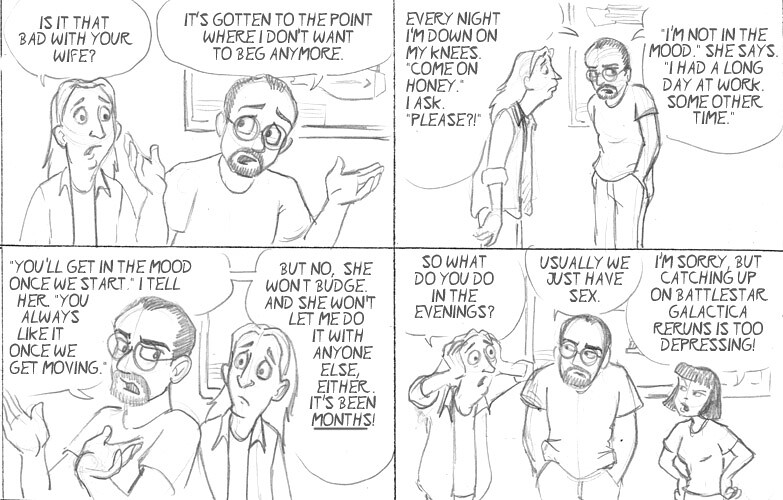
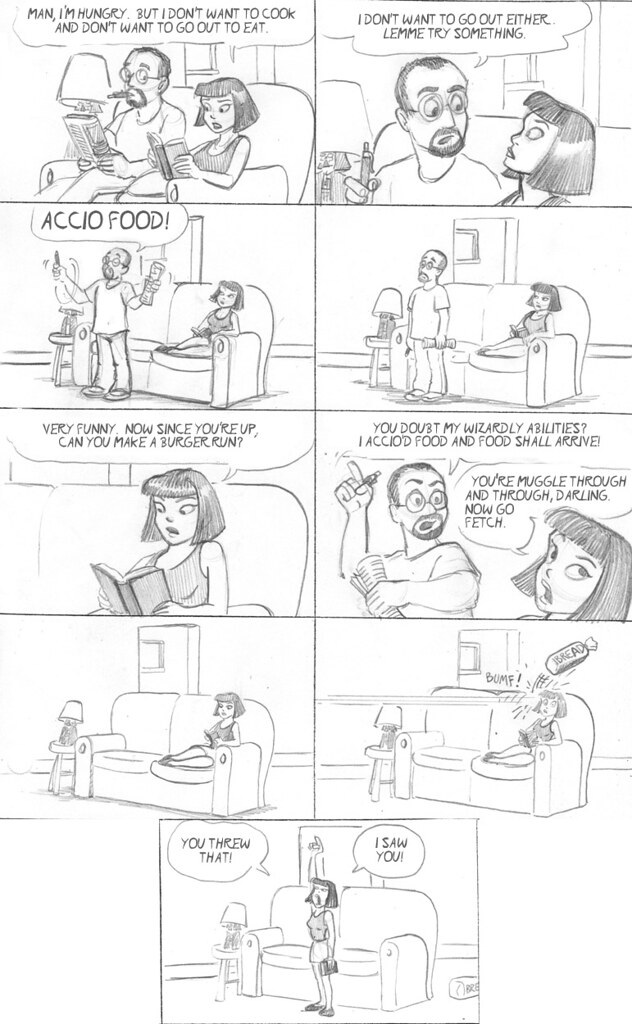
(Speaking of My Name Is Might Have Been, at some point I swear I will write up what happened in the end game. I just need to put together my notes. Probably some time before 2020.)
Two Types Of Dicks
I love me some roleplaying, but there’s two types of jerks in RPGs that summarize why the world is so fucked up. Satisfy one, you encourage the other.
See, in roleplaying, the DM plays the guy who adjucates reality: you tell him what you want to do, and he decides what happens. And in a perfect world, you wouldn’t need rules: you’d have a DM who rewards cleverness and good strategy, and punishes the mundane and badly thought-out. Maybe throw in a few dice rolls to keep things interesting, and bam! Perfect game.
Unfortunately, there are both DMs and players who are divorced from reality. So fights start something like this:
PLAYER: “I fling my knife into the demon’s eye, killing it instantly!”
DM: “The demon is twenty feet high, and your knife is plain lead. It wouldn’t kill it in one shot.”
PLAYER: “What? An eye-shot is invariably fatal! Read your Tolkien! What kind of a crappy DM are you? You just gypped me, man!”
…or maybe the DM is the sort of jerk who completely neutralizes a well thought-out infiltration plan just because he’s pissy you circumvented the big fight he had planned. Doesn’t matter. One side’s being unfair. And what happens is there’s a big old fight over what should happen, where both sides are convinced that they’re right, and after a while people get tired of arguing over this.
So they create rules to standardize things. A dagger now always does 1d6 damage, triple damage if it’s a called shot to the eye, and for demons you need magical weapons to hit. But in creating rules, you bring on this guy:
PLAYER: “So my character is an ocular ninja. If you notice, I’ve taken every advantage that allows a stacked bonus for called shots, so now my character not only does triple damage with every hit, but he actually has a +2 to every roll.”
Next thing you know, thanks to Rules Lawyer boy, you’re in an arms race – the DM has to either develop ridiculously overpowered monsters to keep up with this ridiculously overpowered character, leaving the “normal” characters in the dust, or everyone else starts lawyering and the game becomes more about loopholes than gaming.
Such is the world. If you leave things open for interpretation, some greedy asshole will grab everything he can get, thinking it’s her due. And when you devise rules to cut down on arguments over fairness, some other asshole will sift through the rules to find the loophole.
This is why you can’t win.
Relationships, Expectations, and Rules: Failure States
I’m going to say something controversial about relationships. But before I can do that, I need to define two terms that often get slurred together.
In relationships, there are two tools you can use to determine how your partner should react to things: Expectations and Rules. There’s a fine distinction between the two, which is often confused.
Expectations are what you believe your partner will do in a given situation. For example, based on past history, I think Gini and I will probably sex it up a couple of times a week. We’ve never discussed this; it’s just something that, assuming Gini and I are both healthy and in a good mood, I expect will happen.
Rules are limitations that you set down explicitly to avoid hurting your partner. For example, I have an agreement with my partners that I will not sleep with anyone without getting explicit permission first.
Every relationship has expectations. Not every relationship has rules.
Now, expectations are nebulous in that sometimes the expectation is, “I don’t expect anything from you,” as in a FWB thing or a very open poly where both partners do as they please, and have no say in what the other wants. (In which case, the expectation is, “You’ll leave if what I do bothers you enough.”) And expectations are useful in diagnosing potential relationship problems – if, for no reason that I can name, Gini starts having sex with me only every couple of months, it’s probably not a bad idea for me to check in and ask what’s going on.
But most relationships contain an (often hidden) expectation of a certain level of honesty, and of good intention (you’re not going to hurt me in a bad way intentionally), and of some form of attraction (or else why are you dating, unless you’re asexual?). Those expectations are, in fact, generally the reasons you’re dating that person, even if it’s as simple as “I expect we’ll have some pretty damn amusing conversations.”
The problem is, it’s extremely easy to break an expectation, because it’s just some mental construct someone’s formed of you – in many cases, completely arbitrarily! I tell people time and time again, “I write up my essays because I screw things up so often that I have to keep notes. I am not a together person. I am a teeming mass of insecurities.” Yet because I write strongly, and consistently, people often think that I’m a confident, wise person. Then they date me, expecting a confident, wise person.
…that doesn’t work out too well.
But that’s usually the reason relationships collapse; you realize that the model you have constructed of this person inside your mind does not actually exist, and the person who’s really there is not anyone that you actually want to live with.
Managing expectations is difficult. It’s complex math, trying to synchronize a model with a real person who doesn’t even fully understand themselves. You’re creating a simulation of the person inside your head, and running that simulated person’s reaction against what is happening now, then determining whether they’d be upset by this, and then deciding whether they’re correct in being upset by this and whether you’re willing to have the argument…
Rules, on the other hand, are simple. You set down like a lawyer with a contract, delineate what is and is not acceptable behavior in a given set of circumstances, and hash it out. They’re clear. Easily understandable.
And here’s my controversial statement: Rules are a failure state of a relationship.
Not “the sign of a failed relationship.” Many functioning relationships have rules. But I’d argue that most of those relationships have a weak point that’s been poorly shored up, and relationships with a lot of rules are often on the verse of collapse.
“What’s wrong with rules?” you ask. “Aren’t rules clear and easy to follow?” Well, yes. And no. There are millions of laws on the books out there, and having watched my wife do law, you could dispense with 95% of them if everyone just went by the tenets of “Be fair, be honest, and don’t be a dick.” Most people can spot dickery in the wild, but there’s a significant percentage of folks who go, “No, that’s not dickery, that’s just good honest business practices!” or “That’s a perfectly fair price I’m offering this man with no recourse!”
So what happens? You codify. Endlessly. Exactly what percentage of orange juice must you have in a drink before you can call it “natural ingredients”? How many square feet can you devote to a home office before you can write it off on your taxes? Basically, all you do in law is take a basic principle and narrow it down to precise, exacting terms – terms that are ludicrous when you look at them. So, okay, 30 fly eggs per 100 grams of pizza sauce is okay, but 31 is just crazy?
But that’s what happens when you turn “fair” into “law” – you wind up with an arbitrary marker. And maybe your pizza sauce contains 20 rat hairs, but hey, that’s not on the books, we didn’t check, that’s totally cool. Until somebody complains about their furry pizza, and wham. One more guideline for business owners to feel resentful about checking. They feel hemmed in, taking this extra time and expense to have to someone inspect their pizza for infestations.
Which is what happens with relationship rules. You think they’re well-defined, but often there’s a lot of room just outside the defined zone to cause further problems. And they cause resentment.
“You can’t sleep with other people,” goes the rule. But can you kiss them, even if you never intend to sleep with them? Can you flirt with them? Can you go over and spend time at their apartment alone? Can you give friendly backrubs? Tickle fights? Beatings at the club? Beatings in private?
You’d think those should be simple questions – but the fact is, generally if you say, “You can’t sleep others,” then one or more of those things will often cause agita. Because the rule is “No sleeping with other people,” but the problem it’s attempting to address is something like, “You can’t form romantic, intimate bonds with other people, because that would make me feel completely insecure.”
The problem with rules is not what they’re intended to do – which is minimize hurt, a valid goal – but rather that an excess of rules encourages a certain laziness in expectation management. People follow the rules blindly, forgetting why they exist, and their mental map often fails to take into account all the other things that might upset their partner. And so their partner piles on more rules, trying to shut off the undesirable behavior, not realizing that their partner literally just doesn’t get the root cause that all the other issues stem from.
Rules are not inevitably bad. They’re often a starting point for a good mental map; I’ve been on hiatus from new sexual partners now for eight months as I try to devise a better set of rules that will lead to my long-term partners being happy. But the rules are not the rules. The rules are there so I can see what I’m doing wrong in creating new relationships (and I was doing things wrong, as far as I’m concerned), and create a new mindset that’s going to make anyone I’m dating happy. And when they’re done, it won’t be a set of law, but rather a mental map of good expectations that works.
In other words, I’m developing rules as a method of what my partners expect of me. When this process is complete, then I won’t need rules. When I date other women, I’ll know exactly when I’m pushing the limits of my current lovers’ comfort zone.
Now, the danger of valuing expectations over rules is that there is the unspoken assumption that “If I just make my partners happy, then I’ll have a great relationship!” Which is, of course, ridiculous. Sometimes, you go through all the effort of forming a proper set of expectations, understanding exactly what actions will make your partner happy… And discover that the only way you can keep them happy is to be miserable.
It also doesn’t exempt you from fights. Even when I know exactly how Gini’s going to feel sometimes – and expectations being as inaccurate as they are, I’ll say that after thirteen years of marriage I still have about a 1 in 20 shot of getting it wrong – there are times when I have to say to her, “Look, I know you feel this way, but that’s crazy.” And she has to do the same with me.
Then there’s all the times I get the expectations wrong, and have to talk about that. The goal is not to be perfect, of course – that way lies madness – but to create a working model to determine what, if anything, you need to talk about in advance. Which involves finding new information.
It also doesn’t exempt you from using that information. The reason New Relationship Energy gets such a bad rap in polyamory is because people will meet a new partner and just fucking forget to run the actions by the Expectation Engine. Why should they? That’s effort! This is love! I don’t want to think about old him when new him is right here, kissing me! And so, rather than having to deal with any sort of model (which takes a fair amount of brainpower at all times), many kinky folk go, “Fuck it, I’m not bothering to consider other people’s emotions at all, I’m just demanding no strings whatsoever.” Which is a workable way of doing it. (Or, you know, you just date people with low expectations. Which is also workable. Which is also not me.)
Furthermore, expectations are not only nebulous, but they’re mutable. What I wanted six months ago isn’t what I want now. The reason they tell you that communication is a good idea is because the best way to keep those mental models updated is to spend time together, to be open to new experiences, to pay attention. I’ve broken up with people not because they’re evil, but because what they came to want out of a relationship wasn’t what I wanted, even if it we’d synced up at the beginning.
But I don’t think it’s much of an exaggeration to say that properly managed expectations are the key to a happy relationship. Not rules, because rules are stiff and generate conflict, but a mutual understanding of what you think is fair and what you want of each other. Which, when done properly, is wondrous.