

In Which I Have Possibly The Most Satisfying Day Of My Life
For those of you who are new here, woodworking is the old beekeeping – which is to say the flashy hobby I had that consumed disproportionate amounts of my blog time. I took classes, made chests, boxes, even hand-cut dovetail joints. (Terrible ones, but still.) Gini even bought me a garage full of woodworking equipment for Christmas.
And then… it just sat there.
For five fucking years.
Why did I do nothing with all of this expensive equipment? I told myself that it was scheduling – I needed to take a full day to clean out our garage, and then at least another day to assemble all the equipment. But the truth was this: my most infamous woodworking experience was the day I sawed off my thumb – or should have, but a piece of very expensive safety equipment prevented me from amputation. The table saw we have is small, and has no such wardings. Should I touch it wrong, I’ll maim myself.
So I just kept… putting it off. And why not? It was a lot of work, after all.
Cut to Saturday, where Erin and I are at a local art fair, and for some reason Erin said she wanted to learn woodcraft, and we both agreed that tomorrow, we’d get up early and set the whole damn shop up.
Which we did, but I didn’t know how bone-deep satisfying it would be.
Thing is, I’m not a very masculine guy – and yes, my feminist friends break out in hives at the idea of masculinity, as it’s been so warped into misogyny, but there’s a certain quiet competence associated with tasks that men are supposed to possess, and I never have. When I think of manliness in a positive sense, I always go back to To Kill A Mockingbird‘s Atticus Finch – competent at what he was, slow to pronounce judgement, quick to ask his loved ones to look at things from another angle, full of hidden surprises at just how good he actually was. And woodworking – the power tools, the realms of hidden knowledge, the classic connections – was perfect for that. It satisfies some deep need within me to be masculine, fulfilling a societal pressure that’s been subtly bearing down on me for decades, without me having to misshape myself to fit it.
So sitting in a hot garage, listening to tunes as we tried to figure out how to dissemble the lockdown pin from the miter saw? Good times.
Plus, there was the unexpected pleasure of father-daughter bonding. Erin and I have always been close, as she got her love of punk from me… but I don’t think she’d ever learned anything useful from me, at least in terms of her hands. But the two of us grunting over complex instruction manuals together, puzzling over terrible diagrams and shorted pieces and descriptions that were just flat-out wrong, was a great way of spending time together. We felt like we were both accomplishing something we’d longed to do for perhaps too long. Every time we finished a piece and heard the buzzsaw roar of the table saw produced ecstatic high-fives.
And there was the pleasure of watching Erin grow. My daughter has many strengths, but “following instructions” is not one of them; hand her a manual or a recipe, and she’ll inevitably throw her hands up and go, “I cannot do this.” But I lied, scandalously, frequently, to quietly push her; I tossed the miter saw instruction manual at her and told her that I didn’t know any more than she did about all of this, so just follow what it said.
This was not true. I at least had the advantage of knowing how the miter saw worked, and knowing what parts it should contain when it was done. And I did go over and provide consultation when she seemed truly stuck. But I tossed her in the fire, with nothing but a manual and her own two hands, and by the end of it damn if she hadn’t assembled the miter saw with a bit of assistance, but then proceeded to get the jointer and the planer up and running completely on her own.
And then that was done, we assembled the firepit I had bought for Gini back in 2005, and Erin built a fire in our back yard, and she played guitar and used her new light-up hula hoop while we all bathed in smoke.
We’ve agreed on the need for father-daughter dates; the work is not done by any means. We assembled the saws but did not calibrate them, so we need to go through and make sure everything is level and sharp and won’t kick wood back at us or misfire under stress. There’s still hours of work to do before we can start using this stuff safely, and then comes our first project of actually building a wooden box just so she gets all of the principles in line. (Erin, being Erin, wants to start by building a dresser. She thinks it’d be simple. Oh, sweetie, you gotta walk.)
But even if we don’t do that, just a solid day off spent lazing in labor, knocking off a task left fallow for half a decade, sipping beer with cans full of nuts and bolts at our feet… it was a good thing to share with your daughter. And to share with your wife when she comes home from a weekend with her boyfriend to discover an utterly transformed garage. And to share with you, my friends, these photos of our reconstruction.
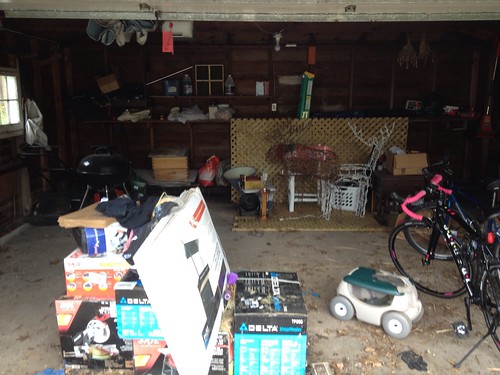
This was the garage as it was, about an hour and a half after we’d started cleaning and rearranging – the boxes were there, but we’d swept the floor and moved a bunch of stuff around. Note that the boxes had been there so long,a chipmunk had set up shop in our miter saw box. In this sense, finding all of this old equipment working was kind of like our own Storage Wars.
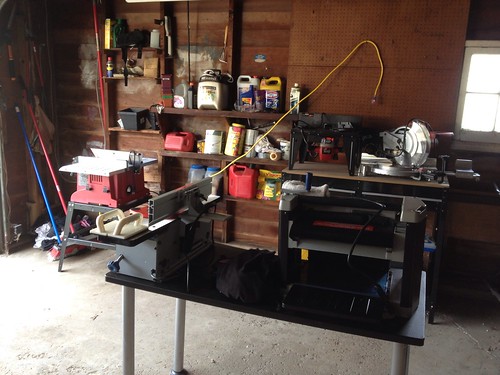
The shop afterwards, with all the acoutrement in place. We’re definitely going to need a second bench, and we’re definitely going to need to screw the equipment to some blocks of wood so we can clamp them safely to the table.
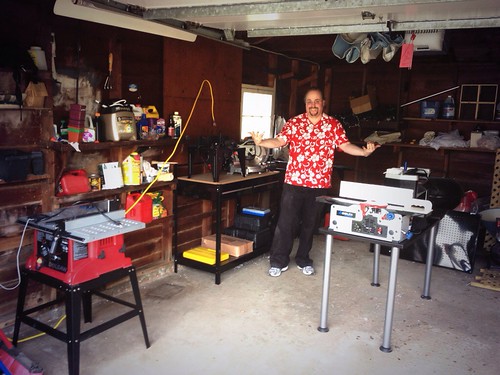
Me, after eight hours of shared labor.
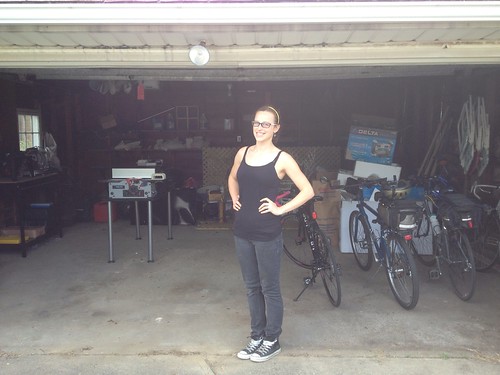
Erin. So very proud.
Why I (Probably) Won't Buy Xbox One
Years ago, I abandoned my beloved gaming PC and got an XBox 360 instead. It was one of the best decisions I ever made.
Oh, I do occasionally miss my roleplaying games, but the XBox was a static investment – I didn’t have to keep sinking money into new videocards and RAM upgrades and, eventually, whole new computers. That switch literally saved me thousands of dollars, and the gaming’s been almost as good. (I do miss mouse + keyboard for first-person shooters, and I do miss my in-depth roleplaying games.)
But I don’t think I’ll be switching to XBox One. And I should. I mean, I have a history on XBox at this point – all of my hard-earned Achievements, all of my purchased downloads, my XBox membership. But it’s a hard sell for me, and it’s not because of:
The Kinect. I have a Kinect. After all the hype faded, it’s been kinda shitty – the voice recognition isn’t integrated into anything useful, the gestures don’t work well from my distant couch, and aside from Dance Central the games have been these spastic, flailing, thoroughly nonfun events. But the fact that it’s watching me 24/7 is something I already pretty much experience, and at least I didn’t pay extra for it this time.
The “always-on” Internet. I’m fortunate enough to need good Internet as part of my job, so that’s a part of my household expenses as it is. Not the greatest move for a lot of poorer families, though.
The disappointing quote-unquote “new features.” I’ll let Gordon Ramsay say it for me. But I never really socialized on my XBox; it’s all about the games, man, and if Fallout 4 is good then I won’t care.
No, it’s the way they’re distributing the games. You don’t own the games; you merely license them from Microsoft. And can you sell them to Gamestop… or, more importantly, from Gamestop? Not without the publishers’ permission. And given that most publishers hate Gamestop for making five times as much money off of their games than they do, I’m gonna say that’s prooooobably a “no.”
Look, I dig that as a games publisher, you want to lap up that stream of moolah, and you deserve to. What Microsoft is clearly trying to do is to become Steam, Valve’s way-too-popular digital download system… and if they did that properly, that’d be awesome. Steam reprices their games downwards rapidly, holds lots of sales, makes dynamic changes based on user demand, and has a ton of free games to boot. There has been talk saying that the reason most videogames are so riotously expensive is because publishers can’t make money off of resales, and so have to charge a ton up-front to ensure they get their fair share (as Gamestop will then sell the game used for $50, and then $40, and then $30, and so forth).
If that works? I’m in. I could use $40 games and $10 sales.
But I don’t think it’ll work that way. I remember the land grab of Compact Discs, which actually cost less to make than Cassettes, and the record industry promising “Oh, yeah, they’re just twice as expensive as tapes because we make so few of these – the price will come down.” Then they shot themselves in the foot by purposely taking this opportunity to raise prices forever, at least until piracy started looking like a great goddamned alternative to paying $17 for that one song you liked.
If Microsoft lowers the overall price of games? Awesome. I’ll watch for a few months to see what the game economy is, and if it’s an even mix of cheap and expensive, I’m in. But I suspect this will be their opportunity to artificially raise the prices, forcing us so the only way we can purchase it is at $60 – forget your friend giving it to you permanently, forget getting it on eBay, et cetera. This will be their CD moment, where the cost of gaming will rise across the board.
(Though to their credit, they have said up to 10 family members can share a game. One suspects there will be a lot of impromptu families made at college.)
And if that’s the case? Fuck that. I’ve gotten turned on to some of my greatest games by a buddy tossing me his disc and saying, “Try this shit!” or me taking a Gamestop chance at $20. Remove that, and make it so my only option is full-price? I won’t. It’s just too valuable a deal to give up.
…unless Fallout 4 is really good. I mean, like really good. Then maybe we can talk, Microsoft.
A Mild Scam
The other day, I got an offer from [COMPANY REDACTED] in an email entitled “[REDACTED] Sponsoring,” where they said they were fans of my blog and offered to give me a $50 Amazon gift certificate if only I mentioned their company here, on my blog.
It was a friendly-sounding email, and continued to sound friendly right up until I discovered three of my friends also got this same email. (Except they got offered a $25 gift certificate. I guess it’s done by Google Page Rank, or summat.) So I was tilting towards saying “Thanks but no thanks” before, and now definitely am off.
So. If you got that email? They’re casting it wide in order to get the word out on their software. Don’t feel flattered, and I’d wonder if the gift certificate would arrive, myself.
(Though I feel bad! The guy said he wanted to have coffee with me! And everything!)
You Make The Blog
I have many pressing issues of the day, including:
- Why the traditional libertarian alternative of “Just shop someplace else!” fails when businesses start to discriminate;
- Religious expression and feminism, based on a particularly irritating essay posted the other day;
- The potential origins of an artificial “I feel”.
- The limits of sexual consent.
But I have to get to work on a big refactor for my day job today, so hey. Vote which one you’d like to see on Monday, and I’ll make it happen. Or suggest another topic, and maybe I’ll write about that!
So tired.
Seriously. Fuck Those Guys. (The Big Brain Theory)
So I’ve been watching Discovery’s The Big Brain Theory for a while, on a tentative basis. It’s a show I should like, with a Mythbusters-like premise: a bunch of smart guys get together to solve engineering challenges. And it should be fun, except the people who make it have clearly never watched reality shows.
Which is to say that there’s some really poor choices that go into the structure of the show. For example, when someone is voted off the show at the end, they stay on the team, which makes a modicum of sense; you want guys working on big challenges that require massive infrastructure, and if the nerds left then the finals would be two dudes working on erector sets. So they keep them about.
But they don’t have them wear different clothes, so you can’t tell who’s been kicked off and who’s not. They’re just eight interchangeable nerds in nerd T-shirts. And the mechanism via which they’re incentivized to stay on the show, the chance to get voted back in, is completely incoherent. Nobody’s sure how they retain their old standing. So there’s no sense of forward motion, no sense of anything at stake. If you lose? Well, you’re still there. (Not that there’s any tension in losing; Kal Penn shrugs and says, “Okay, well, it’s not you.”)
The bigger problem is, however, the idiot judges.
See, at the beginning of each show, the contestants are presented with the challenge (stop an incoming foam missile, prevent this box from exploding), and they have an hour to sketch out their designs to solve the problem. At which point the judges decide which designs are worthwhile, choosing the two team captains.
But the judges are never held accountable for their poor decisions, and inevitably prioritize “flashy” over “workable,” meaning that both teams failed the first three challenges. And the show might have been interesting if the judges had sat down and said, “So what are we doing wrong in choosing people?” and treated the show itself as a scientific theory to be refined, as in, “Clearly we’re not picking the right designs, so how can we improve our decision-making process?”
And then there was Dan.
The nerds were, typically, competitive and asocial, but Dan was the worst. He was a flat-out bully, yelling at people in attempts to intimidate them, throwing things, shrieking at the top of his lungs and then storming out in a paroxysm of fury. He verbally threatened people with veiled threats of physical violence, throwing hammers to prove that he was better at welding. One of the women in the group was so threatened by his antics that she literally could not remain in the same room with him.
And when it came time to choose who got to go back on the team, was there a contest? No. Was there a challenge of wits? No. The judges merely picked one person out of the elimination lineup, because they thought he had potential.
And they picked Dan.
Oh, sure, he had temper problems, they said. But his engineering designs –
– and I turned it off.
Fuck those guys. Fuck their show. When they do this on television, to a show with millions of people, what you’re telling folks is that it’s perfectly okay to be an abusive asshole, as long as you’re really good at what you do. (A talent that wasn’t necessarily shown on the show, but whatever.) And it’s telling people that yes, if you’re smart, you too can be a bully! It’s okay! We want to reward this behavior! He’s good television!
I can’t stop them from choosing whatever damn fool person they choose to pick. But I can stop their show, cancel my DVR subscription, and tell everyone that this show is a steaming pile of shit that should be ashamed of itself. If you were watching, I heartily encourage you to stop. And if you weren’t watching… well, it looks like you made the right choice.
How The Story Is Told: Hell's Kitchen Vs. Master Chef
Non-writers think the idea is the unit of writing – as in, “Hey, I got this great idea, I’ll sell it to you, and you make a million bucks!”
Problem is, the idea is actually one of the least important bits of writing. I mean, yes, you need an idea to start a story, but an idea is like selling someone an acorn for a hundred bucks, because hey, man, this could be some serious lumber.
No. Stories are all about the execution – the characters who exist in that idea, the emotional journey they take, the reader’s investment in the story. Without that, the idea pretty much counts for nil – and the shows that brought it home to me last night were Hell’s Kitchen and Master Chef.
Both of them are reality cooking shows, hosted by the same guy. The structure is basically the same – throw sixteen cooks into a pressure cooker, have them do small-scale challenges (each cooks a dish with a certain number of ingredients), and large-scale (they split into teams to cook for huge numbers of people). Every week, one of the less-talented chefs is tossed off the line, leading to the One True Chef.
That’s the idea.
Now, the execution is in how the shows present the chefs. Because I find Hell’s Kitchen exhausting and sad, vastly preferring Master Chef – as Gini accurately observed, “I never want to cook anything after watching Hell’s Kitchen, but Master Chef makes me want to get out there and create.” And that’s because the challenges are presented entirely differently.
In Master Chef, when a chef beats a particularly difficult challenge, there’s a loving circle of the camera on the food that they worked so hard to create. There’s swelling, triumphant music. There are long shots of the flushed victor’s face, of the other teammates clapping for him (perhaps with a brief, ominous cut to The One Jerk conspicuously not clapping), and an acknowledgement that this chef has, at least in this moment, faced the abyss and pulled through.
In Hell’s Kitchen, you have the exact same moment – at least as far as the chef is concerned – but we cut away to the other teammates, each bitching about how they could have done better or how the chef got lucky. The food is barely shown. The emphasis is all on the competition, personalities, the toll this high-pressure situation takes on its teammates. There’s a reason Hell’s Kitchen spends so much time in the after rooms, showing the competitors bitching and romancing and cutting each other down, whereas the Master Chef contestants might as well be sealed in vaccuform until they’re trotted out to perform.
And it’s not like some members of Master Chef don’t hate each other. Clearly, if you watch last night’s episode, Krissi and Jordan are perfectly willing to insult their fellow teammates. They could get that footage. Likewise, there’d be nothing stopping Hell’s Kitchen from presenting the food as if it was the singular accomplishment of a chef and displaying their well-earned pride. But one reality show is structured to show the challenges in a much more sympathetic light, and the other showcases the challenges as personal insults to the other team members.
Now, some would argue that this is only natural: after all, Master Chef is the “amateur” show, and Hell’s Kitchen is the “professional” show. But no. It’d be just as easy to argue that the professional chefs would be kind and courteous to each other, having competed with other chefs all their lives, and the amateurs would be flailing and unstructured. The truth is, one show chose to make the chefs sympathetic in order to differentiate itself, and that’s the only reason.
The fact is, I suspect both shows are very similar underneath the hood. You’re placing people in a weeks-long competition that stretches them to their limits, forcing them to live together, separated from their families, knowing their whole future is (ostensibly) on the line. There will be good moments of surprising friendships, and bad moments of egotistical self-destruction. All of those scenes are on the plate, like ingredients, like idea, a messy gathering of disparate concepts waiting to be pulled up and edited into a Story.
One’s a nice, heartwarming story. The other’s a cold, mean story of chefs yelling at each other. They’re both the same thing, at their heart; FOX just had to put a lot of work into them to turn them into a hit TV show.