

Would I Have Supported The Government Shutdown?
Well, the government is down to life support at this point, and the only people happy about it seem to be Tea Party members. The rest of the world sees this as a massive dysfunction of our politics, but the dyed-in-the-wool conservatives look at this rebellion against a Congressional vote, an electorial referendum, and a Supreme Court ruling as a noble stance. Obamacare will ruin America if it’s passed. Nothing is more important than stopping this hazardous and poorly-engineered law. Thus, they’re pulling out all the stops to shut this down.
…which is really what I wanted when Iraq and the Patriot Act went on the table. I bashed the spineless Democrats for rolling over to Dubya, was infuriated that they didn’t put up any major resistance to what turned out to be legitimately terrible intel and lawmaking (provided, may I remind you, largely by Republicans), and felt impotent as the Dems donned their patriot flags and went along with it.
In fact, the one guy who didn’t flow with the crowd wound up being President. And though he turned out to be almost every bit the warmaker and privacy-destroyer that Bush was, the fact that he refused to support Iraq was a major component in him getting elected.
So what if the Democrats had some blood in them, and had forced a government shutdown in the Senate? Would I have been cheering?
I know I would have, at least initially. It would have felt good to see my guys making a big fuss about how awful the Patriot Act was, and to not fund a damn dime until Bush and company told us exactly where all their intel was coming from. It would have been a deeply unpopular move, but in retrospect it would have been the right thing – to bring the focus to the American people. And doubtlessly, every Republican in the world would have called the Democrats terrorists (which, you know, is a term they bristle at when they’re dismantling the government and literally killing children with their holdups), and talked about how unpatriotic they all were, and I don’t doubt they would have gotten a free pass from the media.
Yet as time went on, and the costs of the shutdown became apparent – my friends out of work, the damage it’s doing to the next generation of government (remember when getting a government job meant bad pay in exchange for security? that’s gone), the hurt poor, the threat of defaulting on loans – I’m positive I would have backed off. Because there’s two things in this:
1) Holding our breath and shutting everything down to stop this war would be, in some ways, more costly than the war itself.
2) Even if we could shut everything down, regrettably, 90% of the country backs this thing, and assuming the resolution had been passed to go to war, legally we’re looking at what America wants, and America should have it.
Because yeah, I disliked the Iraq war. But despite the constant conservative whining, government is not about getting everything you wanted. It’s about pooling resources to get some of what you wanted, making compromises for much of the rest, and enduring a couple of really odious things that are popular and may even be vital. Yeah, you’re not thrilled about birth control being handed out on your dime; I’m not thrilled about drone strikes being handed out on mine. But the deal with, you know, democracy is that we all vote on it. It’s the will of the people, not the will of one person.
And there are times when the minority rights should be protected, no question. But when all the legal hoops have been passed on multiple occasions, that’s actually what democracy is. What you’re doing is actually the opposite of democracy, shutting down everyone’s votes until you get your way – and maybe that’s morally necessary at times, but don’t call it “Constitutional” or “Democratic” or anything like that. It’s violating the oath and the intent of your office to try to armwrestle people into submission.
The will of the people has been expressed through the mechanisms of the people. Now you’re exploiting loopholes and refusing to pass a clean CR bill to get your way. If that had happened with Iraq, I probably would have been morally behind them, as I would have seen the stopping of the Iraq war as a good and just cause. (Which, really, the post-invasion havoc, the lessening of American political power, and the drag on our economy all has only proven to be not nearly worth the cost of taking down one repugnant dictator. It’s like burning down your house to rid yourself of a bedbug infestation.) I would have at least appreciated the intent behind the shutdown.
Ultimately, though, I would have been against the shutdown as going too far. Yes, we could have done it. But we’d made our point. We had raised the issue of the Iraq war 40 times in the Senate and had it shut down every time by the House, and at this point it’s not the House that’s the problem, it’s our refusal to do what the Democrats ultimately did in real life – say, “This is a shit sandwich, but how can we refine it so that it works as best as we can make it?”
Because no, I don’t like the Iraq war and the Patriot Act. The way this works is not to hold my breath until I turn blue; it’s to convince people how awful this is in the next round of elections, and get enough voters on my side that the government has no choice but to transform it bit by bit into something functional. But until then, I make these ugly laws work to the best of my ability, because my job is to keep the country running smoothly, not to punish people for poor decisions.
So I wouldn’t have. As I don’t now. As does most of America, and unfortunately, given that the Republicans’ avowed and open strategy is not to negotiate with Obama until he caves on Obamacare, the blame for this mess can be laid squarely at the feet of the Republicans.
Numenera: How'd The Second Session Go?
So last week, I took the Numenera system out for its first spin. Last night, my players showed up for the second session. And we learned more what worked about Numenera and what didn’t.
As usual, my toss-off ideas have already begun to mutate into large-scale pillars of the campaign. You see, last week, the characters started out on the Wandering Way, a pilgrimage-like walk around the land, and I figured I’d have them run into a few fellow travellers so it didn’t feel like they were alone. And so they ran into – oh, I don’t know, an old wise man who looked like Obi-Wan Kenobi and his boy apprentice, who’d had his mouth sealed shut by the Iron Wind (the rogue storm of nanobots that plagues Numenera). They were on their way to the healing pools. Flavorful, a brief encounter…
…but then, thanks to a twin set of botched rolls analyzing the old man’s cypher equipment, the players became convinced that the old guy’s equipment was about to explode, and hastily made their exit. Which meant the big monster that was scheduled to attack that night hit the old man and his apprentice first. Which meant when the players defeated the monster, they found a small, scared, mouthless teenaged boy hiding nearby, which was not at all part of the adventure I had planned.
So it goes.
As a good DM, you roll with it, and I said, “Well, they’ve already rescued the boy, how can we make him a) helpful and b) interesting?” The helpful was an easy shot: this group had no nanos, which is to say nobody who understood technology at all. The boy’s a nano-in-training. But what made him interesting?
So when the session started tonight, two of the players – who were healers – discovered that the boy’s mouth had been sewn shut. As in, he’d had a mouth once, and had been purposely sealed.
Further examination revealed that the boy had a head full of wasps.
That’s right; some unfortunate experimentation with the Iron Wind – the kid’s an explorer – had transformed the boy’s brain and skull into a literal hive mind of small wasps. He thinks, he thinks, through the insects now, which has put a sadly premature end to his dating life. But fortunately, one of the cyphers the players had was a one-shot “learn a language” numenera, and he burned it to learn the kid’s body language, allowing this mute boy to tell his sad story – how he’s convinced the Iron Wind is sentient, how he’s been chasing it (and all nanites) for study, and how once his head was transformed to a wasp cage they sewed up his mouth so they wouldn’t escape.
That set a nice tone of weirdness for the evening.
The players then set out on the obligatory “find the foozle” part of the canned adventure, wherein they were to go to the Synth Gardens to get healing supplies. The Synth Garden, I extemporized, was a large half-buried geodesic dome. Jerry, who’s playing a parkour-like Jack, immediately scaled the dome and started looking for alternate entryways. Why, strangely enough, as he began to explore, he found a crack in the dome, because you try to reward players who do interesting things.
Then I made my first GM Intrusion: “Hey, Jerry, how would you feel if the crack snapped underneath you and you fell into the dome?”
“Don’t mind if I do,” he grinned.
Jerry fell in solo; I was wondering how the other players would get in, as they weren’t notably climby, but then Christie realized she had a cypher that allowed her to pass through walls. I hadn’t been expecting that, but that was actually an awesome solution – even if I had to burn a GM Intrusion to have the portal explode a second after they dove through it.
The inside of the Synth Garden was a wood of of tall, slender black trees made of circuitry and blinking Christmas lights, the dark place filled with the warm whirr of fans keeping the servers at operating temperatures. Stacks of home-grown servers were everywhere, sprouting from the ground, surrounded by curls of cable. As Jerry tried to make his way back to his compatriots (guided by the convenient explosion), another GM intrusion meant that he leapt over a stack of disk drives and landed straight in the middle of a pack of Broken Hounds.
These Hounds, however, were circuitry beasts, wiry half-robot things that looked like a Doberman made of legos and buzzsaws. A fight, needless to say, broke out, as poor Bob (the hive-mind boy) ran for the hills. Many GM intrusions and botched rolls (this group loves 1s) helped keep the combat interesting, including:
1) Yes, you fake the Doberman out so it bites its companion instead. The companion is so wounded it explodes in your face.
2) You chop the Doberman to bits. The bits crawl to the trees and reform into four more smaller techno-spiders.
3) You chop a tree down to kill a techno-spider! The botch means it falls on your companions. This intrusion means two black techno-spiders were in the tree, and they fall on your friends!
That went on until it was clear the players would be either overwhelmed by the endless waves of regenerating techno-spiders or have to run, at which point clever old Bob the NPC shut down the garden’s guardians long enough that they could find the central virus-server and destroy it. End session as they harvest a bunch of Numenera in triumph.
So. What did I discover about Numenera this week?
1) Players Love GM Intrusions.
After last session’s intrusion-low game, which gave them little experience, I amped up the intrusions, giving as many as I could. After the session, all three players told me they frickin’ loved the intrusions, as it always made the game more interesting – and requested even more of them in the future. They were enthusiastic, and in fact I started to ask, “Hey, can I raw-dog this intrusion?” because it was more exciting to offer them a “blind” XP that they trusted would be weird and fun rather than explain the new surprising thing in advance. They were generally receptive except when it was life-and-death, in which case they wanted to know. Which is fair.
2) Players Are Not Sold On The XP Tension.
You spend XP to reroll, or to advance your character. Which means every time you throw in an XP, you’re sacrificing future gain. It’s part of the game system, but it does mean they feel bad about cancelling out that failure by burning the level of Effort they were about to buy. The players were generally good about it, but they did note an understandable reluctance to throw all that away just for silly combat.
It’s one of those things where the system works, and is in fact designed around the idea of burning XP for current and future gain, but it just doesn’t feel rewarding when you do it.
3) The Descriptors Are Badly Designed.
If you’re “Intelligent,” you get a pure bonus to your stats – all upside. But if you’re “Charming,” you get a minus on any willpower rolls.
Considering the players make all the rolls, it’s sort of mean to ask them to remember when they’re bad at something. There’s every incentive to remember the positive rolls, but the negative ones are just baggage they’re carrying with them. Which isn’t to say that it couldn’t work, but the descriptors are designed so only some players have drawbacks – which means it’s hard for me as a GM to remember who’s bad at what, and the players are already (as I mentioned in my writeup of the first session) carrying a lot of mental rules baggage with them already.
If every descriptor had a plus and a minus, that would be awesome. You could say, “You have a minus, what is it?” and feel comfortable as a GM. But they don’t As it is, I was put in the position where I had to ask for almost every interaction, “So do you have a negative modifier for this? Look on your character sheet! Look!” and eventually I just… didn’t bother. Which isn’t a good place to be, where already we’re ignoring portions of the character sheet.
4) The Players Get Much More Into It When They Understand The Rules…
My players told me that the first session was okay, but they had to know so many rules that it was hard to get into the game. Fortunately, the rules are simple enough that this session they got it, and they termed this session “actively fun.” We’ll be playing again next week, yay!
5) …But There’s Still A Lot Of Confusion What Edges Do.
They get that paying some portion of their stats helps them do better at things, but the cost reduction of the edges was still baffling, and required some discussion. I also had to prod them that burning XP let them re-roll, and I’m not sure they remembered that XP could let other people re-roll.
In short: it’s fun enough that we’re already running, and they all said they were looking forward to next Monday. Which is great. I don’t know what I’ll do when I run out of pregenerated adventure as a plot hook, but hey! Clearly, my imagination runs away with me anyway.
(I just hope “GM space” doesn’t take up too much of the creative space I allot to writing fiction. I’m taking a three-week break after my novel draft, so this game is opportunely-timed; we’ll see what happens when I’m back to story-writing. Walking our new dog will give me more time to think, though.)
I Promised You Me Wearing A Cape
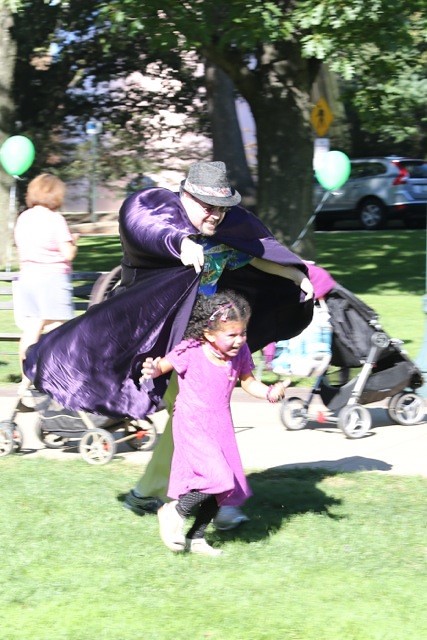
Rebecca’s Cancer Walk was this Saturday, and the cape was the big hit of the show. Rebecca found it to be the most awesome toy ever – we wrapped her sister in it, played tug-of-war all over the park, and spent a lot of time hiding in and under it. If you didn’t know Rebecca had a potentially lethal brain tumor, you would have found it hard to believe she was this sick.
Which led to possibly my favorite photo of me ever taken:
But the Cancer Walk itself was heartbreaking. Because it was so sparsely attended, it reminded me of all of the Men Supporting Men gatherings in Fight Club; a sad group of people battered by diseases the rest of the world ignores, struggling desperately for dignity and attention. Nobody much likes children’s cancer. Too many kids die to feel good about even the victories. And we’re so good at fighting regular cancer that we assume that kids must also benefit, but kids need differing treatments. (Which we benefit from in this case – Rebecca’s brain tumor would be a near-automatic Game Over in a grown woman.) There were maybe three hundred people there, which seems like a lot until you look at the crowds for MS Pedal to the Point or any 5k race in Cleveland.
And when it came time to call the parents of the dead children up to the podium to release white balloons in honor of the kids who didn’t make it, I lost it. Just lost it.
Everywhere around us were people wearing T-shirts with their dead kids on them. And I kept looking at Rebecca and going, she’s so alive. Such a squirming, resilient bundle of life.
I don’t want her as a photograph.
I don’t want to use her image for a cause, I don’t want to shamble out here once a year in her memory, I want a fucking alive Rebecca with me forever, to be a pain in the ass when she’s ten and a disrespectful teenager of fifteen and a twenty-year-old college kid who’s going through the inevitable college heartbreak and struggles with studying.
And I was, and am, infuriated by the lack of attention paid to children’s cancer. It’s like a hideous secret club you get escorted into only once you get the bad news, one where you discover exactly what the odds are once a kid gets cancer, and discover that only 4% of cancer funds go towards kids despite the fact that a lot more kids get cancer than we’d like to think, and you feel like you’re staring into the sun. You feel like you’re being forced to look at something that nobody else has to, and the rest of the world is looking away because it’s too horrible, but goddammit people, why are there only 300 out here on a sunny, beautiful day when I’ve been at small 5ks that were sporting at least 500?
What the hell kind of world is this, where this can happen to a little girl, and this lack of attention is mirrored across the nation?
I know, I know. There are always good causes. My Uncle Tommy had hemophilia, and so I’m hyper-aware. My wife’s sister had kidney disease, as does my girlfriend, so I’m hyper-aware of that. There’s a million diseases, and all of them are terrible. But what’s happening to kids is so deadly and we assume it’s all just okay, that we’ve kind of gotten the level of kids’ cancer survival rates up to that of adults, that it’s just infuriating.
Rebecca has the best shot of survival the Meyers can engineer. It’s still, as we’ve all taken to saying, a toss of the coin. And they’ve resected her tumor and got her the best kids’ care in the nation, and done everything to maximize some pretty crappy odds.
But still. If this enrages you the way it does me, then donations are still open. Heck, pitch in to the fundraisers in your own town. Because while I’m usually not a fan of “awareness” as a cure (we’ve won the battle for being aware of breast cancer years ago, folks), in this case being aware of how dire the situation is and communicating that to does does some genuine good.
Because Rebecca’s my window to a much larger problem. My heart throbs like a toothache, all the time. I love her, and through her I love all the other children enduring this, and through them I hope we can find something to do about all of this.
Have another photo of Rebecca. This is who we’re trying to save.

Every Episode Of "The Dog Whisperer" Ever
AGGRIEVED DOG OWNER: “Cesar! My dog is disemboweling mailmen!”
CESAR: “You are a failure at life. Your dog must be submeesive. Here. Stand near your dog like this.”
*Cesar strikes a pose*
*dog stops disemboweling mailmen*
VIEWERS: “…was that actually helpful for training my dog? I’m not sure.”
How Grammar Is Like Dining At A Nice Restaurant
I wore a patched Ronnie James Dio jean jacket that featured a very large image of a demon hurling a priest into a lake of fire. My hair was long and uncombed, and my gum-chewing date had spray-on 80s hair, fuck-me pumps, and a jacket more obscene than mine.
We had stumbled, accidentally, into one of the most expensive restaurants in New York City.
The waiters and patrons alike wore tuxedos. The tablecloths were of fine linen, the menus engraved. Bowls of sherbet were brought to the patrons between courses to cleanse the palate, and it was the first time in my life I might have been exposed to the phrase “amuse-bouche.”
My uncle, who was wearing his standard accountant’s outfit of blue jeans and a button-down workshirt, looked at the maitre’d. We’d been walking for hours, propelled by our picky eating habits; no restaurant seemed good enough. And now we were exhausted, far from home, and felt wildly out of place in this exquisite dining emporium. But even at sixteen, I did like good food, and this looked good.
The Maitre’d, God bless him, didn’t blink. “Do you have reservations?” he asked.
My Uncle, God bless him, didn’t blink either. “No. Have you a table for three?”
And, unbelievably, they sat us down.
The meal was the first truly great meal I’d ever had in my life, but alas, I don’t remember the food – I remember the sherbet, I remember the way the waiter came to scrape the crumbs off the table between courses, and I remember the bill being a staggering $350, which was pretty damned pricey today, let alone 1986.
And I remember the way they sat us very far at the back, so we wouldn’t upset the other customers.
The thing is, a quality restaurant won’t judge you by your appearance. They’ll sit you down, bring you food, and let your manners decide the course of the evening. I think my uncle’s polite request, his fearlessness in the face of snooty, saved that evening and made it magical. That was the secret signal to the maitre’d that “Yes, despite our slovenly appearance, we do respect this place, and will appreciate it.”
So they treated us well.
And while it was very kind of the restaurant to seat us, I also recognize that a restaurant owner would have been right to judge us. When we showed up to a place like that, where the dress of the day was clearly above our pay grade, we were signalling a potential disrespect. Those heavy metal jackets and torn jeans could have just as easily been a signal for, “We don’t know what this place is like, and we don’t care, we’re going to do as we please.” Because a good restaurant wants you to care about the food, to delight in the experience, to be invested in the group experience of fine dining where everyone has a good time – and if you’re going to show up to burp Pabst Blue Ribbon and laugh at the waiters’ penguin suits, then you’re fucking it up for everyone.
Dress matters. It’s what makes people comfortable. In the same way that showing up to your local dive bar in tuxedos is a signal that these people don’t get what you’re trying to do, it sets people on guard, makes them look at you askance, makes them worry that maybe your appearance signals a deeper problem that you’re actually just completely disinvested in this. Which is why you gotta tailor your look, to some extent, to the crowd… or risk people taking offense at smaller sleights that better-dressed people might miss.
It’d be wonderful if they could overlook your dress. But the fact is, you’ve already said in one way, “We may not know how we’re supposed to act here to maximize everyone’s enjoyment. Or we may not care.” And they’re gonna be on their guard until you’ve demonstrated that you’re cool.
Likewise: grammar.
Someone emailed me this morning with bad grammar in an email, asking why his writings didn’t go over well. And I think bad grammar in most cases is like showing up at an elegant restaurant in a demon-flinging jean jacket: right off the bat, you’re making people nervous as whether your inside’s as jumbled as your outside. It’s hard to convince people you have brilliant thoughts to say when you’re showing a disrespect for the language immediately, and people will suspect your logic is as poorly-presented as your grammar.
This may not be fair. It may well be that, thanks to dyslexia or some other issue, you’re like me and my Uncle Tommy stumbling into the lobby of the fine restaurant – secretly food lovers, clad in unfortunate garb, eager as any other diner here but having accidentally arrived underdressed. And you can hope for a grand maitre’d, one as welcoming as that bold and wonderful man who let us in and treated us like royalty.
But what you’ll usually find is people skirting around the edges, skimming, not wanting to get to know you too closely because you already don’t look like you know what you’re doing. And there are snobs who get too into dress or grammar, blowing people off for a split infinitive or the wrong shade of shoes – these people are jerks. But that’s no excuse for not trying to match the general tone of the establishment… and on the Internet, barring places like YouTube comments, the tone is generally “Decent grammar.”
Because I love that maitre’d… but he sat us in the back, near the kitchen, away from the rest of the crowd. Because we made the other patrons nervous. They did not know that we shared their vision. They could not know, until they got to know us better. And if I could find that restaurant today, I would dress up to the nines, because why put up barriers when you don’t have to?
Which is why, I say, if you’re blogging or communicating, default to proper grammar when you can. Grammar or bad spelling doesn’t mean you’re dumb, but holy God is it a big ugly jean jacket in a nice restaurant.
Bad Game Design That Leads To Immortality.
Magic: the Gathering was a horribly unbalanced game from the outset. Part of that was not the game designers’ fault.
Nobody expected Magic to be as popular as it got, so with this new collectible card game designed in the days before eBay, the designers (sanely) assumed that nobody would buy enough cards to collect all of them. They assumed most people would buy a few packs and play games with the handful of cards they had, which was inherently safe. Maybe it would be nigh-impossible to beat someone if he got ten of all the best cards… but what were the odds on that?
Whoops.
But more importantly, the designers didn’t understand how powerful some effects were – a decision that warped Magic for years. They didn’t understand that “drawing cards” and “mana for free” were actually so powerful that anyone who harnessed these strategies for cheap was effectively unbeatable. So cards like Black Lotus and Ancestral Recall, which seemed so impotent to beginning players that many of them actually traded them away as crap cards, turned out to be so ridiculously strong that today they’re worth… well, click the links if you wanna see what they’re worth.
Which meant that the early days of Magic play often consisted of hunting down these overpowered cards, jamming them all into a deck, and making a deck literally unbeatable by poorer and less-devoted players.
Was that a mistake?
I was pondering that while I walked Shasta the other day, because early D&D seems terrible and overpowered, too. Wizards were glass cannons at the early levels – “Cast your Magic Missile and fall asleep” – and then effectively unbeatable at higher levels. Meanwhile, boring old fighters kept leveling up and doing the same things over and over again.
Plus – and this is a huge design flaw – Wizards can do pretty much anything except heal people. What can’t a spell do? The slate’s almost unlimited. There’s no actual thematic feel to what a “Wizard” spell feels like, aside from being cast by a guy in a robe, which means that of course the characters are going to be imbalanced when there’s nothing a spellslinger is incapable of, given a high enough level and a thick enough spellbook. If the D&D game had said that Wizards were masters of elemental energy, or controlled the mind, then Wizards would have been a lot narrower and given others room to grow… but as it is, you get to ninth level and getcher hands on Time Stop or Wish (Time Stop is better), and it’s game over.
Except.
Except as little Ferrett, ten-year-old boy, those ridiculous levels of spells were what entranced me about the game.
I loved living out my little power trips in my head. I figured out exactly what spells I’d be kitted with on any given day, obsessed over which spells would be most useful in the greatest variety of situations, imagined the potency of a Time Stop at the right moment. And talking to some of my old buddies, I’m not alone; in real life, people often played fighters or thieves, but I’m pretty sure that when lonely little kids were imagining the fun of campaigns, it’s Wizards who got played inside their heads.
If the early rules had been more balanced, I don’t think I’d be a D&D fan today. Some of what made it fun was that overpowered nature – and while I acknowledge that as a game, it’s far better if all the classes are mostly equally useful at every level (or, at least, you’re open about some character classes flat-out being inferior like Ars Magica), for purposes of popularity I think it was the right move to have those ridiculously overpowered and all-encompassing spells.
We can fix the game balance in future editions. But without future editions, we don’t have a game.
Likewise, I know a lot of the dorks in Magic who were thrilled when they discovered that shit, that useless-looking Mox Sapphire was actually really overpowered, and the chase to find those literal gems in trade bins was what got their juices flowing. Yes, some cards were too strong. But they weren’t obviously strong, and I think a large part of what leveraged Magic up to the next level of popularity was discovering that hell, these bleah cards were actually so good that you had to have them, and then a certain portion of high-profile fans got off on collecting the rarest cards and building unbeatable decks. Their energy, their commitment, towards making the “twenty Black Lotuses, twenty Ancestral Recalls, twenty Fireball” deck made Magic spread further than it would have if all the cards were roughly equal.
So is that bad game design? Or is it inadvertently brilliant game design?
I can’t decide.