

What Makes A Roleplaying Game Interesting: Lessons For DMs
The problem with roleplaying games is that we dungeonmasters steal all of our best plot points from books and movies. And no wonder! We loved seeing Frodo sneak his way to Mordor, loved seeing Luke flying down the trench of the Death Star.
The problem is, “Luke flying down the trench of the Death Star” can make for a terribly boring gaming session.
“Okay, you’re flying down the trench. Darth is behind you.”
“I fly up and out of the trench so he doesn’t kill me.”
“You can’t. You need to fly in a straight line to keep your target in sight.”
“I… shoot at Darth?”
“You have no rearward facing cannons.”
“I… dodge?”
“That’s a good idea! He shoots at you… (rolls) He misses. The force is strong with you!”
“I shoot at the exhaust port.”
“You’re not in range yet.”
“Well, I guess I fly forward.”
“Okay, Darth shoots at you… (rolls) This time he hits! Artoo goes up!”
“Are there any tactics I can use in this situation? Any way of bettering my position? Any relevant choices I can make aside from keep flying in a straight line and get shot at?”
“Um…. no. You’ll be at the exhaust port in five rounds. Hang on, and Darth rolls to hit…”
“Wake me up when I can do something.”
See, too many novice dungeonmasters think that exciting roleplaying is generated from situations and stakes. Which is a natural mistake; if you’re not paying attention too closely, that’s what the best stories look like they’re about.
So a lot of dungeonmasters steal from a movie and say, “Well, the Dark Overlord is rising from his pit! The world is at stake! He’s surrounded by a hundred of his minions, and the players must kill the minions before he wakes!”
Then the characters play whack-a-mole for twenty rounds, endlessly rolling the same dice to “kill another minion, kill another minion, kill another minion” and the game is now reduced to what the dice say instead of what the characters do.
The trick to DMing is realizing that situations are only useful so long as they set up interesting choices – then fast-forwarding past all the parts that don’t involve the characters making interesting choices.
Because when a character in a movie has no interesting options, that creates tension, because we’re not that character. We worry because the character is helpless, and we want them to get out. But when we are the character, and we have no interesting options, that creates a mixture of frustration and boredom, because we want to do something to propel our character to safety, and yet we’re told that we are helpless.
People don’t like going to games to be helpless.
Likewise, having big firefights in a movie looks like fun, because it passes quickly and the character is stylish. But if it’s a curb-stomp battle where the DM will not say “Okay, it’s clear you’re winning, so you mop up the remaining five mooks,” then eventually the characters realize “Oh, yeah, I have to roll an 8 or above to kill a mook with my best attack to end this tedium,” and the game degenerates into rewarding dice rolls over creative roleplay.
(Some mooks will argue that a good player will always find a way to make the game interesting. This is partially true. However, a DM’s job is to make the game entertaining for everyone, not just the top-tier players, and why should I work that hard to have fun when the DM should be on my side?)
From a player’s perspective, the trench run is interesting when Luke decides to turn off his targeting computer and trusts to the force. It’s interesting if Han (the character) decides to fight his way to the Death Star and save Luke’s ass.
It’s not interesting when Luke is locked into a single tactic – fly straight and pray – and we have to endure that for five rounds of dice-rolling.
Your players show up because they want to make interesting choices. So:
- Do not present them with false choices: “Oh, I guess you can sneak into this castle! But I don’t like the idea of you sneaking, so I’m going to punish you for not talking your way in like I’d planned.”
- Do reward them for making interesting choices. You don’t have to have them succeed. But interesting failures can be more entertaining – see also, Han charging after the small group of stormtroopers, only to run into an entire squadron of them. Don’t fail; escalate.
- Do not give them combats where the most effective tactic is “use this weapon again.” Mix it up! Find a way to make them devise new tactics! (And if the only tactic that will work is “the tactic you had in mind,” refer back to “Don’t present them with false choices.”)
- Do fast-forward whenever possible. If the characters would make no interesting choices here, summarize. Yes, Luke has to fly another 140 kilometers in this trench, which would technically be five rounds, but what’s better – five boring rounds, or one totally exciting one?
Your whole goal as a DM is to give the characters interesting choices. You want to have a battle with eight mooks? Great! Do that! But don’t have the characters stand in an empty hallway, trusting to dice over tactics. Take a hint from Raiders of the Lost Ark and have the battle take place in a bar, which starts burning, with lots of cover and lots of creative things to use.
Because remember: “Being surrounded by 1,000 goblins” sounds like it should be fun, but you don’t have a lot of choices here. “Having to stand on the bridge and tell the Balrog that he shall not pass”?
That’s the choice.
So Harper Lee Is Probably Old And Doesn't Want Her Book Released
So Harper Lee has a new book coming out – one she wrote way back in the 1950s. The book she actually wrote before “To Kill A Mockingbird.”
And they’re probably publishing it because Harper Lee is a) so infamously reclusive that “We didn’t ask her” is actually something we’ve come to expect of Harper Lee-related topics, and b) so old and out-of-it that people can easily take advantage of her.
I’m sort of appalled, sort of not. This is, of course, colored by the fact that I want to read it.
But Lee’s famous reclusivity doesn’t seem to stem from fear of the quality of the novel – rather, that she hated the PR and intrusions that came from the novel. Her name isn’t even Harper Lee – she just didn’t want anyone to mispronounce her name. And she really hated dealing with the damned press.
So for me, this is a fucking hideous and soulless land grab – kind of like the way the Dr. Seuss estate started selling movie rights the instant that the good Doctor died. It’s just that in this rare and bizarre set of circumstances, they didn’t have the good grace to wait for Ms. Lee to pass on so they could start looting the body.
But I dunno. I suspect Ms. Lee is sufficiently in her dotage that she won’t get what she feared. She’ll need to give no interviews, and she may not even be aware of what’s happening. The most hideous thing about senility is that, in a way, it’s like being dead – I’ve watched too many relatives quietly slip away from this world long before they left it – and if what Harper feared most about her second novel was dealing with the embarrassment of having her personal life probed and dissected, well, she’ll be hauled into the limelight again but I suspect she won’t be troubled by it. If she’s signing contracts like this out of some sort of befuddlement, chances are good she won’t be aware of the freshly-printed newspaper stories about her.
It’s distasteful. It’s wretched. And I loathe myself for still wanting to know what she wrote, even if I acknowledge it’s a lot like those nude Jennifer Lawrence pictures in that consent matters.
It’s not right. And I wish I was a good enough person to assure you that I’d never read this book, but alas, at this point, I cannot. I didn’t go look at J-Law, but on the other hand, man, Atticus Finch was vital to how I formed my morals.
Though I suspect Atticus would disapprove. That’s something I have months to struggle with.
"Should We Go Polyamorous?"
One of the emails I get over and over again is a variant on this one:
“My partner has just told me they’d like to see other people. Should we go polyamorous?”
And that question always carries the assumption that there’s one answer.
Look: polyamory is not for everybody. For a lot of people – and maybe even most people – monogamy is what’s going to maximize their happiness. There’s no “HEY YEAH GO POLY,” and anyone who tells you that everyone should be polyamorous is selling you something, Princess. (NOTE: they are most likely attempting to sell you on the vast benefits of their genitals.)
Should you guys go poly? I dunno. How are you at dealing with jealousy? Can you own your own insecurities? Can you communicate properly? Will you self-destruct if you have to spend a night alone, knowing they’re in someone else’s arms? Are you guys stable enough that it’s a good time to start experimenting?
(Don’t start poly as a last-ditch resort, man. I hear couples going, “Well, we fight so often that I almost stabbed him with a steak knife at the Sizzler last night – but having a baby will bring us together!” Maybe, but probably not, and if it doesn’t you’ve just made things a lot more complex. So it goes with polyamory.)
So the question is, “Was your relationship good enough that you should be staying regardless?” is the looming question that too few people ask when trying to fix their love life.
What’s your partner looking to get out of this polyamory? Are they hard-wired for the polyamory lifestyle – and if so, why hasn’t this been addressed before? Have you been walking around this massive elephant in your living room for months now, and only now are having to address it? (If so, “blithely ignoring the potential dealbreakers until they threaten to crush us” usually isn’t a great dynamic for a flexible, healthy relationships.) Is your partner wanting to sleep with one particular person? Do they want sex, or emotional relationships? Do they want to experiment for a time, or is this a hard-core surety that this is the way it must be? The question of “What is someone getting out of polyamory?” is one that a lot of people overlook, thinking that polyamory all stems from some universal and easily-parsed desire, and you can do great harm with the wrong assumptions.
Do you trust your partner? Do they love you, or are they just hoping to do the bare minimum of placation while they run out and get their rocks off? Do you trust them to care for you, even in the throes of NRE? Do they respect you, or are you making too many excuses for their bad behavior because you fear losing them? The question of “Is your partner someone worth handing the keys to your heart?” is one that every couple faces, and polyamory only exacerbates that.
And are you willing to watch this relationship crash and burn? Any time you make a major adjustment to a relationship – moving to a different state, moving in together, moving in with your family – you risk changing a comfortable dynamic. Is it worth losing everything you have now for something that might be nice but not vital? The question of “How much comfortable stability are we willing to gamble in the hopes of positive change?” is a muddy, ever-shifting question.
And what if this is a dealbreaker for them? Then the answer isn’t “Should I go polyamorous,” but rather “Should I stay with them, or try to see whether I can live with this thing they need?” That’s another separate question – and again, one that gets asked by lovers who’ve discovered their partners need more of a life outside of the house, have discovered their partners need more kink in their lives, their partners need to have less sex. The question of “How much suck is worth tolerating in this relationship?” is something that again, there’s no singular clear answer to that fits everyone.
Thing is, when this is all said and done, “Should we go poly?” is not just one question, but a hundred of them, and there’s no possible way I could give you an answer from a two-line email. Monogamy isn’t bad. Desiring polyamory isn’t bad.
What you gotta do is ask the right questions, and that starts with realizing that “Should we go poly?” is in fact the starter topic to a large discussion that’s only gonna be solved by you two, working together, honestly.
I wish you luck.
Meet A Weasel In Portland!
Seriously. How have you not heard that I have a book coming out? I promise, I’ll settle down once the last of the tour dates are up.
But for now, I’ll be in Portland on Saturday March 21st!
My entire impression of Portland is from a) my wife rhapsodizing about her youth in Eugene, which isn’t quite Portland but she made stops there, and b) Portlandia. Which is, depending on who I talk to, either complete balderdash or entirely accurate.
Regardless, I’ll be signing/speaking at In Other Words, a feminist bookstore, and I am totally psyched to be there. (There’s even a discussion group on the book’s feminist topics, which I confess fills me with a twinge of worry as to how well I executed the inverse tropes, but no matter. This is what it’s like to have a book. First world problems indeed.)
In any case, if you wanna stop by, it’s:
Saturday, March 21st: In Other Words, in Portland, Oregon
14 NE Killingsworth Street, Portland, OR 97211
4p.m. – 6p.m.
And in case you’re going “Aw, man, I wanted to hang out Ferrett!” and you live in New York, Boston, Seattle or – strangely – Cleveland – then remember these dates:
Friday, March 6th: Loganberry Books, in Cleveland
13015 Larchmere Blvd., Shaker Heights, Ohio 44120
7 p.m. – 8:30 p.m.
Friday, March 13th: WORD Bookstore Brooklyn
126 Franklin St, Brooklyn, NY 11222
7 p.m. – 8:30 p.m.
Saturday, March 14th: Annie’s Book Stop Of Worcester
65 James Street, Worcester MA 01603
5:00 p.m. – 7:00 p.m.
Friday, March 20th: University Book Store, in Seattle
4326 University Way NE Seattle WA 981105
7 p.m. – 8:30 p.m.
The One True Scotsman Is Polyamorous, Apparently
I was told the other day that unless all people in a poly relationship loved each other, and were happy, and not manipulating each other, that it wasn’t *really* polyamory.
And look, I get the need to distinguish polyamory from swinging, or even just really bad polyamory. I myself have written essays like Polyfuckery vs. Polyamory, where I’ve referred to certain types of terribly poly as “quote-unquote polyamory.”
Yet I think it’s too goddamned easy to define polyamory by its perfection, as opposed to looking at it as the sum of all its flaws. I think that handwaving off the “bad” poly as “not really being polyamory” marginalizes the many people who have terrible experiences with it, and covertly shuns the people who haven’t managed to make it work properly as being insufficient to the cause, and quietly attempts to erase all the dysfunctionality that often festers in polyamorous networks.
Most educated people would get furious if I said that polyamory consisted exclusively of two primaries and a secondary relationship. And I think they should get equally furious if I said that polyamory consisted exclusively of well-tuned loving relationships.
Because if someone’s in an abusive monogamous relationship, that doesn’t remove the monogamy. If someone’s in a monogamous relationship for petty and shallow reasons, that doesn’t make it not-monogamous. Hell, even if someone’s in a relationship where someone cheats, again, the monogamy is present – it’s a broken form of monogamy, certainly, but common enough that we need to look at cheating as a failure state that can happen within monogamous relationships.
(Even if, yes, polyamory includes the word “love” and monogamy doesn’t. Yet that borked definition, if you’ve ever referred to two people casually dating as monogamous, you left off the gamos for “marriage” and as such you’ve committed word-fuckery. Get over y’self. Every word eventually evolves beyond its word-roots.)
I get the urge. Polyamory is often crapped upon by monogamous society, viewed as strange and off-putting and “I had this friend who was in a poly relationship and she hated it, so it can’t possibly work.” The temptation to snip out all those uncomfortable parts of poly that lurk at the fringes and leave only the shiniest happy bits makes it a lot easier to talk about poly with your friends.
Yet saying to a divorcee, “It didn’t work out for you guys? Guess you weren’t really monogamous” is dismissive, hurtful, and sneering. And it’s no less so for those people who have smashed face-first into a beehive of awful polyamorous behaviors, and had a bad experience, and are now being told on some level that they were too stupid to know the “false” polyamory when they saw it.
Because the truth is, that bad polyamory isn’t on the fringe – that selfishness and manipulation is often at the heart of polyamory as it exists in the real world. What looks like love at first often turns out to be sociopathic marketing. And as such, the word polyamory is large, sprawling, a loose net tossed over a mountain range. Relationships are complicated, and usually when you try to boil them down to simplicity you wind up omitting vital steps.
And maybe you’re trying to define polyamory not as it exists, as some sort of glowing ideal, a beacon to guide people to the One True Way. But the big problem with the One True Way is that it often encourages people to cover up their un-true parts so they can get the credit for doing things the right way. And then you have all of these hidden bits that fester, because we want to believe *so hard* that our heroes walk a righteous path that we’ll quietly overlook mountains of evidence to the contrary.
No. For me, polyamory is defined with its flaws. Polyamory has both grand loves and breathtaking betrayals. Polyamory has both brotherly intensity and shallow fuckery. Polyamory encompasses all these experiences, and to say otherwise is to erase the bad in some misguided attempt to leave only the good.
But like any relationship, I think you can only truly appreciate someone when you adore both the good and the bad within them. Polyamory has done me a lot of good. It’s also done me a fair share of harm.
I love it regardless.
What Sticking Chocolate Chips To My Forehead Taught Me About My Life
So this was pretty much the standard reaction I got last night:
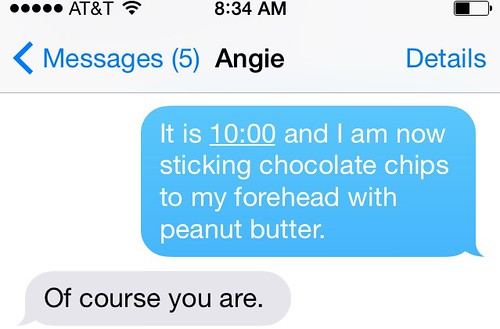
I told many of my friends about my odd adventures, and they didn’t even blink. My Dad didn’t even ask why; I guess after the beekeeping and the fireplay and the Rocky Horror, he’s just used to his son doing weird things.
Apparently, my life is sufficiently odd that “Hey, Ferrett’s sticking chocolate to his forehead” is literally just Wednesday to most people.
Still, most demanded photographic evidence, so I provided it:
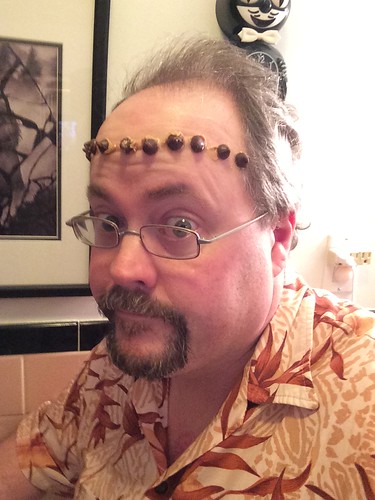
“Why were you doing this, Ferrett?” you may ask. Well, it’s a long story. But fortunately, it’s not so long that I can’t link to it.