

What The President Can Do About The Price Of Gas
“When pollsters ask Republicans and Democrats whether the president can do anything about high gas prices, the answers reflect the usual partisan divisions in the country. About two-thirds of Republicans say the president can do something about high gas prices, and about two-thirds of Democrats say he can’t.
“But six years ago, with a Republican president in the White House, the numbers were reversed: Three-fourths of Democrats said President Bush could do something about high gas prices, while the majority of Republicans said gas prices were clearly outside the president’s control.”
I’m an honest Democrat, so I’m gonna tell you the truth: There’s not that much the President can fucking do about gas prices. So stop blaming him whether he’s Democratic or Republican or Libertarian or Green or Martian. Basically, we need this much gas to survive. Other, outside influences determine the cost of that gas, and there isn’t much we can do short-term to drop our collective usage. On a month-to-month basis, about the only thing the President can do is decide whether to open the strategic gas reserves, and even that’s a pretty stupid idea.
However, the President can influence the price of gas long-term by funding initiatives that reduce our reliance on gas. Oh, yes, I know Mr. Obama has taken a lot of heat from conservatives for investing in poor technologies like solar power, but those self-same conservative politicians back the funding of corn ethanol, which basically is like solar power except we spend infinitely more effort extracting the energy from corn farmers.
The truth is that America loves cars, and the only viable long-term strategy to reduce the effective cost of a limited resource that every other country in the world wants is to reduce our reliance on it. Sure, we can drill, baby, drill, but eventually oil’s going to get scarce enough that we’re going to regret having the transportation infrastructure of our entire country dependent on it.
Which is why we need a President who’s going to work towards other options – yes, I know, you conservatives, you have all the negative reactions towards “Let’s build trains” that most people do to kicking a baby, since it’s taking our freedom to drive wherever the fuck we want away from us! But the truth is that the paradigm of “everyone has a big ol’ expensive car” isn’t going to last forever, and we need to be prepared for the day that doesn’t work. Which will involve car regulation to mandate gas efficiency, the supporting of other technologies to at least the subsidy level and tax breaks we give to the oil companies, and – yes – an investment in public transportation that will not initially be profitable. Just like all of those long-term military projects you never seem to mind funding.
I remember Borders, king of the bookstore world, going, “We’ll just let everyone make their mistakes in online bookselling, and then we’ll rush right in! We can make up that ground overnight!” And right now, conservative America’s going, “We’ll just let everyone else make their mistakes in creating efficient, non-gasoline-powered forms of energy, and then we’ll rush right in when we need to!” That didn’t work out so well for Borders, and it probably won’t work out so well for us. Especially since if gas hits seven bucks a gallon, which eventually it will barring the creation of biofuels, we’ll have a lot of poor people with no way to get to their jobs.
If you want someone who’s going to lower the price of gas long-term, then you gotta find a guy who believes that gas isn’t something America should rely upon. If you want someone who’s going to lower the price of gas next week, well, stop thinking that the President is a superhero who can break the laws of physics. Whatever party he belongs to.
Three Photos Of How We're Doing
So, I am in the middle of my Seasonal Affective Disorder, which meant that I spent the weekend curled up and trying to stay alive. But before that, my beautiful daughter Erin came to visit, and we all went to the Velvet Tango Room.

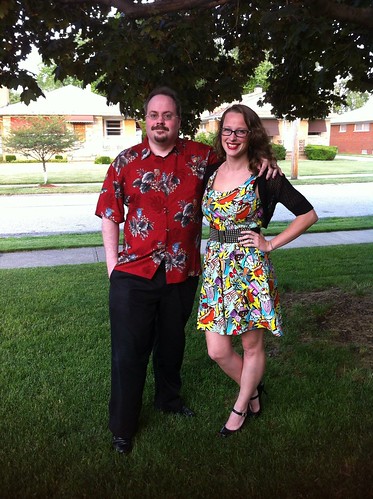
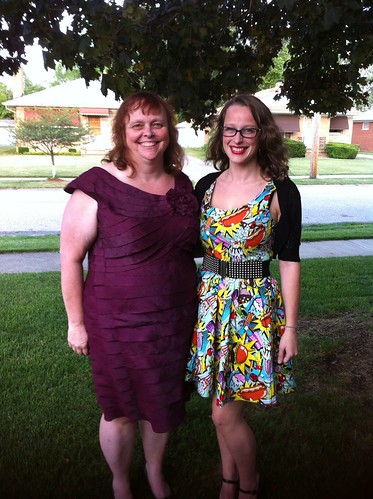
It is little happies like this that I cling to when I am sad.
Why I Don't Bitch About My Girlfriends On The Internet
It is remarkably easy to convince your child that Santa exists. After all, the child trusts you implicitly – why wouldn’t they take your word when you tell them there’s a red-suited jolly guy who brings them presents via a venison-powered transportation system?
Still, it’s a little declasse to do victory laps around the block, yelling, “See? I convinced Virginia that yes, there is a Santa Claus! What wondrous proof that Santa exists!”
Yet people do it. They do it all the damn time, particularly when it’s about ex-boyfriends or arguments they’re having with soon-to-be ex-girlfriends.
The reason I’m writing this essay is something a friend of mine wrote a while ago: “The high road sure is a frustrating bitch, sometimes. Luckily, there’s all that rewarding moral superiority.” That stuck with me, because I worry that’s how I come off when I tell people, “I try not to blog about the arguments I’m having with my lovers” – as if the reason I avoid airing my dirty laundry in public is because I’m just naturally superior.
No, it’s because I’ve learned the feedback you get is nonsensical and misleading.
There’s one of three reasons people read what you write on the Internet:
1) They’ve come to trust your opinion enough to want to know what you have to say. (Thankfully, this is the most common reason.)
2) They think you’re a fascinating train wreck, and want to see what sort of dysfunction you’re up to this week.
3) They think you’re an active hazard, and your blog is a lighthouse warning of what deplorable fuckeries you plan on committing.
Now, in the case of #1, you’ve built up a big ol’ well of trust to draw from. People have showed up because you’re either a good friend who they like, or because you’ve dropped enough truth-bombs that they’ve become a fan of your blogsmithery. In either case, whenever you post that Facebook status, you are talking to people swimming in a deep pool of “Benefit of the Doubt.”
In other words, you’re talking to an audience that is on your side already. And as long as whatever you write doesn’t insult them directly, well hey, all your complaints are gonna sound good! I mean, if I’m in an argument and dash off some Chinese fortune cookie complaint like, oh, “You can’t have true love without true trust,” then twenty people will like it on Facebook and the comment threads with my friends will be about how yes, true love needs a partner who believes in you.
But like all advice, that’s good in a vacuum. What if my wife’s complaint is that I’m spending all my free nights with a single girl she has never authorized, a girl who she knows is deeply attracted to me? What if she’s come home to find us cuddled up on the couch, knowing that I’ve been texting her at mysterious times and never letting Gini see what I wrote… And then, aggrieved after she’s been haranguing me for more detail on what’s going on, I flee to my Twitter and write angrily about her neediness and lack of belief in me?
NOTE: This has not happened. But if it damn well did, then my complaint of “You can’t have love without trust” becomes an obfuscated complaint of, “Gini doesn’t trust me when I’m doing sketchy things.”
But hey! I write the posts, so I get to frame how all this turns out. And I’m talking to a veeeeery Santa-friendly audience. They all vouch for my status as a Good Guy. And what I get are tons of attaboys, and you keep dropping that wisdom, and lots of positive feedback for something that I could well be completely wrong on in the first place.
In other words, what I get when I post about my troubles to the Internet is an echo chamber, telling me how wonderfully correct I am. It’s the kid, hanging the stockings by the fireplace. Because relationships are relative things – it’s right in the fucking word, people – any complaint I have, no matter how fucktastically incorrect, can be extracted and made to be true for someone.
“The beautiful thing about being a grown-up is that you get to choose your own family.” – Charlie Manson
“When all else fails, you just have to believe in yourself.” – Jenny McCarthy, head of the anti-vaccine movement
“When you find the right person, you have to follow your heart.” – Britney Spears
See? All true for someone… But not the people I’ve attributed them to.
And what’ll happen if I keep posting discussions on what’s wrong with my girlfriends? Some of the #1s will automatically take my side, whereas many others will quietly slide into the #2s (train wreck) and the #3s (uses your blog as a warning). But they won’t post, generally. Why would they? Your blog/Facebook/Twitter is generally a positive space, unless you’ve been so psychodramatic that you’ve actually edged out all the #1s and now the #2s and #3s are in the majority.
(NOTE: This sad state can be assumed if you’re in high school. Everyone’s nutty in high school. Be prepared to be flayed alive, should you complain.)
So when you do post, what do you actually accomplish? You get a feeling of moral correctness that is not at all justified. You get friends, using this as an excuse to tell you how wonderfully wise you are. You get some people quietly stepping away, not wanting to be on the train that’s rapidly heading for another collision. And you piss off the person you’re posting about, at which point they often post their own interpretations of what’s wrong with your relationship, which gets their own cascades of “Attaboys” and “You go, girl!” and “Santa loves me, this I know, for my friend she told me so!”
What you do not get:
- Actual wisdom.
- Forward movement with your relationship.
- Presents from Santa.
As such, I try not to post about a personal foible until it’s so dead that nobody even thinks about it any more… And usually, I make damn sure that it’s clear that I was the one at fault. Because otherwise, what I get is a big ol’ tide of supportive nothing.
Don’t get me wrong, pals. I appreciate your being on my side. But I want that to be because I’m on the side of genuine truth and justice, not just because I sound good.
The Only Way To Survive Was To Become Legend: Musings On Old Vs. New Videogame Design
These days, people play videogames to pretend to be a badass. In my day, you had to be a badass.
I say this because I finished playing Prototype 2 this weekend, the epitome of the “Press X to kick ass” style of videogame that’s become increasingly prevalent. You play a virus-infected shapeshifter who slurps up enemies, runs up buildings, and slices tanks in half.
Yet none of this is difficult.
To hijack a tank, you press B to grab it and then mash X to tear its gun off. The military rains useless gunfire down on you while you mash Y to Hammerfist them into oblivion. You can fall infinite distances and never get hurt, soaring over the landscape before slaughtering a crowd full of people by mistake as you land in a thunderclap. Even the boss battles are rendered easy, as you destroy a cancerous giant one limb at a time, your targeting system telling you which leg is vulnerable.
You’re doing these incredibly difficult things, but it boils down to “mash these buttons.” You feel like a God because hell, you’re destroying the city block, but none of it is difficult once you master the control scheme. I got through the game in less than a week, playing part-time. Which is pretty much the same as God of War, wherein you perpetrate legendary violence through a series of Simon Says events, and Mass Effect and Dragon Age wherein you can destroy entire caverns full of mooks right off the bat, or Grand Theft Auto.
Videogames have made power fantasies trivial. Here! Do this quicktime event to DESTROY THE UNIVERSE! You pressed X, then Y, then A? You, sir, are a badass.
Which is interesting, because the worlds of my old videogames were designed to kill you quickly, so the next quarter could be inserted. Their whole profit margin involved shuffling you to that “GAME OVER” screen as soon as possible.
When I was a kid, the world was designed to show you how insignificant you were. You weren’t the center of a universe that was waiting hand-and-foot for you to come along and rescue them; you were a small, pizza-shaped wedge beset by four ghosts, any of whom could kill you by touching you. You were a spaceship at the bottom of a screen, harangued by hundreds of flying, shooting enemies. You were a small spaceship struggling to survive in a deadly asteroid field. You died easily, trivially, unfairly.
Your only way to survive was to become legend.
There was no easy way to do this, aside from applying hard-earned skill. You plunked quarters into the damn machine until you figured out the patterns, honed your reflexes, slid into the game’s rhythm. Bit by bit, you lasted longer: two minutes. Five. Ten. If you were exceptionally good you might last fifteen, at which point other pasty nerds would edge forward to watch you, knowing they were seeing something that few got to witness. Sometimes you’d show them screens that had only existed in rumor before.
There was no in-game reward, and little out-of-game reward, as videogames weren’t particularly cool then. But the right people would know that you had that high score, your three letters your call sign (“WTS” for me early on, “WZL” now), the unremarkable skill.
There were no faux-skills to be built up. You had to learn a real skill – perhaps one that wasn’t usable anywhere anywhere else, but one that set you apart from other people. You didn’t pretend to be a badass soldier – you became a badass player, and that in turn gave you a strange and ephemeral confidence. You’d watch the novices play and realize how far you’d come. You’d put the quarter in and feel invincible.
Thing is, I spent maybe fourteen hours devastating New York in Prototype 2. I tore the heads of goliaths, I firebombed secret bunkers, I fought the US Army and the mercenary forces of watches to a standstill, then defeated Alex Mercer in an epic rooftop battle.
Yet none of that meant one-tenth as much to me as my legendary Ms. Pac-Man run, where I spent two agonizing hours racking up a personal best score with my Dad and wife at my side cheering me on. Because in one game, all of my prowess was granted to me by a developer who wanted me to feel good about myself. In another, I had painstakingly built up an arsenal of skills over the years, stealing prowess from a developer who wanted me to die, die, and die now.
The design has changed. And I wonder how that affects people today.
I Want To Speculate About Legend of Korra. And Mad Men. Talk With Me.
There are two shows that have been causing a lot of discussion in my house, each about as diametrically opposed as media can get: Legend of Korra and Mad Men.
So, of course, I want to talk about both of them. Light spoilers may apply, but I’ve gone to some efforts to obfuscate details of what have happened – though gloves will be off in the comments.
If you haven’t been watching Legend of Korra, you’re missing out on one of the best action-adventure cartoons in a long time. Like the recent Star Trek movie, no knowledge of past Avatars is necessary, but you get an emotional tie to the old references if you have seen Airbender.
The big question is, of course: Who is Amon, the masked leader of the anti-bender faction?
Being a kids’ series, Korra’s gone the route of peppering the show with so many dicks that frankly, it could be any number of obstructionist gits. For a while, I thought Amon was clearly Asami, as she is a) an avid follower of pro-bending and the cheating team got decimated, b) the daughter of a rich industrialist who can manufacture anti-bending tech at will, and c) infiltrated the Avatar’s camp by literally running into Mako. But what happened in “The Aftermath” indicates that this is probably not true.
The too-obvious choice was Tarrlok, the sneeringly evil politician, and if the show had chosen him to be Amon I’d have torn my teeth out. But the most recent show seems to indicate that Tarrlok has his own agenda that’s overlapping with Amon but not parallel (note how clearly I am avoiding spoilers here). So while Gini’s not ruling it out, I am. So let’s go nuts with the speculation: Who do you think is Amon, and why?
In other, subtler, news, the big twist of Mad Men is what Joan chose to do at the end of the last episode – which was heartbreaking, ugly, and stayed with me for a couple of days afterwards. It was the implosion of a lot of Joan’s dreams, conspired by everyone at the company, and I think it was the big watercooler moment of a season that had already had a ton of them. (Was there ever a more realistic depiction of an acid trip than Roger’s LSD shenanigans? I think not.)
That said, I’ve seen some people complaining that Joan’s reaction was forced, that big strong Joan would never act like that. And that’s something I feel is completely inaccurate. Like everyone else on Mad Men, Joan’s a complex character, and her primary drive has been to go with the way the wind is blowing strongest. She chooses her shots within that, yes, but unlike Peggy who’s decided to buck the system, Joan’s decided to surf it. She has her own agenda, and she makes good choices within that realm, but realistically she dresses sexy because she realizes that a) men are going to treat her like a sex object anyway, and b) given that choice, this is the easiest way to get what she wants. So she uses that for her benefit, while still maintaining her integrity.
With what happened last week, well, it became clear that no one in the company was going to protect her. Pete was the slimy little prick he’s always been, Lane was quietly manipulating her for his own hidden ends (and I think he’s gotta be the guy in the elevator shaft, since now he’s got nowhere to hide), Bert wanted his hands clean, and Don walked away in disgust (but Joan didn’t know that).
(The only forced bit, to me, was the complete abstention of Roger, who theoretically cares about Joan and you’d think would have some input. That absence seemed damning, particularly because honestly I’m not sure that Roger wouldn’t ultimately told Joan to do it. But that may be a matter of time, or cold orchestration on the part of the writers.)
So to me, when Joan discovered that she had been isolated, given the double-whammy of everyone there hating her if she didn’t and despising her if she did, she went the way that got her a bunch of cold cash. It was not a pleasant choice. It was a delightful scene where she turned her back at the right moment, forcing this to happen on her own terms. But Joan’s compelling nature is that she actually bends with the culture in a way that appears to be completely on her own terms, but often is a small choice made while bowing to outside pressures that even Joan cannot escape from. And she never, ever lets that heartache show.
So I think it was in character, and one of the creepiest episodes of television ever. And there are two episodes left in the season. I can’t wait to see what happens next.