

How The Electoral College Made Me Fat
You ever remember the moment where you first truly felt like an adult?
I do. It was at a diner.
Because there I was, with my friends, at my favorite diner in Westport. And I was in total control of the meal: I’d chosen my company, I could eat anything I wanted off the menu (even the desserts!), and at the end of the meal I paid the check with my own money, which I had earned.
I remember sitting there, eating my open-faced turkey sandwich with two buddies as they drank coffee and traded stories, feeling the pride of realizing I’d made this meal happen.
I was all of nineteen, but I’d already integrated the idea that Grown-Ups Go Out To Dinner.
Which, in my household, was honestly the metric. My mother and Uncle Tommy both loved fine dining, so at least twice a month we’d go out to a restaurant to see how it was. We’d experiment with different foods – back in the early 1980s, the idea of “sushi” or “salsa” was still alluringly transgressive – and gush about the idea of mole sauce on steak, and compare meals to see who had won.
So eating out was always an event – family-style, with Gramma and Tommy and Mom and Bruce all sipping wine and asking about the daily specials.
Was it any wonder I became a foodie?
Which drove a lot of experiments in life – I became relentless in seeking out new experiences, in part because of my mother and Uncle’s dinners at the latest joint in town, which translated into other wild adventures like me playing Frank at the Rocky Horror Picture Show and me setting people on fire for fun (safely, of course) and me keeping bees and me moving to Alaska to marry a woman on the Internet –
Just crazy stuff after crazy stuff, but it mostly worked out.
But I didn’t realize all the knock-on effects until I was driving home from dropping Gini off at the airport yesterday. She’d made delicious Chicken A La King last night, which was still in the kitchen with fresh rice, ready to go for my lunch….
Yet all the way home, I kept thinking, Gini’s gone. I can treat myself. My eyes would linger on every restaurant, thinking, I could get myself something from there before realizing, “Wait. One of my favorite dishes is waiting for me, for free, in my fridge, and you want to go somewhere else to get a meal?”
Yet part of my brain went, But it’s special.
And a problem with my diet snapped into focus: Because my mother and Uncle Tommy had taken me out to dinner for special occasions, I’d come to think of dining out itself as a special occasion, even if it was something as trivial as stopping by Five Guys. Eating at home was all good and well, especially when Gini’s a good cook and I’m no slouch myself, but…
There I was, nineteen, at that diner.
For me, “eating out” was part of how I defined myself as a functional human being. I mean, not every night. But more nights than I should, because if all else was equal, I’d rather go out to Aladdin’s Diner than I would eating an equivalent meal at home –
And if I’m out, am I eating healthy food? I mean, no! I’m a grown-up. Part of the thrill is getting to choose the special food this place has! Why would I go out somewhere and not try this special milkshake, sample the cool appetizer, see how their take on chicken-fried steak is?
And all that was pretty much subliminal until one car ride snapped it into focus.
Now, I’m almost fifty. And my parents made some decisions when I was seven that, it turns out, still have some pretty weird ramifications decades down the line. They didn’t mean to – they just liked trying new restaurants – but here I am, realizing that part of the reason I eat unhealthy is because I have linked “dining” to “being a grownup” –
- and let me tell you, considering that I know some folks will be moaning, “I’ve never felt like a grownup” in response to my opening question here, being rooted even temporarily in an identity as an adult is a powerful experience. Especially when all you have to do is give the waiter money when they come round with the check.
And all that’s had ramifications – how I look certainly inspires differing social interactions, my heart was always going to be bad (genetically, I have severe issues) but that contributed to the triple bypass, the sweets may have contributed to my gum disease, which may also have contributed to the heart issues….
That’s a pretty elaborate chain of events. And I don’t anyone back in 1982 would have anticipated where we’d get from here – that’s just how complicated life is.
Which brings me to the electoral college.
Now, some of my Democratic friends are considering abolishing the American electoral college, instead electing Presidents by “Whoever gets the majority of the popular vote.” And both those for or against are saying, quite confidently, that getting rid of the electoral college either will or won’t cause politicians to turn away from less populated rural areas, and it certainly won’t (or will) cause Presidential candidates to exclusively campaign in big cities, and they all know what will happen so they’re very for or against it.
Me?
Well, I’m thinking of a comparatively simple decision – “Let’s take little Ferrett with us to the new Italian place!” – and all the weirdo effects that’s having years later. And I’m thinking of how complicated life is, and of all these people who seem extremely certain that they can predict all the ramifications that will spring from a decision that literally affects the overarching strategy of every Presidential candidate from now on, and the ways that voters will react to those strategies, and the counterstrategies that will be formed….
And I think of how the first effective female contraceptive was created only fifty years ago and how it’s led to a wild growth in women’s rights, followed by a conservative backlash because people were freaked the fuck out about independent women, and that’s threaded through all our politics and been amplified by the Internet and led to a societal upheaval where all the old courtship rituals have been upended because women are on a more equal footing and now both men and women are often confused as how to find a partner, whereas others are just fine without partners, and some are finding new ways of creating partnerships that don’t rely much on traditional marriage or commitment as we know it at all….
And I don’t think any of that would have been predicted when Margaret Sanger first started funding The Pill.
And as I watch the arguments over the electoral college, I see everyone being very certain that the future is this easily predictable metric, that people are this homogenous mass that will respond sanely to these new incentives, and while I recognize that life is too chaotic and fast-moving to wait for perfect data before we make a choice, I’m shocked at just how casually these people say, “Oh, we know what will happen.”
Whereas I’m at home alone tonight. I have some leftover Chicken A La King still. And I feel this strong urge to get some takeout, an entirely useless takeout, in a home I own with a loving wife who I once moved wildly out to Alaska to marry because of the unexpected results of a set of very small decisions made decades ago.
And I’m thinking how very hard it is to understand how things will turn out in the long run. Some people do it. And I respect them.
But the ones who seem to get it right the most often are the ones who aren’t quite so certain about their predictions.
The Decisions We Don’t Realize We’re Making: On Chugga Chugga Choo-Choos and White Nationalism
One of my favorite Internet distractions is “Things we didn’t realize we had firm opinions on, but we actually do.”
Today, that distraction is “the number of chuggas.”
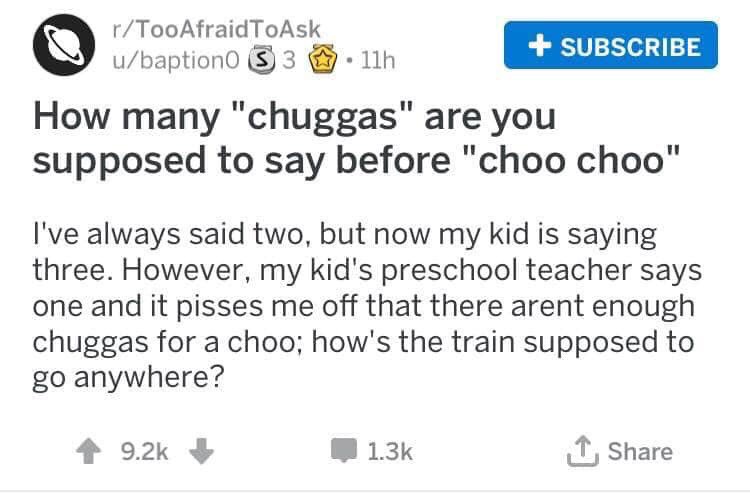
The thing is, nobody ever sat down with you and said, “Here’s how many chuggas come before the choo-choo.” (For the record, I say “four.” I am an outlier.) But internally, thanks to a variety of subtle cues, there’s a certain number of chuggas that feels right to you before that oh-so-satisfying “choo choo” comes whistling out.
But that’s not the only weird decision you’ve come to! For example, I’m describing a dragon, and I tell you it’s a green young dragon. Wait – that can’t be right. It sounds weird. I mean a young green dragon, certainly.
Yet as Mark Forsythe wrote:
“Adjectives in English absolutely have to be in this order: opinion-size-age-shape-colour-origin-material-purpose Noun. So you can have a lovely little old rectangular green French silver whittling knife. But if you mess with that word order in the slightest you’ll sound like a maniac.”
And again, nobody sat down with you to teach you that – I mean, maybe you saw the same viral Tweet I did and learned it, but there weren’t grammar lessons forcing you to list them in the proper order. You just fell into the rhythm of things.
The fascinating thing about all of this is that we are awash in firm opinions we didn’t actually realize we had, because nobody challenges them seriously. We’re continually ping-ponged back and forth by ideas that we didn’t generate, and weirdly, we didn’t even realize we’d internalized – they’re just there, so deeply ingrained that we don’t even bother to argue with those ideas, and recoil from anyone who presents an opposing opinion.
Yet there’s an equally weird idea many people have that they purposely chose all of their opinions. As though at some point in their childhood, a dark tall Opinion Man came round to their house with a leather large valise full of potential opinions and laid them all out before them – and then the children, using nothing but the power of logic, either accepted or rejected every conclusion they could have possibly come to.
And those people will get very flustered if you suggest they inhaled some of their opinions without thinking about them, picking them up like trace elements in water. I remember a jovial friend of mine who, when I suggested he had some intuitive elements to his personality, grimly told me, “No. I am a rational man. I know every element that has ever affected me.”
He is now on his second or third divorce, I don’t remember which. And his exes will tell you that he doesn’t so much know every element that affects him so much as he constructs a logical justification in retrospect, because he’s utterly terrified of believing that any part of him is not properly vetted by himself.
But my point is, none of us are immune to picking up opinions that you didn’t realize you had. It’s kind of frightening to think that something slipped past your conscious thought and became rooted in your expressed behavior – but here you are, wincing when I described a suitcase as a “leather large” valise.
So there you are, surrounded by a whirlwind of subliminal opinions that have wormed their way into your judgment. There are things that seem right, and things that seem wrong to you. And they’re generally not so earth-shattering that you will bother to correct someone; they just irritate you, so that you think a little less of someone.
And some of those opinions? Are racist.
And some of them are sexist.
And yes, like my very rational friend, some of the folks reading this will rise up in indignation because I’m not sexist or racist, I don’t know what you’re thinking, I’m a very rational thinker.
But there’s a lot of things that do get absorbed into your system, and you might not even be aware of ’em until someone points them out. It’s sort of like the way black kids are more likely to get arrested or shot by cops because at some point an opinion made their way into the cops’ bloodstream that young men with black skin are more threatening than young men with white skin.
And I think most of those cops, if they gave an honest answer, would deny the idea that they’re racist. But when they’re chasing after someone, that idea that “black kids mature faster” or “black people feel less pain” triggers, and they act in a way that comes to a racist conclusion even if none of their conscious mindsets went for that at all.
Likewise, a lot of people – men and women – would tell you that they’re not sexist. But studies have shown that a group is perceived to be overwhelmingly dominated by women if they’re occupying around 30% of the conversation. And that reaction is probably as subliminal as the leather large valise problem, but it does affect how the conversations happen.
And whenever I suggest “Hey, maybe you have some subliminal conclusions that help encourage discrimination,” I get a variant on the “Yes I am very logical” debate, because these people know who they are, it’s ridiculous to suggest they might not have mapped out the entirety of their being, they don’t have a racist bone in their body.
But I wonder how many chuggas they need. Again, they probably didn’t map out the number of chuggas – but whenever they’re playing with a kid, there they are, taking a number they did not actually come to a conscious conclusion on and passing it on to another child. If they hang around with that kid long enough, eventually that kid will grow up to be a three-chugga kid because, well, that’s the chuggas in the air and that’s the way chuggas should be.
Pretty harmless for a chugga-chugga-chugga-choo-choo.
Little more harmful if it’s racism.
Why Gatekeeping Fandoms Doesn’t Really Work.
For me, “polyamory” is a big, sloppy, gloriously inclusive wrestling match of a word. Do you only see your sweetie only once a year and never text outside of that? Well, if you say that’s polyamory, I’ll agree with you! Do you go mostly to sex clubs and mostly boink and rarely talk? I might say that’s a more swinger-flavored polyamory, but sure! Welcome to the club.
Others, however, would rather classify.
“That’s not polyamory,” they sniff at the once-a-year person, “That’s more of a ‘friends with benefits’ situation. And the other people? They’re clearly swingers! And I’m not judging people: we simply need to ensure everyone’s on the same page so we can speak a common language.”
And that classification mentality seeps into a lot of places – is this person a true fan, or just someone who likes the albums? Is this person someone who actually knows how to manipulate code, or just some hacker? It’s not a judgment, I’m just trying to be precise.
Problem is, that effort fails on both goals. You do wind up judging people, and language is inherently imprecise so you’re gonna fail there. And even if it did work – which, remember, it doesn’t – I’m opposed to that kind of classification because it’s got two hidden agendas buried in it: covering up errors and attaining superiority.
Basically, any attempt to break down what counts as a “true” polyamorist – or a “true” comics fan, or a “true” programmer – and then sorts the people into other buckets is a system that’s inevitably designed to fuck other people over.
So how’s that work?
Well, for someone who’s trying not to be judgmental, the classifier is invariably comparing someone to their ideal of whatever this perfect fandom is. “Yeah, okay, these people say they’re polyamorous, but I have a definition, and I don’t think they have enough love as I’ve defined it to match. So I’m gonna kick them down into a different category.”
Literally the first thing you do when you classify is to judge. So you’re being judgmental.
And you can say “I’m not kicking them down! This isn’t a hierarchy! One isn’t better than the others” – but that doesn’t work, really, because this isn’t an exhaustive taxonomy where we have a specific word for every possible configuration. Casual usage of language doesn’t work that way. Unless we’re birdwatchers, most people have a couple of specific birds – “robin,” “bluejay,” “crow” – and then all the other birds that just aren’t interesting or unique enough to remember specifically.
(Actually, my wife – a former birdwatcher – informs me that some birdwatchers have a term called “LBB,” which means “little brown bird” because there’s a zillion of them.)
Eventually, you wind up with the “whatever” bucket, for the people who don’t fit all your other standards. And no matter how good your intentions, assuming you have good intentions, that bucket eventually becomes the butt of jokes. Because everyone assumes that that bucket is the castoffs.
And I’m guilty of that. I’ve mocked a few Hufflepuffs in my time, which is why I still laugh at this Tweet:
FOUNDER OF HOGWARTS: okay, so we all know there are four types of kid. brave, smart, evil and miscellaneous.
SCHOOL BOARD: yes, continue.
But Hufflepuffs aren’t bad – they just weren’t given a lot of focus. And yet because that focus was taken off them, a lot of people assume they’re the joke school. Which is not an unusual reaction to a catchall classification.
So basically, even if you don’t mean to, you wind up categorizing people as lesser simply by excluding them from a more specific definition.
But wait, there’s more! Because the other thing that invariably happens there is the “No true Scotsman” fallacy at play, wherein the act of classification starts to idealize the definition.
Are those people polyamorous, but in a way that make you look bad? Well, it’s time to exclude those people from the definition. You keep refining the definition to make it better – and unsurprisingly, the “better” that definition refers to almost always prioritizes your preferred method of this action!
I mean, hardly anyone defines a “true fan” of their own fandoms as something they don’t do. Oh, they might admit they’re not a “true fan” of some TV show they’re casual about, but if they’re seriously into Supernatural and trying to categorize fans? Oh, they’re gonna be on top.
But once you’ve actually placed yourself into a group, then comes the pressure of not wanting to look bad. If a bunch of dorks are embarrassing you, it’s a lot easier to refine the model of “true fan” to exclude the dorks than it is to wrestle with the fact that a lot of people can love the same show as you and yet be repellent.
So you create another category of “bad fan” or relegate them to the catchall category or whatever – but in any case, eventually you’re very much adding a judgment now of “good” or “bad,” even if that’s as simple as “Has the good kind of deep love we should treasure in a polyamorous relationship” and “They don’t.”
In that way, new classifications are added to cover up errors. There’s no bad fans, just fans and people who aren’t fans. There’s no bad polyamory, just true polyamory and the catchall.
And every layer of definition you provide to erase these errors adds another hoop for people to jump through to get to the most specific, most flattering definition.
Eventually, that definition of “true” becomes not a definition, but a coping mechanism. You’ve conveniently defined yourself at the top of the hierarchy and are emotionally invested in it, so your goal becomes excluding people to ensure that only people you like share your most-specific definition.
Congratulations. You’re a gatekeeper. Whether you meant to be or not.
And it’s not at all about clarity. It’s about ego.
And mayhaps you’re all like, “What does language exist for if not to provide clear definitions?” To which I say, “A tomato is technically a fruit, but most people also call it a vegetable. A penguin’s technically a bird. Take fifty people who are called liberals, and you’ll find so much variation that it becomes hard to find a central point.”
Life is inherently unclear. Language is sloppy. Don’t believe me? One of the most common phrases in English is “I love you,” and yet we have yet to agree on what that means aside from in the most general sentiment. Does it mean romantic love? Platonic? Does it mean deep commitment, or just warm fuzzies?
If someone says “I love you,” you’re always going to have to investigate what that means to them.
Except in the most scientific of circumstances, which hardly ever apply to day-to-day living, someone citing a term is never the end of an identification – it’s the start of a larger conversation where, yes, “I’m a fan” means some level of enthusiasm, but you have to investigate what valence and depth and meaning that enthusiasm takes for them.
Attempting to remove that investigation by creating universally agreed-upon terms to determine who’s a “true” polyamory or a “true” swinger or a “true” Tony Stark fan does not add clarity – it removes it. It creates a barrier to understanding designed to prioritize your own specific preferences.
Which is why, yeah, polyamory is a big term for me. There’s people in relationships I wouldn’t be in, but if they wanna call themselves polyamorous, I’ll agree. I may think they’re terrible polyamory, a kind of polyamory you should never be in – and if that happens, I’ll say that.
That’s part of the conversation.
That’s part of the value of allowing things outside the taxonomy to thrive.
This Man Needs To Lose His Beard. Stat.
This is Jim. He has a beard.

As you can see, the beard is kind of his signature look. I have never seen Jim without the beard. I literally cannot imagine Jim without the beard.
The beard needs to go.
Now, one other thing you should know about Jim: He’s a doting godparent to the Meyer children. In fact, before they could speak, they used the sign for “beard” to refer to Uncle Jim. Uncle Jim is an axiom in the Meyers’ life; Uncle Jim shows up for dinner a couple times a week, does emergency spillover duty when one of the kids needs to be picked up.
Unfortunately, for the Meyer kids, their sister Rebecca is no longer an axiom in their lives.
You may remember Rebecca during the painful year-long period where I kept blogging about her, and her brain cancer. The cancer was horrendous on every level; the constant rollercoaster up of hope and then the crash down into the latest results, the stream of decisions as to what treatment would be right for this, the stream of fights for the Meyers to be good parents to all their children when poor Rebecca was rightfully occupying so much of their attention.
And also, this is America; if the Meyers hadn’t had good insurance, Rebecca’s death would have bankrupted them.
If you’ve ever read my book Flex, Aliyah is pretty much Rebecca. I didn’t set out to immortalize her; it’s just when I wrote a book with a scrappy, fearless, and funny kid, I cribbed notes from the scrappiest, the funniest, and the most fearless kid I knew. And I watched as the cancer spread through her brain and took her from us on her sixth birthday.
That’s why Jim’s beard needs to go.
Because Jim will be shaving his head for St. Baldrick’s charity to raise money to help fight childrens’ cancer, as he does every year. (As I would every year, but I decided I looked better bald.) And he’s put his beard on the line; if he can raise $5,000 by this Saturday – a big ask – he will shave that beard that Rebecca used to once tug.
He’ll do it because he knows what it’s like to lose a beloved child to cancer.
Which is why I ask you: please help raise $5,000 to shave Jim’s beard. It’s a big ask; he’s got a long way to go. But every dollar you donate goes to finding better ways to help save kids with cancer – and believe me, that’s one of the best uses for your spare dollars you can imagine.
The link is here. If you can donate, I ask, please. Do.
(And if you can’t donate this time around, may I ask that you share this page with your social media to help spread the word? Thanks.)
And We Forgot The Taste Of Bread: The Social Dynamics of Food
So as a reminder, I’ve just started an all-Soylent diet for a couple of weeks, eating nothing but nutritional goop in an attempt to reset my system.
And here’s the weird thing: Gini started early.
That’s not the weird thing – Gini always wants to go NOW NOW NOW, whereas I’m like “Hold on, I’mma sleep on this sofa until the starting gun.” Her attitude was, “If we gotta start, I’ll go on Thursday” and I shot back with, “I promised myself a weekend of ice cream and I’m gonna get a weekend of ice cream, so I’m on Monday.”
She was, of course, miserable.
Transitioning to Soylent will do that to you. We’re used to being able to spike our blood chemistry at a moment’s notice – some caffeine to jolt us awake, some sugar for quick-release carbs, whereas Soylent is like a nutritional IV pump – it’s slow, and steady, and if you’ve been relying on “I’m feeling sluggish so I’ll just make a cup of tea with sugar,” you will feel like you’re crashing all damn day.
So she was grumpy the whole weekend.
And I still had to eat.
Thursday, it wasn’t too bad – I had dinner with a friend. Friday, I scavenged leftovers.
But come Saturday….
We went out for a drive to hunt Pokemon, which is what we often do on weekends – and we got stuck for an hour in line at the car wash. And by the time we were done with the usual chores, I was hungry, and I said, “Can we stop at the drive-in for some food?”
I did not say it unthinkingly. I spoke as sensitively as I could: “If we’re gonna keep going, I need to keep eating” was my tone. And she said “fine” and we went to my favorite drive-in and got burgers – this was my last weekend before the long haul, after all – and Gini was kind enough not to say anything as I scarfed down some calories, but the seething anger she was concealing made me ashamed to eat.
The ensuing Pokemon hunt was short and and not very sweet. She wasn’t in a mood to enjoy anything. So we went home.
And come dinner, I could have anything! My cardiac issues be damned, I could go absolutely bezonkers. And I looked through takeout menu after takeout menu, deciding whether I’d have rich peanut-sauce Thai or a thick Chicago-style pizza, and then imagining Gini’s sadness as the scents of these things permeated the house and she couldn’t eat…
For my wild Saturday night dinner, I had Kraft macaroni and cheese. Because I knew she hated that shit, and it wouldn’t make her sad.
And come Sunday, I didn’t want to eat. Food had become a barrier between us. I mean, I had a chocolate milk because Gini didn’t like that – but all the foods we’d shared once had, in the course of three days, become a barrier. No longer could I say, “Hey, I got the new Coke Vanilla Orange, come take a sip.” No longer could I say “I got corned beef egg rolls at the Chinese store, try them with me!”
I couldn’t even drink a beer without feeling guilty that Gini – who loves her wine – was going wineless.
I let the moments slide by until my stomach rumbled, then snuck out without telling Gini to get some food, and gobbled it down before she could find the evidence.
And that’s when it became clear how much of our food habits are driven by socialization.
I said this in my prior writing on Soylent:
“Gini and I have been thinking about how to restructure our lives to eat better, but what we agreed we needed to start was a hard reset – something to jar us out of our normal habits of ‘Oh, a glass of wine here will be nice’ and ‘Well, since you’re having a wine I’ll have this cookie.'”
And what became crystal clear once the good will had stopped was how much crap we were eating because the other person covertly tolerated it. We do have a certain detante in our household – okay, yeah, we’ll eat well tonight, but we’re out to dinner at a nice restaurant, of course we’re going to try the appetizers. And we have guests in town, don’t we want to have a drink with them?
Food is not only a social lubricant, but a bargaining chip – I’ll overeat a little if you will.
That only became evident when, in the course of a weekend, I went from a welcoming “Hey, you wanna go for Mediterranean food tonight?” to dashing out to eat as little as possible.
Which is… well, it’s something to consider.
Because once we’re off the Soylent, Gini and I will have to consider how to eat better. And we love fine dining – that’s a joy I don’t want to give up, because the thrill of going out to new restaurants with friends and experimenting with high-class mushroom-and-gin drinks and trying some new sauce are part of who we are.
But there’s also a fair amount of low cuisine that creeps in. A glass of chocolate milk here. A bag of Chex Mix there. Stuff we both know is bad, and not particularly comforting – more like background radiation – but we both go, “Well, you’re eating that, so I’ll have this” and the pounds creep up over the years.
And as I engineer the new dietary habits, one of the axioms of this is that Shame does not work. Shame has never worked for us – yes, we should go to the gym, but we know we’d rather be at home. What worked for us, exercise-wise, was when I devised a plan that kicked away shame and locked us into mutual support – “I don’t want Gini to go to the gym alone today, and this is a lot of money we’re spending and I don’t want to waste it, so I guess I’ll go.”
That’s worked for almost two years now.
So when I’m thinking of a new diet, it’s tempting to go, “Well, just have Gini and I yell at each other!” But that wouldn’t work in the long run. I’d feel bad for a while, but in time, I’d just learn to pig out in quiet, like some sort of caloric spy.
What I need to ponder – and keep in mind this is a personal solution, whatever works for you may well fall flat at the arena of our personal psyches, so slow your roll when suggesting your One True Solution – is how to engineer a solution where Gini and I support each other in positive ways as opposed to negative ones. Which is difficult, because neither of us want to eat healthy – we want to be healthy, and Jesus is there a distinction to be had there.
So I’m pondering. Because it’s become apparent how much we enable each other. And we have to figure out how to enable each other to eat more broccoli and less Chex Mix.