

Book Review: Robert J. Bennett's American Elsewhere
 It’s hard to be impressed by the unknowable when you live right next door to the fuckers.
Which is to say that there’s a reason most of Lovecraft’s protagonists went insane at the end of the story. If they’d continued to explain the Elder Gods in a refined, white-dude tone of voice for another fifty pages, it doesn’t matter how horrific Yog-Sothoth was, we’d get used to him. Humanity’s survival skill is adaptation. No matter whether we’re living in a ditch with flies laying eggs in our eyes or so rich that it’s cause for a bitch-slap if someone brings you a drink without ice, we come to think of what we know as normal.
So most books that open up a portal to brain-blowing other-dimension worlds and stay there long enough for us to get a good look? Suck, and suck hard. The Elder Gods are built on shock value, the idea that we literally cannot adapt to them… but the truth is, we probably could. Stare hard enough into the void, and you’ll learn to ignore enough of it to get by. And the more time we spend with Cthulhu, the more he seems kind of rubbery and sad.
American Elsewhere, however, takes a different approach.
Because there is a town in New Mexico, one that is on no map, one next to a mysteriously abandoned physics lab on a mesa. This town, despite being miles from nowhere, is a 1950s-style wet dream of a town with a perfect pie-making diner and freshly-mowed lawns and kids playing baseball under the American flag. Except when Mona, a hard-bitten cop with a suicidal mother haunting her past, discovers that she owns a piece of property here, she seeks it out – and finds exactly what is wrong underneath the surface….
Part of what keeps American Elsewhere bubbling along is that Robert J. Bennett knows just what detail is going to throw you. He’s very good at setting up a realistic world, one that feels exactly like this one, made of studded 2x4s set deep into concrete foundations. And then, in the middle of that painstaking realism, he places that one odd detail that uncorks potential worlds of weirdness seething underneath, a flurry of implications that keeps your brain frothing nicely.
(And, more importantly, he plays fair with the details. They all make sense later on, in context. It’s a lot like if LOST had actually thought that cause and effect was a priority instead of an annoyance.)
I don’t think it’ll be a surprise to any horror fan that the town of Wink, New Mexico is living right next to the unthinkable. But the trick here is that Robert is smart enough to understand that if these wild other dimensions exist, we would be just as alien to them as they are to us. As such, the book contains an astonishing amount of weirdness, but that weirdness expresses itself as a struggle for cross-pollination – of two wildly differing spaces trying to fathom each other, and the insanity that evolves from that imperfect adaptation.
Yet for all of this chaos, American Elsewhere remains firmly character-driven. It’s not about the weirdness – it’s always resolutely set on exploring the people facing this weirdness, and the actions they take to defend what they think is right. As such, what you wind up with is a lot like Half-Life might have looked if the protagonist wasn’t a mute man who could only interact with the world through violence; there’s a lot of exploring the past in an attempt to view the prism of the future, with many mixed results.
The end result is a very satisfying lap-buster of a tome, with that happy tension of a Stephen King or a Ray Bradbury echoing throughout it – that nostalgic pull we all feel for a stable town and home clashing inevitably with change – that feels remixed and refreshed. It’s one of those books that should be a hot mess, but instead assembles itself into something more than the sum of its parts to become a statement on what America is, and might be.
As such, what you get is not a reflection of the unknown, but a distorted lens reflecting upon us. And that is worth the price of admission, my friends. Recommended.
Want To Hear Me Read One Of My Best Stories?
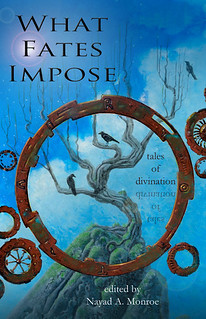 The best story I’ve written in the past year is a glacial little tale called “Black Swan Oracle,” originally entitled “Facebook Oracle” – a fortune-teller who reads social media, contrasting and comparing the posting habits of billions of users to tell you your fate out to six significant digits. It was heavily influenced by Nate Silver’s The Signal and the Noise, a nonfiction book on forecasting. Thematically, it’s got a lot in common with my story “‘Run,’ Bakri Says,” if you liked that.
The good news: I sold this story.
The better news: You can buy it.
The best news: If you chip in at the $15 level, you can hear me read it. I’m told I’m pretty decent at doing readings, but until now it’s all been to small crowds; for the first time, I’m going to commit myself to doing a full-on, dramatic interpretation of my own story, so you can hear it as I hear it in my head.
The bad news, and you knew this was coming: it’s in yet another Kickstarter. But I’m pretty confident this one will get funded, particularly if y’all chip in – it’s got lots of good people in the table of contents aside from just little ol’ me, some absolutely brilliant authors who I am proud to share story-space with. I’ll give you more information as we get closer to the date, including an excerpt, but my advice? Head over to the Kickstarter, kick the tires, and hand ’em some money if this all sounds good to you.
"Just Shout Louder": A Failed Viewpoint
Yesterday, inspired by watching a forum I love fall apart, I Tweeted this:
The problem with unrestricted free speech: one loud idiot can drive away forty sane people.
To which my Facebook friends replied, “RAH IT’S ALL THE FAULT OF THOSE MEEK FORTY PEOPLE YOU JUST YELL LOUDER AND DRIVE THOSE FUCKERS AWAY.”
No. That’s really not how it works, nor how it should work.
See, the issue at hand is most places are optional forums – you don’t have to contribute to them. Which means that people are only really participating because, despite a handful of inconveniences, they enjoy being there. So if you have your lovely woodworking community where you all get together to build Amish rocking chairs, people are going there after the stress of work to get their chair on.
Fortunately, human beings largely enjoy themselves via the act of creation. Which includes creating new friendships, new communities, new skills. So you often wind up with an organization by mistake, simply because people get off on this sort of thing.
Now. Throw in one lunatic – the guy who insists that YOU’RE DOING IT ALL WRONG, THIS ISN’T STRICTLY AMISH, and yells at everyone because their chairs suck and starts trying to amend the bylaws so that every chair produced here must fit his crazy standards. This guy does this shit because he gets off on being right. In fact, the more people fight him, the more he enjoys it, because there’s the challenge of winning. So your yelling at him won’t drive him away – it’ll just be fuelling what he loves doing, which is arguing semantics.
The other forty people? They find arguments stressful, especially when they’re about silly things that don’t really need to be argued about. And this guy won’t stop. Suddenly, they’ve stopped going to a place they enjoyed hanging with their friends and creating things they were proud of, to a place where they’re squared off against Idiot Boy and creating things that they’re not proud of, because Idiot Boy is changing the nature of what they’re producing.
Now, according to my short-sighted friends on Facebook, the proper solution is to just push back until he leaves. Except, as noted, he won’t leave voluntarily. He views this place as his his home, and he’s determined to make it suit him. Every action you take will involve battling Idiot Boy in a public showdown. Which means, really, what you’re saying is, “Even though you’re now made miserable by this group, it having turned into a chore you actively hate doing, you should stay in there forever just out of principle, in your spare time!”
Which is a fucking stupid approach. Basically, what you’re saying is, “This one idiot ruining all your fun should get what he wants, and you should have your spare-time enjoyment destroyed, forever.” No, the rational approach is to leave the group, because you’re now in a hostile situation where you can’t enjoy yourself. This isn’t the future of American defense programs… it’s a fucking wooden chair, or a writing group, or a fantasy football league. So they leave, making the idiot have fewer people left to fight him.
“Well, why can’t they throw the idiot out of the group?” you ask. That’s a great question. It solves your issue neatly, tells people what sort of conduct you expect to see in this group, and sets a tone that bolsters the enjoyment of everyone else in the club. There’s just one problem:
That’s not unrestricted free speech. It’s moderation.
This is why moderation is fucking awesome.
Look, it only takes one idiot to ruin it for a lot of people. And if two idiots find each other and form a power bloc? Forget it, their strength magnifies. (And that’s assuming, often charitably, that the idiots actually believe what they’re saying and aren’t just trolling to see what damage they can do.)
Letting the idiots run loose means that you’re effectively prioritizing one communication style – loud and confrontational – over all the other forms of communication that exist. When the idiots run reign, there are at least forty people who stay quiet because they don’t feel like getting into a fight – and that not wanting to fight all the time with crazies is entirely justifiable and logical. Which means that you’re effectively suppressing whole swathes of thinking, making your group dumber.
I’m not saying that unrestricted free speech is bad. I’m saying that in many cases, it’s completely suboptimal, particularly if you’re trying to foster a welcoming environment for people who don’t get heard much anyway. Shaping environments are as much about what you won’t allow to happen as what you will… and to respond to every idiot by saying, “IT’S HIS RIGHT TO SPEAK!” is, quietly, telling all the other people who are not having fun any more that this isn’t about satisfaction, it’s about a bitter sticking to principles and you’d damn well better suck it up.
Not surprisingly, that’s not terribly appealing. And then you wonder why your group never gets anything done.
In Which I Have Possibly The Most Satisfying Day Of My Life
For those of you who are new here, woodworking is the old beekeeping – which is to say the flashy hobby I had that consumed disproportionate amounts of my blog time. I took classes, made chests, boxes, even hand-cut dovetail joints. (Terrible ones, but still.) Gini even bought me a garage full of woodworking equipment for Christmas.
And then… it just sat there.
For five fucking years.
Why did I do nothing with all of this expensive equipment? I told myself that it was scheduling – I needed to take a full day to clean out our garage, and then at least another day to assemble all the equipment. But the truth was this: my most infamous woodworking experience was the day I sawed off my thumb – or should have, but a piece of very expensive safety equipment prevented me from amputation. The table saw we have is small, and has no such wardings. Should I touch it wrong, I’ll maim myself.
So I just kept… putting it off. And why not? It was a lot of work, after all.
Cut to Saturday, where Erin and I are at a local art fair, and for some reason Erin said she wanted to learn woodcraft, and we both agreed that tomorrow, we’d get up early and set the whole damn shop up.
Which we did, but I didn’t know how bone-deep satisfying it would be.
Thing is, I’m not a very masculine guy – and yes, my feminist friends break out in hives at the idea of masculinity, as it’s been so warped into misogyny, but there’s a certain quiet competence associated with tasks that men are supposed to possess, and I never have. When I think of manliness in a positive sense, I always go back to To Kill A Mockingbird‘s Atticus Finch – competent at what he was, slow to pronounce judgement, quick to ask his loved ones to look at things from another angle, full of hidden surprises at just how good he actually was. And woodworking – the power tools, the realms of hidden knowledge, the classic connections – was perfect for that. It satisfies some deep need within me to be masculine, fulfilling a societal pressure that’s been subtly bearing down on me for decades, without me having to misshape myself to fit it.
So sitting in a hot garage, listening to tunes as we tried to figure out how to dissemble the lockdown pin from the miter saw? Good times.
Plus, there was the unexpected pleasure of father-daughter bonding. Erin and I have always been close, as she got her love of punk from me… but I don’t think she’d ever learned anything useful from me, at least in terms of her hands. But the two of us grunting over complex instruction manuals together, puzzling over terrible diagrams and shorted pieces and descriptions that were just flat-out wrong, was a great way of spending time together. We felt like we were both accomplishing something we’d longed to do for perhaps too long. Every time we finished a piece and heard the buzzsaw roar of the table saw produced ecstatic high-fives.
And there was the pleasure of watching Erin grow. My daughter has many strengths, but “following instructions” is not one of them; hand her a manual or a recipe, and she’ll inevitably throw her hands up and go, “I cannot do this.” But I lied, scandalously, frequently, to quietly push her; I tossed the miter saw instruction manual at her and told her that I didn’t know any more than she did about all of this, so just follow what it said.
This was not true. I at least had the advantage of knowing how the miter saw worked, and knowing what parts it should contain when it was done. And I did go over and provide consultation when she seemed truly stuck. But I tossed her in the fire, with nothing but a manual and her own two hands, and by the end of it damn if she hadn’t assembled the miter saw with a bit of assistance, but then proceeded to get the jointer and the planer up and running completely on her own.
And then that was done, we assembled the firepit I had bought for Gini back in 2005, and Erin built a fire in our back yard, and she played guitar and used her new light-up hula hoop while we all bathed in smoke.
We’ve agreed on the need for father-daughter dates; the work is not done by any means. We assembled the saws but did not calibrate them, so we need to go through and make sure everything is level and sharp and won’t kick wood back at us or misfire under stress. There’s still hours of work to do before we can start using this stuff safely, and then comes our first project of actually building a wooden box just so she gets all of the principles in line. (Erin, being Erin, wants to start by building a dresser. She thinks it’d be simple. Oh, sweetie, you gotta walk.)
But even if we don’t do that, just a solid day off spent lazing in labor, knocking off a task left fallow for half a decade, sipping beer with cans full of nuts and bolts at our feet… it was a good thing to share with your daughter. And to share with your wife when she comes home from a weekend with her boyfriend to discover an utterly transformed garage. And to share with you, my friends, these photos of our reconstruction.
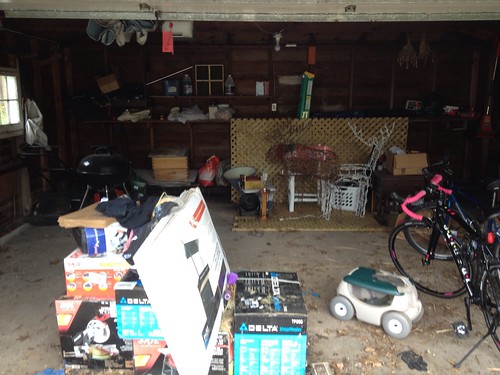
This was the garage as it was, about an hour and a half after we’d started cleaning and rearranging – the boxes were there, but we’d swept the floor and moved a bunch of stuff around. Note that the boxes had been there so long,a chipmunk had set up shop in our miter saw box. In this sense, finding all of this old equipment working was kind of like our own Storage Wars.
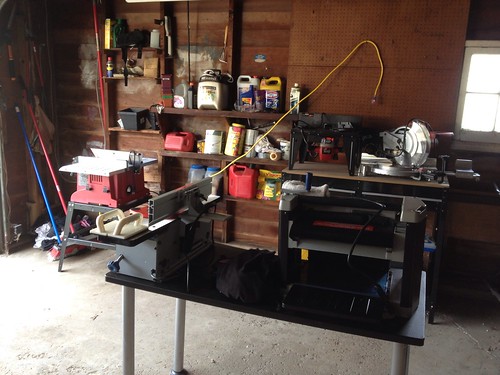
The shop afterwards, with all the acoutrement in place. We’re definitely going to need a second bench, and we’re definitely going to need to screw the equipment to some blocks of wood so we can clamp them safely to the table.
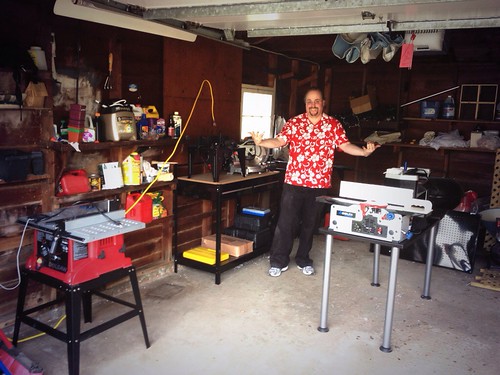
Me, after eight hours of shared labor.
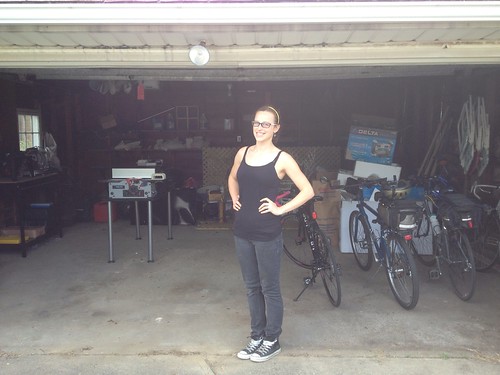
Erin. So very proud.
Why I (Probably) Won't Buy Xbox One
Years ago, I abandoned my beloved gaming PC and got an XBox 360 instead. It was one of the best decisions I ever made.
Oh, I do occasionally miss my roleplaying games, but the XBox was a static investment – I didn’t have to keep sinking money into new videocards and RAM upgrades and, eventually, whole new computers. That switch literally saved me thousands of dollars, and the gaming’s been almost as good. (I do miss mouse + keyboard for first-person shooters, and I do miss my in-depth roleplaying games.)
But I don’t think I’ll be switching to XBox One. And I should. I mean, I have a history on XBox at this point – all of my hard-earned Achievements, all of my purchased downloads, my XBox membership. But it’s a hard sell for me, and it’s not because of:
The Kinect. I have a Kinect. After all the hype faded, it’s been kinda shitty – the voice recognition isn’t integrated into anything useful, the gestures don’t work well from my distant couch, and aside from Dance Central the games have been these spastic, flailing, thoroughly nonfun events. But the fact that it’s watching me 24/7 is something I already pretty much experience, and at least I didn’t pay extra for it this time.
The “always-on” Internet. I’m fortunate enough to need good Internet as part of my job, so that’s a part of my household expenses as it is. Not the greatest move for a lot of poorer families, though.
The disappointing quote-unquote “new features.” I’ll let Gordon Ramsay say it for me. But I never really socialized on my XBox; it’s all about the games, man, and if Fallout 4 is good then I won’t care.
No, it’s the way they’re distributing the games. You don’t own the games; you merely license them from Microsoft. And can you sell them to Gamestop… or, more importantly, from Gamestop? Not without the publishers’ permission. And given that most publishers hate Gamestop for making five times as much money off of their games than they do, I’m gonna say that’s prooooobably a “no.”
Look, I dig that as a games publisher, you want to lap up that stream of moolah, and you deserve to. What Microsoft is clearly trying to do is to become Steam, Valve’s way-too-popular digital download system… and if they did that properly, that’d be awesome. Steam reprices their games downwards rapidly, holds lots of sales, makes dynamic changes based on user demand, and has a ton of free games to boot. There has been talk saying that the reason most videogames are so riotously expensive is because publishers can’t make money off of resales, and so have to charge a ton up-front to ensure they get their fair share (as Gamestop will then sell the game used for $50, and then $40, and then $30, and so forth).
If that works? I’m in. I could use $40 games and $10 sales.
But I don’t think it’ll work that way. I remember the land grab of Compact Discs, which actually cost less to make than Cassettes, and the record industry promising “Oh, yeah, they’re just twice as expensive as tapes because we make so few of these – the price will come down.” Then they shot themselves in the foot by purposely taking this opportunity to raise prices forever, at least until piracy started looking like a great goddamned alternative to paying $17 for that one song you liked.
If Microsoft lowers the overall price of games? Awesome. I’ll watch for a few months to see what the game economy is, and if it’s an even mix of cheap and expensive, I’m in. But I suspect this will be their opportunity to artificially raise the prices, forcing us so the only way we can purchase it is at $60 – forget your friend giving it to you permanently, forget getting it on eBay, et cetera. This will be their CD moment, where the cost of gaming will rise across the board.
(Though to their credit, they have said up to 10 family members can share a game. One suspects there will be a lot of impromptu families made at college.)
And if that’s the case? Fuck that. I’ve gotten turned on to some of my greatest games by a buddy tossing me his disc and saying, “Try this shit!” or me taking a Gamestop chance at $20. Remove that, and make it so my only option is full-price? I won’t. It’s just too valuable a deal to give up.
…unless Fallout 4 is really good. I mean, like really good. Then maybe we can talk, Microsoft.