
Sleepy Hollow vs. Agents of SHIELD
I’ve only seen four episodes of Sleepy Hollow, and yet I’m hooked. It’s not a great show, but it’s a fun show.
Yet it’s weird. When people said, “Hey, we have this Marvel show created by Joss Whedon, starring Agent Coulson, and there’s this show about Ichabod Crane,” I know everyone was like, “Aww, man, Whedon is gonna be a good time!” But Agents of SHIELD is like the functioning government bureaucracy it covers: workable, mostly humorless, marginally efficient but uninspiring.
And compared to Sleepy Hollow in particular, SHIELD’s lack of ambition is killing it.
I think the central problem is what SHIELD seems to think is really spectacular. Last week’s episode, which was arguably the best to date, featured as its X-Files creepy moment bodies, hanging in air. That was the crazy thing! Something was causing magnetic impulses that caused bodies! To hang! In air!
Whereas the episode of Sleepy Hollow I just watched featured an albino mouthless sandman that, once it determined you were its victim, turned your fucking eyes to sand. And then to fight it, you had to be stung on the belly by a scorpion and face it in the Dreamlands.
Which is the problem with SHIELD: it shoots low, so low, as if it’s never heard of Jack Kirby. The reason people love the Marvel universe is that it’s got all of this crazy stuff: Tony Stark building a goddamned set of power armor in a cave! Thor crossing the Rainbow Bridge with his goddamned hammer! Spider-Man swinging through New York City while the newsmen yell out his name!
And SHIELD has… a bunch of guys in suits. They’re cookie-cutter: the hot young buck, the hot female hacker, the nerdy hot scientists, the hot not-really-old old hand with Secret Trauma. We’ve seen all this stuff before. It’s recycled before we got here. And what we’re getting is CSI procedurals with a touch of Marvel magic, but it feels grudging, as though really they don’t like all of these whacky superhero antics and don’t want to spend the budget on it.
Whereas Sleepy Hollow features Ichabod Crane, former revolutionary soldier and eidetic mastermind, who slept 200 years and woke up in 2013 as the Four Horsemen of the Apocalypse (one of which is, yes, headless) are bearing down on a small New England town.
Ichabod Crane has more colorful story in him than we have seen in the entirety of Agents of SHIELD to this point.
Much has been made of Sleepy Hollow’s casual racial mixture, with three major black characters having conversations, but that’s not why Sleepy Hollow’s a hit. Sleepy Hollow is a hit because each of those characters are already more interesting than Agent Coulson, and they’re all being forced into a larger plot that doesn’t wrap up neatly at the end of every episode. Sleepy Hollow takes American history and throws it in a blender – last night had me going “Angry Hessian agents in 2013? Bring it on!” – and as such, what it winds up doing is creating a must-see TV we can’t get with Agents of Shield, because Agents of Shield seems to treat “craziness” as some sort of bizarre spice you can’t put too much on or who knows what’ll happen.
Agents of SHIELD is a bit of salsa next to a heaping vat of corn chips.
Sleepy Hollow is Sriracha sauce poured on a bowl of kim-chi.
And as such, SHIELD is disappointing people because they make such a big deal about “NEXT WEEK WE’LL SHOW YOU SUCH CRAZINESS LIKE YOU WOULDN’T BELIEVE!!!!” and the craziness is something the X-Files would barely have blinked at. Whereas Sleepy Hollow is packed full of crazy, revels in it, rolls in it, and maybe it’s taking big risks that should have collapsed but hey, you don’t know where it’s going.
With last week’s SHIELD, twenty minutes in, I knew exactly how it would end. I’m not the kind of guy who’s good at anticipating plots, either. But – SPOILER WARNING – when one of the characters fell into deathly danger, I said, “Well, she’s infected with a horrible virus, I guess they’ll engineer a cure, because it’s too early in the season to kill anyone yet.” And I bet pretty much everyone watching thought that too.
Whereas with Sleepy Hollow? I have no idea how it’s going to turn out. I watch because I’m four episodes in and there’s crazy Sandman people and Ichabod Crane talking to the Onstar lady and crazy sisters and all sorts of things where when they go to commercial break I actually don’t have a good sense of how it’ll end.
I think that predictability is killing SHIELD. It’s a 1970s show in 2010 trappings, where everything is going to be wrapped up at the end of the episode. It’s a CBS show for an audience that doesn’t much want CBS, and I don’t know how it’s playing with the CBS crowd but considering it’s hemhorrhaging ratings I suspect the sixty-plus crowd isn’t tuning in either.
Maybe Sleepy Hollow will get too wild and lose us. That’s always a danger. But better a high-wire act that falls off than a guy walking the beat.
Seven Ways Our Advertisements Will Appear Quaint In The Future
One of the things I love about the past is old advertisements. You know, the ones with men with bushily intense mustaches, proclaiming the VIM! and VIGOR! of this AMAZING NEW ELIXIR! where the ads are crammed with tiny text because shit, what else did people have to do back in 1905 aside from read a magazine? They had no television, no MP3 player, no radio, so hell, throwing walls of text at them probably helped them stave off the inevitable boredom that consumed them just before the cholera did.
And there’s something really charming about the sway doctors held over the population then. Those ads were packed with paintings and line drawings of physicians touting the veracity and astonishment of this new ELECTRO-STIMULATOR KERDAZZLE! and the ads touted the “plain facts” of things, summing up all the “prodigious advantages” one could get from purchasing these new and very manly object.
Then one day, all of those techniques stopped working.
All those words that once held such potency – such as, in fact, potency! – sounded antiqued, a little embarrassing, not anything you’d really want to use in an ad. The words themselves had become associated with advertisements and hucksters, where if you heard the word “nostrum” you knew you were gonna have some schmuck in a pharmacist’s coat shelling you a tube of ointment. And when something becomes associated primarily with advertisements, buddy, it’s pretty much over.
So there’s this dust-heap of words and illustration styles that are just not used. They’re funny, now. People like James Lileks make a living off of mocking old ads. It’s something no one does these days unless you’re trying to be ironic.
The weird thing is that all of this link-bait will one day be quaint.
Oh, XKCD’s already nailed it, but that’s just the edge of froth on an incoming wave. Kids who grow up learning that most of the Upworthy and Buzzfeed links they see turn out to be kinda disappointing will eventually start rolling their eyes when they see another “You Won’t Believe What This Single Parent Has To Say!” link. They’ll realize at least 5 of the “8 Things You Didn’t Know About Star Wars” are things they in fact did know, or aren’t actually that interesting. And worse, in time it’ll become corny, like the word corny has become corny, and then someone will develop a new technique to sucker people in and these linkbait techniques of the 2010s will become as antiqued as stacks of AOL discs.
In time, people will only use these techniques ironically, as a fictional technique to indicate that hey, we’re in the silly 2010s when people actually bought this hokum, and maybe it was kinda-charming back in the day but wow, who the hell would think that “You won’t believe this thing!” would actually get a sane person to click through?
We’re charging forward, into the past. We always are.
Oh, Siri, You Crack Me Up
So what I actually said to Siri was, “Off to the dentist period. What a madcap, exciting life I lead exclamation point.”
What Siri sent was this:
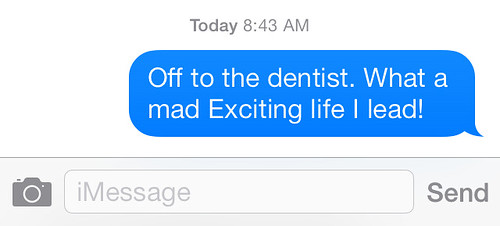
It took me a minute, and then I laughed.
No, I'm Not Happy About Being Ripped Off
I checked into Facebook last night to find that one of my most popular cartoons – the one where Tom preaches the Church of Doctor Who – was making the rounds again. Facebook told me, “Ten of your friends have shared this link!” I got tagged six times from people going, “Ha ha, Ferrett, this is making the rounds again, aren’t you happy?”
No.
No, I am not happy.
Because the site you’re linking to is not my site.
Some asshole stole the hard work that Roni and I did, without asking, and put it on his site where it could fuel his ad revenue. If I hadn’t insisted to Roni that all our strips have the URL as part of the image, there’d be no way of tracking it back to us, the creators.
And as of now, not a one of the people who shared this or tagged me seemed to think there was anything wrong with this.
I am by no means the first creator who this has happened to, nor will I be the last. And certainly many webcomics creators have had it far worse – I have a day job, whereas for many of them the comic is their income, and when someone steals their artwork to fuel their traffic, that means they’ve lost both fans and ad revenue and possibly merch revenue.
But the problem is you.
Fuckin’ seriously. The first thing you should ask when you see a funny image on the web is, “Is there an identifying mark? Did this belong to someone before this schmuck stole it? Is this a site that routinely grabs other people’s works without accrediting them, and am I encouraging the success of assholes at the expense of the people who actually created this wonderful thing?”
Because let’s be honest: all these content stealers thrive because 99% of the Internet treats art like it’s leaves that fell out of the trees, just some interchangeable amusement to be picked up and put anywhere else. Art isn’t “an artist’s way of earning a living” – it’s just some random amusement, hey, who cares who made it, it’s funny! I’mma post it to my blog. I don’t care who did it, that doesn’t matter, the Internet doesn’t care. You know that book you spent two years of your life working on? I think it should be, oh, $0.99, and if it’s not I’ll just pirate it because you don’t deserve any better.
Yet when you shit on artists – and let us be strictly factual here, you not caring where something you liked was made or who’s earning from it is shitting on the artist – you basically tell them, “Hey, you know all that effort you put into creating things? You don’t deserve to be rewarded for that. Stop doing that, because nobody cares what you want.” And so some of them listen to you, and go away.
Look. I don’t pay for movies and books and music because I like paying for movies and books and music. I pay for movies and books and music because I want to tell directors and actors and writers and musicians and producers who made all of this stuff I fucking love, “Hey, that? You deserve to be paid for this beauty. You should make as much of it as you can, and I’m going to do what I can to help you in this.”
And seriously, if you’re not with us, you’re against us.
And hey, not every artist in the world minds being having their stuff pirated. Neil Gaiman doesn’t. Neither does Randall Munroe, creator of XKCD. And that is awesome. If that’s what they want, then please, go forth and do it. But the truth is, you’re probably not actually checking in with the artist to say, “Hey, do they mind this?”, you’re just saying, “No, fuck all the artists, I don’t care where it came from or who benefits, it’s not my job to think,” and then you should shut your fucking hole if you ever wonder why that guy you loved isn’t doing this any more. Because there’s a good chance he’s not doing it in part because he had bills to pay and a job to get to, and you decided that his continued artistic lifestyle wasn’t your problem.
The point is that as consumers, you should value the artist who did something funny, even if it’s a one-off comic strip you found pasted into some forum thread. That guy and/or girl (or in our case, and/or both) worked hard to make something for your enjoyment. Take a second to trace the original image, link to the site it really came from, and decide that the scumbucket who’s riding on the back of a thousand artists who he is quite literally robbing of both credit and possible revenue is not worth mentioning.
Hey. If the dude had said, “Can I post this?” I would have said yes in a heartbeat. I’m not really making money off of Home on the Strange any more, and I don’t mind sharing. But he didn’t ask, and nobody thought to ask him “Say, why is this on your site when it clearly has someone else’s URL listed on the bottom? Why is the image link in this site to your site?” and as such that dude’s probably gotten a ton of hits and inbound links that he doesn’t deserve – not just from me, but all the other people who he’s treated like they were free candies in a Halloween bowl.
It doesn’t take much. If there’s a URL embedded in the image, find the original page that was on and link to it. If not, do another quick Google search for a phrase in that funny comic to see if it turns up the creator, and link to them. Funnel traffic towards the people who made it, not the assholes who stole it.
I can’t stop you. But if you’re encouraging this stuff by just blindly linking whenever something’s funny, you are contributing to a culture that treats artists like they don’t matter. And I’m not gonna be proud of you if you do.
(EDIT: Some friends of mine have told me that they tagged me to ensure that I was aware that my content was possibly being used without my knowledge, and to inform the people who were linking just who this belonged to. Go, friends. Sorry if I was snappy to you.)
(EDIT TO THE EDIT: Roni has a different take, which is entirely fair. The principle remains the same: I’m willing to bet nobody checked in with her to see whether it was cool first.)
Why Characterization Is Overrated
In Iron Man 3, fourteen members of the President’s cabinet are sucked out of Air Force One, after a Mandarin attack. Tony Stark, a.k.a. Iron Man, flies in to rescue them in a daring aerial rescue, saving them from certain death with only yards to spare, and dumps them in the water. They cheer as he flies away.
…they cheer as he flies away?
Look, these people have literally been in terror of dying for the last three minutes, and weren’t sure they were saved right up until they hit the water and realized their heart was still beating. They’d be adrenaline-shocked, enduring the beginnings of PTSD, barely able to move. A weak “thanks” would probably be the best any of them could give.
And yet even assuming that they were compos mentis enough to process everything that had happened, the President had just been kidnapped and Air Force One destroyed in what has to be the most successful terrorist attack in American history. At least two of their friends had been slaughtered in front of them, one speared through with a souvenir. They might be happy to be alive, but they would no sooner be cheering happily than we saw the victims of 9/11 whooping “GO FIREMEN! WHOOOO!” when they got hauled out of the World Trade Center. Their applause is completely inaccurate characterization.
It’s also perfect for the scene.
What’s perfect is what’s perfect for the scene.
Too many beginning authors treat “accurate characterization” as though it were some sort of magic formula for fine writing: just stay true to the characters, and you’ll have a good narrative. But that’s no more true than any of the other million inflexible “rules” for writing scattered throughout the Internets. In this particular scene, we the audience are thrilled by Tony Stark’s ingenuity and derring-do, and dammit at the end of the scene we want to feel the triumph of Tony’s magnificent accomplishment. So the traumatized survivors cheer like Tony just won a football game… and this is precisely the correct thing to do.
Likewise, maybe your lead character should have PTSD after everything he’s been through. Maybe she has every reason to snap angrily at someone who doesn’t deserve it. But does that characterization serve the scene? Is having your lead scream at someone for no reason going to yank the reader’s sympathy away when you need the reader to feel empathy for your protagonist? Then maybe, just maybe, you skip the “biting someone’s head off” bit and have the character remain reasonable and calm.
In fact, if you pay really close attention to a lot of comedic works, the motivations of even the lead characters fluctuate from scene-to-scene. The Big Bang Theory is one of the most popular shows on television, and Sheldon its most popular character… but he oscillates between “God, Leonard, how could you spoil that comic for me? You know the rules of spoilers are inviolable!” and “Who cares if I spoiled that novel for you?” depending on what comedic purpose it serves. (And you can’t say, “That’s just Sheldon being self-serving”; Sheldon is established as a character who treasures rules and conventions above all else, except when it’s funnier than he doesn’t.)
(And if you don’t like Big Bang Theory, read Terry Pratchett’s work. Most of his characters shift a little to fit the circumstances, although his best characters like Vimes and Granny Weatherwax do tend to revolve around certain inalienable axioms.)
And I think we can all point to longer series where characters evolve as the author figures out who he wants them to be, and then you go back and read the first novel in a series and everything seems subtly wrong because the characters are acting in ways that they simply wouldn’t do in later books. That’s because it was more interesting for characters to be that way, and thank God the author didn’t stick to her guns and say, “No, on page 10 of book 1 the character did this, and that’s the way they must always be.”
The point is that accurate, consistent characterization is merely another tool in the writers’ toolbox to serve a larger purpose… and sometimes the correct call is to look “What should happen logically” in the eye and ignore it. Sometimes you change someone’s reaction to mirror the emotional tone of the scene, as in Iron Man 3. Sometimes you do it to crank up plot tension, as Sheldon’s shifting characterization does in Big Bang Theory. (In fact, one of the reasons why Big Bang Theory is as successful as it is is that Sheldon’s character can shift effortlessly to become an antagonist to anyone.) Sometimes you do it to preserve or manipulate emotional reactions to a story. Sometimes you do it because the alcoholic falling off the wagon for the fifth time this novel isn’t interesting any more.
Now, if you push inaccurate characterization too far, you have howlers like Prometheus, where everyone acts like idiots. But as a writer, you’re not shooting for accuracy; you’re shooting for verisimilitude. You don’t need to describe every blow in a fight, you don’t need to describe every touch in a romantic scene, and you don’t need to keep to absolute gritty realism unless that’s the tone you’re shooting for. And even then you’re probably going to fake some things.
The truth is, characters are as mutable as dialogue, or plot, or prose. They adapt to serve the greater purpose of “What you’re trying to accomplish in this scene.” And yes, like bad dialogue or plot or prose, done badly it’s glaringly obvious that something’s wrong, but that doesn’t necessarily mean that good characters always hew the line. Quite often they’re subtly manipulated in ways you don’t notice, and when that happens the author has done her job correctly.