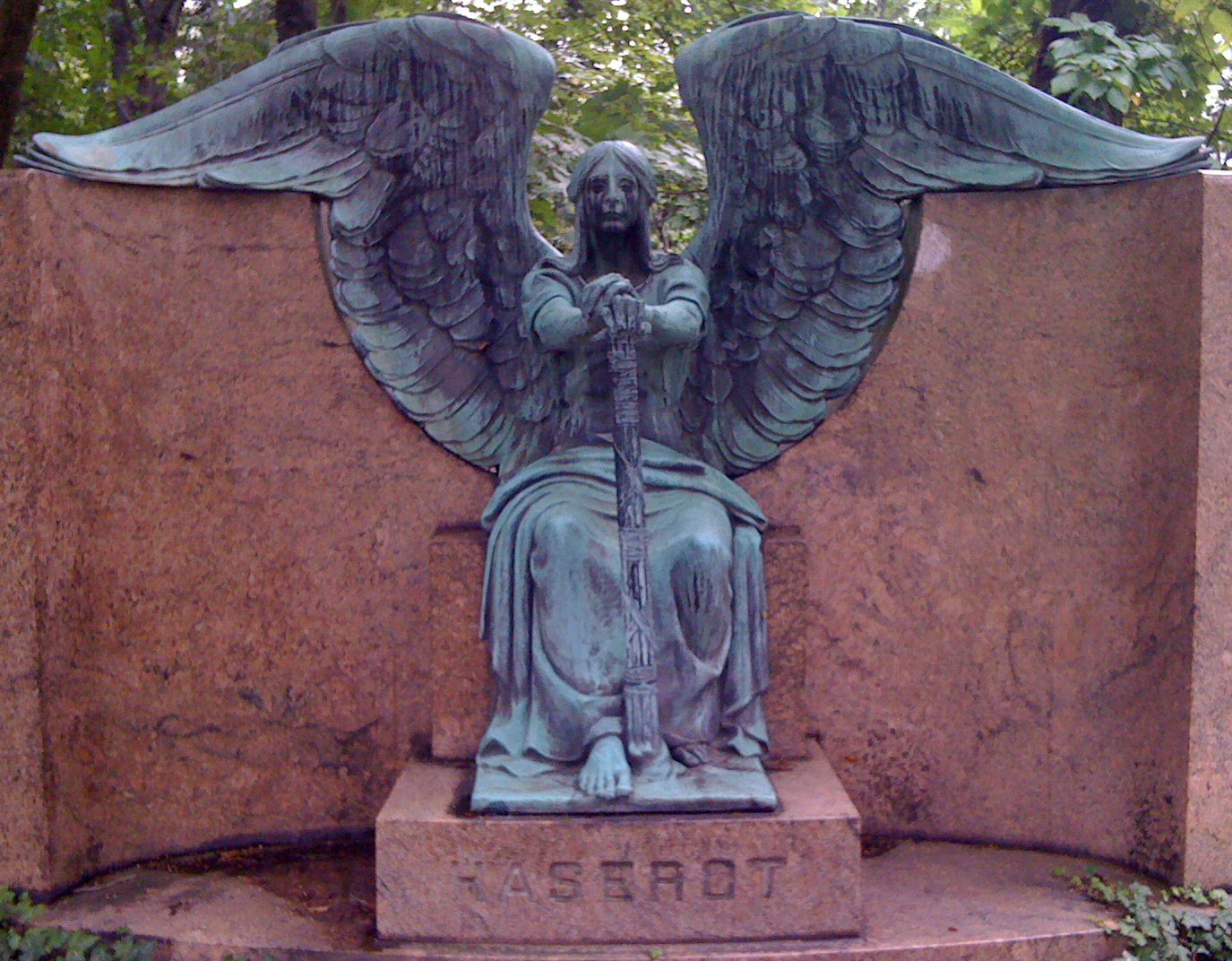

A Closed Door: Goodbye, Grammy
When my Uncle Tommy died, I wrote several long entries on his death and what it meant to me. And when my Gramma, Tommy’s mother, died, I wrote a long essay on all the ways she affected my life. And when my Grampop passed on, he too, got a long discussion of how his wondrous life shaped me.
Yet my Grammy died in August, and not one word on the blog.
This one’s too painful.
It’s not that my Grammy ranks higher in the pantheon of my beloved dead, but rather that she is the last. My grandparents are all gone. A whole era of my childhood, wiped by mortality. And to a very real extent, Grammy was the axis on which the Steinmetz family turned; my Grammy was the social one, the one who remembered every name of every nurse in the assisted living facility even when senility took bites out of her memory, the one who loved parties and get-togethers and trips.
She stayed that way right up until the end. The last time I saw her, she asked about my trip to Hawaii – re-asked the questions several times, as the memory of a ninety-something year old woman has a few gaps, but by God she remembered to tell me to exercise, Billy, exercise, we were all so worried about you with your heart.
And in the end, I can’t. Encapsulating who my Grammy was to you is closing the door on myself, acknowledging that the last of that generation of relatives no longer walks the earth, and I would have to say goodbye not just to Grammy, but her husband Grampop, and Gramma, and Tommy. I will say that the Steinmetz family now lacks a spoke to revolve around; with Grammy, we were one great family, all dancing to please her and be pleased in turn, as Grammy was the sort of person who expected you to be wonderful and so alchemically transformed you in her presence so that you were wonderful. Without her, we are still a family of sorts – but separate ones spinning on our own axes, intersecting on Facebook. Will there be any great family parties to return to? Will we have this cohesiveness?
I doubt it. She was special that way.
And I keep looking in the mail for that $10 check from Grammy, that tiny Christmas present that maybe bought a meal at Boston Market but told me she was thinking of me. She is still thinking about me, I’m sure, but from a place she can’t send me postcards and newspaper clippings and tiny angels in the mail.
I don’t owe you anything when it comes to this blog. But the blog is, in some sense, a chronicle of the great events in my life, and Grammy passing is a great event. Just not one that struck like thunder, but a slow ebb that’s hard to chronicle.
No matter. They gave her daisies.
Good night, Grammy.
Walking The Dog, Walking The Dog
So my Mom is visiting for the holidays – yay! – and she brought her adorable dog Koshi! Yay!
Koshi and Shasta are going tooth and claw at each other! Boo!
So we hauled them off to our dog trainer – we have a dog trainer – for an emergency negotiations, and within half an hour she had them sorted out. Koshi and Shasta are by no means buddies now, and we do have to watch them closely, but we’ve learned the signs of impending aggression and know how to cut them off. They’re dogs, so a brief “HEY!” at the right moment can completely knock them off track.
The most revealing aspect of it, however, was when the dog trainer was talking to my Mom about how to work with her dog.
“We’ll work on this,” my Mom said.
“No,” said the dog trainer sternly. “You will work on this.”
Which is the weirdly fascinating thing about dog training. The dog has tendencies, but mostly? The dog is a product of their environment. Give the dog a situation where the dog feels no one is in charge, and the dog starts to break down. The dog has to take over, and the dog is simply not equipped to deal with modern life. The dog does not understand the context of a car, or know what this mailman is, or comprehend how the food gets here. So the dog makes doggish decisions, freaking out from the stress, and becomes a neurotic doggie mess.
And those decisions have to be made from the dog’s perspective. From my Mom’s perspective, whisking Koshi off when she starts barking at another dog is mere courtesy; who wants a yappy dog in their presence? But from Koshi’s perspective, she just started screaming her head off THERE’S A THREAT, THERE’S A THREAT, and the pack leader just picked her up and ran off, and my God, what a horrible place this must be, we’re always retreating from life-threatening dangers, I must be alert.
But if you make the right decisions for the dog, the dog is fine.
Which is a little discomfiting, really. Is a dog nothing more than an organic program? Put in good input, the dog behaves appropriately; put in bad input, the dog goes berserk? And the answer, to a distressing amount, is “yes.” There are factors of temperament, of course, and some dogs have been irreparably damaged, but in general Shasta has behaved vastly differently depending on how we treat her.
And if Shasha can be so altered, what about us?
I know Gini used to be a different woman. She used to go skiing every other weekend. She used to quilt a lot, nearly an obsession. She never used to watch TV. And now, she doesn’t ski, she doesn’t quilt, and ZOMG SLEEPY HOLLOW IS ON.
I have altered her with my presence. She is, in many ways, an entirely different wife than she was to John, simply because I reward different things. And I too am different; this house is far cleaner than it would be without her, and I go to many more parties because she is the social one.
Gini and I are not merely a married couple; we are a shaped unit. We would be, to a very real extent, totally different people in the hands of other spouses. One of the reasons we adore our marriage is not just that we make each other happy, but we make each other into people that we like better. I’m wiser, more compassionate, and more resilient in the presence of Gini than I ever was dating other people. There are many wonderful people who, if I dated them, would make me more neurotic and panicky.
What we surround ourselves with is who we are. And to think, “Gee, I’m not much different than a dog” is a scary thought, as it brings up all those tangles of free will and our core personalities and humans are more than animals and whatnot. But it’s true. You surround a dog with firm leadership, the sense that the right things are handled for the dog, and it thrives. Give it a place where, for whatever reason, it feels out of control, and the dog spins apart.
I don’t like to think that I’m a blend of external forces. I like to think there’s a core of immutable me-ness, a fortress of unalienable personality that is never touched by other humans. And that exists, to be sure; I’m always going to be a little neurotic, I’m always going to be stubborn, I’m always going to be thoughtful.
But that core is much smaller and more malleable than any of us want to admit. We, too, are input machines, functioning according to what the world hands us. And we don’t want to admit that maybe, if we were placed in someone else’s situation for a decade or too, we might become very much like people we despise.
I don’t know who I’d be if I’d grown up poor, or molested, or black, or gay. I most likely wouldn’t be talking to you now through blogs, and I’d certainly be saying different things.
I’ve been trained to be who I am. I’m glad I like that. I’m glad I got that luck, because we certainly don’t choose our environment.
Which isn’t a bad thought to have as the holidays arrive.
This Comic Is So Brilliant, I'm Going To Devote A Blog Post To It
If you had asked me, “Ferrett, would you discover your absolute favorite Marvel comic of 2013 the week before 2013 ended?” I would have said “No.”
If you’d then asked, “But what if that Marvel comic isn’t even produced by Marvel?” I would have squinted at you.
But this is the case. My slam-dunk, perfect Marvel comic is all about the Avengers, and yet… it isn’t about the Avengers at all. It’s about Steve Rogers, dealing with PTSD by drawing his life in webcomic format, in a beautiful webcomic called American Captain. It’s like a perfect intersection of Harvey Pekar and superheroes. There are no battles. Just perfectly delineated conversations about a man with realer feelings than I’ve ever seen in any Marvel comic, trying to come to terms with waking up from World War II in the middle of a very strange 2013.
And the conversations are beautiful. They’re what should happen in between all the punching, though there is no punching. And it takes a while to really roll into what turns out to be a storyline, as it should – Steve Rogers’ take on things is a little disjointed – but by the time it gets to “Little Dog,” it is firing on every cylinder it should be.
This is a comic for people who don’t love comics, and a comic for those who really do. It’s the best comic I’ve read in 2013. So wait until you have a half an hour or so to get in, and then I urge you to read it.
Thanks For The Boobs, OKCupid
I absolutely love OKCupid, even though I haven’t gotten a date out of it in almost two years. But it is the perfect form of people-watching.
I actually adore sitting down in a train station and watching all the people go by. I like imagining their past histories, where they’re going, trying to read the history on their faces. And OKCupid is this place that allows me to see who’s near me in the neighborhood, gives me a match percentage so I can imagine what kinds of friends we’d be, and read little snippets of their personalities. I rarely contact people, but I love seeing who stops by.
And lately, the attractiveness of the people I’m viewing has stepped up.
As anyone who knows me knows, I have a type: pale, large-chested, plump, smiling. And the photos of almost everyone I’ve looked at have fallen into that pattern, whether I’m selecting for match percentage or not. There’s a lot more pictures with ample cleavage, a lot more paper-pale women smiling at me. Walls of heartbreaking beauty.
Is that OKCupid homing in on me?
It’s a serious question. I’ve written before about how Facebook quietly mutates to present you with your own customized world. And OKCupid’s sadly-discarded blog shows that they’ve been able to do some fairly sophisticated analyses of what makes for an attractive picture way back in 2011. They have the processing power to look at JPGs, break them down, and determine what’s attractive in general.
Two years later, it’s entirely possible that they’ve determined what’s attractive to me.
And that’s the fascinating thing about these large-scale social networks: there’s no incentive for to share their techniques with us. It’s all back-end stuff, quietly massaged to try to keep us logged in and coming back. How does Facebook decide what posts make your stream? Nobody knows, except for Facebook’s engineers.
Which lends an oddly deity-like atmosphere to social networks as a whole. It could well be that the past couple of weeks have been mere coincidence, that whatever algorithms choose who gets presented to me have randomly shown me the busty beauties who stir my affections. Or it could be that some monolithic parallel processing machine behind the scenes has ticked into place, having finally ascertained what I want and now routinely doles out only women whose photos it knows I’ll find appealing.
In a strange sense, I wind up in the position of ancient man: attributing intent to things that may be completely random. Or maybe attributing intent to something that moves according to rules I don’t quite understand. In either case, I am a dumb caveman, goggling at the world, creating gods from clouds.
Except in my case, I know something is watching me. I just don’t know how much. I’ve just spent the past 500 words pondering, “Does OKCupid know how much I love boobs?” – and the question is, at its core, a quite serious one, as I’m pretty sure OKCupid would benefit from this knowledge if it could get it.
The question is, does it have it?
…Yet?
I'm Too Tired To Discuss Duck Dynasty, So Let's Bring Up Trayvon Martin
A while back, I discussed how Twitter twisted world views of Trayvon Martin, presenting customized versions of the world depending on what your friends were like. My Twitter-feed, f’rinstance, consisted of tales of how badly the defense was doing and how clear it was that George Zimmerman would be convicted.
And after I said, “I hope George Zimmerman is convicted,” an LJ-friend replied:
So you admit your information comes from The Daily Show and an overtly biased Twitter feed, yet you have presupposed the ‘correct’ outcome.
You, sir, are part of the problem.
Which I thought about for a good long time. For I could be a part of the problem.
Except that my biased Twitter feed linked directly to the coroner’s report, which I read in full, and several transcripts of various testimonies. Now, admittedly, I did not watch the case with the full attention of, say, a juror, and it’s possible some damning evidence in Zimmerman’s favor slipped through the loop.
But my very point in that essay was that when you have a biased Twitter-feed, you need to compensate. Which I tried to do so, by skimming the more morally-superior essays and drilling down to what facts were presented. In short: I compensated.
And what I saw from that evidence was a man who was not irredeemable – he was trying to accomplish good – but someone who, as I once described a friend, “Would break a little old lady’s hip in his eagerness to escort her off the street.” Zimmerman seemed to be acting from fear, not quiet justice, and I do believe from the evidence I saw that he placed himself into a position where he shot Trayvon Martin in, if not cold blood, extremely reptilian-temperatured blood.
Was Zimmerman an active racist? Hard to say. But was he the sort of guy who’d automatically jump to “kid in a hoodie in strange neighborhood who refuses to answer questions from a terrified stranger” == “mortal threat”?
I think so. He was certainly driving around seeking danger. Maybe he did it because his neighborhood had gone to shit and crime was on the rise, but you know who’s the last guy I want running around my block with a gun? The guy who’s treating his turf like it’s territory to be defended in a videogame.
So I said that I hope he was convicted. The man shot a teenager who literally no one has seriously argued was doing anything illegal at the time of the shooting. That fact left conservatives twisting in the wind, because there were all sorts of arguments of who should be threatened by what, and whether a hoodie should equal suspicion, and brought up all sorts of facts about what Trayvon had done in the past.
But based on what Zimmerman knew as he stepped out of that car, I think he was a danger to innocents, and is a danger. The only reason he’s not in jail is because the “Stand Your Ground” laws vindicated him – but vindicated in the eyes of the law does mean that someone is safe, unless you’d care to invite OJ Simpson to date your daughter.
And frankly, Zimmerman’s actions since then have done not one iota to contradict the impression I built up from reading those biased articles.
Which is not to say that I couldn’t be wrong. The accusation leveled against me is serious, and I take it seriously. It’s too easy to drink the Kool-Aid of whatever social stream you swim in, picking up outrage and narrowing to a sclerotic world view. Which is why you have to compensate, working hard to see past the obvious to what’s there. And if you don’t, yes, you become the danger. You become George Zimmerman, convinced so utterly of his righteousness that he steps out of a car against police advice to start handling problems his own bad self. And, armed with twisted information, you leave truth dead on the sidewalk.
The distinction my friend failed to make is that yes, I’ve convicted him in my heart. But I did it based on a fair amount of evidence, and I am not a jury. The jury acquitted him, and they did so rightfully – based on the box they got shoved into, they had to.
That does not make the laws right, it does not make George Zimmerman a stable man, and it doesn’t make the shooting a good thing.
It does not also make me right.
Now. Go read the best article you’re going to read on the Trayvon Martin case, a wonderfully balanced take not just about the case but how people reacted, and draw your own conclusions.