

The Hypocrisy of "Not All Men"
There’s a lot of controversy these days over the dudes interrupting women’s complaints about guy behavior to interject, “Not All Men!” Which, you know, it’s true – not all men do these creepy-ass things, but so many men do it that all women are affected by it. Hence the rise of the much-needed #YesAllWomen hashtag.
And I have some sympathy for some of the dudes who interject, “Not all men!” because frankly, some significant percentage of these dudes are simply clueless and in need of some education. I know if someone made a comment about the stupid things that writers or polyamorous people do, I’d probably say “Not all of us!” reflexively, just because yeah, there’s a gut-feel to respond that way even if it utterly doesn’t fix the problem that those writers/polyamorous people/men are doing fucking awful things.
(Which is why the #YesAllWomen idea was brilliant, sparking just how our society’s permeated with anti-women problems. As a guy, I’ve never had to worry about being sexually assaulted once; I literally do not know of a woman I’ve been close to who hasn’t.)
But you know who pisses me off? The Men’s Rights Advocates who whine, “Not all men do that! How dare you assume we’re rapists or abusers?”
Dudes, you fucking say “All women do this” all the fucking time.
The women who say “I’m afraid of men,” well, most of them seem to grok that some percentage of men are okay, but enough of them are a danger that it’s hard to trust. (As has been noted on the Internet, “10% of these M&Ms are poisoned. Eat a handful. Tell me, ‘Not all M&Ms.'”)
But the MRA idiots I’ve run into talk about all women, and seem to mean it. All women just wanna use men. All women want a certain kind of man, the alpha male, with chiseled abs and money and the ability to lead a conversation. All women want to transform society into some emotional tear-zone where women’s rights are privileged merely by dint of their sheer womanhood.
They’re furious at women because all women require them to act in absurd and ridiculous ways to get laid, and my God they are so bitter at all women because all women did that to them.
Clueless guys, I can maybe excuse. But you? Shit, all you do is get on the Internet all day and go, “Women are this, women are that”… and then you have the balls to get annoyed when someone makes a generalization about men?
Christ, you have the least right to complain, given that your entire philosophy is a shitty generalization.
And you know, I’m kinda sympathetic that you can’t get a partner to cuddle – human companionship is a fundamental need of mankind, and if there’s a phrase I’d feel comfortable applying to “all people” it would be “people don’t like to feel alone.” I myself spent years locked in my room as a teenager, with no friends, seriously facing down a future where no woman would touch me ever, and I still have flashbacks to those days. So I understand that being lonely is a terrible thing that can leave deep scars, even if you’re lonely because you’re a complete and utter asshole.
But women? Are more likely to be killed by men than heart attacks. Abusive men are, quite literally, their number-one danger right through middle age.
And when I compare your “I’m lonely” or “I bought her an iPhone and she didn’t even sleep with me” to their “I got raped and murdered,” I kiiiiinda have to prioritize their needs over yours, you know? Especially when you can actually be less lonely by giving up your expectation that women are some sort of slot machine where you keep putting in affection until the pussy spills out, and she has no realistic way of avoiding dudes creeping on her except maybe by living as a hermit in the woods.
So yeah. Maybe it’s not all men. But those men who do affect about as close to “all women” as you can get. And of all the people who get to bitch about generalizations, you will not be one of them, Mister MRA, until you back off mainlining that outrage about what “all women” do.
I Could Use A Little More Of Joe's Honesty: On Dead People And Costs
So Joe the Plumber, that conservative footnote to the 2008 election, had this to say about the latest shooting spree:
I am sorry you lost your child. I myself have a son and daughter and the one thing I never want to go through, is what you are going through now. But:
As harsh as this sounds – your dead kids don’t trump my Constitutional rights.
And I read that and went, “Fuck yeah, Joe, thanks for being honest.”
Because Joe, at least, is looking those dead kids in the eye and saying, “I’ve done the math, and I find this level of killing and pain to be acceptable for the greater good.” And he’s getting pilloried on the Internet, but really, Joe is the only pro-gun guy having an honest conversation with the media about guns right now.
You don’t like what Joe has to say? Well, how do you like Obama?
Because the drones Obama is so fond of using, as it turns out, target on potentially-erroneous metadata. The terrorists have figured out that the NSA tracks cell phones, so they swap SIMs all the time, hand their phones off to different people – and we occasionally just blow up a phone in the hopes that we hit the right guy.
And here’s what Obama is saying, but not out loud:
I’m sorry I blew up your family. I myself have a son and daughter and the one thing I never want to go through, is what you are going through now: everyone you love being destroyed accidentally because someone handed your kid the wrong cell phone.
But as harsh as this sounds – your dead kids don’t trump our right to safety.
And if you don’t think Obama isn’t saying, “Incinerating a few innocents is worth keeping terrorists down,” well, you’re not looking at it honestly. He’s done the calculations. He knows there are no clean wars with no collateral damage or accidents.
He’s just not saying it, because if we presented the choice in that way, we wouldn’t actually make that choice.
Here’s another fun thing Obama doesn’t say:
I’m sorry that one out of every twenty black men are in jail right now, as we speak. I’m sorry that roughly one out of every three black guys will go to jail in their lifetime. I myself have a son and daughter, and I’d be distraught if they got a twenty-year sentence for holding a dime bag. It’s not fun keeping one out of every hundred people in America locked in prison – in fact, it’s expensive, cruel, and costly in more ways than just funding.
But as harsh as this sounds – this is better than legalizing drugs.
These are three things I believe should be dismissed, of course – I dislike drone strikes, I dislike drug sentences, I dislike the gun laws we have. But the thing that’s absent in all of these discussions is that we all just sort of sidewalk past the costs, not wanting to look at the trail of wrecked and burned bodies to ask, “Is this worth it?”
And we should ask that question. The ugly truth is that America is sufficiently large a country that almost any decision we make is going to crush someone innocent underfoot. If we react to the MRA shooter by saying, “We need better mental health laws, and more proactive targeting to put these people away before they can harm people!” then we’ll probably lock away some potential shooters – but we’ll also have a nonzero number of troublesome-but-not-harmful weirdos locked away for the crime of “his neighbors found him creepy.”
What’s the real cost? Can we stop pretending that nobody would ever dies or get hurt if only we just got our way, and be honest about the sadly imperfect solutions we have at our fingertips? Can we say, “Look, bureaucratic screwups and funding shortages are going to kill a lot of people, no matter what kind of health care system we have. Maybe we should stop pretending that ‘death panels’ are a failure state of a callous system and are, rather, an unavoidable part of having non-infinite resources to help people… and instead of acting as though we can prevent every death, start investigating which methodologies are least unfair in terms of picking the people we decide to let die.”
Obama doesn’t say how many innocents he thinks are worth killing thanks to bad cell phone data, but that’s because America is very fucked up about how we think things should be. We don’t want to think that any innocents are worth killing – which is laudable in theory, but lacking perfect data, the only way to do that is to not ever shoot any terrorist at all. And maybe not shooting those terrorists, and letting them kill innocents, would lead to even more deaths.
The point I’m making is that we’re gonna have blood on our hands. And yet if we ask, “Well, how do we minimize the number of accidental victims?” then we fucking flip out because this is America, and we don’t do that.
Except it may be unavoidable.
And keep in mind, I’m not saying that I know how many bad drone strikes are worth it. I’m against drone strikes in principle. But then again, we’ve never really had an open debate in this country about what we perceive are the dangers of inaction vs. the dangers of action-with-inevitable-error-margins, so I can’t actually say. My gut says, “Don’t kill anyone ever if there’s any chance,” but I fully acknowledge that’s my natural denial of I Don’t Want Anything Bad To Happen Ever kicking in, along with an unhealthy side order of It’s Those Guys Far Away So I Don’t Have To Look At What Happens. I can say “no drone strikes,” but then again I’m not an Afghan girl risking having acid thrown at her just for the crime of going to school.
So rather than yelling at Joe for being an asshole, I’d rather applaud him. What he said is harsh, but it’s also accurate. And while I don’t think he’s correct, at least he’s not shying away from the very real calculations that we should be doing about “How many dead kids are worth a cause?”
We don’t do enough of that in America. We really don’t.
John Wiswell Asked Me Four Questions About Writing!
I miss the glory days of LiveJournal, when so many people were blogging they’d do stupid things like, “Ask me five questions, and I’ll tag in five others and answer all of them.” So I was delighted when John Wiswell resurrected the ancients to ask me four questions about my writing process. Which couldn’t be timed better, as I’m literally at one of the most interesting points in my writing career.
(Alas, I shan’t tag in four people of my own, but feel free to play along.)
1) What am I working on?
I just finished up the first round of Official Edits on my debut novel Flex yesterday. Today, I’ll continue work on the sequel to Flex. Both are turning out to be really jarring to my existing workflow, and I’m trying to adjust to that.
See, as an artist, your whole job is to figure out what processes uncork your most interesting work. And one of the best things about attending Clarion, where I had six weeks with eighteen writers to see them write several stories from start to finish, was really getting that not everyone’s head worked like mine. At the time, I was a guy who couldn’t write at all unless I had the ending mapped out, and I wrote in Word from start to finish, and I thought that everyone did that.
No. As it turns out, some people started with a single weird sentence and had no idea where the story was going. Some wrote scenes in random order, fitting the best ones together like jigsaw puzzles at the end. And others wrote by hand, with special ink, in journals they carried with them at all times.
Seeing all those people writing in such different ways really shook things up for me. I realized that there were a thousand different ways to write good stories, and maybe I should try some of them. And as such, I experimented wildly, trying all sorts of new workflows – and while I still can’t write by hand and I do need to write the tale from start to finish, it turns out that I work a lot better when I don’t plot everything out in advance.
And for novels, I’ve discovered that I need about three months of uninterrupted space to focus on nothing but the first draft.
Problem is, that’s impossible now. I can’t focus on nothing but the first draft of Novel #2, because Angry Robot keeps coming back to me about Novel #1 to say, “Hey, could you fix these flaws?” Which means that I have to pull myself out of Entirely New Sequel Headspace to get back into Novel-Fixing Headspace, and as any programmer can tell you, it takes a while to transition between the two zones.
And I was getting very frustrated because I needed three months in isolation if I was going to make the deadline and get this second book in my next summer, but I also couldn’t blow off, you know, the fixable issues with my current manuscript. So I was killing time between novels, writing stories I wasn’t that interested in to fill the gap – and let me tell you, “writing stories I’m not that interested in” is a sure way to produce writers’ block.
Thankfully, Seanan McGuire is a mensch. I will give you her advice as she gave it to me:
“Your novel is a newborn baby. And like any newborn’s parent, your life is never going to be the same again. If everything goes right and your career takes off, you will never have three uninterrupted months to work on any project ever again. So like a newborn’s parent, who must learn to nap whenever their child dozes off, you must learn to write whenever you are between projects.”
With that in mind, I said, “Fuck it, I’mma write as much of the sequel as I can before Amanda drops the deadline on my desk,” and so I got about 1,500 words into Flux before the edits arrived.
Which means tonight, I write another 500 or so words as I explore the sequel. Which is also unsettlingly new territory. Opening chapters are difficult enough for me, but the opening of a sequel has to be viewed through two lens:
1) How’s this look to people who read the last book and want more?
2) How’s this look to people who picked up this book by mistake, and this is their first introduction?
What I’m finding as I write Flux is that I’m trying very hard to hint at evolution. This takes place about two years after Flex, and I want to provide the sense that the characters have evolved somewhat between books – so they’ve got new magical techniques you haven’t seen before, Aliyah the daughter has developed some new psychological issues that need to be fixed, and so forth. They didn’t just step into a freeze locker when they were off-screen – they’re like my NPCs, where even if the player-characters don’t show up at the merchant’s shop for five sessions, the merchant still has their own agenda. And that keeps things fresh for me.
Whoah. That was all the answer to just one question, wasn’t it? Sorry, John.
2) How does my work differ from others of its genre?
The one thing people seem to be focusing in on is the psychotic magical system – which is based on obsession. If you’re enough of a crazy cat lady, you wear a hole in the laws of physics with your belief, and become a felimancer. Problem is, you may then technically have world-bending power, but realistically you’re going to use this incredible magic to take care of your kitties.
And a lot of the early blurbs have referenced the “loopholes” in the magic that the characters keep finding. So that kinda makes me proud, that people are reacting to the coherence of how magic works.
But to me, what’s really unusual about Flex is that it’s a completely inverted gender-novel. The lead character, Paul, is a sensitive and physically unimposing guy (he is a scrawny amputee), given the maternal instincts of needing to protect his daughter after she gets wounded. His magic, bureaucromancy, is a very potent magic – imagine anyone being able to rewrite legal contracts at will – but it won’t stop a bullet.
Whereas his partner Valentine is highly sexual creature, not big on self-introspection, and her videogame magic is tailor-made for massive violence. So while I didn’t set out to do that, the male and female traditional roles are reversed in this, with the dude being the emotional caring one who functions as Valentine’s Manic Pixie Dream Girl and the chick being the protector with overt power and sexual agency.
3) Why do I write what I do?
The realistic answer is, “Because I don’t know how to stop.”
The slightly less-murky answer is, “Because I want to see the kind of stories that I wind up telling.”
4) How does my writing process work?
As mentioned before, I’ve made the switch from being a plotter to a pantser, writing on the fly with no set idea of where this is going.
The way Flex originated is that I was roleplaying in a small-scale Mage campaign, where our characters basically got drunk and got into bar-fights, and someone mentioned that we could make drugs to get some cash. And I laughed that we were so incompetent we’d be the magical Breaking Bad, and I went, “…wait.”
Thing is, that’s a solid idea, but for me I had to think. Because yeah, it sounds good to make magical drugs, but what are the limits? I hate it when stories go, “Well, it’s magic, it can do anything” – because then you don’t know what challenges the character faces. You have no good idea of what obstacles might stop them. Sure, the fact that Green Lantern’s ring didn’t work on anything yellow was kinda dippy, but knowing that a) his ring might run out of juice and b) it can’t touch yellow set up endless permutations of suspense.
So I started thinking, “Okay, how would you make magic drugs? As in, drugs that contained magic?” And I started devising all sorts of restrictions on that – only hematite can properly hold the magic without it dissipating away, so of course that’s highly illegal now, and magic has a backlash that makes it so brewing it risks massive meth-fire-style explosions but worse, and, and, and….
…and by the time I got done, I did have a fairly comprehensive magical system in place. I just kept asking question after question with the intent of understanding what magic could do, and what it couldn’t. And the answer was kind of fascinating: there wasn’t much this magic couldn’t do, technically, but since only the craziest of people could get access to it, that meant its use was severely restricted in practice.
Then I needed to put characters in it. But that’s a whole other essay.
Memorial Day Musings #3: Photos Of My Art Deco Nails!
It isn’t actually a musing per se, but my mad manicurist Ashley did some amazing work yesterday:
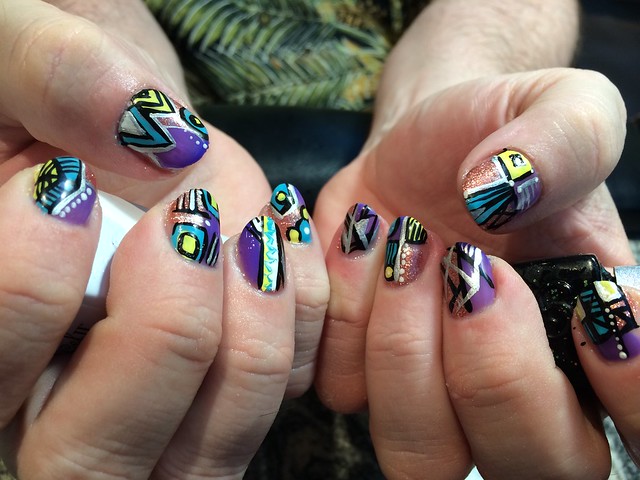
Incidentally, if you’d like an idea of how quickly I can rattle off blog posts, I wrote all of today’s posts in real-time. So figure all of today is about an hour’s writing, minus the time it took me to photograph my nails and get it online.
Memorial Day Musings #2: The Godzilla Movie
The fascinating thing about the new Godzilla movie: the things people complained about were things I saw as strengths.
For example, people complained there weren’t enough monster-on-monster battles, and that they kept cutting away from the monsters or showing them in parts. For me, big monster battles are like Chinese Five-Spice – I like them, I really do, but I can’t have a meal of all Chinese Five-Spice. I need a palate-cleanser between courses, and so a little monster goes a long way.
I liked the way we hardly ever got good, long looks at the monsters. It made them seem fucking huge. Seeing just a foot or an eye kept me thoroughly rooted in the human perspective, forcing me to keep in mind that this is a 300-foot tall lizard, and holy crap is he big.
And I like the way we only got flashes of the monster battles. I would have been pissed if we’d ultimately gotten no monster battles – but again, there’s only so many times I can watch Godzilla stomping through a city before it gets old. And by the time we got to the end, where there is one huge-ass unrelenting pounding, I was entirely thrilled with it. Plus, as mentioned before, thanks to all the glimpses of Godzilla, when we finally saw him cut loose he looked gigantic, a mountain to me, amazing.
People complained that the humans didn’t do anything. I loved that, too. We had one hope, Godzilla, and all of our weapons really didn’t work. I actually hated the one moment where a monster noticed a human in any significant way – I adored the way they didn’t even acknowledge us, that they were so huge that all our weapons couldn’t even get their attention.
People complained that the plot was lame. Which it was. But it was lame in that kind of stupid, it-knows-it’s-stupid way that Pacific Rim was, where the movie pretty much flat-out acknowledges that this wouldn’t happen, but let’s all take it with maximum seriousness because goddamn, don’t you want to see a giant lizard eating Las Vegas? With today’s technology, I’m not actually sure how you would make a serious Godzilla film.
But that’s my weakness: I’m not a Godzilla fan. Yet for all that, Godzilla may be an entertaining movie, but be a terrible Godzilla movie – in much the same way that Man of Steel was a great “superpowerful aliens invade America” film, but a pretty crappy Superman movie. Godzilla fans have certain expectations, and I can acknowledge that maybe this didn’t do it for ’em. My friend George Galuschak wasn’t impressed, and he’s a huge Godzilla fan, so I’m willing to admit that maybe it didn’t live up to established expectations.
Still. Worth my $9.50. Totally worth it.