

Clap Harder For Tinkerbell
One of my favorite monologues in the history of theater comes from Christopher Durang, in the play ‘Denity Crisis, wherein a character talks about attending a performance of Peter Pan when she was eight years old:
“You remember how in the second act Tinkerbell drinks some poison that peter is about to drink in order to save him? And then Peter turns to the audience and he says that ‘Tinkerbell is going to die because not enough people believe in fairies. But if all of you clap your hands real hard to show that you do believe in fairies, maybe she won’t die.’ So, we all started to clap. I clapped so long and so hard that my palms hurt and they even started to bleed I clapped so hard. Then suddenly the actress playing Peter Pan turned to the audience and she said, ‘That wasn’t enough. You did not clap hard enough. Tinkerbell is dead.’ And then we all started to cry.”
…I may like twisted things.
But the point is, a friend of mine yesterday posted a snippet from an essay that said this:
“A person who uses the term ‘damaged’ to describe themselves is pigeonholing themselves into a trap of never wanting to heal. People don’t get ‘damaged.’ People get HURT. Hurt can heal.”
When I read this, what I I heard people was clapping very hard for a Tinkerbell who’d never get up.
For me, some wounds don’t heal – and it’s not for lack of trying. I know this, because I have had wounds that have healed up miraculously when I’ve applied effort to them, but…
Others have never been fixed. Despite decades of therapy, communication,and change.
Parts of me are broken, and that’s not because I didn’t want to fix them.
So for me, this advice is a lot like telling a paraplegic, “If you can’t walk, that’s because you didn’t try hard enough.” I think irreparable psychological damage happens. I think broken happens.
But I also think workarounds also happen. If you ask people what would happen if they got confined to a wheelchair, a lot of people say they’d end their lives. But most don’t. Most soldier on, and lots find ways to have satisfying lives around that central damage.
But for me – and keep that “for me” firmly in mind – while irreparable psychological damage happens and broke happens, then workarounds also happen. Workarounds are wonderful. Workarounds make you grow into newer and better places in life – places you might not have explored without the damage.
They find other strengths to keep functioning around that central loss – and to me, in a way, that’s even more miraculous than healing.
Yet when I said that to my friend, he responded very forcefully that I was wrong. He’d been through some terrible shit in his lifetime, also working with all sorts of psychological wounds – and he needed to believe that he could heal everything to get through the tremendous pains he’d had in life. And you know what?
He’s not wrong.
Maybe he can.
My journey is not everyone else’s – which, I think, is the worst and most callous error you can make. I think it’s true for me that I can’t heal every wound by willpower alone, but maybe he can – and if so, good for him.
And if it turns out he can’t heal every wound by pouring willpower into it…. So what? What he’s got is a philosophy that keeps him pushing forward. What that message is saying, at its core, is “Don’t give up” – and that’s not a bad message for people working through difficult issues.
I’m not giving up, either. I’m taking a different approach, and if he has to interpret my differing results as giving up, well – I don’t care. Not because I’m blowing him off, but because I’m happy for him that he’s found a philosophy that empowers him… even if that same philosophy would disempower me.
We’re all different, man. The reason that Christopher Durang monologue resonates with me is because it illustrates how different pasts can lead to different results. For me, I had a play in my past where I clapped until my palms bled, and we still buried Tinkerbell.
For my friend, maybe he got her back. Maybe most people do.
Maybe my experience is not theirs.
And that’s why I didn’t argue. He’s got something that works for him, for now, and maybe in a few years he’ll come around to my way of thinking. Or maybe I’ll come around to his.
But as long as we’re both fighting to improve our mental resilience and stability, he’s my brother. And I support him in finding whatever works for him.
Just as I support finding whatever works for me.
The Men Who Turn Down Sex.
Scott Adams, the creator of Dilbert says “Access to sex is strictly controlled by the women.”
Maybe if you’re Scott Adams. I’ve turned down sex.
And I don’t think I’m unusual in that; I’ve turned down sex because I was in other commitments at the time, I’ve turned down sex because I was tired, I’ve turned down sex because I found the woman unattractive.
I’m not gonna say I turn down sex all the time, but… it happens.
Yet I think there’s this narrative in Western Society that men are these poon-seeking beasts who would hump a dead moose in a bathroom if you slapped a lady-mask on it. Every guy? Wants every girl. All the time. The “Harry met Sally” model, if you will.
And because we’re saturated in that concept of men being sex-crazed beasts, we obscure the times when men do turn down sex. If a guy doesn’t want to have sex with a willing girl, there’s something wrong with him – that guy’s clearly a pussy, right? Or the girl must have something so terminally wrong with her that it’s actually a defect in her character – she’s too ugly, she’s too loose, she’s too something.
If you’re saving yourself for marriage, you’re some kind of brainwashed religious nut.
If you’re too tired and just want to get some sleep, you must be low on testosterone, it’s a medical condition.
If you’re a demisexual who’s only turned on by personality and a mere body doesn’t flip your switches without context, man, that’s crazy.
Because we all know a real guy would fuck a rolling donut if he got the chance, amiright?
What’s happening here is that there’s a narrative that “women control the sex”… And so the times men control the sex get quietly erased. Either there’s a good excuse why the guy shouldn’t have had sex, or the refusal is presented as a man with a problem.
Which would be fine on some level, except this narrative of “women are the gateway to sex, and they’re always *stopping* us” leads to resentment from certain strains of men. They’re taught that women are like some sort of stingy stockbroker millionaire who could pay their mortgage but just won’t – and as a result, women become an obstacle. The reason they’re not having sex? Women. Women are selfish, women are hypercritical…
Women are the problem.
And that leads to a stagnation among that strain of men. They don’t ask the necessary questions like, “What do I bring to the table? What makes me compelling enough to have sex with? How can I improve myself to make the women I find attractive attracted to me in return?”
No. It just degrades into a seething feeling that women somehow owe them sex, and all the times the men don’t want to have sex with someone are, well, different. Somehow.
All that is in quiet opposition to a more sane model that says, “People turn down sex for all sorts of reasons, and nobody is obligated to have sex with you.” I suspect if Scott Adams were societally obliged to have sex with all the gay men who were attracted to him, he’d suddenly switch to the traditional woman’s perspective and complain that he didn’t want to get pounded in the butt by Chuck Tingle.
None of this is to erase the very real reality that women do turn down sex more, of course. They do. But that might not be because women don’t want sex, it might be a combination of “a random guy is likely to suck in bed” and “I’m worried this guy might get too attached and start stalking me.”
But that doesn’t matter. It should be okay if women want sex for different reasons than men do, or even want sex less. The point is that everyone should be able to turn down sex for whatever reason they desire, and that should not turned into some sort of battle scenario where “The person who turns down sex is controlling the supply of a resource that should be FREE TO ALL!”
I get the frustration. There are all sorts of people I’d like to have sex with who don’t want to have sex with me. That happens.
But I think for most men, if they look at it honestly, there are people they turned down sex with as well – because they were the wrong gender, because they were the wrong body type, because they were in the wrong place at the wrong time.
Phrasing these refusals as “controlling access” implies that your body is like a computer, where every resource should be available to the collective unless there are good reasons to restrict it. Whereas the truth is that your body is owned by a conscious human being, and you are not an unmoderated comments section where any idiot can come in and do whatever they please whenever they want.
It’s not wrong when you turn down sex. And it shouldn’t be wrong for anyone else.
A Brief Review Of That New Female-Designed Dating App
So the CEO of Siren got tired of seeing the endless floods of abuse that tormented women on OKCupid. She asked, “If I were going to design a dating app to be friendly to women, how would I do that?”
Her answer was fascinating. And when I read about it, I said, “Let’s download the app and give it a shot.”
Which was a little weird: it is only an app. The old-school dude in me is like, “…where’s my web page?” and Siren says, “Fuck your web page, man, we all work off of mobile anyway, just love the app.” Okay, sure, not a big deal, since everything at Siren is designed to work in 140-character snippets.
(Cue the usual foaming rants of Twitter-length writing restrictions. Yet remember, I like Twitter. 140 characters is enough to get precisely one (1) point across, which forces people to be succinct and encourages witty brevity – two things that are good for a dating app where people are browsing heavily.)
The app starts out strong: you create a user account (which is relatively painless – you have to give it a phone number to avoid spam and sock accounts, then email/password), and then you enter a 140-character description of yourself. (I went with “Polyamorous, science-fiction-writin’, nerdy-ass punster.”)
And it asks whether you’re a man, woman, or nonbinary.
And it asks whether you’re trans and/or willing to date trans people.
So hey, SJW credentials: established.
Yet asking for trans and nonbinary stuff is pretty trivial database stuff. So here’s the first major digression from the norm:
If this was OKCupid or some other dating site, I’d give you a link to my profile. But on Siren, people’s profiles are not visible to you unless you fit their criteria. Even if I could link to my page – and remember, this is a mobile app, so I can’t – you would not be able to see me unless you were, in my case, a woman between the ages of 21 and 66 within 250 miles of me.
Which is a protective screening, really: You can’t even know I exist unless I’m specifically looking for someone like you. Which means that dudes can’t go around looking for every pretty lesbian within 250 miles and spam the shit out of them.
…Well, actually, they couldn’t do that anyway, because you can’t search users.
“So how do you find people, Ferrett?”, you may ask. And Siren’s organized around one central feature: The Question Of The Day. They get some pseudo-celebrity to ask something like, “If you could only eat one meal for the rest of eternity, what would it be?” or “Which dead author would you want to take to dinner?” – and you get to see the 140-character answers from people only who match both your criteria and theirs.
Answering these little snippets is reasonably addictive. It’s fun – well, for me, anyway – seeing how witty you can be in such a small space.
The intent is that you’re trying to start a fun conversation, and you only choose the people who have answers you like. If you enjoy someone’s answers, you ping them and start chatting in private…
Or try to. Currently, Siren is only marketed to Seattle, so when I selected “Within 50 miles of Cleveland,” there was only one person answering questions – or, to be more precise, only one person answering questions who I was potentially compatible with. Pushing that out to a thousand-mile radius got me up to about 44 answers, but I suspect most of those people are West Coasters.
Which is the only thing that makes me suspicious of Siren’s success – it’s a numbers game, the same way some towns have a lot of restaurant ratings on Yelp! and so Yelp is super-useful in those towns, and in others nobody does a damn thing and so Yelp is this broken, pitiful tool. And while Yelp is a place where you can go to be a social media star, where people fawn over your witty reviews, Siren closed-mouthed nature discourages stardom. You can be popular to a narrow set of people who want to know you, but your audience is always limited.
Which is a good thing for the sorts of conversations they want to start up – I just wonder whether it’ll allow the app to get to the point where it has the critical mass of a usable user base in any given town.
And the QOTD seems to be, like, Twitter, very in the moment – if you’re not answering today, you might as well be forgotten. That seems to be something by design, though, so people who aren’t actively participating won’t get continually pinged.
That said, I currently have no idea how well the social aspect of it works! As of this morning, I have no emails – though like I said, the user base is small out in my neck of the woods, and I just got started.
What we have with Siren is a different sort of dating app. There will be a lot of people who read this experience, doubtlessly, and go “Ugh. That sounds awful.” And great! Let it be awful, for you. But a successful user experience doesn’t have to appeal to everyone, or even a minority of folks – just a large enough swathe of people to gather the right folks together to start smoochin’.
I like the idea of Siren, anyway. I’ll probably answer some more questions. And if they ever roll it out in my city, which I presume involves advertisements and a fresh wave of PR, I’ll give it a fresh shot even if I’ve forgotten about it, because it’s all about those user numbers.
In the meanwhile, it’s a solid experiment. I like the idea. Let’s see where it goes.
Star Wars: The Ferrett's Three-Tiered Hidden Review!
I can’t show it to you here – and I can’t link to it permanently, because I put three levels of impressions behind LJ cut tags so people could choose their level of involvement.
But for the near future, if you go to the front page of my LiveJournal and scroll down a bit, you’ll find my three levels of review, which has three sections that you have to click to see:
- A simple thumbs-up or down on what I thought of the movie;
- A slightly more in-depth discussion of the general things that made The Force Awakens work and/or not work;
- Three thousand words of me going berserk on every Star Wars nitpick in the ‘verse.
The Force Is Strong In Our Family: Our Family Tattoos, Revealed!
So I’ve mentioned the way my wife and my two daughters all decided to get Star Wars tattoos on the week of the release to commemorate our love of the film. And I promised photos when it was all said and done!
(Tattoos done by Matt Madda.)
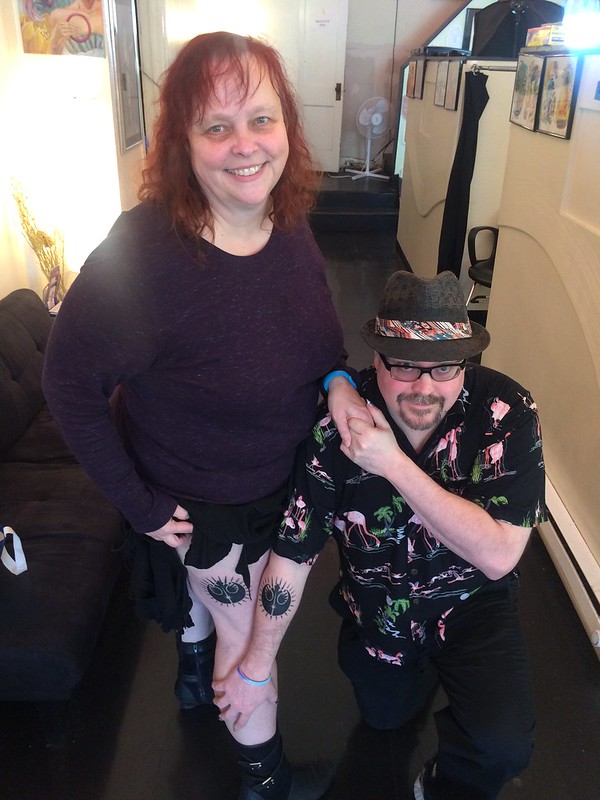
Gini and I decided to get New Jedi Order tattoos – the school that Luke founded in the old canon, which no longer technically exists, but we are Rebel through and through. This is my second tattoo, but it’s my first real tattoo, in a sense – I cover up my tattoo of my goddaughter Rebecca with just a regular shirt, but this big blazing black logo is impossible to hide.
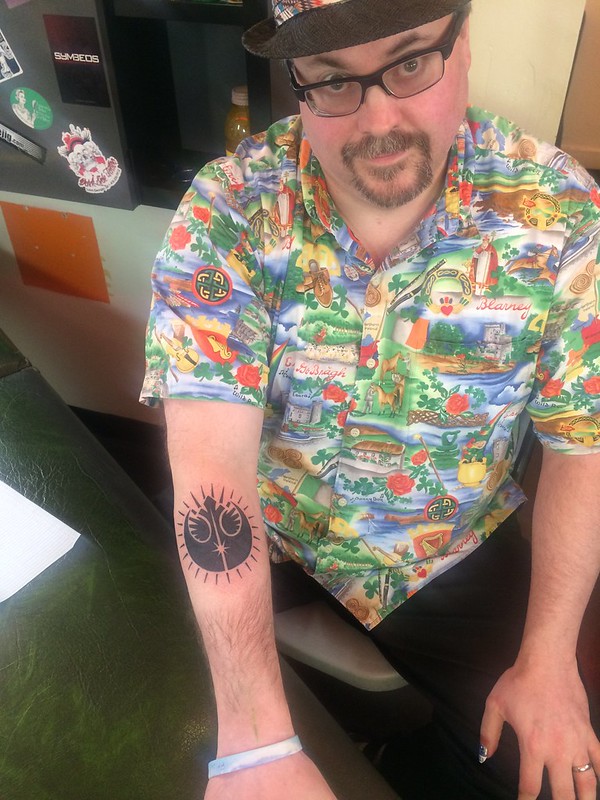
Gini, alas, has to be a professional lawyer-type person, and so she could not get hers in the same place. So she got hers on her right thigh. But we are bonded by a tattoo.
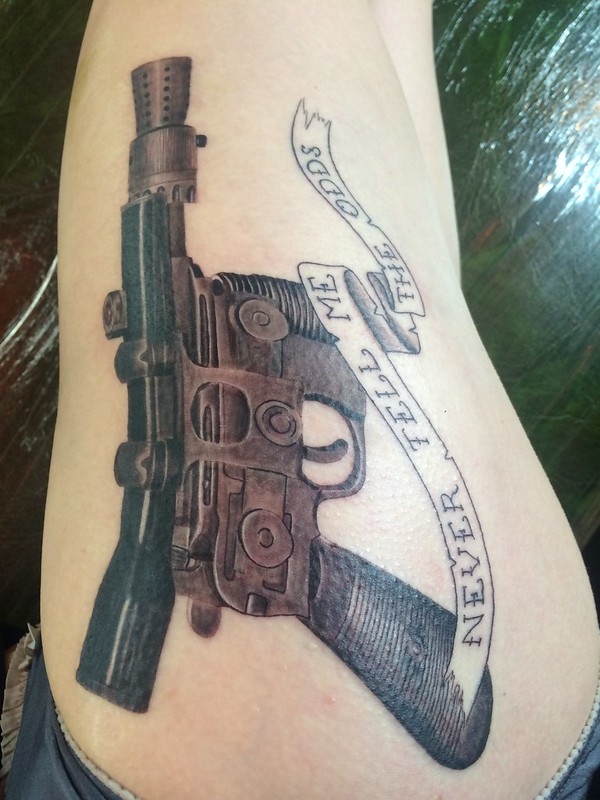
Erin had the most work done – an eight-hour sitting, wherein she had a blaster tattooed on her hip with a banner of “Never tell me the odds.”
Amy, well, it was her first tattoo, and she went small but significant – a stylized X-wing flying into view over her ear.
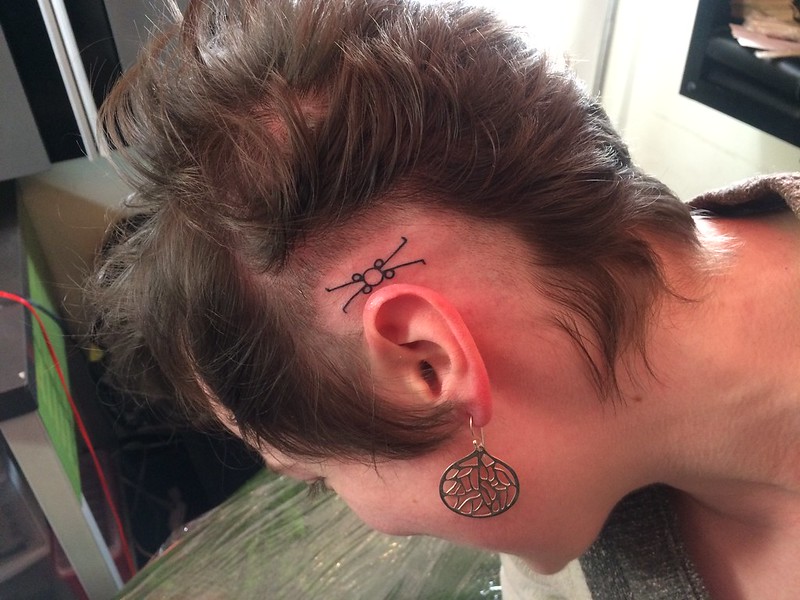
How did we feel about this? Wonderful. We kept high-fiving each other all day.
And then we saw The Film. And later today, after I’ve seen it for the second time, I’ll post my very spoillerriffic thoughts on it in a protected area. I went in not knowing what happened. I think you should, too.
But the film itself doesn’t matter. What matters is that we love the old films so much we wanted them on our body, and we wanted them together. And now we’ve got a lovely reminder of what surrounds us:
Love.
And big fucking nerdery.