
One Bizarre Chick Fil-A Thought
There’s a lot of heartache being thrown around chicken sandwiches these days. I’m not sure how Dan Cathy feels about all of this, but Chick Fil-A is becoming a lightning rod for societal changes, to the point where I’ve actually heard someone referred to scornfully as “a Chick Fil-A Christian.” And I knew what he meant.
But then I think: That’s what would have happened back then, if businesses had worked the same.
‘Cause back in the 1960s, chains were the exception rather than the rule. Oh, you had a McDonald’s or two floating about if you were lucky, but most businesses were thoroughly local. There were Woolworths, but not in every town. And so when you sat down to eat, it was generally at some place that a guy in town owned wholesale, and didn’t take much guff from the home office, because he was the home office.
The idea of an America unified by shopping was still decades off. You shopped at local stores, for local people, and maybe you liked the Woolworth but people would have thought you were crazy if you’d worn a shirt with their name on it. You didn’t take pride in your shopping the way you would a sports team. Your self-esteem wasn’t tied up in it.
But if it had been, then the exact same thing would have happened. The Greensboro Woolworth’s would have been the site of a Negro sit-in, and the owner would have kicked the issue up to the home office, and the chain would have determined that no, black people can’t sit there, and wham. Suddenly you would have had these outbreaks of pride between the anti-Negro factions who’d clasp Woolworth’s to their breast for being the right kind of store, and the anti-segregation folks who condemned Woolworth’s as a shop for dumb rednecks, and we would have seen boycotts and national Woolworth’s love-in days, just the same as now.
And there’d be some people going, “Really? We’re having all this heartache over a goddamned five-and-dime?” And they’d be right. And meanwhile, Woolworth’s marketing department would be having a cow, and to this day – if we thought of Woolworth’s at all – we’d think of it as “that racist store.”
It’s happening now. Only difference is, in the past fifty years, we’ve all been sold on the idea of not just picking sides with people, but with stores.
Can I Buy You A Coffee?
“Excuse me,” she asked. “Can I buy you a coffee?”
It was a nice surprise. Most people don’t buy me cups of coffee, and I was just sitting at the Starbucks trying to plot my novel. So it was kind of charming, to have a cute girl offer to buy me a free drink. I told her sure.
She brought me a nice iced chai, and sat down next to me, and then asked, “So have you heard about Jesus?”
Now, as it turns out, I’m a Christian, so I’m not opposed to Jesus – but it was a little disappointing to realize this drink wasn’t done out of niceness, but as a sort of recruiting tool. Maybe I’d have been into a religious discussion if she’d said, “Hey, let’s have a philosophical talk,” but as it was, I felt a little betrayed. So I said that I wasn’t interested, as politely as I could (for I was sipping a delicious drink), and returned to my plotting.
The next day, another girl: “Hey, can I buy you a coffee?”
This time, I was trying to work out a difficult programming solution in my mind, and she asked me at exactly the right moment to have all of my thoughts collapse like a house of cards. “Are you just going to ask me about Jesus?”
“Oh, no,” she said, reassuring me. “It’s just that I think you’re cute.” And she was kind of pretty.
“…all right,” I said, guardedly. She bought the coffee. Sat down at my table.
“But if you were wondering about Jesus…” she said earnestly, and I ejected her from my table. I kept the drink, though. It seemed cruel, but she had been stupid enough to buy it for me even though I didn’t want it.
Over the next week, it just got worse. Two or three times a day I’d be deep in thought, trying to focus on this tangled plotting that I needed to resolve, and some woman would tap me on the shoulder to offer me a cup of coffee. I couldn’t concentrate, because sometimes they were very insistent: “You sure you don’t want a coffee, sweetie?” they’d ask, sometimes lurking over me after I’d refused them, just in case I changed my mind. Sometimes they just bought the coffee for me anyway, without even asking me if I wanted it, plopping themselves across the table from me and yammering on about being saved.
It was affecting my concentration. I started to tense up at the Starbucks, waiting for the next Jesus freak’s interruption. If it was a regular thing, like an hourly interruption, then maybe I could have worked around it, but it was erratic. Some days, I’d have four or five at once, other days I’d be blissedly free of interruption. But I had to be continually braced for the next hand on my shoulder, knowing that no matter what I was doing they’d be bursting into my personal space. I wrote less, my programs were buggier.
My friends couldn’t understand my upset. “Dude,” they told me. “You never have to pay for coffee again in your life! You’ve got it made! Do you know how much money you’re saving?”
“But I don’t want to talk to these people,” I said.
“You’ve talked about God with us before,” they replied. “Sometimes, we’ll stay up until two, three in the morning discussing the nature of heaven and hell. You dig philosophy, Ferrett. If you like talking about that shit with us, then why not with them?”
“Because they’re just one-note and don’t really care what I have to say,” I said.
“Just try ’em, man. Some of them are cute. Maybe some of them actually want to date you!”
“I guess,” I said. “But how do I know which ones are genuine without having to talk to a bunch of phonies?”
Eventually, it got to the point where I started bringing friends with me for cover, so I wouldn’t get interrupted. That didn’t work, either – while it helped, the more aggressive proselytizers would interrupt me in mid-sentence to ask me if I wanted a drink. Suddenly, the Starbucks wasn’t fun any more – it wasn’t a place to hang out, but a place where I’d just constantly be bugged by attention I didn’t want. And the guys who weren’t getting free drinks were calling me stuck-up, jealous that I was getting all these free drinks and not even wanting them.
So I stopped going.
Okay. Clearly, that didn’t happen. But I’m trying to prove a point here.
One of the things that guys don’t get is why women don’t like to be hit on. As a guy, when you get hit on, even if it’s a clumsy attempt, it’s generally a very rare and remarkable event – it puts a spring in your step, even if you’re not particularly attracted to the woman, because as an average-looking guy, scarcity of compliments is the norm. So if a girl catcalls you and goes, “Nice butt!” and appears to be serious, there’s often this sort of strange pride. Hey, that doesn’t happen often, she must really be into me.
So a lot of guys have this unspoken attitude of, “I wish I’d be harassed.” And they don’t get why women are so angry when hey, I was just trying to be nice, why you gotta be so mean?
Thing is, when it’s not scarce, then even the nicest act starts to get annoying. Because you don’t get to control when people are quote-unquote “nice” to you, and it happens all the time, and you know there’s always a hidden cost behind it. You start to question people’s niceness, because they’re not doing it to be kind, they’re doing it because they want something from you. And maybe, yes, that’s something you like to give to certain people, but definitely not to everyone, and almost certainly not to the kind of guy who’s certain you’re going to give it to him if he just bugs you enough.
Harassment isn’t once. Harassment comes from a lifetime of dealing with people constantly doing things to you, whether you wanted them or not, at random intervals. You learn not to trust people. And what might have been pleasant, once, as an isolated incident, starts to feel pretty oppressive when it’s something you deal with on a weekly basis. It changes you, and then guys call you bitchy when you don’t feel like playing along and pretending this is just about the coffee.
But I think most of ’em would feel the same were the tables turned. So please. Think about what you’re spouting.
(EDIT: In response to some comments, I’ve written a follow-up, entitled, “But If I Can’t Buy You A Coffee, How Will Our Species Reproduce?”: How To Hit On Women.)
Today's Clarion Blog-A-Thon Prize: Handwritten Letters From Favorite Characters!
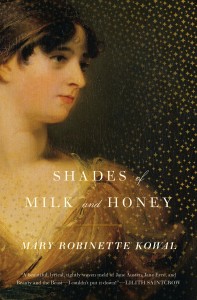 If you like Jane Austen, you should read Mary Robinette Kowal. There. I said it.
Now, if you like Jane Austen and have read Mary Robinette, you’ll know why I’m telling you to read her – her book Shades of Milk and Honey took a Regency-era romance where she mixes the concerns of polite society with the fact that every young lady learns how to do illusory magic. Her sequel, Glamour and Glass, was even better reviewed, and so happily it looks like Mary is well on her way to creating a very fun series for lovers of Sense and Sensibility.
Mary Robinette (that name never ceases to be fun to type) is also a woman of diverse interests herself, being an award-winning puppeteer and a maker of interesting things and someone who has a very good sense of humor about what happens when the very first line of your second book is accidentally deleted at the printers. So I suppose I shouldn’t have been surprised when she gave me an extra-special prize for my Clarion Blog-A-Thon, but she did. Rather than the usual signed book, she asked:
How about a hand-written letter from my main character, Jane Vincent?
How awesome is that, folks? If you love Shades of Milk and Honey, the main character will write you a letter. How often do you get an offer like that? Once in a lifetime, that’s how. (And if, by some chance, you have not read Shades of Milk and Honey, I will throw in a copy of the book at my own expense so you know the quality of what you’re getting.)
So here’s how it works. I’m blogging to help the Clarion Sci-Fi Writers’ Workshop, a six-week boot camp intensive that turned me from a wannabe into a pro with twenty-plus published stories. Every $5 donation will get you an entry into the raffle. At the end of the Blog-A-Thon (which will run for two weeks past everyone else’s Blog-A-Thons, thanks to a medical scare in my family), I will choose the winners. The first drawn winner will have first pick of the available prizes, the second drawn winner will have second pick, and so forth.
Plus – plus! – if you donate $10 total, you will get access to my own writers’ workshop, The Clarion Echo, where I am currently plotting my next novel. This is actually very worthwhile to watch, because I’ve spent four weeks tossing around ideas and I’m just finally realizing where it needs to go, so what you’re seeing is very much what a professional writer considers when he’s plotting. There’s a lot to be learned here, and if you’re interested in writing then I’d recommend it.
Here’s the list of current prizes:
- A signed copy of the script for “What Every Girl Must Know” from my Clarion classmate and upcoming playwright Monica Byrne.
- The challenge coin from Myke Cole’s Shadow Point series (plus a copy of the book, if you haven’t read it!)
- An ARC of Catherynne Valente’s “The Girl Who Fell Beneath Fairyland and Led The Revels There.”
- The book detailing the making of my Clarion classmates’ fencing-and-dance fusion “A Thousand Natural Shocks.”
I’m also running behind, so next week I’ll have to announce a prize every Monday, Wednesday, and Friday just to show you the wealth of what we have available! So donate! Donate now.
Home, Home on the Range
 As a liberal, I’ve never understood the Democratic terror of guns. Sure, I get the whole “people shouldn’t have fully-automatic weapons” bit, in the same sense that I’d prefer my neighbors not have access to tanks or bazookas. But I’ve known a goodly number of friends who quailed in terror from a handgun, or the idea of anyone owning a handgun. They’d feel a lot safer if all guns were outlawed.
I guess I’m a crazy middle-man, because I think people should have access to handguns. As Michael Moore (who is otherwise mostly sloshing with lies) says, other nations have almost as many guns and none of our gun deaths. I’m not entirely sure what it is in our culture, but holy fuck we like to shoot each other. The problem is not in the gun, but something in the way we treat guns and/or violence that spurs us to kill regularly.
Plus, guns aren’t that great a deterrent. My Dad used to be a big gun nut (he started after I was twenty, so I didn’t grow up around guns, in case you’re curious) because he liked the safety. He got to be quite a shot. But then he started taking courses on realistic gun shooting – not “Let’s stand twenty feet from the target in perfect position, feet shoulder-width apart,” but rather “The gun’s at your hip, you have to fire now as the mugger’s jumping you.” And he found that even with all of his training, his accuracy went to hell. In a real combat situation, his chances of hitting the mugger (and not hitting an innocent bystander) bottomed out, so much so that he came to the conclusion that guns really weren’t that much of an advantage.
But the gun itself? I’d like to have more restrictions on who buys them and when – from my admittedly non-gunnish perspective, it seems like it’s a lot more trouble to get a car than it is to get a pistol, and that’s a shame. I’d like some testing to ensure kooks and criminals don’t get the high-powered weapons, and yes, no laws will stop all criminals from getting guns but if you’re going to take that attitude then let’s legalize all drugs and prostitution and gambling and gay sex first, since those are less harmful than guns. (Yes, go, libertarians.)
I would love to own a gun. Can’t. The fact that I’m suicidally depressive at least five weeks out of the year makes owning a gun a Very Bad Thing. And I tend to treat guns like they were toys, as in “Hey, look at all the crazy fun this is, whee!” which probably contraindicates having one in the house.
All of this is a very strange way of saying, “I enjoy guns, but haven’t done much with them.” But when my daughter Erin admitted she’d never shot a gun, nor had Gini, I said, “Well, why don’t we go down to the range and take a course?”
Erin clapped with glee.
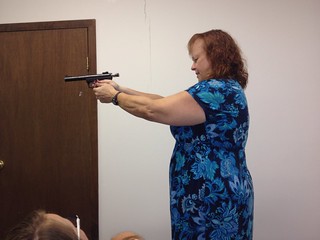
It felt very fatherly. My Dad had taken me down to the gun range for my twenty-fifth birthday so that I could know what it felt like to shoot, so escorting my daughter to the gun range felt like a rite of passage. And we took a half an hour’s safety course, which wasn’t nearly as intensive as Connecticut’s, but the guy at the shop explained the ins and outs of the .22 pistol we had, how to place it on the table to indicate it was safe, how to handle it without putting anyone else in the line of fire, how to hold it to shoot without injuring yourself. We practiced in the room for a while, dry-firing and setting it up…
…then it was out to the range.
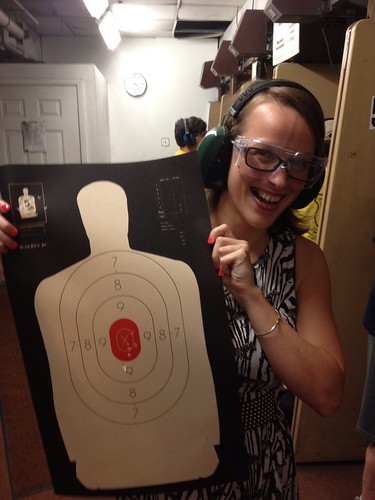
Erin was very nervous and excited, so we let her go first – and the kid’s a natural. She put all five of her first shots into the red zone, no questions asked. (It was pretty close, but hey – she did a lot better than I did.) And, as it turns out, she likes shooting guns. There is something intensely satisfying about pulling the trigger and hearing that flat explosion going off in your hand, feeling the shock of recoil, the brass flying out of the chamber.
I myself was the worst in the family. As it turns out, I can’t close my left eye, so I have to shoot using my right – which screws the alignment up. And I can’t really close my left eye all the way without causing my right eye to water for a bit, so though my grouping was okay, I didn’t have nearly the accuracy of Gini or Erin. But man, when you’re holding a gun in your hands, you’re shocked at how much your hands waver. It seems still until you’re trying to get a bead on things, and then suddenly you feel like a palsy victim.
We burned through a hundred bullets, irritated by every misfire, and of course our family competitiveness got the best of us and we started crowing about who was the best shot. Erin won, but they graciously gave me the title of “Most Improved,” which I’ll take.
We’re planning on going back next week. Erin needs to know what a .38 and a .45 feel like in her hands. And having stronger arms than she does, I might have a better shot this time…
Vote For Pedro
Last year, my “daughter-knifes-her-father-out-of-love” story “My Father’s Wounds” was published at Beneath Ceaseless Skies, and I was pleasantly surprised when I found several people suggesting it as worthy on the SFWA leaderboards come Nebula Awards time. Just in case you’ve forgotten the lead:
Father carries the knife, because I asked him to—but he keeps turning to look at me, earnestly, as if he hopes I’ll take it back.
It’s hard to believe he knows I’ll stab him with that knife. Even harder to believe he’s eager for me to do it. But that’s my father; he thinks the world of his precious daughter. He’s thin yet unbowed in his ascetic gray Blacksmith robes as he leads me up through a cold forest to the Anvil.
It doesn’t matter whether my father will live once I stab him. That’s not the point. The point is all the questions that no one thinks to ask after we’ve healed their fathers, their soldiers, their daughters. Nobody questions our magic, except for us, the loyal priests and priestesses of Aelana.
We can’t stop asking. We can’t sleep for asking.
Anyway, Beneath Ceaseless Skies is holding a poll to see which stories make it into “The Best Of Beneath Ceaseless Skies, Year Three,” and if you think it’s worthy, then you should probably go vote. And if you don’t vote, there’s a lot of other Very Cool stories over at Beneath Ceaseless Skies, and reading them would probably be a very enjoyable use of your time.